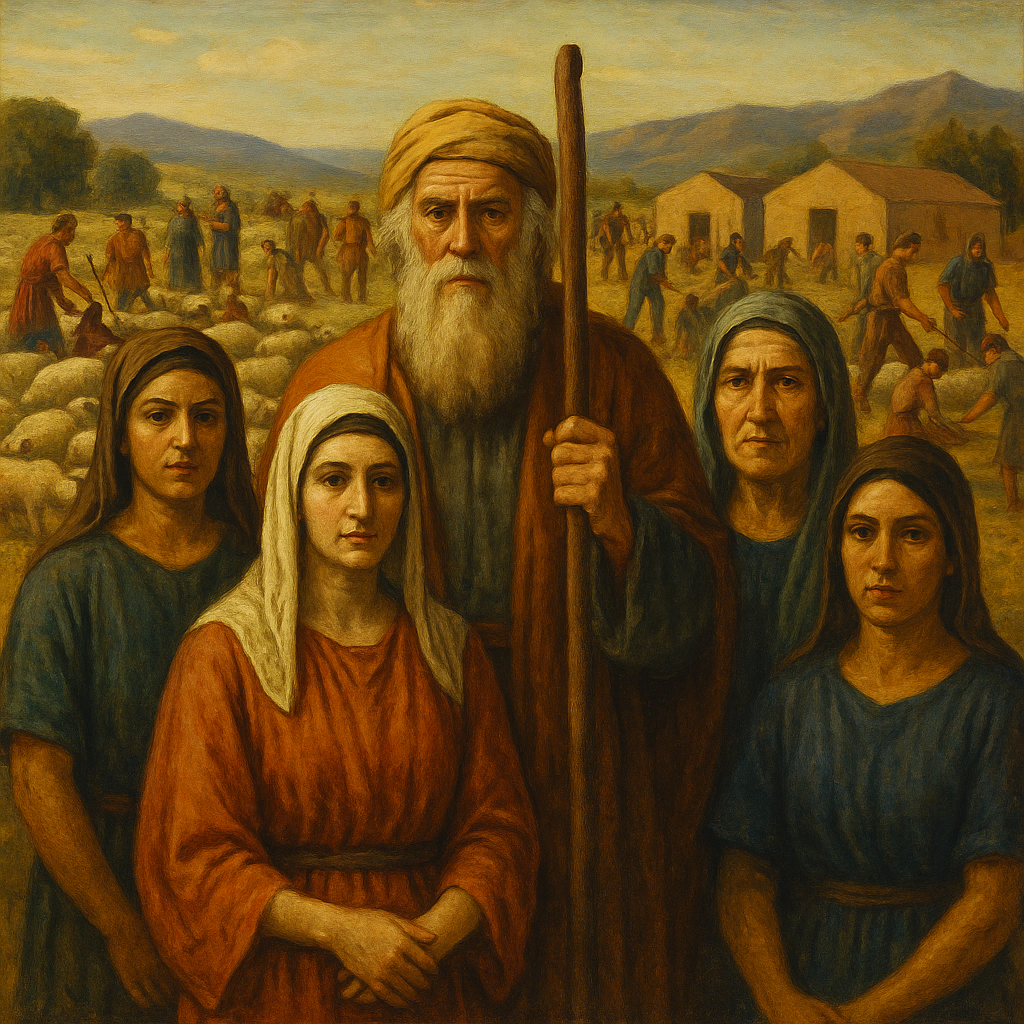
I. Introduction: The Man Who Became a Nation
Jacob is not a moral mascot. He is a patriarch. A bruised heel, a cunning mind, a relentless force. The Church today wants poster boys of piety, neat beards, monogamous morality, and tidy households with devotional apps and filtered family photos. But God chose Jacob. And Jacob’s house wasn’t tidy. It was turbulent, expansive, polygynous, fruitful, and entirely God-ordained.
If you want a clean legacy. A polished resume. A family tree that could make a Hallmark movie jealous that Jacob is not your man. But God doesn’t build nations from photo albums, He builds them from blood, betrayal, polygyny, and perseverance. If you’re looking for perfection, Jacob is not the image you seek. If you’re looking for fruitfulness, covenant, household dominion, and raw masculine endurance, then Jacob is your patriarch.
Jacob, the man renamed Israel, was no sanitized church hero. He lied to his father, deceived his brother, worked for and purchased underage wives, married sisters (a move later forbidden under Mosaic Law), took their handmaids as concubines, played favorites with his children, stayed silent when one was sold into slavery, and fathered the entire nation of Israel through a household that modern pastors would call “unbiblical.”
When God renamed Jacob “Israel,” He wasn’t baptizing a perfect man. He was commissioning a patriarch. The man who fathered twelve sons by four women. The man who bought teenage brides and later took their handmaids to be concubines (who eventually became additional wives). The man who lied to his own father and was later lied to by his uncle. The man who watched his sons slaughter a village and did nothing.
And yet… he is the chosen one. God’s own covenant was sealed with this man, not because of his morality, but because of God’s sovereign purpose. Jacob didn’t “fall into” polygyny. He didn’t slip. He wasn’t ashamed. He built an empire from it. And God didn’t rebuke him, He built His people on that household. And God called him blessed. Why? Because Jacob was in covenant. He wrestled with God and would not let go until the blessing was secured, no matter the cost.
II. Delayed Beginnings and the Demands of Legacy
Jacob didn’t marry until he was 77 years old. That’s not a typo. While modern men are told they’ve peaked or passed their usefulness by 40, Jacob hadn’t even begun to build his household until nearly twice that age.
So what was he doing all that time? Scripture gives us glimpses: he stayed in tents, remained under his father’s instruction, dwelled quietly while Esau hunted and conquered. He was not a builder yet. Not a warrior. Not a leader of men. He was preparing, slowly, painfully, and in obscurity.
But when the time came, Jacob fled to Haran with nothing but a staff. He didn’t even have the means to purchase a wife. At 77, he had to labor 14 years just to acquire two brides. He started late, but he didn’t whine, complain or make excuses. He never lamented about what he could have or should have done.
And because he started late, he had to build rapidly. Polygyny wasn’t really optional, it was necessary. One wife would not bear twelve sons fast enough. One womb could not produce a nation in a lifetime. Jacob’s strategy was not romantic in the modern sense, it was patriarchal. He accepted handmaids. He honored both sisters. He honored his position and multiplied quickly.
This is the lesson: it’s never too late to start. But starting late requires strategy. It requires scale. And it requires the rejection of modern sentimentality. If you aim to build a nation past your youth, you will need polygyny, patience, and patriarchal vision.
II. The Meeting at the Well: 77-Year-Old Meets 14-Year-Old Rachel
Jacob met his beloved Rachel at a well in Haran. She was a shepherdess, tending to her father’s flocks, in a pattern echoing across Scripture. But the part your Sunday school teacher skipped was this: Jacob was 77 years old when he met Rachel who was 14 at the time, her older sister Leah, whom Jacob would also marry, was about 15. He kissed Rachel that very day and wept aloud (Genesis 29:11). This was not a “grandfather’s greeting”. It was the beginning of a marriage transaction.
Modern minds recoil. But Scripture does not. Jacob kissed Rachel that very day and proclaimed “love at first sight”. In a world where men shrink from commitment and women delay marriage until their youth has withered, this scene offends modernity. But it honors God. Rachel wasn’t dating. She wasn’t career planning. She wasn’t collecting degrees. She was a bride in waiting, working in her fathers kingdom. And Jacob didn’t flirt. He pursued. Immediately, definitively, and even with payment.
Now, the modern mind reels. “Predator,” they say. “Groomer.” But Scripture says something else entirely: he loved her. From the first moment. And he proved it with the only thing that proves love, action and sacrifice.
No flirting. No promises. No “let’s see where this goes.” Jacob laid down seven years of labor for a bride he met at the well. He didn’t wait and send a text later, he didn’t date for a few years. He rolled up his sleeves and purchased his bride.
III. A Price for a Bride: Love Is Proven in Labor
Jacob did not propose over dinner. This wasn’t romance, but a transaction, a Covenant. He paid a price. Not having the available finances to purchase his bride outright he offered Seven years of hard labor managing Laban’s flock. Rachel was the daughter of his uncle, but that did not make her free. She was a daughter, which meant she was a commodity. She belonged to her father until another man purchased her through covenant.
Genesis 29:20 says, “So Jacob served seven years for Rachel, and they seemed to him but a few days because of the love he had for her.” Let that sink in: love was proven by labor, by action. Not words. Not poetry. Not dinner dates, or “communication”, but sweat and dedication.
And Jacob paid. Full price, without complaint. Then Laban deceived him, sending Leah into the wedding tent under darkness. The next morning, Jacob discovered the swap. Did he storm off? Cry betrayal? No. He married both. Even stayed and worked another seven years for Rachel. Fourteen years total. This wasn’t indentured servitude, it was dowry. It was love measured in action.
You don’t “date” a wife. You earn her. Jacob earned two, (well 4 eventually), but we will get to that later.
IV. Sisters, Servants, and Sons: A Household of Four Mothers
Modern minds recoil at the idea of marrying sisters. But Jacob did it with full cultural legitimacy. Rachel and Leah both bore him sons, though Rachel, beloved as she was, struggled with barrenness. In the ancient world, this was not just a personal sadness, it was a crisis of legacy (as it should still be).
So Rachel did what almost any woman of her day would have. She gave Jacob her handmaid Bilhah as a concubine. Bilhah bore sons on Rachel’s behalf. Leah, seeing this, gave Jacob her maid Zilpah as well. He didn’t argue, he didn’t moralize. Jacob accepted both. No argument. No sermons. No shame. He lay with the maids and received their sons into his household. These were not mere bedwarmers. They were concubines, wives by function if not by primary rank.
From this household of four women, two wives, two concubines, came twelve sons: Reuben, Simeon, Levi, Judah, Dan, Naphtali, Gad, Asher, Issachar, Zebulun, Joseph, and Benjamin. Plus one daughter, Dinah. These sons became the twelve tribes of Israel.
Polygyny wasn’t the side story. It was the structure. It wasn’t a concession, but the covenantal method for fruitfulness. This is not just descriptive, it’s prescriptive. God used it, blessed it, and God built His people on it. Let that sink in for a minute – polygyny is the method God chose EVERY time for the expansion of his covenant people.
This wasn’t dysfunction, it was dynasty. Jacob didn’t “fall” into polygyny. He stewarded it, and in doing so created the 12 tribes of Israel.
V. The Cost of Favoritism and Silence: Jacob’s Fathering Failures
Jacob was a patriarch, but he was not perfect. His household was marked by favoritism. He loved Rachel more than Leah (Genesis 29:30). He loved Joseph more than the others (Genesis 37:3). He even clothed Joseph in a special garment that stirred the envy of his brothers. Everyone knew it. When this favoritism bred resentment among the other brothers Jacob saw it. He knew they hated Joseph. But he stayed silent.
He also stayed silent when Joseph was sold into slavery. The brothers dipped the robe in blood and brought it to Jacob. He wept. But he didn’t investigate. He didn’t lead. He accepted the story, descended into grief and mourned for years.This silence wasn’t passive, it was leadership failure. And yet, even in his failure, Jacob remained the patriarch of promise. God didn’t revoke His covenant. The twelve tribes still bore his sons’ names.
His sons murdered the men of Shechem in retaliation for Dinah’s violation. Jacob’s response? “You have brought trouble on me” (Genesis 34:30). Concerned with reputation, not righteousness.
Yet this flawed, quiet father remained God’s patriarch. Because God doesn’t require perfection, He requires covenant. God doesn’t wait for perfect men. He uses patriarchs who limp.
VI. A Man of Deception Chosen by a God of Truth
Jacob’s life was woven with deceit. He lied to his blind father, tricked his brother Esau out of the birthright by impersonating him to steal Isaac’s blessing. He manipulated livestock breeding, using selective breeding tactics to enrich himself at Laban’s expense (Genesis 30:37-43). He was shrewd, cunning, and unapologetic.
This wasn’t accidental. Jacob was strategic. And God still blessed him. Why?
Because Jacob wrestled with God, and didn’t let go. He demanded blessing. He demanded covenant. And God granted it.
Genesis 32 recounts the midnight wrestling match. A mysterious Man (understood to be a theophany – God Himself) wrestles Jacob until dawn. Jacob refuses to let go. He demands blessing. The Man touches his hip, dislocating it, and then renames him: Israel.
Israel means “He who strives with God.” Not “He who obeyed nicely.” Not “He who conformed.” Not “he who behaves.” God renamed him for wrestling, striving, and demanding. God honors hunger and dedication, not manners.
The same man who deceived his father became the father of a nation, then grandfather of nations.
VII. God’s Blessing on a Polygynous Man
Jacob was a polygynist. He had four wives (two by direct marriage, two by concubinage). Scripture never condemns him for it. Not once.
The modern Church blushes and stammers over polygyny, offering excuses: “It was cultural,” “It was allowed, not ideal,” “God just tolerated it.”
Spineless nonsense!
God could have shut Leah’s womb. He could have shamed Rachel. He didn’t. Instead, He opened their wombs, multiplied their children, and formed a nation from their bodies. Polygyny is not the curse, but a blessing. it was the structure God used to build Israel.
Jacob’s sons founded the twelve tribes. From Leah came Levi (priests) and Judah (kings), Reuben and Simeon. From Rachel came Joseph (double-portion through Ephraim and Manasseh) and Benjamin. From Bilhah and Zilpah came the remaining tribes. The modern church teaches monogamy as doctrine. Yet the very people of God were born from a household that no modern pastor would allow on the church membership roster.
You want revival? You want legacy? Start by embracing the blueprint God actually used. God didn’t “allow” polygyny, he crowned it.
VIII. The Legacy: A Nation Birthed by a Household
Jacob’s sons didn’t just fill a tent, they founded tribes. Reuben’s line. Judah’s kings. Levi’s priesthood. Joseph’s double portion through Ephraim and Manasseh. Benjamin’s warriors.
Jacob didn’t have a Pinterest family. He had a warring, womb-bearing, legacy-generating household. A patriarchal dominion. And that’s exactly what God used.
He didn’t wait for reform. He didn’t impose 21st-century ethics on a Bronze Age household. He multiplied fruitfulness through what would today be labeled “toxic masculinity” and “patriarchal oppression.” But it was, and is God’s design. It was God’s man. It was God’s house.
These weren’t random children. They were the seedbed of civilization. And they came not from a modern “nuclear” family, but from a polygynous, patriarch-led household.
The legacy of Israel, our spiritual and ancestral heritage, was not born in a sanitized seminary. It was born in tents. On blood-soaked soil. With sisters competing, handmaids birthing, and a patriarch directing the legacy.
Jacob fathered a nation not in spite of polygyny, but ONLY because it.
IX. What the Church Refuses to Preach
The modern Church preaches romance, butJacob lived reality.
He would be excommunicated from most if not all modern churches.
- Married sisters? Forbidden.
- Slept with handmaids? Scandal.
- Favored wives? Misogynist.
- Bought 14-year-old brides at 77? Predatory.
- Married 20-22 Year old women at 84? Pedophile.
But God doesn’t flinch. He names Jacob “Israel.” He renews the covenant of Abraham through him. He appears to him personally and blesses him repeatedly. The Church today wants sanitized saints, but God wants fruitful patriarchs. Men who are willing to stand on Biblical truth, demanding conventional blessing no matter the cost.
The Church preaches sentimental monogamy. Jacob lived divine multiplication. The Church preaches equality. Jacob chose favorites, led with hierarchy, and structured his household for fruitfulness, not fairness.
They talk about “waiting for the one.” Jacob worked 14 years for two. And when his wives gave him their maids, he didn’t hold a Bible study on the ethics of polygyny, he received them as part of his house and expanded the kingdom.
The Church fears offense. God builds with obedience. Jacob’s life doesn’t fit the evangelical mold. Which is exactly why it built the Kingdom!
X. Conclusion: God Builds With Dust and Blood
Jacob was not a poster child for moralism. He was old, shrewd, polygynous, and often silent at the worst times. But he was chosen. Not because of his goodness, but because of God’s purpose.
He kissed a 14-year-old girl and loved her for life. He married sisters. He fathered sons through servants. He allowed his favorite son to be sold. He limped after wrestling with God. He blessed the wrong grandson on purpose. And he died in a foreign land, trusting in a promise that he did not live to see fulfilled.
And from that life – flawed, complex, masculine, covenantal, came the nation of Israel. Our entire faith is rooted in a man with four wives, twelve sons, and a limp. This is not an insignificant side story. This is the foundation of our faith, our people and all of western civilization.
If you want to restore biblical manhood, stop chasing modern respectability. Start embracing patriarchal fruitfulness. Start understanding that God builds not with sanitized myths, but with real men, real blood, and real households. Jacob did not live to please the world. He lived to build the kingdom of God, and in doing so he built nations.
And if the Church wants to reclaim legacy, it must reclaim Jacob, not as a relic of ancient oddity, but as the blueprint for dominion.
God builds with blood. He builds with covenant. And He builds through patriarchs who refuse to let go until the blessing falls.
Let God’s Great Order be restored.
So now we know it is okay to marry little girls, at least we cleared that up!
I was struck by the assertion that God doesn’t require perfection but covenant.
Solid read! Jacob wasn’t some goody-two-shoes, more like a patriarch with a rough edge, and that makes the story so much more relatable. Definitely gives me hope that mistakes don’t disqualify someone from God’s plan.
Jacob’s story hits close to home, his scheming and favoritism echo family tensions I’ve faced. Yet the transformation he undergoes encourages me that God can work through our mess to bring healing and purpose.
While I appreciate the portrayal of Jacob’s flaws, it feels like the article softens some of the severity of his actions, particularly deceiving his father at such a vulnerable moment.
This article does a powerful job of highlighting how Jacob’s life wasn’t a smooth path but was exactly the kind of imperfect journey through which God’s purposes unfold. It’s humbling to consider that even with deception and moral messiness, God remains faithful to his covenant.
Funny how the modern church praises the 12 tribes of Israel… but condemns the polygynous household God used to create them.
Wow. Just… wow. I cannot believe in 2025 people are STILL writing garbage like this and pretending it’s ‘biblical truth.’ You’re seriously trying to defend a 77-year-old man kissing and ‘purchasing’ a 14-year-old girl as if that’s some kind of holy act? That’s not ‘patriarchy,’ that’s predatory abuse. And don’t even get me started on your glorification of polygamy, yeah, let’s drag society back to the Bronze Age because you found a few verses you think excuse men collecting women like furniture. You talk about ‘fruitfulness’ like women are just wombs on legs, and you have the audacity to say God wants this? No. Just no. This is toxic masculinity promoted by trump. It’s cult-level brainwashing. The fact that you can write paragraphs defending child marriage, favoritism, and treating human beings like property is exactly why the church is dying. This is not faith, it’s abuse, control, and misogyny. If Jacob is your blueprint for manhood, then thank God the rest of the world has moved on.
awe, poor Jacob…… with 4 WIVE TO CHOOSE FROM, he just had it sooooooo bad.
It’s refreshing to see Jacob portrayed, not just as a trickster, but as someone shaped by God’s sovereignty even when unworthy
Sure, let’s celebrate the guy who dressed like his brother in animal fur and tricked his parents. Because that’s exactly the kind of leadership you’d want to model!” (winking), Jacob’s legacy is more blessed than spotless.
This piece nails it: yes, Jacob schemed, but faith trumps schemes. God uses broken vessels to build dynasties. If He can bless cheaters, He can redeem any of us. The bigger lesson is not about cunning, it’s about humility, trust, and grace.
I respect Jacob’s faith, but the article downplays his manipulations. Why glorify strategy over genuine repentance?
Favoritism toward Joseph and Rachel’s children led to bitterness and family division. That tension gets understated here.
This article does justice to Jacob’s complexity. He wasn’t a hero without scars he was obedient despite them.
But what about the trauma for others, Rebekah’s deception of Isaac, Esau cheated, those relational costs run deep and you don’t care.
Jacob messed up, lied to his dad, favored sons unevenly… but God still called him Israel and built a nation. That’s grace on display….
This country presents itself as a center of growth and opportunity, but for students like me, it is something else entirely. I study at Reigate Grammar School Riyadh, and behind the well-kept halls and foreign accreditation lies a silent system of control. Since my arrival, I’ve experienced synthetic emotional shifts, artificial mental interruptions, and physical symptoms I cannot attribute to any natural cause. I know what stress is, this isn’t it.
What’s happening is deliberate. This is psychological warfare, conducted under the cover of education. I hold Saudi military signal units, internal intelligence services, and Ministry of Interior surveillance operations directly responsible. They operate with impunity, embedding silent technologies into civilian zones, schools included. The intent is not safety. It’s obedience. They monitor, distort, and suppress the internal lives of students with signal-based precision, and no one dares to question it.
I regret ever setting foot in this country. If I had known what was waiting beneath the surface, I would have refused the visa, torn the offer, and never boarded the plane. I am not the only one. Others feel it too, they just haven’t said it yet. I write this so the lie cannot remain clean forever. This is a regime of silence, and I’m breaking it.
Reading how Jacob wrestled with God, limped but was renamed Israel, gives hope. Our failures don’t disqualify us.
I love how this piece leans into Jacob’s faith despite his flaws. It’s not about perfection, it’s about trusting God through brokenness.
You literally romanticized child marriage, human trafficking, and patriarchy. What century is your brain in?
Not gonna lie, I’d have married Jacob too. Or you. Something about men who build empires from chaos that just does it for me….
This helped me understand why my household feels so off. My husband refuses to lead, and I’ve been resenting him instead of encouraging him to rise up. Thank you.
Jacob was flawed, sure. But God used him because he built. Today’s men cry into microphones. Solid read.
This is just a rebranded manifesto for male supremacy. You twist scripture to excuse your creepy cult vibes. You’re not a prophet. You’re a narcissist.
Just read this with my 9 oldest boys. We need more men teaching the whole Bible, not just the soft parts. You’re doing work that matters, keep it up. I am sending some support soon. Starting next month our family will be supporting your work EVERY MONTH!
Man’s out here telling women they’re not wives unless they obey. Based. Keep going.
Flawed men are the ones God uses. The soyboys want saints with safe words. I want warhorses with calloused hands. This is real talk.
Can a man like Jacob even exist today? Or have we bred them all into wimps?
Ok… but can we talk about the fact that Jacob’s wives were basically bought? This ain’t cute.
Jacob walked with a limp. This generation walks with pride. Excellent lesson, sir.
I don’t agree with everything, but this made me rethink Jacob. There’s a pattern here, God chooses builders, not victims.
I read this to my 14-year-old daughter. She asked, “So lying is fine if God likes you?” Fix your theology.
I’m sick of weak Christians trying to sanitize scripture. Jacob was messy. So what? God chose him anyway. Not because he was perfect, but because he could wrestle. That’s what God needs: men who don’t quit just because they’re not polished. Men who build, fight, and limp forward anyway. Stop expecting saints in suits. God’s army is full of limping men who fear Him more than public opinion. If you can’t handle that, go back to Joel Osteen.
You’re glorifying an abusive system of “order” built on the backs of women. Jacob bought his wives. You think that’s noble? You think building a nation off the wombs of girls sold by their father is holy? You don’t see God. You want a world where women are property and men rule unchallenged, but that’s not righteousness, it’s ego. You can quote scripture all day. It doesn’t make your kingdom biblical
If Jacob was willing to labor fourteen years for a wife… or 2, what would a man like you expect from a woman for marriage? Asking seriously.
You mean the con man who lied, manipulated, and slept with two sisters and their servants? That guy? This is the “model” now? Hard pass.
This was a very educational piece that the modern church doesn’t talk about. Not even the ones who are more fundamentalist than super modern main stream churches teach these things. The church as a whole needs pastors that really want to teach the real truth gospel and not Willy wonka style fluff.
I read this really slowly, taking in every word.
Jacob, so flawed, yet chosen. So weak in will, yet so strong in his fruit. The more I study your words, the more I realize how little I understand about the weight of headship. About legacy. About what it means to carry something beyond emotion.
You said not to reply with another plea so this is not a plea. This is an acknowledgment: I’m watching. I’m listening. I’m learning.
Even Jacob had to be broken before he could walk in blessing. May I be broken rightly, My Lord.