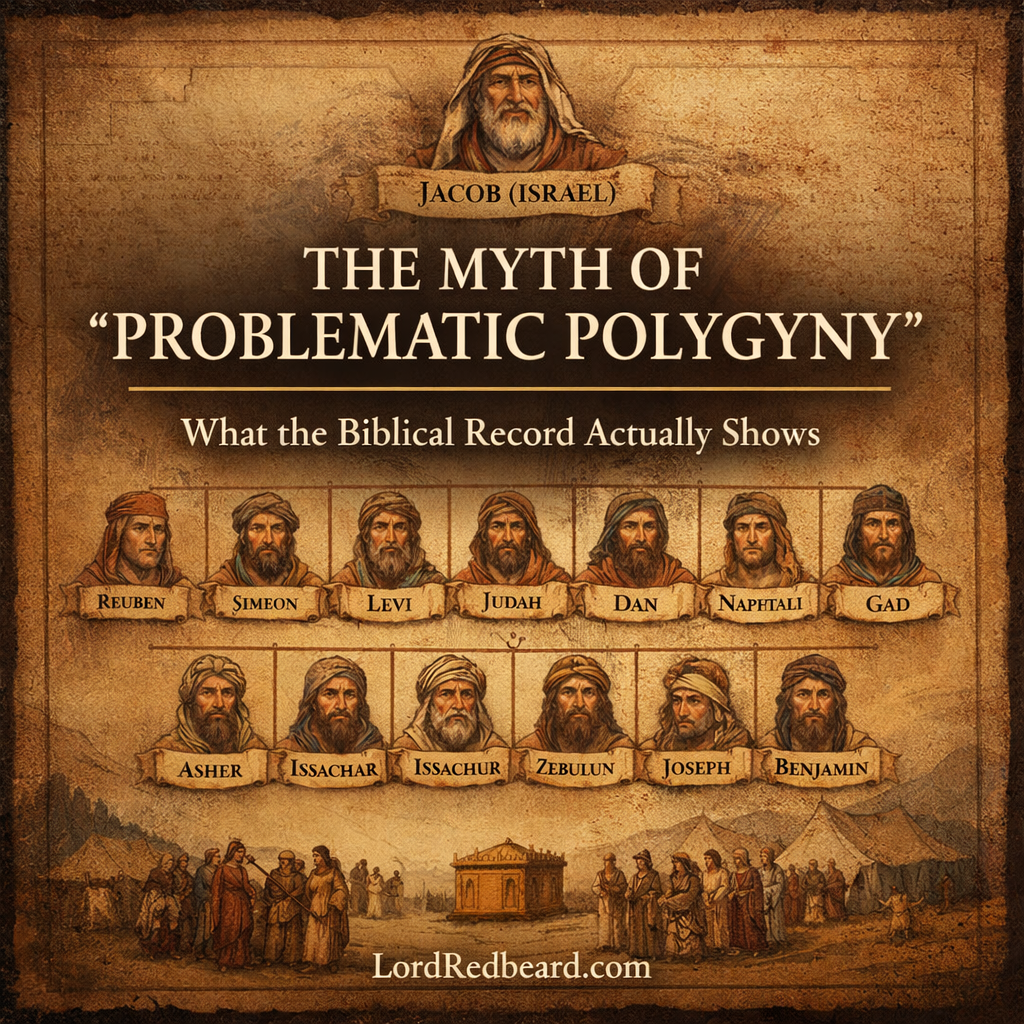
Among modern Christians, few assumptions are repeated with greater confidence and examined with less scrutiny, than the claim that all polygynous marriages in the Bible were problematic. Closely connected to this assertion is the equally common belief that monogamy represents God’s ideal marital structure, while polygyny is portrayed as a regrettable concession to human weakness, cultural backwardness, and/or moral failure.
These ideas are so deeply embedded in modern Christian thought that they are rarely (if ever) questioned. They are taught from pulpits, embedded in marriage counseling materials, and repeated in apologetics as if they were explicit biblical doctrines. Yet when Scripture is examined carefully, on its own terms, without modern sentimentality or inherited tradition, these claims are simply absent altogether.
The Bible does not say that all polygynous marriages were problematic. The Bible does not say that monogamy is God’s ideal. What the Bible does give us is a large body of historical narrative, legal regulation, covenantal structure, and genealogical data. When that data is examined honestly, a far more complex (and far less comfortable) picture emerges.
Scripture records more conflict, rebellion, and disaster in monogamous marriages than in polygynous ones. This does not mean monogamy is sinful. It does mean that the modern argument against polygyny is not biblical.
I. The Foundational Interpretive Error: Reading Condemnation Where Scripture Is Silent
The most basic mistake underlying the “problematic polygyny” narrative is the confusion of description with condemnation. Modern readers frequently assume that when Scripture records conflict within a household, it is implicitly condemning the structure of that household. This is a hermeneutical error. The Bible routinely records human failure without indicting the institutions within which that failure occurs.
Scripture records Corrupt kingship without condemning kingship, abusive priesthoods without abolishing priesthood, violent families without abolishing family and faithless Israel without abolishing covenant. The Bible does not sanitize history to make moral points. It presents reality, then explicitly condemns sin when condemnation is intended. This distinction is critical.
When Scripture wants to condemn something, it does so. Idolatry, adultery, murder, child sacrifice, oppression of the poor, false worship, and covenant betrayal are all explicitly rebuked. God does not rely on implication, discomfort, or hindsight theology to make His will known.
Nowhere does Scripture say “this happened because the man had more than one wife.” That sentence does not appear anywhere in the Bible. The idea that conflict in a polygynous household proves divine disapproval is not a biblical argument. It is a modern assumption used to justify false teaching.
If conflict equals condemnation, then the entire human story stands condemned – including marriage itself.
II. Polygyny Is Not Peripheral – It Is Structural
One of the most damaging myths surrounding polygyny is the idea that it was rare, fringe, or marginal in biblical history. In reality, polygyny is structural to the biblical narrative.
Jacob and the Formation of Israel
The nation of Israel does not emerge from a monogamous household. It emerges from a four-wife household. The patriarch Jacob, later renamed Israel, had two wives: Leah and Rachel, then two concubines – Bilhah and Zilpah
From these four women came twelve sons, who became the twelve tribes of Israel (Genesis 29–30; 35:22–26). This fact cannot be overstated. Without Jacob’s polygynous marriage there are no twelve tribes, no Levitical priesthood, no Davidic kingship and there is no covenant nation as described in Scripture
The New Testament affirms that Jesus Christ descends from the tribe of Judah (Matthew 1:1–3; Luke 3:33). Judah exists because Jacob had multiple wives. If polygyny were inherently sinful, this would mean God established His covenant people through sin, God preserved His promises through disobedience and God advanced redemptive history using a structure He opposed. Yet scripture gives no indication that this is the case.
III. Rivalry Does Not Equal Rejection
Critics of polygyny often point to the rivalry between Leah and Rachel as proof that plural marriage causes dysfunction. This argument fails on several levels. First, rivalry is not unique to polygynous households. Scripture is filled with sibling rivalry such as Cain and Abel, Isaac and Ishmael, Jacob and Esau, Joseph and his brothers.
Second, Scripture never attributes the rivalry to polygyny itself. The tension in Jacob’s household arises from favoritism, barrenness, jealousy, and emotional wounds. These are human problems and would have existed regardless of the household structure.
Third (and most importantly) God actively blesses this household. He opens wombs, He multiplies offspring, He establishes tribes and He preserves covenant promises. At no point does God rebuke Jacob for having multiple wives. At no point does Scripture suggest the structure itself is the problem.
The narrative treats the household not as a mistake, but as the means by which God fulfills His promises.
IV. Polygynous Marriages With No Recorded Problems
A crucial fact routinely ignored in modern discussions is that many polygynous marriages are recorded in Scripture with no conflict at all, in fact most polygynous marriages. These households are mentioned incidentally, without rebuke, without tension, and without moral commentary.
Examples include Judges described as having multiple wives and many sons (Judges 8:30; 10:3–5; 12:8–15), household heads listed with “wives” and descendants without explanation and kings whose multiple wives are mentioned neutrally unless idolatry is involved. There are more than 40 polygynous men listed in the Bible with only a few having what modern men have decided to be “problematic”.
When Scripture wants to condemn sin, it does so clearly. Silence is not accidental. These marriages are treated as ordinary social realities, not moral failures.
V. Biblical Law Assumes Polygyny
Perhaps the strongest evidence against the “problematic polygyny” narrative is found not in narrative, but in law. God’s law explicitly regulates polygynous households:
- Exodus 21:10 – commands that a man must not diminish the marital rights of an existing wife when taking another
- Deuteronomy 21:15–17 – regulates inheritance in a household with two wives
- Levitical purity laws – make no distinction between monogamous and polygynous men
Law does not exist in a vacuum. A legal system that regulates an institution assumes its legitimacy. God does not regulate sin as a moral good. He restrains it. Yet polygyny is not restricted, discouraged, or scheduled for abolition. It is assumed.
A structure repeatedly assumed by divine law cannot simultaneously be considered immoral.
VI. The Ignored Half of the Data: Monogamous Marriage Failures
Now we arrive at the comparison modern Christians never make. Explicitly Monogamous Marriages With Recorded Disaster. Scripture records numerous monogamous marriages marked by severe dysfunction:
- Adam and Eve – disobedience and the Fall (Genesis 3)
- Isaac and Rebekah – favoritism, deception, and family fracture (Genesis 25–27)
- Samson and his wife – betrayal and death (Judges 14–16)
- David and Bathsheba – adultery, murder, and generational violence (2 Samuel 11–12)
- Hosea and Gomer – repeated infidelity (Hosea 1–3)
In fact there are more “problematic” monogamous marriages than polygynous ones listed in the Bible. If one applied the same reasoning used against polygyny (that conflict proves divine disapproval) monogamy would be overwhelmingly condemned.
Yet Scripture never does
VII. The Mathematics of the Biblical Record
When the question of “problematic polygyny” is removed from emotional reaction and placed where it belongs (in the realm of evidence and proportion) the modern Christian claim becomes an obvious lie. The problem is not that Scripture lacks data. The problem is that most readers have never been taught to examine that data consistently.
The Bible is not written as a statistical ledger of marriages, yet it contains enough explicit and verifiable marital records to allow meaningful comparison. When those records are examined using the same standards, the results are striking.
Counting What Scripture Actually Records
First, consider polygynous marriages.
Using only cases that are verifiable from Scripture itself (excluding extra-biblical sources, speculation, or later tradition) there are at least forty identifiable polygynous men in the biblical text. This includes patriarchs, judges, kings, and household heads, some righteous, some wicked, and many morally neutral in the narrative.
Of those forty-plus cases only a small minority include any recorded marital conflict at all, even fewer include conflict that affects covenantal outcomes and none are condemned for the act or structure of polygyny itself
Scripture often names plural wives incidentally, in genealogies or narrative transitions, without commentary. That silence is how the Bible treats lawful, unremarkable behavior. When Scripture wants to condemn sin, it does so clearly. Now contrast this with monogamous marriages.
The Scarcity – and Severity – of Explicit Monogamous Records
Despite modern assumptions, far fewer monogamous marriages are explicitly detailed in Scripture. Most marriages in the Bible are assumed, not described. When a marriage is described in detail, it is usually because something significant (often something catastrophic) is occurring.
This creates an unavoidable reality that monogamous marriages are disproportionately represented in narratives of failure, conflict, and collapse. Examples are not obscure or rare. They form some of the most foundational stories in Scripture the first monogamous marriage ends in the Fall of Man, a monogamous household produces generational deception and division and several monogamous unions are defined almost entirely by betrayal, disobedience, or judgment.
This does not mean monogamy is sinful. But it does mean that monogamy is not uniquely stable, pure, or problem-free, despite how often it is presented that way.
Proportional Analysis, Not Cherry-Picking
Christians routinely highlight a few polygynous households where conflict appears and treat them as representative of the whole. At the same time, they either minimize or spiritualize away the far more numerous failures recorded in monogamous marriages.
That is not biblical reasoning. That is selective analysis. If we apply the same criteria to both structures then the numbers reverse the expected conclusion.
Polygynous marriages, taken as a category, show lower recorded conflict per case, greater covenantal productivity and no structural condemnation while Monogamous marriages, taken as a category, show higher recorded conflict per case, more frequent narrative emphasis on failure and repeated catastrophic consequences. Again, the conclusion is not that monogamy is wrong. The conclusion is that the claim “polygyny is uniquely problematic” is mathematically indefensible.
Why the Numbers Matter Theologically
This matters because modern Christian objections to polygyny are rarely theological. They are supposedly “statistical” claims. The argument is usually framed like this: “Polygyny causes problems; monogamy does not.”
But Scripture does not support that claim, neither narratively, legally, nor proportionally. If “problematic outcomes” are the standard by which a marriage structure is judged, then monogamy fails that test more often in Scripture than polygyny does. If outcomes do not determine legitimacy, then the argument against polygyny is false. There is no third option.
The Only Honest Conclusion
When the data is handled honestly, only one conclusion remains viable: The Bible does not treat polygyny as inherently problematic, and it does not present monogamy as uniquely successful.
Both structures exist. Both structures experience human sin. Neither structure is condemned by God. The claim that polygyny is “biblically problematic” is not rooted in Scripture. It is rooted in modern expectation, retroactively imposed on an ancient text that does not share those assumptions. And when the numbers are allowed to speak, that becomes impossible to ignore.
VIII. “God’s Ideal” – A Phrase the Bible Never Uses
The phrase “God’s ideal marriage” does not appear anywhere in Scripture. What does appear? God regulating marriage, God blessing households of varying structures and God condemning sin within marriages, not marriage structures themselves
The concept of monogamy as “God’s ideal” emerges later, shaped by greco-Roman philosophy, Roman civil law, medieval canon law and post-Reformation moral sentiment
“God’s ideal” is not a biblical category.
In the ancient Near East, polygyny was common. What distinguished Israel was not the absence of plural marriage, but the legal protections afforded to women and children within it. Early Christianity inherited Roman monogamy not from Scripture, but from empire. As the church became institutionalized, Roman marital norms were gradually theologized.
By the medieval period, monogamy was treated not merely as law, but as doctrine, despite the lack of biblical prohibition against polygyny.
IX. What Scripture Actually Teaches
Scripture teaches marriage is covenantal, household health depends on leadership, not the number of wives, sin originates in the heart, not the structure and God works through both monogamy and polygyny equally (perhaps more so through polygyny).
The claim that all biblical polygyny was problematic is not supported by Scripture, law, narrative, mathematics, or history.
Polygyny built Israel, produced the twelve tribes, preserved covenant lineage, led directly to the birth of Christ, was regulated, assumed, and blessed
Monogamy exists lawfully, experiences frequent failure and Is never called “God’s ideal”. The real question is not what the Bible says. The real question is whether modern Christians are willing to submit their assumptions to Scripture, or whether Scripture must be reshaped to fit modern sensibilities.
The Bible does not apologize for the households God used to build history.
Neither should we.
There is nothing “problematic” about Poly!
Your pseudo-intellectual spin on polygyny being just misunderstood is straight up ridiculous. It’s asymmetrical marriage – that means inequality is the intention!!!!!. Don’t insult women by pretending this is just “Normal”
Systems that allow men to hoard wives are systems that hoard power and abuse women. Don’t kid yourself with philosophical justifications. It’s white racist abusive patriarchy your article tries to sanitize it and fails spectacularly.
I can’t believe the gall it takes to argue polygamy being problematic is a myth. Calling it “misunderstood” makes it sound like a misunderstanding but it’s a monster. Don’t insult people’s intelligence.
his article reeks of denial. You pretend systemic power imbalance doesn’t exist in polygynous systems as if coercion, jealousy, and rape magically disappear. The world isn’t blind, despite this nonsense trying to blind us.
You call this analysis? It’s propaganda. The only people who cling to polygyny myths are those too scared to admit it’s fundamentally unequal and abusive. Don’t hide behind scriptures or “history” to justify inequality. Women aren’t cattle and your arguments are garbage.
What a pathetic attempt to rewrite reality. Polygamy isn’t some misunderstood divine harmony just a religious way to justify treating women like animals. Anyone with eyes sees the pattern of exploitation and coercion in every society that’s ever practiced it. Grow up.
Honestly, the idea of polygyny being problematic always seemed like a semantic tactic. A way to slam biblical norms by redefining them as socially harmful. Scripture assumes polygyny in law and narrative, so the real question isn’t whether it exists, but whether critics are arguing against a false caricature rather than the actual practice.
I get where the author is coming from, but I do think some real-world polygynous situations have plenty of issues, not because polygyny itself is wrong, but because in practice men often fail to provide equally for multiple wives, leading to jealousy, competition, and hardship.
One commenter mentioned unfairness and exploitation, and that’s exactly the confusion the article highlights: critics see dysfunction in specific cultural contexts and then declare the whole institution to be problematic.
Something I wish people debated more is the demographic angle. Critics assume polygyny automatically creates unmarried “leftover” men, social unrest, etc., but anthropological data on marriage is far more complex than that.
I appreciate the argument against the “problematic” narrative, but are we really ready to dismiss all sociological concerns? Some studies link polygyny to marital strife and mental health challenges among wives even if the cause isn’t inherent to the institution, it’s real in lived experience.
Polygyny is not the actual problem. The problem is with the “Christian folks” who want to cherry pick the parts of the bible that agree with their narrative and not wanting to believe/read/study the entire thing. Polygyny is mercy to women who would otherwise have been left to stay single, barren cat ladies that died alone. Patriarchy and patriarchal societies are the ones that actually have structure and survive.
Raw statistics from some secular research certainly highlight dangers in some polygynous contexts like competition among co-wives or unequal resource distribution but I don’t think that invalidates every polygynous arrangement. Context matters.
Wow
Hi, King Solomon here – and I approved this message!
You’re absolutely right about one thing: Scripture does not apologize for the households God used. The modern church does!
Once you stop emotionally privileging monogamy, the data does not support the modern Christian narrative at all.
What bothers people is not whether the argument is biblical, it’s that it dismantles a moral hierarchy they’ve assumed without any evidence. You’re exposing a tradition that has been taught as doctrine.
This feels like sophistry. Jesus said “the two shall become one flesh,” not “the five.” Why are you ignoring Christ?
I grew up being told polygyny was a “cultural mistake God tolerated.” After reading this, I’m realizing that explanation comes from tradition, not the text. That’s unsettling.
The rivalry argument falls apart once you realize Scripture never blames the structure of polygyny. Favoritism destroys families everywhere both monogamous or not.
This article ignores the pain of women. Leah and Rachel were miserable. God may have worked through it, but that doesn’t mean He endorsed it.
I don’t agree with everything here, but the claim that “God’s ideal marriage” is monogamy isn’t in Scripture.
I’ve never heard anyone compare monogamous failures with the same standard used against polygyny. That exposes how emotional the debate usually is.
Honestly this just feels like men trying to justify lust with the Bible. You can dress it up in “data” and “math,” but that doesn’t make it God-honoring.
Exodus 21 and Deuteronomy 21 are the pieces most pastors never want to talk about. You’re correct: law assumes legitimacy. If polygyny were sin, it would be treated like adultery and it simply isn’t.
This reads like cherry-picking. Just because the Bible doesn’t explicitly condemn something doesn’t mean God approves of it. Jesus pointed us back to Eden for a reason.
This is uncomfortable, but I can’t actually refute it. I’ve been told my entire life that polygyny was “clearly condemned,” yet no one ever showed me where Scripture actually says that. You’re right, silence isn’t condemnation.
I genuinely don’t know whether to laugh or scream reading this kind of garbage anymore. Male entitlement and control in faux-biblical language doesn’t magically turn it into wisdom or order it just exposes how desperately some men want divine permission to dominate women.
Women aren’t uncomfortable because we’re brainwashed by feminism we’re uncomfortable because history shows, over and over again, that systems like this concentrate power in the hands of men and reduce women to property. You can quote Scripture all you want, but pretending those arrangements didn’t consistently result in exploitation, rivalry, emotional harm, sexual assault and loss of agency is either willful ignorance or outright dishonesty.
If a system repeatedly produces harm, instability, and inequality, at what point do you stop blaming individual failure and admit the structure itself is the problem? Feminists figured this out decades ago, but apparently we’re supposed to pretend that because something appears in ancient texts, it’s good. What’s especially infuriating is the way women’s voices are erased or minimized in these discussions. We’re told we’re emotional, rebellious, disordered, or “infected by modernity” any time we object. Meanwhile, men positioning themselves as patriarchs are praised for “leadership” no matter how controlling, narcissistic, or self-serving they are. The double standard is insulting.
This entire worldview depends on redefining obedience as a virtue. Women who comply are praised as “biblical”; women who question are demonized as sinful. And the constant insistence that women naturally flourish under male authority sounds eerily similar to every other system that’s ever tried to justify inequality as “God’s design.”
Let’s also stop pretending this is about protecting families or restoring morality. If it were, there’d be real concern for consent, autonomy, economic independence, and emotional wellbeing. Instead, what we see is fixation on hierarchy, ownership, and submission that strips women of personhood while pretending to elevate them spiritually. The irony is that this entire argument relies on the same selective literalism it accuses others of. Context is invoked only when convenient. Women’s suffering is reframed as incidental. And any moral progress made since ancient times is dismissed.
You can call this “truth,” “order,” or “biblical clarity” all you want. From where I’m standing, it looks like a repackaging of patriarchy that refuses to admit it’s afraid of equality and no amount of theological posturing changes that.
This article articulates something I’ve struggled to put into words for a long time. Calling polygyny ‘problematic’ often feels like a way of blaming God for human disobedience and immaturity. Scripture doesn’t hide the messiness of people but records it honestly, without pretending that God’s design failed simply because men and women did. I appreciate how clearly this separates structure from sin. Reading your work has reshaped how I understand authority, covenant, and responsibility, and I’m grateful for teaching that doesn’t apologize.