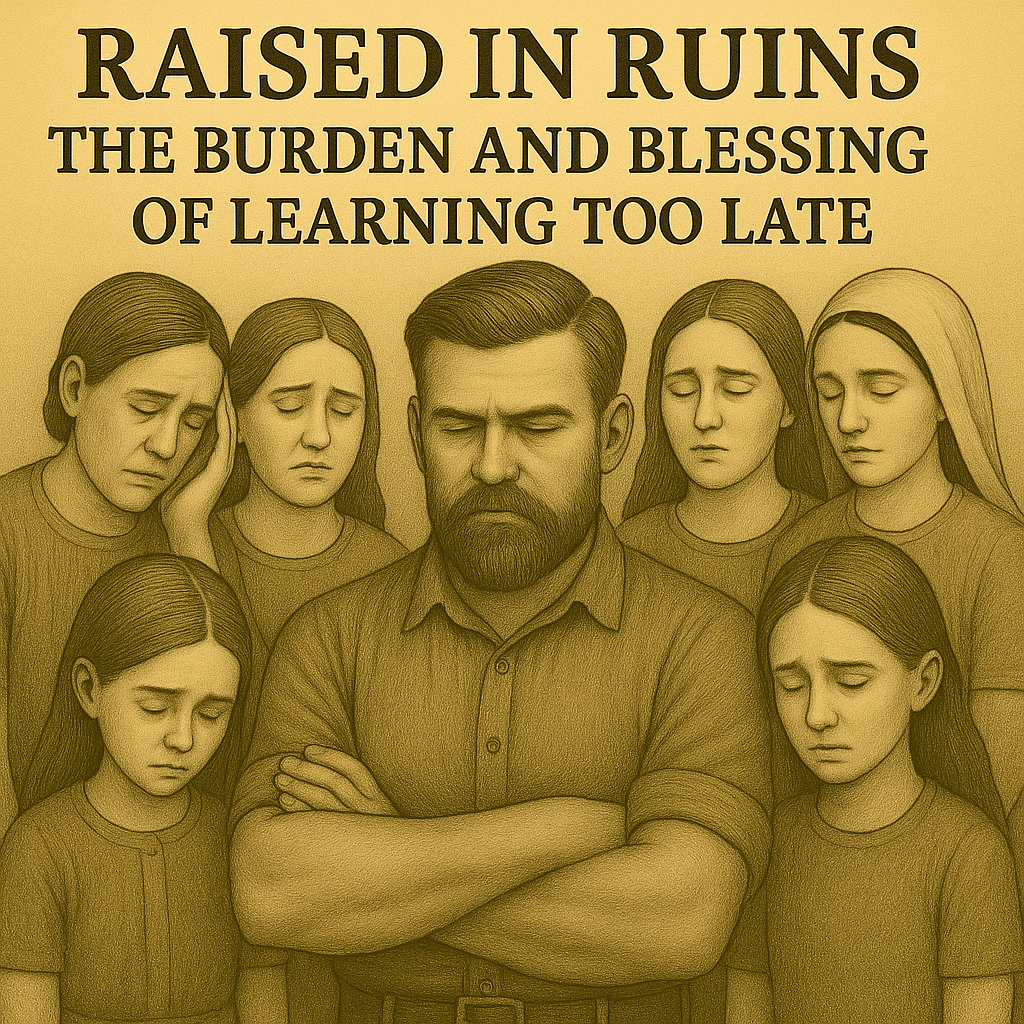
Introduction: Born Behind Enemy Lines
If you were raised in the West in the last 50 years, you were raised in ruins. Not ruins of brick and mortar, but of order, morality, and faith. The family, once the cornerstone of civilization, has been shattered. The church, once the uncompromising herald of truth, has become an entertainment venue. Education, once built on Scripture (the New England Primer taught children to read using Bible verses), now churns out graduates who can deconstruct gender but cannot build a household.
We are not Israel in its golden days under Solomon; we are Israel in exile, more Babylonian than Hebrew in our habits, desires, and worldview. The prophet Hosea said: “My people are destroyed for lack of knowledge: because thou hast rejected knowledge, I will also reject thee…” (Hosea 4:6). That verse reads less like a distant oracle and more like tonight’s headlines.
Consider the numbers. Barna Group’s 2022 survey found that only 4% of Americans have a biblical worldview. Only 11% of Christians read the Bible daily. Fertility rates in the West are collapsing (the U.S. sits at 1.62 births per woman, far below minimum replacement of 2.2). Divorce rates, cohabitation, single motherhood, every marker of covenantal order is broken. We are living not in a neutral environment but behind enemy lines.
And what happens to those of us who wake up? We find ourselves already behind. We were not trained from childhood to pray daily, to memorize Scripture, to honor the Sabbath, to celebrate God’s feasts, to order households under covenantal headship. We were trained by Disney, Netflix, and TikTok. By the time truth collides with our lives, we are not fresh recruits; we are middle-aged soldiers stumbling onto the battlefield after decades of indoctrination by the other side.
This is the burden of the late learner. We spend the first 20, 30, sometimes 40 years unlearning lies, scraping together fragments of truth, and trying desperately to retrofit them into families, marriages, and churches already formed by the world. And yet, this burden is also a blessing. Because the very lateness of our discovery sharpens our hunger. What we had to fight for, we treasure. What we had to dig for, we cling to. And that hunger, if we harness it rightly, becomes the seedbed for generational restoration.
- The Zeal of the Late Learner
Every revival starts the same way: with someone stumbling across a truth that was always there, buried under the rubble of tradition, distraction, and neglect. For most modern men, that truth might be as simple as the Sabbath still matters, or headship is God’s design, or the feasts were never abolished. To the awakened man, it feels like a lightning bolt. To God, it is simply one brick of His eternal order being dusted off.
The problem is, when you discover truth late, you don’t just learn it, you burn with it.
Biblical Parallels
Consider King Josiah. In 2 Kings 22, Hilkiah the priest finds the lost Book of the Law in the temple. Think about that, God’s covenant document with His people was so forgotten that it had to be “rediscovered” like some museum artifact. When Shaphan the scribe read it aloud, Josiah tore his clothes in grief. He realized how far his fathers had strayed. He didn’t shrug. He didn’t schedule a committee meeting. He threw himself into reform, tearing down idols, breaking altars and restoring the Passover.
Josiah’s zeal was righteous, but it was also desperate. He knew time was short, judgment was near, and he was late to the party. Many modern believers live in Josiah’s shoes: we look at the wreckage of our culture, the idolatry of entertainment, the brokenness of marriage, and we see clearly: we are late, but we must act.
The Boot Camp Syndrome
Here’s what usually happens. A man learns some long-lost truth and suddenly his household becomes a spiritual boot camp. If it’s Sabbath, suddenly his kids can’t so much as breathe wrong on Saturday without hearing a lecture. If it’s headship, suddenly his wife feels like she’s living under a general barking orders. If it’s feasts, then birthdays are outlawed overnight, and the entire family feels like they’ve been force-drafted into a Hebrew movie.
The zeal is real, but so is the collateral damage. Proverbs 19:2 warns us: “Also, that the soul be without knowledge, it is not good; and he that hasteth with his feet sinneth.” Zeal without wisdom turns households into laboratories for half-baked experiments. Instead of joy, there is tension. Instead of inspiration, there is exhaustion.
The Weight of Wasted Years
Fueling that zeal is often guilt. The late learner looks at his children, half grown, half lost to the world, and thinks, If only I had known this twenty years ago, everything would be different. He looks at his wife, who married him under one set of assumptions, and now finds herself drafted into a completely different reality. He looks at his community, sees them still asleep in the lies he just woke up from, and feels like a man drowning in urgency.
Sociological studies confirm this desperation. The Pew Research Center reports that the average Christian adult in America doesn’t begin serious religious engagement until their late 30s. By then, children are already formed, marriages already strained, and habits already calcified. In other words: we wake up late, and the clock is already ticking.
That’s why the zeal of the late learner often turns outward. He shouts from rooftops. He tries to shake his brethren awake. He spams social media with long posts. He debates endlessly with pastors, friends, strangers. But instead of sparking revival, most of the time he is met with blank stares, polite nods, or outright hostility.
The Pattern of History
This is not new. Every revivalist has faced the same frustration. Martin Luther nailed his theses to the church door in 1517, burning with rediscovered truth about justification by faith. His own peers shrugged, mocked, or tried to silence him. William Tyndale translated the Bible into English so commoners could read it, he was strangled and burned for it. Every man who ever dragged a buried truth into daylight has first been met with yawns and stones before eventual fruit.
Why should we think it will be easier for us?
The Blessing in the Burn
Here’s the good news: zeal is not the enemy. Misplaced zeal is. Paul himself said in Romans 10:2 of Israel, “For I bear them record that they have a zeal of God, but not according to knowledge.” Zeal without knowledge destroys; zeal shaped by patience, Scripture, and humility builds.
The late learner’s fire, if refined, can ignite households, churches, and even nations. He has something the complacent Christian does not, hunger. He is not bored with the Word because to him, it feels brand new. He is not indifferent about obedience because he knows what disobedience costs. He is not casual about truth because he has tasted the bitterness of lies.
That hunger, if it becomes humble, is the seed of reformation.
2. When Zeal Becomes Identity
If zeal is the spark that wakes us up, pride is the thief that steals its fruit. Many men discover a rediscovered truth and instead of letting it shape them quietly, they let it become their identity. They don’t just keep the Sabbath, they are Sabbath keepers. They don’t just learn headship, they are the “real patriarchs.” They don’t just study the feasts, they become the loudest, most obnoxious feast-day crusaders in the room.
The Badge of Obedience
What starts as a lifeline becomes a badge. And once it’s a badge, it’s only valuable if others can see it. Suddenly everything is measured through this single lens. Every brother is judged: Do you keep this commandment like me? Do you honor this feast like me? Do you submit to headship like me? If the answer is “no,” he’s automatically lesser, ignorant, or even rebellious.
The irony is painful. This same man ignored the truth for 20, 30, sometimes 40 years. He wants mercy for his own blindness, but judgment for everyone else’s. He forgets that it took him decades to get here, yet he demands others arrive in weeks.
Jesus spoke of this. In Matthew 23:23, He rebuked the Pharisees: “Woe unto you, scribes and Pharisees, hypocrites! for ye pay tithe of mint and anise and cummin, and have omitted the weightier matters of the law, judgment, mercy, and faith: these ought ye to have done, and not to leave the other undone.” They boasted in their badges of obedience while ignoring the heart of God’s law.
The Sabbath costume or the feast-day calendar can never replace the weightier matters: humility, order, discipline, love, prayer.
Pride Dressed in Holiness
Here’s the subtle trick: religious pride doesn’t look like pride. It looks like holiness. The Pharisee in Luke 18 prayed, “God, I thank thee, that I am not as other men are…” (Luke 18:11). That prayer wasn’t about God; it was about himself. His identity was wrapped up in being different, more obedient, more enlightened.
Many late learners fall into the same pattern. They think they are guarding truth, but they are actually worshiping their reflection. Their “obedience” becomes performance, their identity becomes a costume. Meanwhile, their household is still in chaos, their children undisciplined, their prayer life shallow. But at least, they say, we’ve got the Sabbath right.
Historical Warnings
Church history is littered with this trap. The Anabaptists of the 16th century rediscovered believer’s baptism. It was a true, biblical correction. But many became so consumed by it that they judged the entire body of Christ only by that single practice, fracturing fellowship and mistaking their badge for the whole counsel of God.
The Puritans rediscovered the necessity of household order and covenantal obedience. Yet in their zeal, many became so obsessed with “proving” their election by external works that they lost the joy of Christ’s mercy. Their children, raised in endless examinations and suspicion, rebelled in droves.
Badge-identity Christianity always eats its own children.
The Poison of Comparison
Paul dealt with this in Corinth. One said, “I am of Paul,” another, “I am of Apollos,” another, “I am of Christ” (1 Corinthians 1:12). Each group made their teacher or practice their identity, and the church fractured. Paul’s rebuke was sharp: “Is Christ divided?”
The modern version is no different. Some are “Torah keepers.” Some are “headship men.” Some are “feast-day households.” Some are “real patriarchy families.” Each one waving their badge, each one convinced they’ve arrived, while the rest of their obedience still lies in ruins.
Comparison fuels pride. Pride destroys unity. And pride presented as holiness is the hardest poison to detect, because it feels righteous while it kills.
The Call Back to Wholeness
Real maturity is not polishing one badge of obedience until it blinds everyone around you. Real maturity is submitting every corner of your life to God’s order. That means your speech, your work, your household, your finances, your marriage bed, your discipline, all of it.
And it means giving the same grace to your brethren that God gave you. If He patiently endured your 30 years of ignorance before opening your eyes, why do you think He expects you to hammer others into submission overnight?
Paul wrote in Romans 12:3, “For I say, through the grace given unto me, to every man that is among you, not to think of himself more highly than he ought to think; but to think soberly…” Sobriety means perspective. It means remembering where you came from, and recognizing that one truth doesn’t make you holy, it just makes you a little more responsible.
Truth Is Not a Trophy
Here’s the bottom line: truth is not a trophy. God does not hand out crowns for “Best Feast-Day Enthusiast” or “Most Authentic Sabbath-Keeper.” He crowns faithfulness, humility, endurance, and generational fruit.
Truth is a stewardship, not a status symbol. It is something to live, not to brag about. It is a tool for building households, not a badge for winning debates. When zeal becomes identity, it rots. But when zeal becomes stewardship, it multiplies. The first breeds division; the second builds generations.
3. The Mercy Hidden in Delay
If there’s one thing harder than waking up late, it’s accepting that maybe – just maybe – God planned it that way. We beat ourselves up over wasted years, lost opportunities, bad choices, and missed training. We wish we could rewind the clock. But God does not work on our clocks. He works on His.
To Every Thing a Season
Solomon wrote: “To every thing there is a season, and a time to every purpose under the heaven” (Ecclesiastes 3:1). That includes your awakening. You didn’t miss God’s timing, you entered it. He reveals truth when He chooses, not when we demand.
Think of Israel in the wilderness. God did not dump the whole law on them at once. He led them step by step, command by command, shaping them over decades. He fed them manna daily, not yearly, so they would learn dependency. He didn’t even drive out all their enemies at once: “By little and little I will drive them out from before thee, until thou be increased, and inherit the land” (Exodus 23:30). Gradual revelation and gradual conquest was mercy, not neglect.
Tailored Convictions
Not every man needs the same lesson first. One brother must confront his addiction to pornography before he can think about feast days. Another must establish household order before adding Sabbath discipline. Another just needs to learn how to pray without falling asleep before he can lead anyone else.
God tailors His conviction. He doesn’t overwhelm; He trains. He doesn’t reveal everything at once, because none of us could carry it. Jesus Himself told His disciples, “I have yet many things to say unto you, but ye cannot bear them now” (John 16:12). If even the apostles needed staggered truth, why would we be any different?
History’s Witness
History proves this pattern. The Reformers did not recover every truth in one generation. Luther hammered justification by faith, but he still clung to state churches. Calvin recovered God’s sovereignty, but he missed household-level reform. The Anabaptists rediscovered believer’s baptism, but neglected unity. Each generation grabbed one rung of the ladder and pulled the church a little higher.
Even Israel’s kings were awakened in waves. Asa rediscovered covenant loyalty. Hezekiah rediscovered temple worship. Josiah rediscovered the Law itself. God did not dump the whole restoration on one man. He parceled it out. Why? Because His plans have always been multigenerational.
Data and Human Nature
Modern data supports this divine pattern. Psychologists tell us that forming a new habit takes an average of 60-90 days. But that’s just for one habit, like drinking more water or exercising daily. Imagine the overhaul God demands: reordering marriages, finances, households, worship, even thought patterns. That is not a 90-day project. That is a lifetime project.
And most late learners don’t start young. Barna’s 2021 report showed that only 9% of practicing Christians began regular Bible study before age 30. Most don’t start until their 40s or 50s, exactly when marriages, children, and careers are already in motion. That’s not failure, that’s reality. And God knows how to work with it.
Patience as a Mirror of Mercy
The danger comes when we weaponize our own convictions against others. We forget how blind we were just a few years ago and demand others see immediately. We confuse our timetable with God’s. But if He was patient with us, how dare we be impatient with our brethren?
Paul reminds us: “We then that are strong ought to bear the infirmities of the weak, and not to please ourselves” (Romans 15:1). Bearing means carrying their slowness, their struggles, their blindness, just as Christ carried ours.
Patience doesn’t mean compromise. It doesn’t mean lowering the standard. It means remembering that growth is a process, not a performance. God is not running a speed contest. He is raising sons, and sons learn by degrees.
The Blessing in Delay
Here is the blessing: late learners treasure what early learners take for granted. The man who wasted 20 years in lies clings fiercely to the truth once he finds it. The woman who grew up in chaos rejoices deeply in order once she experiences it. The household that wandered finally understands the sweetness of stability.
This hunger is an inheritance. If we steward it rightly, we can pass it to our children so that they start where we ended. That is the mercy in delay: not that God withheld truth, but that He entrusted us with the hunger that comes from discovering it late.
David said it well: “It is good for me that I have been afflicted; that I might learn thy statutes” (Psalm 119:71). Affliction, delay, confusion, wasted years, can be the soil in which lasting obedience grows.
The Ladder Ahead
Instead of despairing over how late we started, we must see ourselves as the first rung for our children. Maybe we lost 20 years. Then make sure they never lose one. Maybe we fumbled headship for the first decade of marriage. Then train your sons from boyhood to lead with strength. Maybe you only learned the feasts at 40. Then let your daughters grow up with them as second nature.
The mercy hidden in delay is this: if you carry your burden well, your children won’t carry it at all.
4. What Really Matters
The danger of being a late learner is that we obsess over the when, when we discovered the truth, when others will discover it, when the world will finally catch up. But in God’s eyes, the when is irrelevant. What matters is what we do with the truth once it’s in our hands.
This section breaks into four essentials, study, live, example, and patience. If you master these, you’ll move from frantic latecomer to steady patriarch.
Study the Word Daily
“This book of the law shall not depart out of thy mouth; but thou shalt meditate therein day and night, that thou mayest observe to do according to all that is written therein: for then thou shalt make thy way prosperous, and then thou shalt have good success” (Joshua 1:8).
There is no shortcut around daily immersion in Scripture. The late learner must recognize this brutal truth: the reason we wasted years is because we didn’t treat the Word as bread. We treated it like dessert, an occasional treat when convenient. And so we starved.
The statistics don’t lie. Lifeway Research found that less than 10% of professing Christians read their Bible every day. Barna reports that over 70% of Christian teens cannot name even five of the Ten Commandments. We live in a famine of the Word.
Daily study is not optional, it is survival. No man can lead his household without eating daily bread from God’s mouth. If you want your children to be stronger than you, let them see you open your Bible before you open your phone.
Live What You Know
“But be ye doers of the word, and not hearers only, deceiving your own selves” (James 1:22).
Late learners are especially prone to the bookshelf trap, stacking books, collecting truths, debating online, while their households remain unchanged. Conviction becomes intellectual furniture, arranged neatly but never used.
The only way to redeem wasted years is to obey immediately. If you learn headship, practice it tonight. If you discover Sabbath, set it apart this week. If you realize your household is out of order, begin correcting it today. Waiting for the “perfect time” is another form of disobedience.
Truth is not ammunition for debate. It is material for construction. Build with it, or it rots.
Set the Example
Your household does not need another lecture, they need a picture and so do others.
Paul lays out the qualifications for overseers: “One that ruleth well his own house, having his children in subjection with all gravity” (1 Timothy 3:4). Notice that ruling well at home is the test for public leadership. If you can’t lead your wife and children, you cannot lead a church, much less a movement.
Men think shouting truth will win others. It rarely does. But a house in order, wife respectful, children obedient, work steady, finances disciplined, preaches louder than any microphone.
The Puritans understood this. They practiced daily catechism in the home, not just Sunday sermons. Every father was a pastor, every meal a teaching moment. That’s why their communities endured hardship with faith and built generational strength. They lived what they taught.
Do the same. Let your household become the loudest sermon you’ll ever preach.
Show Patience
Paul commands: “We then that are strong ought to bear the infirmities of the weak, and not to please ourselves” (Romans 15:1).
This is where late learners fail most often. We forget how blind we were. We demand instant clarity from others. We treat delay as disobedience when God may simply be laying foundations.
Patience is not compromise, it is humility. It remembers that we, too, were slow. It trusts God’s timing more than our timetable. It gives space for brothers to grow while holding the line for our own households.
Patience is the difference between a tyrant and a father. A tyrant demands instant performance. A father trains with mercy, discipline, and consistency. Which one reflects God’s heart?
At the end of the day, what matters is not how quickly you learned, but how faithfully you now walk. Study daily. Live what you know. Set the example. Show patience. If you do these four things, your late start will not matter. Because your children will never have to start late at all.
5. What I’ve Learned the Hard Way
Confession time: I have been the man I’ve just warned you about. I’ve been the one who discovered a truth late and tried to drag everyone else into it with the enthusiasm of a drowning man waving for help. I’ve been the zealot who turned my household into a boot camp, who spammed friends and brethren with long essays, who got angry when they didn’t see what I saw. I’ve been the one who thought a single rediscovered truth was the key to holiness while ignoring other gaping holes in my life.
And I paid for it.
The Cost of Misplaced Zeal
I have seen firsthand headship discovered, then used to bark orders like a drill sergeant instead of leading like a father. I have seen Sabbath first grasped, then made heavy instead of joyful. I have observed feasts studied, then treated like performance rather than celebration. I have witnessed firsthand (even in my own home at times) where someone thought they were leading their family into holiness; but was really loading them down with the guilt of being late to the party.
That’s what most late learners don’t see: our zeal is often more about us than about God. We feel the weight of wasted years, so we try to make up for it by going twice as hard, twice as fast. But our wives and children never wasted those years, they didn’t need the boot camp we invented. They needed steadiness, not intensity.
“Fathers, provoke not your children to anger, lest they be discouraged” (Colossians 3:21).The same could easily be said for friends, and wives.
The Futility of Arguments
I’ve also been the man who thought I could argue people into conviction. I’ve written essays, hosted debates, and shouted truth online, thinking if I just proved it clearly enough, people would change. They didn’t. Most rolled their eyes. Some blocked me. A few humored me with polite nods.
But here’s the truth: conviction is not won by debate. If it is “won” at all it will be through the observation of the example you set in your daily lives for others. It is most commonly given by God.
Paul told Timothy, “And the servant of the Lord must not strive; but be gentle unto all men, apt to teach, patient, in meekness instructing those that oppose themselves; if God peradventure will give them repentance to the acknowledging of the truth” (2 Timothy 2:24–25). Did you catch that? If God peradventure will give them repentance. It’s His work, not mine.
I had to learn to stop shouting from rooftops and start living from my household. Arguments win attention, but order wins hearts.
The Treasure of Wasted Years
But here’s the strange blessing: the wasted years make me hungrier now. The confusion I had to crawl through makes me cling tighter to the truth once I find it.
David said, “Before I was afflicted I went astray: but now have I kept thy word” (Psalm 119:67). Affliction sharpened his obedience. Delay deepened his gratitude. My wasted years did the same.
And that’s why I no longer want to be known as “the man who keeps this-or-that law.” I want to be known as the man whose children never had to fight the same battles. If my sons grow up already knowing headship, if my daughters grow up already knowing submission and Sabbath, then they won’t spend their adulthood patching holes in a broken foundation.
“A good man leaveth an inheritance to his children’s children” (Proverbs 13:22). That inheritance is not money, it is foundation.
Generational Vision
Here’s the real prize: not boasting that I know something new, but passing it on so the next generation never has to “rediscover” it. If my grandchildren grow up with what I only found at 40, then I have redeemed the years the locusts have eaten.
That’s the shift every late learner must make: from guilt to generational vision. Stop obsessing over how late you started. Start obsessing over how early your children can begin. Stop beating yourself up over lost decades. Start building so your grandchildren never lose one.
Moses said in Deuteronomy 6: “And these words, which I command thee this day, shall be in thine heart: and thou shalt teach them diligently unto thy children, and shalt talk of them when thou sittest in thine house, and when thou walkest by the way, and when thou liest down, and when thou risest up.”
The answer to wasted years is not self-pity, it’s daily teaching. Not rooftop shouting, but dinner table discipleship. Not badge identity, but generational legacy.
The Hard Lesson
So here is what I’ve observed and even learned the hard way:
- Zeal without wisdom breeds chaos.
- Arguments without example fall flat.
- Truth without patience becomes pride.
- And guilt without vision crushes a household.
But zeal, wisdom, patience, and vision together? That builds dynasties.
6. Conclusion: Rebuilding from Ruins to Generational Glory
We began with ruin, our culture in ruins, our training in ruins, our households half-formed under the influence of lies. Most of us woke up far too late. We discovered truth in midlife, with scars already etched into our families and decades already lost to vanity. The burden is heavy: wasted years, missed opportunities, ignorance that cost us dearly.
But the burden is also a blessing. Because hunger born of delay can do what casual inheritance cannot. The man who found truth late clings to it with ferocity. The woman who wandered in chaos treasures order with joy. The family that was patched together by grace values stability in a way the second and third generation will never understand. And if we are faithful, that hunger can be turned outward, handed down, and will be multiplied.
From Burden to Legacy
Scripture is clear: “And I will restore to you the years that the locust hath eaten” (Joel 2:25). God does not erase our past; He redeems it. He takes the pain of delay and turns it into fuel for generational strength. The very affliction that once felt like loss becomes the reason our children rise stronger.
We are the bridge generation, the ones who grew up on sitcoms instead of Psalms, video games instead of Proverbs, school textbooks instead of the Law of God. We were raised in ruins. But if we do our work, our children won’t be.
The burden is that we must carry both guilt and hunger. The blessing is that we can hand off foundation instead of rubble.
Generational Vision vs. Individual Pride
The temptation will always be to turn truth into a badge, to make our identity rest on being “the Sabbath household” or “the headship family.” But God is not handing out trophies for costumes. He is looking for generational builders.
Abraham received promises he would never see fulfilled in his lifetime. He walked in tents while believing for nations. Hebrews 11 says : “These all died in faith, not having received the promises, but having seen them afar off, and were persuaded of them, and embraced them…” (Hebrews 11:13).
If Abraham could spend his life building what he would not see, can we not spend ours building what our children will inherit? That is the shift from pride to vision: from boasting in what we discovered to planting what they will live by.
What Really Matters – Revisited
So let us remember the four essentials we covered earlier:
- Study daily – because truth neglected is truth forgotten.
- Live what you know – because conviction without obedience is self-deception.
- Set the example – because households preach louder than pulpits.
- Show patience – because God’s timetable is wiser than ours.
These are not just survival tools for late learners; they are the blueprint for generational glory.
From Ruins to Glory
Our story does not have to end with ruins. It can end with households in order, wives joyful, children trained, grandchildren faithful. It can end with the very truths we discovered late becoming second nature for the next generation.
Imagine a household where your grandchildren cannot even fathom the confusion you once lived in. Imagine a church where the young men grow up already knowing headship, prayer, fasting, and Sabbath as normal rhythms of life. Imagine daughters who never once wrestle with feminism because submission was always the air they breathed.
That is glory. Not loud, not flashy, but steady. That is what God intended from the beginning: households living His order, generation to generation, until the earth is filled with His glory.
Final Charge
So to the late learner: stop staring at the ruins. Start laying stones. Stop obsessing over the decades you lost. Start obsessing over the generations you can save. Stop shouting on rooftops. Start discipling at dinner tables.
Because the truth is this: we are all late. We all grew up in Babylon. None of us began where we should have. But if we are faithful, our children will never know Babylon the way we did. They will be raised not in ruins, but in order.
And that, brothers and sisters, is the burden and the blessing. We carry the weight of delay so they can carry the freedom of inheritance. We were raised in ruins, but they will be raised in glory.
This is God’s Great Order in Restoration!
I was raised on lies that looked like love. It took years to realize my “freedom” was actually fatherlessness. Learning too late hurt but it also saved me. I’d rather rebuild at 30 than decay in ignorance forever.
My father was absent, my mother bitter. I thought that was normal until I saw what a real household looks like. The burden is knowing how much time was lost; the blessing is that truth came anyway.
I used to despise my upbringing. Now I thank God for the ruins, because they made me hungry for something solid. You can’t appreciate order until you’ve lived through chaos.
The worst part of being raised in ruins isn’t the pain, it’s watching everyone pretend it’s normal. You tell them marriage is supposed to have hierarchy, children need correction, women need covering, and they look at you like you’re speaking a foreign language.
We’ve raised three generations on rebellion and called it “self-expression.” Now everyone’s depressed, divorced, and directionless. The ruins aren’t poetic, they’re deserved. If you’re still defending the system that destroyed you, you deserve the dust you’re choking on.
There’s a strange ache that comes with wisdom gained through ruin, you wish someone had told you earlier, but you also realize you wouldn’t have listened. God’s timing humbles both the wound and the pride.
I think this is true for everyone alive today.
ohh….poor you.
We learn exactly when we are supposed to, this whole article is trash
This is a burden we all carry brother.
The modern mind loves its ruins. It decorates them with self-help quotes and calls it “healing.” No, healing is demolition and rebuild, not therapy sessions in the rubble. Until we stop romanticizing dysfunction, we’ll keep producing generations who think brokenness is a personality trait.
You weren’t “misunderstood.” You were undisciplined. Your parents weren’t “trying their best.” They were rebels. And the only way out of the ruins is repentance, not affirmation.
Everyone wants to cry about being “raised in ruins,” but no one wants to admit who built them. Those ruins weren’t accidents. They were crafted by weak men, rebellious women, and pulpits that went silent while families collapsed. You weren’t “unlucky.” You were the casualty of generational cowardice dressed as modern freedom.
The burden is that you inherited their mess. The blessing is that you don’t have to repeat it—if you’re willing to call it what it is: sin, not “trauma.”
I used to think “too late” meant “no hope.” Now I see it means “now you understand.” The ruins taught me to value structure, leadership, and truth the very things my parents ran from.
The ruins are both punishment and mercy. They remind us what happens when man rejects God’s design, but they also prove that He allows enough left standing for the faithful to rebuild. That’s grace in its most practical form.
God let me grow up in ruins so I would never confuse comfort with righteousness. It’s only when you see how deep the cracks go that you understand why His structure.
Some of us were born into the aftermath of generations that forsook order. Yet Christ still calls us to rebuild. The gospel doesn’t erase ruin, brick by brick, until obedience becomes our new heritage.
Being “raised in ruins” reminds me of Nehemiah surveying the broken walls of Jerusalem. The ruin wasn’t permanent, it was a call to rebuild under God’s authority. We inherit the wreckage, but we also inherit His blueprints for restoration.
It’s comforting to know we’re not alone in this. I thought being “raised in ruins” made me defective, but now I see it just makes me aware. The blessing is that I can see the cracks in the walls before they collapse on my kids.
The hardest part is realizing no one’s coming to rescue you from the ruins. you have to become the rescuer. And once you do, you stop blaming the rubble and start building the walls again, this time with wisdom.
“Learning too late” describes my whole 20s. I was proud of my ruin because it was all I knew. Then truth came and it destroyed me again, but in a holy way. Thank you for reminding us that repentance isn’t regret; it’s reconstruction.
My father left chaos; my sons will inherit order. That’s the burden and the blessing, realizing the baton was dropped but choosing to pick it up anyway. We can’t fix our past, but we can make it our children’s floor instead of their ceiling.
There’s a strange mercy in waking up after the damage is done. You start to see how grace can rebuild what rebellion destroyed. I used to resent the ruins I came from, but now I see them as proof that God builds from ashes.
But even Jesus drunk wine
Most of us weren’t raised, we just survived childhood. It takes humility to admit we were shaped by dysfunction, but strength to rebuild on truth. “Learning too late” is still learning. The tragedy is refusing to learn at all.
The historical parallels were fascinating like Josiah, Luther, Tyndale. It’s humbling to realize our struggles aren’t new. I appreciate the reminder that zeal without wisdom can destroy what we’re trying to build.
Honestly, this feels manipulative. All the stats and Bible quotes just to guilt people into your version of “order.” It’s always men telling everyone else how they’ve got it all wrong. Maybe stop writing essays and start serving women quietly for a change.
This is spot on. I was a late learner too, and yes, I probably turned my house upside down with my new “truths” at first. Reading this makes me want to slow down, humble myself, and focus on setting an example rather than barking orders.
Wow. The section about fathers turning their households into boot camps happened to me. My husband did exactly that after discovering the Sabbath. We’ve been trying to recover from that season for years. Balance is so hard to find.
This is just another long sermon blaming culture for everything instead of people taking responsibility for their own lives. The West isn’t Babylon, it’s just modern life. If you want to live like it’s 1500 B.C., go for it, but don’t act like the rest of us are doomed.
I cried through half of this. I’m 37, divorced, and only now beginning to see what a covenant household should have been. The “zeal of the late learner” describes me perfectly. Painful, but healing.
You’re just fear-mongering. Families aren’t “in ruins,” they’re just changing. Women working and kids not being “submissive” doesn’t mean the end of civilization. Stop trying to drag us back into the dark ages.
This article is exactly what I needed today. I’ve been feeling like it’s too late for me to change anything, but the part about God redeeming wasted years gave me hope. Thank you
My lord, I can hardly breathe as I read this. Every line feels like you have written my story, though I never told it. Raised in ruins, shaped by lies, trained by the world until I hardly knew which way was up… and now, so late, I wake and see how much was wasted. I carry that guilt every day, the ache of years lost, the shame of not having been ready when I should have been.
And yet your words also give me hope. Hope that even I, broken and behind, can still be useful. That my hunger, though born of delay, could yet be turned to obedience and fruit. Sometimes I wish only that I could sit at your table, learn at your feet, and pour out the years I have left in service, so that at least my children would not have to wander as I did. I do not want to die in Babylon. I want to be kept, to be taught, to be made whole under your covering. That is my confession, and my prayer.
This was a good read. It is important to just learn as much as we can daily and try not to repeat the same mistakes we were raised with and try to raise our children with the knowledge that we have gained. As parents, there is the need to “give your kids the things you did not have” and that is not always a material aspect. I am thankful to be in a family and with a husband who wants to do life the right way.
Amen brother!