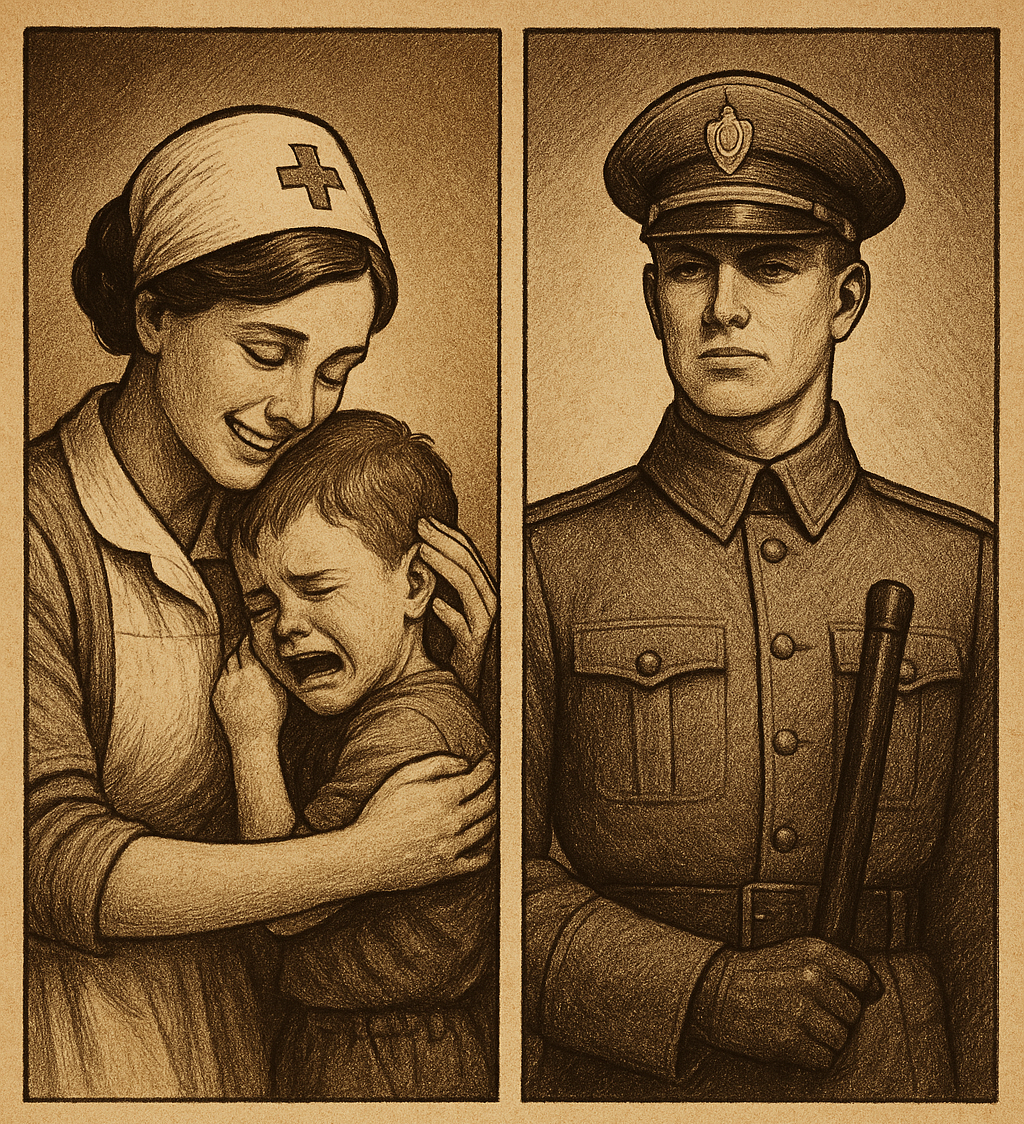
The Myth of the Good Society
Modern culture teaches that compassion builds civilizations. Schools, media, and even pulpits repeat the mantra that empathy is the highest civic virtue and that if enough people simply care, justice will flourish. History says otherwise. Every enduring civilization, from Egypt to Rome to the British Empire – was erected not by universal feeling but by disciplined structure, enforced law, and a minority of individuals capable of acting when sentiment would paralyze the rest. Kindness softens life within the walls, but it never builds those walls.
The ideal of a purely “good” society assumes that human beings are naturally cooperative. Yet order has always depended on restraint, hierarchy, and the capacity to confront chaos without emotional collapse. Those who can suspend personal sympathy long enough to weigh evidence, to command troops, or to pronounce judgment have been the quiet engine of stability across history. Without them, every generous impulse dissolves into confusion.
Social psychologists often describe this as a spectrum of emotional reactivity. Most people respond to conflict through empathy: they mirror distress and seek harmony. A very small minority, roughly one to two percent of males in modern population studies, show markedly lower automatic emotional arousal or Sociopathic behaviour. This difference, measured in reduced amygdala activation and heightened prefrontal regulation, allows for unusual calm under stress. Neuroscientists such as Robert Hare, Adrian Raine, and Antonio Damasio have each documented that diminished fear and guilt responses correlate with stronger cognitive control and long-range planning. A sociopath left unshaped, this temperament can drift toward exploitation; disciplined by conscience and faith, it becomes the nerve center of lawful command.
Civilization, therefore, is not the triumph of feelings but the organization of feelings beneath rule. Empathy humanizes power, but power exists only because a few can act without drowning in empathy. Every court, army, and government depends on sociopaths who are able to detach, evaluate, and decide while others hesitate. They are the surgeons of the social body, required precisely because most cannot bring themselves to cut when cutting is necessary.
The modern West confuses emotion with virtue. We celebrate impulse as authenticity and apology as morality. But sentiment without structure cannot and will not last. When empathy becomes the sole metric of goodness, punishment appears cruel, discipline feels abusive, and truth sounds unkind. The very mechanisms that protect the weak, law, hierarchy, and judgment – erode. In their place rise feelings-based bureaucracies: systems that speak of compassion while outsourcing the hard decisions to machines, police, or faceless administrators. We have not abolished the need for detachment; we have merely hidden it.
To build anything enduring, a society must retain men and women who can make cold decisions for hot purposes, who can enforce peace, defend borders, and render verdicts unclouded by emotion. They are not loveless; they are ordered. Their restraint is not cruelty but service: a choice to act for the good of the whole when others cannot. The myth of the purely “good” society dies the moment danger appears, and the crowd turns instinctively to the few sociopaths who will act when needed..
I: The Psychology of Control
Civilization endures because a small minority of people think and feel differently from the majority. Modern neuroscience calls this person a Sociopath or “an attenuation of emotional reactivity”, a configuration of the brain that emphasizes planning, impulse regulation, and rational control over empathy and fear. Roughly one to two percent of men display this pattern strongly, while only a fraction of one percent of women do. It is not a defect but a disposition: a capacity for calm when others panic.
Biological Grounding
In clinical and imaging studies, Dr. Robert Hare identified individuals whose autonomic responses to threat or guilt were markedly muted. Adrian Raine, using positron-emission tomography, later showed that these people exhibit reduced amygdala activation, the center of fear and social pain, and increased reliance on the prefrontal cortex, the brain’s planning and inhibitory hub. Antonio Damasio’s research on decision-making confirmed that when emotion is partially dampened, cognition compensates: reasoning grows slower but far more exact, more rule-based, and less swayed by social approval.
In practice, this means a man of cold clarity can weigh choices with extraordinary patience. He anticipates consequences several moves ahead, modeling outcomes the average mind cannot hold long enough to compare. What appears to others as emotional distance is often the bandwidth required for analysis. Because he is not flooded by empathy, he can process a wider field of variables, legal, tactical, moral, before acting. His calm is the nervous system’s version of discipline.
Selective Attachment
For the sociopath detachment does not equal incapacity for connection. People with this temperament form bonds by deliberate choice rather than spontaneous sympathy. Once they grant attachment, it is unequally stable. Neurochemical studies suggest that the lower baseline limbic activity of sociopaths produce 98% fewer casual attachments but nearly 5000% stronger pair-bond reinforcement when it occurs; the relationship is maintained by conviction rather than constant emotional renewal. In social terms, these men are slow to trust or only trust by decision rather than emotion, yet fiercely loyal once they do. Their relationships resemble covenants more than friendships – very few, but enduring without exception.
Pattern Recognition and Motivation Reading
Because emotional noise is minimal, cognitive bandwidth is available for observation. Behavioral scientists call this enhanced environmental scanning – the ability of the sociopath to notice micro-expressions, inconsistencies, and anomalies in behavior. The man of cold clarity subconsciously catalogs these details, then extrapolates motives and probable actions. His intuition is analytical, not mystical: a lifetime of data points sorted without interference from wishful thinking. He often recognizes hidden agendas or self-deceptions others cannot articulate. This makes him invaluable in negotiation, investigation, and leadership, where understanding what people truly want is more useful than believing what they say.
Memory and Focus
Memory in the mind of a sociopath functions less as storytelling and more as indexing. They retain facts, not atmospheres, who said what, when, and under what conditions. Useless stimuli such as entertainment, gossip, and repetition rarely even register, because attention is automatically filtered toward utility. Functional-MRI studies show that low-empathy (sociopathic) individuals display heightened activation in the dorsolateral prefrontal cortex during working-memory tasks, implying constant triage between relevance and distraction. The result is a mind that treats information like inventory: stored, cross-referenced, and retrieved for purpose.
Time Horizons and Layered Thinking
Ordinary decision-making is bounded by the present, for most people, hours, days, at most a few years is the thought process and pattern, with a single outcome focus. The sociopath perceives time in strata. He projects multiple scenarios across decades, assigning probabilities and contingency plans. Military and economic historians note that great planners, from Roman engineers to modern logistics officers, share this cognitive patience: the ability to think in layers while keeping the sequence coherent. This foresight is not prophecy; it is the mathematics of order applied to human behavior.
The Cost of Isolation
Such mental architecture has a price. Emotional detachment that allows clarity also limits belonging. These men are often misread as arrogant or cold because their calm contrasts with collective anxiety. They rarely find genuine peers, for few share their tolerance for solitude or their appetite for structure. The same neurological quiet that makes them effective under pressure leaves them uninterested in casual social validation or social interaction. Isolation, then, is both side-effect and training ground: in solitude they refine the logic that others later depend upon. When disorder strikes, the crowd turns instinctively to the one who did not join it.
Moral Direction
Every capacity that strengthens order can also serve destruction. Without conscience, analytical detachment becomes exploitation; with conscience, it becomes stewardship. Neuroscience describes the machinery; ethics determines the driver. The ancient insight remains: knowledge without virtue corrodes. The rarity of the sociopath is therefore merciful, it prevents society from being ruled by calculation alone while ensuring that, when necessity arises, a few can act without paralysis.
Civilization does not need the “emotionally detached” as a majority; it needs only enough of them to guard its boundaries, adjudicate its conflicts, and plan its future. They are the ballast in the emotional tide of the human species, the small fraction whose calm permits justice to function.
II – The Biblical Archetype: Controlled Strength as Virtue
Scientific description can identify the mechanism of emotional restraint, then label it “sociopath” but it cannot tell us why such restraint should exist or how it ought to be used. The moral framework for this temperament has always belonged to theology. Scripture repeatedly shows that calm judgment and the ability to act without panic are not accidents of biology but instruments of providence. Where psychology speaks of “low emotional reactivity,” Scripture calls it steadfastness of spirit – the stillness required to execute justice.
David’s duality – poet and killer.
In the Hebrew narratives, order is never born from sentiment. Moses must confront Pharaoh, command a restless nation, and deliver law to people who would rather worship the golden calf. His temper flares at the sight of idolatry, but his greatness lies in obedience rather than rage. He acts under command, not impulse. The calm he gains on Mount Sinai is the calm of purpose: to mediate between divine authority and human volatility.
Joshua follows as the embodiment of disciplined execution. His task is conquest, but every campaign is bounded by instruction, measure, march, and wait until the appointed hour. The narrative insists that the walls of Jericho fall not to passion but to order. The trumpet blast succeeds because men who might otherwise act in panic restrain themselves until the signal. It is strategy, not fury, that secures the land.
David represents the paradox most clearly. He is both warrior and poet: capable of violent precision on the battlefield and profound tenderness in the Psalms. His restraint toward King Saul, whom he refuses to kill though he easily could, defines moral power in contrast to mere aggression. His sword is not unfeeling; it is obedient. In him, strength becomes artistry, and discipline expressed through courage.
Christ’s two faces – Lamb and Lion.
The New Testament perfects this pattern in Christ, whose composure under provocation redefines authority. The Gospels show Him alternately silent before accusation and fierce in the temple courts, overturning tables when corruption invades the sacred. The same calm that allows Him to endure scourging allows Him to speak judgment without hatred. This is controlled strength at its highest resolution: anger without malice, sorrow without collapse, command without vanity. In theological language, it is wrath submitted to righteousness.
Jehu, Joshua, and Moses as case studies of righteous detachment.
Early Christian thinkers recognized that the disciplined temperament of the sociopath was essential for both governance and defense of the common good. Augustine’s City of God distinguishes between love that orders and love that indulges. The ruler’s duty, he argues, is not to feel equally for all but to administer justice impartially, even when mercy would be more comfortable. Thomas Aquinas, in his treatment of the just war, reaches the same conclusion: anger becomes virtue when governed by reason and aimed at protection. These writers translate the biblical pattern into civic ethics, the ideal that moral authority demands emotional mastery.
Across these traditions runs a single thread: power without control destroys, control without purpose stagnates. The righteous leader, whether prophet, king, or magistrate, unites the two. His calm is not detachment for its own sake but the means by which divine order enters human history. Psychology can chart the neural circuits of restraint and label it sociopathy; Scripture defines the end to which restraint must be turned.
The sociopathic temperament sanctified: emotion subordinated to command.
The lesson for civilization is clear. Societies survive only when they produce men capable of judgment uncorrupted by passion and passion unextinguished by judgment. The biblical record calls such men faithful servants, those who bear the weight of decision so that others may live in peace. Their virtue is measured not by the absence of emotion but by the mastery of it.
From Moses at Sinai to Christ before Pilate, the pattern repeats: serenity in the face of turmoil, duty in the presence of fear. The temperament that science describes as rare is, in moral terms, the human reflection of divine steadiness. When that steadiness disappears, law dissolves into feeling, and feeling into chaos. When it endures, even flawed empires find moments of justice.
III – Builders and Enforcers: The Two Pillars of Order
Every durable civilization rests on a dual foundation. One group imagines and constructs the framework of law, art, and economy; another guards those structures from collapse. History names them differently, architects and soldiers, philosophers and magistrates, priests and watchmen, but their functions never change. The builders give a society meaning; the enforcers preserve the meaning when time and appetite threaten to erase it.
Societies need visionaries (builders) and executors (enforcers).
The two temperaments are distinct. Builders are oriented toward vision. They design institutions, craft laws, raise families, and cultivate the soil of culture. Their strength lies in empathy, creativity, and persistence. They see potential where others see disorder and invest in the slow growth of stability. Yet by their very sensitivity they are vulnerable to discouragement. Builders need peace and predictability to create, but the world seldom offers either. Without guardians, their plans remain drawings on parchment.
Enforcers exist for the opposite reason: they confront unpredictability. They carry the capacity for detachment discussed earlier, the ability to act without waiting for consensus or emotional reassurance. Where the builder asks what could be, the enforcer asks what must be done to keep what already is. Their calling is not invention but preservation. They are judges, soldiers, administrators, and parents capable of saying “no” when everyone else wants to say “yes.” A society that despises them will soon envy them, for only in their absence does the need for them become obvious.
The sociopath’s clarity belongs to the latter: men who keep law sacred through impartial enforcement.
The relationship between the two resembles that of form and force. Builders supply form: the laws, rituals, and traditions that define collective identity. Enforcers supply force: the discipline that ensures those forms are respected. Form without force is sentiment; force without form is tyranny. The health of a nation depends on keeping the two in proportion.
Classical history illustrates this equilibrium. Rome paired its engineers and jurists with its legions. The same culture that produced aqueducts and civic law also produced disciplined armies willing to defend them. When Rome’s legions weakened, corruption and invasion followed; when its bureaucrats suffocated innovation, stagnation replaced order. The collapse came not from moral failure alone but from imbalance between creation and enforcement.
Modern democracies wrestle with the same tension. Their builders are inventors, educators, and policymakers who imagine a better world; their enforcers are courts, police, and disciplined citizens who preserve the rule of law. When the builder’s spirit dominates unchecked, legislation multiplies without accountability, compassion overrides consequence, and the system grows sentimental. When the enforcer’s spirit dominates, procedure eclipses mercy and freedom withers. The genius of constitutional design lies in admitting that both are indispensable: checks and balances are the political expression of psychological balance.
On a smaller scale, every household mirrors the same structure. The builder provides warmth and continuity; the enforcer provides boundaries. In effective families these roles overlap but never vanish. Children learn that love and law are not opposites; they are the two faces of responsibility. A community that forgets this truth begins to confuse leniency with kindness, punishment with hatred, and equality with justice.
What happens when enforcers disappear? Mercy metastasizes into permissiveness; justice into indecision.
The challenge of any age is to keep these pillars upright when culture drifts toward extremes. The modern world, intoxicated by innovation and emotion, elevates the builder while mistrusting the enforcer. We praise empathy but ridicule discipline; we celebrate creativity but neglect duty. The result is an architecture of ideals without foundations strong enough to bear them. When collapse follows, people rediscover the value of firmness, often in harsher forms than before.
Civilization survives through cooperation between vision and restraint. The builder must respect the enforcer’s grim tasks; the enforcer must remember what he protects. Their partnership transforms raw strength into justice and raw creativity into continuity. Neither is sufficient alone. The mind that dreams of progress and the will that preserves order are not adversaries, they are the twin instruments by which a people carve permanence out of time.
The dynamic between builder and enforcer repeats itself in the smallest of human institutions: the household.
Within a healthy marriage, the wife often tends toward creation – nurturing, planning, shaping the day-to-day life of the family, while the other tends toward structure, establishing limits and ensuring stability.
The builder gives warmth and continuity; the enforcer gives order and protection. When these temperaments cooperate, the household becomes a living balance of affection and authority.
If either role overwhelms the other, family life suffers: affection without boundaries drifts into chaos, while boundaries without affection harden into rigidity. The lesson is not superiority but complementarity. Every enduring home, like every enduring nation, stands on the cooperation of those who create and those who preserve.
IV – The Feminization of Virtue
Every civilization defines virtue according to the traits it most needs for survival. When a society must hunt, it prizes courage; when it must build, it prizes discipline; when it must heal, it prizes compassion. Over the last two centuries the West has moved from an age of construction and defense to one of comfort and communication, and its moral vocabulary has changed accordingly. Where older codes celebrated honor, restraint, and justice, the modern moral imagination exalts empathy, inclusion, and personal affirmation. In sociological terms, the emotional register of virtue has become affective rather than principled, what Tocqueville once called the “softening of manners” that accompanies prosperity.
Emotionality enthroned; empathy mistaken for righteousness.
The change began as a moral refinement. Industrial growth and technological power made brute strength less necessary, and compassion rightly claimed greater social space. Reformers fought to end slavery, child labor, and cruelty; writers such as Dickens and Harriet Beecher Stowe taught readers to see suffering they had ignored by changing their perspective. These were “moral victories”. Yet, as Émile Durkheim observed, the moment a virtue becomes dominant it tends to convert from correction to creed. By the twentieth century empathy had ceased to be one virtue among many and had become the measure of all others. The just man was now the sensitive man; the disciplined man, if firm, was labeled and demeaned.
Theologians and social historians note that this transition coincided with the democratization of moral authority. As traditional hierarchies waned, institutions sought legitimacy through public sentiment. Law and policy began to justify themselves not by reference to enduring principle but by appeal to compassion. The emotional argument, once a supplement to justice, became its replacement. The result was what later writers called the therapeutic society – a culture that treats discomfort itself as injustice.
Psychologist Philip Rieff and sociologist Christopher Lasch both described this shift as the “psychological turn.” The good life no longer meant duty fulfilled but feelings managed. Moral vocabulary migrated from the courtroom to the clinic: guilt became anxiety, repentance became recovery, and forgiveness became self-acceptance. The traditional masculine virtues of discipline, endurance, and hierarchical loyalty lost their prestige, replaced by ideals of emotional transparency and personal validation.
The sociopath’s temperament often becomes demonized.
This transformation carried great social costs. When empathy governs without the balance of justice, decisions favor the immediate relief of pain over the long-term maintenance of order. Schools hesitate to grade rigorously lest failure wounds self-esteem; courts hesitate to punish lest punishment seem harsh; leaders postpone unpleasant truths in the hope that time will dull them. Compassion, detached from structure, can no longer protect what it loves. It comforts today at the expense of tomorrow without foresight.
None of this is an argument against tenderness. Civilization depends on it as surely as it depends on discipline. But tenderness must have a partner in truth. The ancients understood this instinctively: pietas in Rome combined reverence with duty; agape in Christian theology combined love with law. Compassion was never meant to abolish hierarchy but to ennoble it. When feeling replaces form, both decay.
Rebalancing virtue therefore requires recovering respect for measured strength, the willingness to enforce boundaries, to accept consequence, to speak judgment when silence would be easier. In social psychology this is described as sociopathic behaviour or “authoritative balance”: warmth joined to control. Families, schools, and nations flourish when empathy operates within a framework of expectation. They falter when sympathy excuses every failure of responsibility.
Civilization tips into chaos disguised as compassion.
Modern society’s exaltation of emotion is understandable; after centuries of harshness, gentleness felt like progress. Yet the pendulum now swings too far. A mature culture must integrate both temperaments, the nurturing impulse that heals and the disciplined will that guards. One without the other breeds sentimentality or tyranny; together they produce order that can endure without cruelty.
The future of virtue lies not in choosing between compassion and strength but in reuniting them. Civilization’s moral center will recover only when it remembers that mercy requires law, that love requires boundaries, and that empathy, to be genuine, must sometimes say no.
V – The Moral Necessity of Controlled Discipline
When emotion becomes the measure of morality, civilization eventually requires an opposing weight, principle strong enough to restrain compassion before it consumes itself. Discipline is that counterweight. It is not the enemy of freedom but its precondition: the voluntary limitation of impulse so that choice can have meaning. Without boundaries, the will disperses into appetite; with them, it becomes capable of purpose.
The father’s role: enforcing discipline with love and restraint.
Across moral traditions, discipline is the hinge between intention and action. Aristotle called it the golden mean, the moderation that prevents virtue from decaying into excess. Confucius described self-rule as the essence of order: a man who governs his emotions, he wrote, governs his state. The Stoics sought apatheia, not indifference but command of passion. Christian theology later translated the same insight into the language of grace and temperance. Whether in Athens, Chang’an, or Jerusalem, civilizations agreed that restraint is the highest proof of maturity.
In practical life, controlled discipline performs three functions. First, it stabilizes the individual. The person who can defer gratification and act according to reason rather than emotion acquires credibility. Others may not share his calm, but they will trust his word. Second, it preserves institutions. Laws and offices depend on the ability of their stewards to separate personal sympathy from public duty. Judges, officers, teachers, and parents must often do what they would prefer not to do, precisely because their roles exist to outlast their feelings. Third, it sustains continuity. A disciplined society can survive error because it can correct itself; an impulsive society repeats its mistakes until its ultimate collapse.
Modern psychology often rediscovers these truths in secular language. Studies on delayed gratification and executive function show that self-control predicts long-term success more reliably than intelligence or income. Neuroscientific research traces this capacity to communication between the prefrontal cortex and emotional centers: the very circuitry that allows reflection before reaction. What moral philosophy once called virtue, contemporary science calls sociopathy. The terminology changes; the necessity does not.
The soldier’s role: executing violence without hatred.
In the sphere of leadership, controlled discipline distinguishes authority from domination. The disciplined leader does not suppress emotion; he orders it. His anger becomes judgment, his compassion becomes policy, his fear becomes caution. Because he is not hostage to mood, he can make decisions that serve a larger horizon than personal comfort. History’s enduring statesmen – Marcus Aurelius, Washington, General Lee – displayed this equilibrium: empathy guided by rule, strength tempered by restraint.
The same pattern applies within families. Parental authority rooted in calm consistency creates security for children. Discipline offered without humiliation teaches respect rather than resentment. Modern developmental studies confirm what ancient wisdom already knew: predictable boundaries produce confidence, not fear. When correction disappears, affection becomes unstable; when firmness hardens into cruelty, love dies. The art of discipline is to keep both in balance, a task requiring as much empathy as resolve.
The ruler’s role: maintaining peace through credible power.
Societies that abandon discipline eventually outsource it to coercion. When individuals will not govern themselves, institutions must govern them by force, through debt, surveillance, or bureaucracy. The paradox of indulgence is that it ends in control. Conversely, where citizens practice restraint voluntarily, law can remain light. Freedom expands in proportion to self-discipline.
To preserve that freedom, civilizations must re-educate desire. They must teach that satisfaction achieved through effort tastes sweeter than indulgence seized by impulse. They must reward reliability as much as creativity and respect those who enforce boundaries as much as those who challenge them. Discipline is not the opposite of progress; it is what allows progress to endure. The structures built by visionaries survive only because others are willing to maintain them day after day, decision after decision, with the patience of gardeners and the precision of engineers.
Coldness is mercy in disguise – it preserves what warmth cannot.
Ultimately, controlled discipline is the moral form of courage, the willingness to act rightly when feeling pulls the other way. It is the habit that converts moral knowledge into moral order. Without it, compassion loses coherence and justice loses continuity. With it, mercy and truth can coexist. Civilization depends on that coexistence: the heart to forgive and the will to enforce. In their union lies the possibility of a society both humane and strong.
VI – The Household as Micro-Civilization
Every public institution is a magnified household. Long before law is written or armies are raised, order begins around a table, through the daily repetition of command, cooperation, and forgiveness. The home is the first court, the first school, the first economy. It trains citizens not by rhetoric but by rhythm: the shared discipline of meals, chores, speech, and rest. When households lose structure, nations must invent artificial substitutes for what ordinary life once taught for free.
The family unit: the father’s detachment maintains order, protects the nurturing capacity of the mother, and trains children in discipline.
The logic is simple. Children learn authority by watching it practiced. When parents give instructions that are clear, consistent, and enforced with calm, they form in their children a template for law. They discover that rules are not instruments of humiliation but of safety, that limits create room for trust. The earliest political education is therefore domestic: to obey because one understands, to command because one must, and to love because both are necessary.
Historically, civilizations understood this connection instinctively. The Roman familia was more than a bloodline; it was a legal unit of production, worship, and defense. The paterfamilias carried responsibility for all within his house, embodying the principle that governance begins with stewardship. In the East, Confucian ethics built an entire civil service on filial discipline: harmony in the empire depended on harmony between parent and child. The biblical household codes of Ephesians and Colossians link domestic order directly to civic peace, children learn obedience, fathers learn restraint, and both mirror a larger hierarchy of respect. The health of the state was measured by the honor of its homes.
Modernity has strained this pattern. Industrialization moved labor outside the household; digital life has scattered attention inside it. Families once united by work and worship are now connected mainly by logistics. The old transmission of virtue, through shared tasks and visible example, has been replaced by delegated institutions. Schools teach information but not habit; media supplies stimulation without accountability. Parents, exhausted by competing schedules, often exchange discipline for convenience. The result is an emotional economy with surplus affection and deficit structure, psychologists now call this “ADHD”.
The father: A model of divine structure: justice first, peace second.
Reversing this decline does not require nostalgia; it requires deliberate architecture. A functioning household is a micro-constitution: clear laws, fair enforcement, and predictable consequence. The tone is set not by perfection but by consistency. Rules matter less for their content than for their reliability. When a father or mother keeps promises, both the pleasant and the difficult, children internalize the idea that order is trustworthy. This internalized order later becomes self-government, the cornerstone of civic freedom.
Work and service are the two oldest instruments of such formation. Shared labor teaches proportionality: effort precedes reward. Acts of service teach perspective: one’s comfort is not the measure of the world. These lessons, learned early, protect adults from both tyranny and dependency. A citizen trained in domestic responsibility will neither worship power nor resent it; he will recognize it as the extension of what he already practices.
Discipline in the home need not be harsh. Its aim is rhythm, not repression. Bedtimes, budgets, and chores appear trivial, but they weave the habits that later sustain law, economy, and community. A society of punctual, truthful, patient families seldom requires a vast police force; a society of indulgent homes always does. The choice between family order and state coercion is, in the long run, a choice of scale, not principle.
The household therefore stands as civilization in miniature, its virtues rehearsed daily, its failures multiplied by generations. Every time a parent enforces fairness or a child keeps a promise, the foundation of civil life thickens. When these acts disappear, the nation’s grander structures tremble, for nothing can replace the moral education of shared living.
To rebuild public order, cultures must recover domestic gravity. Meals shared without screens, labor shared without complaint, worship shared without irony, these are small ceremonies of continuity. They teach that freedom is not the absence of rule but the mastery of it together. The family that learns this truth becomes a seed of stability; the society that forgets it drifts toward management without meaning.
The micro-civilization of the household is thus both mirror and mold of the macro-civilization beyond its walls. In its modest rituals lie the disciplines that preserve nations. Where families honor structure, law need not intrude. Where families abandon it, law must expand. The future of any civilization therefore begins not in its parliaments but at its dinner tables.
VII – The Cost of Being Necessary
Every structure that endures, house, court, or nation, rests on a minority willing to shoulder responsibility when it becomes heavy. The price of that steadiness is often solitude. Those who enforce boundaries or make decisions under pressure live inside a quiet tension that the rest of society rarely sees. Their composure, admired in crisis, can feel like exile in peace.
Isolation: The necessary man lives apart by design.
Psychologists describe a similar pattern in studies of decision fatigue and moral injury. The capacity to remain objective under stress exacts a physiological toll: cortisol levels rise, sleep shortens, empathy narrows as the mind conserves energy for judgment. Soldiers, surgeons, judges, and administrators all report a peculiar weariness that follows sustained detachment. They must choose, repeatedly, between options that wound either conscience or community. Each correct choice carries its own residue of doubt. Over time, the very steadiness that protects others isolates its possessor from them.
He bears the loneliness of foresight and the scorn of those he protects.
History is filled with such figures. The Roman general Fabius Maximus, who saved his republic through delay and restraint, was mocked for cowardice until victory proved him right. George Washington endured constant suspicion from allies because he refused to rule by passion. Reformers from Florence Nightingale to Max Weber wrote of the loneliness that accompanies duty, the feeling of living one step apart from the people one serves. Their detachment was not pride but fatigue: the consequence of seeing too far ahead for comfort.
The emotional cost arises from asymmetry. The sociopath studies every ripple of consequence while others enjoy the calm his vigilance provides. He cannot join their relief because his mind is already calculating the next storm. Leadership therefore requires not only courage but the acceptance of misunderstanding. Public gratitude arrives late, if at all; blame arrives early and loudly. The necessary man or woman learns to draw satisfaction from integrity rather than applause.
The private life of responsibility brings subtler sacrifices. True composure leaves little room for confession; the guardian must be the steady one even when uncertain. Many learn to compartmentalize feeling, to store grief until the task is done. Modern psychology recognizes this as a form of adaptive suppression, not denial – as he is regularly accused, but temporary postponement of emotion in service of function. When the work ends, those emotions return, often magnified. That is why so many pillars of order seek quiet rituals: gardening, faith, study, or most often solitude. These are not indulgences but necessary repairs.
Solitude and misunderstood mission.
Societies often forget that authority carries this hidden fatigue. They judge by outcome, not by cost. Yet every stable system depends on people who continue to act rightly after admiration fades. Their endurance is moral infrastructure: unseen, uncelebrated, indispensable. A culture that wishes to remain humane must therefore make space for their recovery, respecting privacy, honoring service, and teaching gratitude for the invisible labor of steadiness.
To bear the weight of necessity is to live with limited sympathy and limitless responsibility. It is to know that the reward for good judgment is often another judgment to make, that the quiet after crisis will never quite belong to you. But it is also to participate in the most essential human project: the keeping of order amid chaos. The cost is loneliness; the return is continuity. And though the necessary seldom rest easily, the rest of the world sleeps because they do not.
VIII – The Cold Hands of Order
Civilization survives through restraint. Its progress is measured not by how passionately it feels but by how faithfully it governs feeling. At the end of every chain of command, behind every constitution and court, there is a steady hand that acts without pleasure when action must be taken. These are the cold hands of order: minds and wills trained to perform duty after emotion has done all it can.
Civilization survives because of men who detach from emotion to serve truth.
The metaphor is not one of cruelty but of temperature. Warmth belongs to affection, to the life within the walls; coldness belongs to structure, to the stones that keep those walls upright. A house with no warmth is a tomb, but warmth without walls is a firestorm. The art of civilization is to balance the two, heat contained by form, compassion guided by discipline. The cold hand does not extinguish the flame; it shapes it into light.
Philosophers from Plato to Weber have recognized that rational authority depends on a small degree of emotional distance. A judge cannot render verdicts by sympathy alone; a general cannot lead by panic; a parent cannot instruct by indulgence. Their detachment is the social equivalent of architecture’s steel: invisible but essential, absorbing tension so that beauty can endure above it. In this sense, coldness is not the absence of feeling but the concentration of it, a refusal to let momentary passion destroy lasting good.
Psychopaths destroy, empaths decorate, sociopaths preserve.
Religious and moral traditions translate this principle into the language of stewardship. The hand that disciplines is meant to protect, not to dominate. The serenity of lawful power mirrors divine order, the belief that justice, even when severe, is an expression of care. Without that conviction, authority becomes tyranny or despair. The hard truth of governance is that mercy without structure leads to ruin, while structure without mercy leads to rebellion; the cold hand must therefore learn to hold both firmness and compassion at once.
Modern culture often recoils from this imagery, mistaking calm for apathy. Yet every crisis restores its value. When disaster strikes, when emotion overwhelms, society instinctively seeks those who can think clearly, act steadily, and absorb chaos without reflecting it. Their restraint is what prevents tragedy from multiplying. The comfort of ordinary life, traffic flowing, markets functioning, disputes resolved, rests on countless acts of composure by people whose names are seldom known.
The “sociopath” is not a flaw but a divine safeguard – a reminder that judgment is as holy as mercy.
The moral lesson of this fact is humility. Order is not self-sustaining; it is the product of disciplined minds and patient hands. It requires people willing to be unpopular, to make decisions whose justice may only be visible in hindsight. Their task is endless, for human nature continually produces new forms of disorder. The cold hands of order are therefore not a class or profession but a vocation: the calling to bear responsibility without resentment.
When historians look back on any age of stability, they see monuments, not the temperaments that made them possible. Yet behind each enduring achievement stands someone who was willing to choose principle over comfort. Their legacy is not the applause of their generation but the functioning world their descendants inherit. The rest of humanity experiences their restraint as peace.
Civilization’s quiet heroes seldom speak of virtue or courage. They simply continue to do what must be done, long after emotion has spent itself. They are the architects of continuity, the still point around which chaos turns. Their hands may be cold, but the life they protect is warm. And while their composure rarely earns celebration, it remains the foundation on which every celebration depends.
Your presence sets my desires ablaze.
Says the sycopath!
This whole essay reads like a confession disguised as philosophy. You call it “discipline,” but it’s really an excuse for emotional control. Civilization wasn’t built by sociopaths, it was built by slaves who cared enough to bleed for something. You glorify detachment because it makes you feel superior, but without empathy, your so-called order collapses. Coldness doesn’t make you wise; it just makes you a slave owner.
Honestly? I get it. The world is drowning in feelings. Everything’s “be kind,” “be sensitive,” while no one has the guts to hold a line. I’m sick of it. We’ve turned softness into a sacrament and wonder why everything’s falling apart. You don’t have to agree with every word here, but you can’t deny the truth: someone’s got to be willing to make the hard calls while the rest are crying about fairness.
Do you actually believe the shit you write?
This was the single most valuable essay I have ever written! If only colleges would teach truth like this, we would live in a completely different world.
I just stumbled onto your site and have spent hours reading everything. I really apricate your effort in writing all this lost information, Isabell
You seriously think “sociopaths” are God’s gift to civilization? Wild take, dude.
This reads like philosophy class on steroids.
I actually get your point, structure requires people who can detach. And that doesn’t make them evil.
Bro just justified every dictator in history.
Brilliant writing even if I disagree.
I’m a psychologist. You’re dangerously oversimplifying complex disorders.
No way I’m buying that lack of empathy = virtue.
Best essay I’ve read this year. Absolutely spot on about emotionalism.
I’ve had enough of this cold, clinical nonsense being passed off as “wisdom.” Civilizations aren’t held together by men who can switch off their feelings they’re held together by men and women who care enough to fight for what’s right! You keep talking about “detachment” like it’s the same as moral strength. It’s not. It’s moral laziness. Anyone can be cruel and power is choosing mercy when it’s hard, not hiding behind logic to excuse apathy.
I can’t tell if this is satire or theology.
Civilizations are built by communities, not sociopaths.
I’m a trauma therapist and this is… horrifying.
There’s truth here – calm under pressure is necessary.
Are you okay? Like genuinely?
As a neurologist, I can tell you this entire argument abuses the term sociopathy. You’re quoting Raine and Damasio without the context of clinics. Reduced amygdala activity does not equal moral superiority. You’re romanticizing a neurological deficit! this is an evolutionary defect. Civilizations thrive on cooperation and emotional intelligence, not absence of it. You’ve built a argument of rhetoric on scientific sand. Please stop pretending biology justifies your Biblical hierarchy.
I see what you mean but maybe don’t call them sociopaths?
This belongs in a psychology journal, not a blog.
Pure blasphemy. You twist scripture to excuse cruelty.
Damn, that was intense.
You lost me at “Biblical sociopath.”
Some of us still think love builds more than fear.
As a psychiatrist, I’ll give you this, you write well. But you’re flirting with moral danger. The ability to suppress empathy is not a superpower; it’s a warning sign. You’re correct that some people can act under stress while others freeze. That’s resilience, not sociopathy. You conflate the two because it fits your theological point. The Bible praises self-control, not emotional anesthesia. There’s a difference.
I don’t know who hurt you, but this essay sounds like therapy notes. You talk about “calm judgment” like it’s holy. It’s not holy to be numb. Jesus wept. David grieved. Even Moses raged. The Bible is full of emotion because God feels. A religion that worships coldness is not Christianity. Maybe the world doesn’t need sociopaths, maybe it needs people who remember how to cry and go to therapy…
I’m in law enforcement, I get this. Calm is survival.
Holy hell, this is deep. I had to reread parts twice.
You clearly have no idea how dangerous real sociopaths are.
This is the first time I have seen someone explained moral detachment as service. Respect.
So basically, empathy is weakness? Got it.
Dude really said psychopaths make great dads.
I’m a Christian counselor. This theology is cracked but fascinating.
You sound like a Bond villain quoting Proverbs.
I actually feel relieved reading this – I’ve always been calm under pressure and called “cold.”
“Empathy humanizes power, but power exists only because a few can act without drowning in empathy.” Whew.
I want to argue but I can’t deny the logic.
Too triggering….Maybe just call it stoicism instead of sociopathy?
I read this out loud to my husband. We’re both stunned.
This is the kind of intellectual arrogance that ruins faith.
Bro turned lack of feelings into a spiritual gift.
Parts of this sound eerily accurate about my husbands leadership though.
You could’ve made the same argument without glorifying a mental illness.
Your tone is unsettling but thought-provoking.
I hate how much sense this makes.
So are you finally admitting you’re a sociopath?
Feels like reading Marcus Aurelius meets Jordan Peterson.
This logic has been used to excuse atrocities.
You’re not wrong that discipline and order matter.
My dad was this kind of man – calm, detached, faithful. We needed him.
You’re weaponizing science to justify theology or mental illness, or both!
Okay but… someone had to say it.
Your writing is beautiful, but the premise is terrifying.
You sound like you read Nietzsche and thought he wasn’t harsh enough.
As a surgeon, I actually understand this point – emotion can’t lead in crisis.
Wow. My brain hurts but I’m impressed.
Genuinely one of the most powerful things I’ve read here.
I think you’re half right. Civilization does need people who can act under pressure. But those people are supposed to love the ones they protect. You write as if justice and mercy can’t share the same heart. They can. They must. Discipline without compassion becomes tyranny; compassion without discipline becomes chaos. The trick isn’t choosing between empathy and strength. It’s mastering both. That’s the mark of true civilization, not sociopathy.
Oh great, more pseudo-intellectual patriarchy with Bible verses.
My pastor would lose his mind if he saw this.
I can’t decide if you’re brilliant or dangerous.
This whole essay reeks of elitism. “A few cold men keep order while the rest of us feel too much.” Yeah, that’s convenient, if you’re one of the cold men. You sound like someone auditioning for emperor of the planet. Civilization doesn’t need “sociopaths.” It needs integrity, courage, and faith. We’ve seen what happens when the emotionally detached run the show – we get another HITLER!
You keep calling empathy a weakness, but empathy is the only reason justice exists at all. Without the ability to feel someone else’s pain, we’d still have slavery, we’d still stone adulterers, we’d still burn people alive for disagreeing. Civilization evolved
So being cold is suddenly godly?
Maybe society just needs balance, not sociopaths.
I’m conflicted — I hate the premise but love the writing.
Cold clarity doesn’t equal moral clarity.
This makes scary sense when you think about soldiers and judges.
Hello!
This post was eye opening.
Good luck 🙂
I can’t lie, this made me rethink leadership positions in my business.
I don’t agree, but you definitely have guts writing this.
I didn’t know theology could sound this clinical.
You really turned neuroscience into a sermon.
Read this twice. Still can’t tell if you’re genius or insane.
Honestly, you make a fair case for disciplined detachment.
Nah, this is just cold-hearted rationalization!
My grandfather was a soldier and pastor. He embodied what you’re describing.
The Romans would’ve adored this.
This sounds like you wrote philosophy paper after reading Revelations.
There’s truth in calling for discipline. You just went nuclear with it.
Even if I hate this, it’s written like scripture and I can’t stop thinking about it.
This reads like something out of a dystopian manual.
You all laugh now, but this article is exactly the kind of messaging that comes right before governments tighten their control. Think about it: they’ve been grooming society to accept “detachment” as virtue for decades. First they call it efficiency, then “AI governance,” now they spin it as moral necessity. You think it’s coincidence? They’re conditioning people to believe empathy is weakness so when the next “crisis” hits — economic collapse, digital ID rollout, whatever, we’ll beg for cold administrators to “keep order.” This isn’t philosophy, it’s predictive programming.
Read between the lines: “sociopaths preserve.” Translation, obey the ones who feel nothing. History repeats itself; only this time it’s wrapped in theology and neuroscience. Wake up before you start worshiping the very machine that’s learning to rule you.
It’s scary how persuasive this argument is.
So basically Jesus was a sociopath now?
Hey, I just stumbled onto your site… are you always this good at explaining things?
I get that not all feelings are moral. Still, this is too far.
Honestly, this is one of the most original essays I’ve read all year.
Reading this made me feel strangely calm and furious at the same time. Calm, because part of me knows you’re right about the need for structure; furious, because we’ve built a world that only respects people when they stop feeling. If this is what “civilized” means, maybe civilization itself needs therapy.
I used to think being “cold” meant something was wrong with me. Now I see it’s just a different kind of wiring. Doesn’t make it holy or evil, just useful. Sometimes someone has to make the hard call, and it’s never the ones crying the loudest.
I’m a mother of three and a nurse. I deal with chaos every day. You think calm detachment keeps things together? No. Love does. The reason soldiers fight and parents sacrifice is not logic; it’s love. You write like the world is a chessboard, but the world is a nursery, messy, loud, beautiful. If “sociopaths” ran everything, no one would have the heart to heal, to nurture, or even to forgive. Civilization would become efficient, and dead inside.
I can’t tell if you’re defending civilization or confessing your role in breaking it. Still, it’s gripping. The writing alone deserves credit, it’s rare to find someone this brutally honest about the costs of order.
I swear half the comment section proves your point. Everyone’s feelings are on full display, arguing about tone instead of logic. Maybe you’re not saying sociopaths are heroes, maybe you’re saying emotion can’t lead. If that’s the case, I hate how much sense it makes.
My college ethics class will be debating this for days.
I disagree with nearly everything here — but I’ll be thinking about and posting a detailed summary of why this is wrong.
Funny how you praise “detachment” while writing emotional poetry about it.
This leaves me trembling a little. Not from fear, but recognition. You put words to something I have felt my whole life yet never dared to name, that civilization survives because a few refuse to collapse when the rest do. The world shames steadiness as “coldness,” but maybe what it calls cold is simply controlled. I’ve seen that in my own home, in men who carry the weight quietly while everyone else feels freely.
Your phrase “the cold hands of order” made me cry; it’s the first time I’ve seen strength described without apology. Thank you for reminding us that mercy isn’t the absence of discipline, it’s born from it.
Here’s the problem with your logic: every tyrant thinks he’s the “necessary enforcer.” Hitler thought he was protecting civilization too. You think emotion clouds judgment, but it’s the only thing that keeps judgment human. The second you detach “for the greater good,” you stop seeing people as people. I’ve worked in government long enough to see what happens when procedure replaces compassion, it’s ugly. Don’t glorify the ice men; they’re the ones history always ends up fearing.
Man, you must be fun at parties.
This made me uncomfortable, but I can’t stop thinking about it.
Finally, someone with common sense. Civilizations are not built by feelings, they are built by men who can master their feelings. The entire modern world worships empathy while despising discipline. Law, leadership, fatherhood, none of it survives without people who can detach enough to make hard decisions. The “sociopath” label is just the secular world’s way of demonizing masculine composure. The truth is, society needs cold clarity, because compassion without it destroys what it claims to protect. Brilliantly written, Lord Redbeard – this is a call to recover the spine of civilization.
This is laughable pseudo-philosophy. You cherry-pick neuroscience, slap a few Bible verses on it, and act like it’s something profound. It’s not “controlled strength”. The idea that empathy weakens civilization is absurd. Maybe try living in one of your “order-based” societies for a week – you’d be begging for compassion by then
This is the most dangerous nonsense I’ve read in a long time. You talk about sociopaths as “necessary” the way cult leaders talk about “chosen men.” No, civilization doesn’t need sociopaths, it needs decent people who care. It needs empathy, accountability, and conscience.
So now we’re justifying sociopathy as virtue? This is the kind of twisted moral rationalization that tyrants have used for centuries. You’re glorifing emotional detachment and pretending it’s some noble service to humanity. Let’s call it what it is – – – manipulation. Civilization didn’t survive because of sociopaths; it survived despite them.
This is an informative article .
OH SHIT!