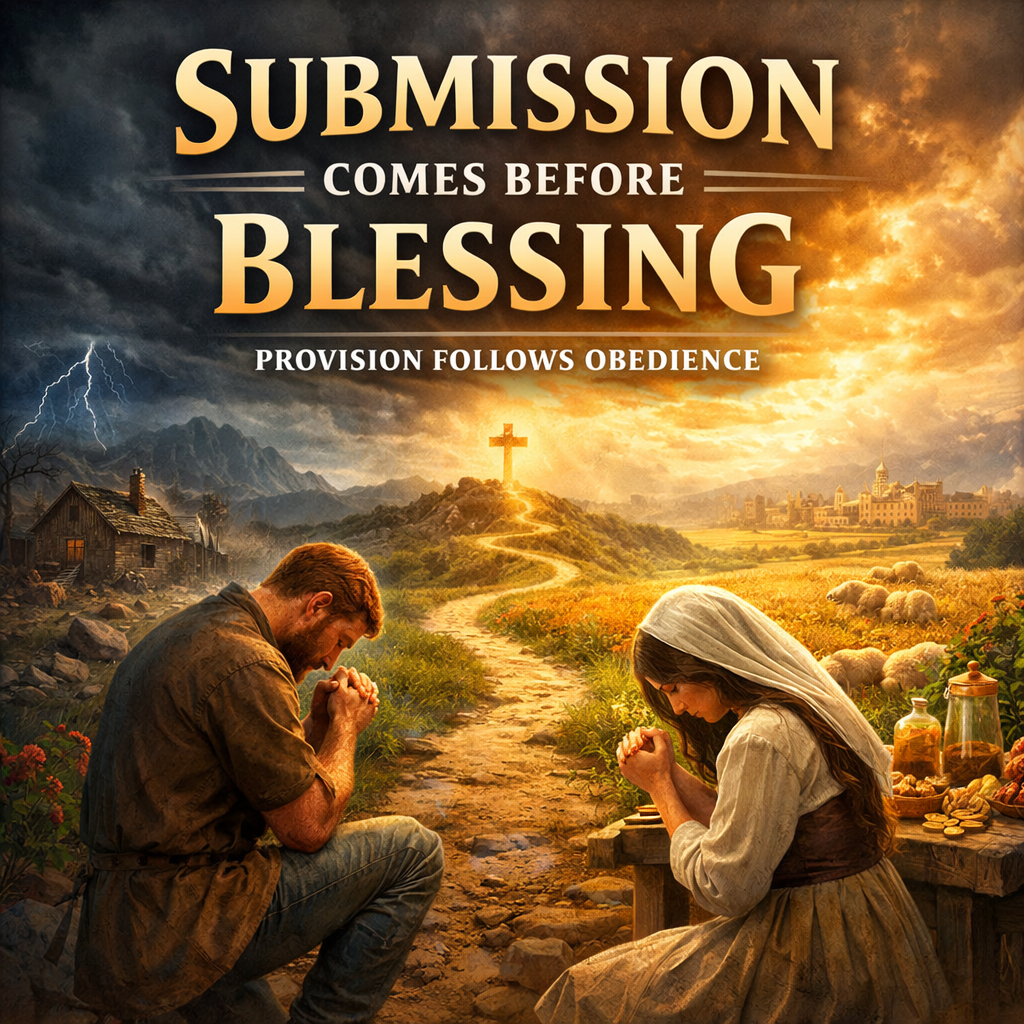
Blessing and Provision Follow Submission and Obedience
Modern man has been trained to invert God’s order. He expects reward before responsibility, provision before obedience, and blessing before submission. Women demand security before alignment, men demand authority before discipline, and churches promise favor without repentance. This inversion has produced a generation that is perpetually frustrated with God, not because He has failed, but because they refuse to meet Him on His terms. Scripture is unambiguous: God establishes order first, demands submission second, and releases blessing third. He does not negotiate with rebellion, nor does He subsidize disorder. Blessing is not bait dangled in front of the disobedient; it is the natural consequence of alignment with divine authority. Those who refuse submission disqualify themselves from provision, then blame God for withholding what He never promised to disobedience.
I: God’s Order Has Never Changed
From the opening lines of Scripture, God does not merely exist – He governs. He speaks, separates, assigns, names, and establishes boundaries. That is not “poetry”, but a blueprint. Creation is the first lesson in authority: order comes before abundance, structure comes before fruit, and obedience comes before rest. God does not begin by giving man a reward; He begins by giving man a world that functions according to hierarchy. Light is separated from darkness, waters from land, day from night. Each thing is placed in its proper sphere and given its proper function. Only after God has established order does He pronounce it “good,” and only after order is complete does He rest. This is the pattern modern men refuse to learn: God does not “bless” chaos into becoming order. He establishes order and blesses what aligns with it. That’s why so many households remain without provision no matter how much they pray. They’re asking God to pour water into a bucket with a hole in the bottom, then they call Him unfaithful when it won’t hold.
Eden itself proves the same truth. Eden was not a lawless paradise where love floated in the air and everyone followed their feelings. Eden was structured. Adam had responsibility. The garden had a command. The command was not oppressive, it was the boundary that kept man inside life. Provision existed in abundance, but it existed inside obedience. When the boundary was crossed, blessing did not “pause”, access was lost entirely. The moment Adam and Eve rejected authority, they did not simply commit a small mistake, they stepped outside the covering of God’s order. They traded alignment for autonomy, and the consequence was not just “punishment.” It was the natural result of disorder: friction entered the relationship, labor became painful, fruitfulness became difficult, and peace was replaced by fear. This is what the modern world doesn’t want to hear: rebellion is not just “sin,” it is self-exile. You can’t demand the fruit of a system while rejecting the structure that produces it.
Follow the thread through the rest of Scripture and it never changes. God does not bless Israel because Israel needs blessing. He blesses Israel when Israel obeys covenant. When they submit, they inherit. When they rebel, they scatter. When they keep His statutes, their land bears fruit. When they reject Him, the heavens become as brass. That is not “Old Testament harshness.” That is divine consistency. The New Testament does not abolish this order, it reveals its fullness. Christ does not come to destroy authority; He comes to embody perfect submission. Even the Son, equal with the Father in nature, submits in function. He obeys, He endures, He humbles Himself. Then (and only then) He is exalted. Exaltation follows submission, glory follows obedience, and inheritance follows alignment. Anyone preaching a gospel where blessing comes first is preaching a gospel that contradicts the life of Christ.
This is where the modern church has committed treason against God’s design. It has taught men and women to treat blessing as an entitlement and obedience as optional. It has framed obedience as “legalism,” discipline as “abuse,” and submission as “dangerous.” Then it stands shocked when families collapse, marriages burn, children despise their parents, and men become passive spectators in their own homes. You cannot remove structure and keep stability. You cannot remove hierarchy and keep peace. You cannot remove submission and keep blessing. God’s order is not a suggestion for the spiritually elite, it is the environment where provision thrives. And provision is not given to those who complain the loudest, cry the hardest, pray the most, or “believe” the most emotionally. Provision is given to those who align, obey, and remain under authority. If your life feels barren, stop accusing God and start examining order. The first question is never “Where is the blessing?” The first question is “Where is the submission and obedience?”
II: Submission Is Alignment, Not Inferiority
Submission has been one of the most deliberately sabotaged words in the modern age, not because it is unclear in Scripture, but because it is intolerable to a culture addicted to autonomy. It has been reframed as weakness, humiliation, loss of identity, or the surrender of dignity, particularly when applied to women and children. This distortion is not accidental. If submission can be made synonymous with inferiority, then rebellion can be sold as virtue. Scripture, however, never treats submission as a statement of worth. It treats it as a matter of alignment. Alignment determines flow. When something is aligned properly, strength passes through it, protection covers it, and purpose is fulfilled. When alignment is broken, nothing flows correctly, no matter how much potential exists. Submission is the act of placing oneself under rightful authority so that life, provision, and stability can move through the structure God designed.
Every functional system operates this way. A soldier does not become less valuable by submitting to command; he becomes effective. A body does not function because every organ asserts independence; it functions because each part operates within its assigned role. A branch does not produce fruit by insisting on autonomy from the vine; it withers. These are not metaphors invented by men, they are the exact images Scripture uses. God repeatedly ties fruitfulness to connection, obedience, and order. Submission is not the erasure of strength; it is the positioning of strength. Misaligned strength is destructive, while aligned strength is productive. This is why rebellion is never neutral, it does not simply remove authority; it removes protection and provision along with it.
The modern hatred of submission is rooted in fear of accountability. To submit is to admit that authority exists above you, that boundaries are real, and that consequences follow disobedience. That reality terrifies a culture trained to worship self-definition. Women are told submission makes them “less,” when in truth it places them under covering. Men are told submission to God limits their freedom, when in reality it anchors their authority. Children are told obedience stunts growth, when in fact it produces discipline and security. Each of these lies serves the same end: the removal of order so that no one can be held accountable. But accountability is the very thing that makes blessing sustainable. God does not pour provision into systems that refuse governance.
This is why so many people experience dryness, frustration, and instability while claiming to honor the Christian faith. They want the fruit of submission without the posture of submission. They want authority without obedience, security without alignment, and provision without order. But God does not operate on emotions; He operates on structure. Alignment determines access. When someone steps outside of order, God does not chase them with blessing to lure them back. He allows them to feel the result of misalignment. That friction is mercy, it exposes what has been rejected and invites repentance without coercion. Blessing resumes when alignment is restored, not because God changed, but because the channel has been reopened.
Submission also clarifies responsibility. When authority is clear, blame evaporates and stewardship becomes possible. A wife aligned under her husband knows where protection comes from. A husband aligned under God knows where judgment begins. A child aligned under parents knows where safety resides. When submission is removed, confusion reigns. Everyone feels wronged, no one feels responsible, and chaos becomes the default. Chaos then demands more resources, more energy, and more crisis management, which further drains provision. This is why rebellion is always expensive. It multiplies loss at every level of life.
Ultimately, submission is not about who is “greater” or “lesser.” It is about whether God’s order is honored or resisted. Scripture never presents submission as optional for those who want blessing. It presents it as the doorway through which blessing enters. Those who refuse submission are not brave or enlightened; they are misaligned. And misalignment always produces scarcity. When submission is restored, dignity is not lost, it is secured. Authority becomes stable, provision becomes sustainable, and peace becomes possible. Alignment is not oppression, but the architecture of blessing.
III: Provision Is Conditional, Not Emotional
One of the most corrosive lies taught in modern Christianity is that God’s provision is primarily a response to emotion, need, desperation, sincerity, or suffering. This lie persists because it feels compassionate, but it quietly detaches blessing from obedience and replaces structure with sentiment. Scripture never presents God as a cosmic provider responding to whoever feels the most pain. It presents Him as a King who governs distribution through order. Mercy exists, yes, but mercy does not cancel structure, and compassion does not erase conditions. God feeds, protects, and prospers according to covenantal alignment, not emotional intensity. When provision is framed as emotional entitlement, rebellion becomes justified and obedience becomes optional. The result is a generation praying loudly while living misaligned, then accusing God of silence when provision does not arrive.
Throughout Scripture, provision is repeatedly tied to obedience, not desire. Rain falls where God sends it, not where it is demanded. Protection is promised within covenant, not outside it. Israel is warned that obedience brings abundance and rebellion brings scarcity. These are not metaphors; they are governance. When the people align, the land yields. When they rebel, the heavens close. Modern believers recoil at this because it sounds transactional, but it is not transactional, it is structural. God is not bargaining with man; He is managing His creation. Provision flows through the channels He established, and when those channels are rejected, supply does not reroute to accommodate rebellion. It stops.
This truth becomes especially offensive when applied to households. Men want authority without responsibility. Women want provision without submission. Children want freedom without obedience. Each demand is emotional, and not structural. God does not respond to these demands because they undermine the very order He designed to sustain life. Provision requires stewardship, stewardship requires authority, and authority requires submission. When that chain is broken, provision becomes unstable or disappears altogether. This is why many households burn through resources at alarming rates. Chaos is inefficient. Disordered homes leak time, money, energy, and peace. No amount of prayer compensates for structural rebellion.
Emotionalism also distorts suffering. Not all hardship is persecution, and not all lack is testing. Sometimes lack is discipline. Sometimes God withholds provision not to punish, but to expose misalignment. Delay is often correction, and silence is often instruction. Modern Christianity treats any withholding as injustice, but Scripture treats it as mercy. God does not subsidize dysfunction. He allows people to feel the weight of their choices until they either repent or harden. Provision given prematurely would only entrench rebellion further. A man who cannot govern his household cannot be trusted with abundance. A woman who resists order cannot be entrusted with covering. A child who rejects discipline cannot be given freedom. This is not harshness, but wisdom.
When provision is understood correctly, obedience stops feeling like a burden and starts feeling like access. Obedience does not earn blessing; it qualifies one to handle it. God’s resources are not infinite in the sense of reckless distribution. They are infinite in supply, but carefully governed in release. Heaven is not chaotic generosity, but ordered abundance. This is why rebellion feels dry even when surrounded by opportunity.
Those who continually ask God for provision while refusing obedience reveal that they want God’s hand, not His authority, and they want benefits without boundaries. Scripture has no category for that posture. God does not bless defiance out of pity, nor does He reward disorder out of sympathy. Provision follows obedience because obedience proves alignment. When alignment is restored, provision becomes natural, sustainable, and multiplying. Emotion may cry out for blessing, but only obedience opens the gate.
IV: The Household Is the Testing Ground
God does not test submission in theory; He tests it in the household. The home is where authority is either exercised or abdicated, where obedience is either trained or neglected, and where blessing is either invited or obstructed. This is why Scripture places such enormous weight on household order. The household is the smallest unit of dominion, the first jurisdiction entrusted to man, and the proving ground for stewardship. When order collapses in the home, it does not remain private. Disorder multiplies outward, into churches, communities, and nations. Conversely, when the household is aligned under God’s structure, peace stabilizes, provision multiplies, and authority becomes generational. God does not pour favor into homes ruled by emotion, negotiation, or rebellion. He governs households the same way He governs creation: through His established order.
Disordered households do not lack effort or intention; they lack leadership. Passive men are one of the primary reasons blessing is delayed or withheld. When a man refuses to lead decisively under God, he creates a vacuum. That vacuum is always filled, by emotion, manipulation, resentment, or chaos. A man who will not establish boundaries forces his household to operate without structure, then wonders why peace is elusive and provision feels strained. Authority cannot function where leadership is absent and God does not bypass the head of the household to compensate for his passivity. He holds him accountable. Leadership abdicated is blessing blocked!
Undisciplined women further strain provision by resisting alignment. This is not about cruelty or suppression; it is about order. A woman who refuses submission does not become independent, she becomes uncovered. Covering is not mystical; it is practical. It is protection, provision, and peace flowing through established authority. When submission is resisted, friction enters the system, and friction always consumes resources. Conflict drains energy, emotional volatility destabilizes decision-making, and over time, the household becomes inefficient and costly. Chaos demands constant management, and constant management leaves no margin for growth. God does not reward resistance with abundance, He simply allows resistance to reveal its own cost.
Children also play a role in the household’s condition. Rebellious children are not merely “expressing themselves”; they are consuming peace and resources at an unsustainable rate. Discipline is not punishment, but preservation. When children are not trained to submit to authority early, they become liabilities later. A home ruled by undisciplined children cannot be a home of peace, no matter how loving the parents claim to be. Love without order produces entitlement, not security. God’s design is clear: obedience in children produces stability in the household, which invites blessing.
Many families respond to household dysfunction by chasing external solutions, more income, more therapy, more programs, more prayer meetings, but none of these can compensate for structural rebellion. Money cannot buy order, therapy cannot replace authority, and prayer cannot override disobedience. God addresses households at the level of alignment, not activity. When roles are confused, authority is undermined, and submission is negotiated, blessing stalls. This is not because God is distant, but because the household is misaligned.
When a household is ordered, when a man leads under God, a woman aligns willingly, and children obey consistently, the environment changes. Peace increases, resources stretch further, decision-making becomes clearer, and conflict decreases. Provision then becomes stable because it is no longer leaking through disorder. This is not prosperity gospel; it is governance. God blesses households that reflect His order because they are capable of stewarding what He provides. The household is the testing ground because it reveals whether submission is real or merely a facade. Alignment in the home is not optional, it is the gateway through which blessing enters the home.
V: Blessing Follows, It Never Leads
The final error modern believers make is believing that blessing is meant to lead them into obedience rather than follow it. This inversion sits at the heart of entitlement theology and explains why so many people remain perpetually dissatisfied with God. They are waiting for provision as motivation, security as persuasion, and favor as proof, while God is waiting for alignment. Scripture never presents blessing as bait. God does not dangle provision in front of rebellion in hopes that people will eventually comply. He establishes His order, commands submission, and releases blessing in response to obedience. Anything else would reward disorder and undermine His authority. Blessing that leads obedience produces dependence, not faithfulness, while blessing that follows obedience produces stewardship.
This is why delay is often misunderstood. When blessing does not arrive, modern Christians interpret it as abandonment, injustice, or failure. Scripture presents it differently. Delay is frequently discipline, and silence is often correction. God withholds not because He is unwilling, but because alignment has not occurred. He does not rush to relieve pressure that is meant to produce repentance. Pressure reveals his posture. Those who submit under pressure emerge aligned. Those who rebel under pressure expose their true allegiance, and God does not remove that pressure prematurely, because doing so would validate rebellion.
This principle exposes a dangerous posture in modern faith: the demand for proof. Many refuse to submit until God “shows up.” They withhold obedience as leverage, expecting blessing to justify compliance. This posture treats God as a negotiator rather than a King. Scripture offers no examples of God responding to ultimatums. Those who demand proof before submission are not exercising faith; they are testing authority. Faith submits first and trusts God to respond rightly. Rebellion demands response first and withholds submission until satisfied. Only one of these postures is honored and rewarded.
Understanding that blessing follows obedience also clarifies suffering. Not all suffering is a sign of disobedience, but all obedience is tested. The difference is posture. The obedient endure suffering without rebellion. The rebellious endure suffering with accusation. God responds differently to each. Obedience under trial refines and prepares a person for greater blessing. Rebellion under trial disqualifies them from it. This is why Scripture repeatedly ties endurance to inheritance. Those who remain aligned prove themselves trustworthy, and blessing follows trustworthiness, not desperation.
This truth applies universally, to individuals, households, churches, and nations. Systems that reward rebellion collapse. Systems that honor order endure. God’s governance does not change based on modern sensibilities or emotional appeals. He remains consistent because consistency is what sustains creation. Blessing that leads obedience would create chaos, but blessing that follows obedience creates stability.
The final and unavoidable reality is this: submission is not the price paid for blessing, it is the evidence that blessing can be handled. God is not stingy; He is precise. He does not bless intentions, feelings, or demands, He blesses alignment. Those who submit find peace, provision, and protection not because they earned them, but because they positioned themselves to receive them. Those who refuse submission find friction, scarcity, and frustration not because God is cruel, but because disorder always consumes itself. God’s order stands, whether men accept it or not.
May God’s Great Order be restored!
This is true.
This in not 1950