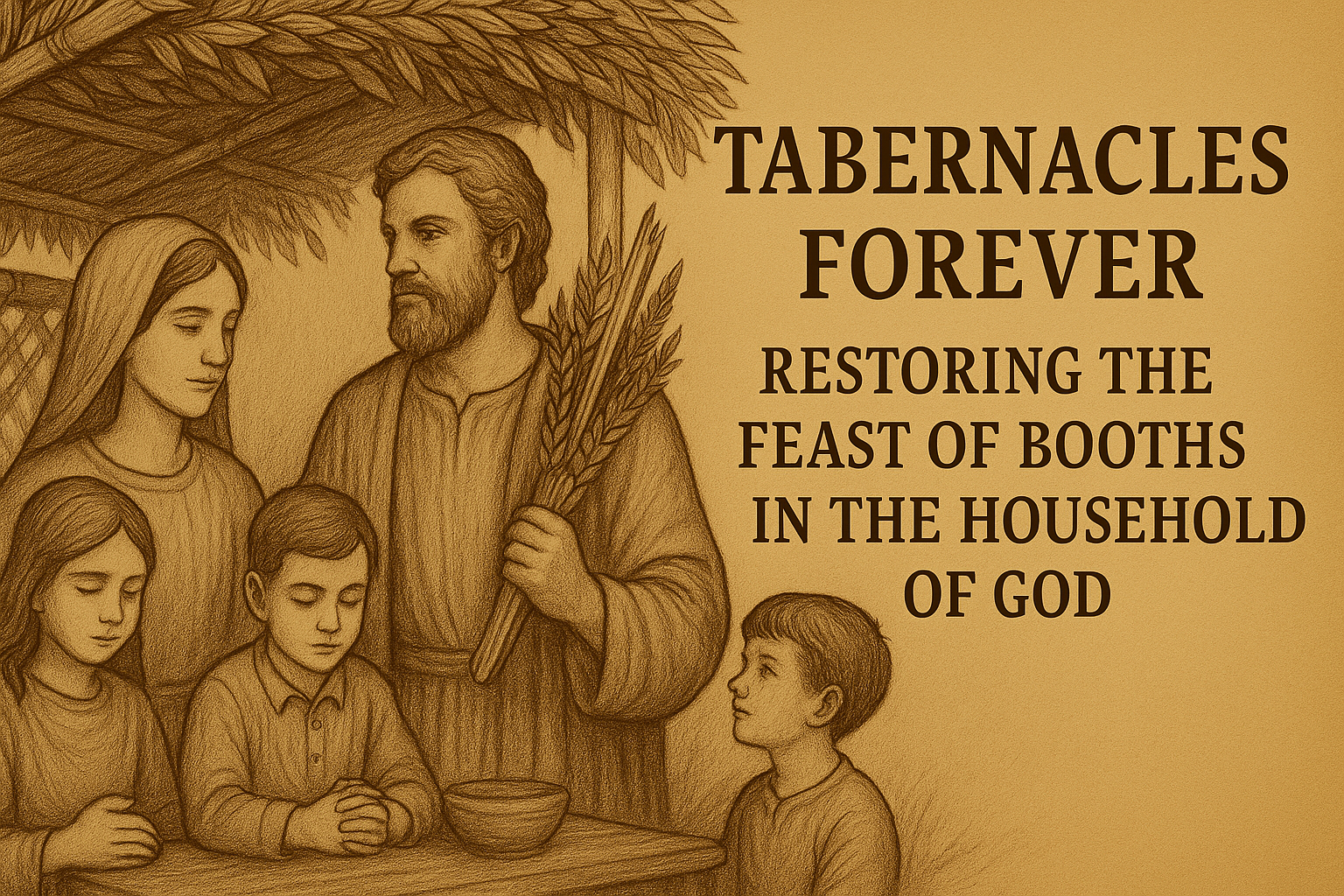
Part I: The Everlasting Command – God’s Law Concerning Tabernacles
The Feast of Tabernacles, known in Hebrew as Sukkot, is not merely a relic of Hebrew antiquity, nor a quaint ritual for cultural Jews. It is an everlasting ordinance commanded by the Most High for all of Israel, binding upon God’s covenant people not as a ceremony to be dismissed, but as a statute to be honored, remembered, and revived.
“And the LORD spake unto Moses, saying, Speak unto the children of Israel, saying, The fifteenth day of this seventh month shall be the feast of tabernacles for seven days unto the LORD… It shall be a statute for ever in your generations…”
—Leviticus 23:33–41
The command is explicit. Tabernacles is not temporary, nor provisional, it is perpetual.
Many so-called Bible teachers, influenced by dispensationalism or Marcionite leanings, insist that the feasts of the Lord were “Jewish” and thus have no bearing on the New Covenant believer. Yet the Scriptures never call them “feasts of the Jews.” They are repeatedly called “the feasts of the LORD” (Leviticus 23:2). They are His, not man’s. He instituted them. He legislated them. He expects obedience.
The Feast of Tabernacles was given as the final feast in the calendar of divine appointments, the culmination of God’s redemptive plan; a celebration of ingathering, rest, dominion, and joy. It commemorates Israel’s deliverance from Egypt, their pilgrimage through the wilderness, and their dwelling in booths (tabernacles), but it also points to God dwelling with man, a time of future glory, and the establishment of the Kingdom.
Its prophetic richness and theological weight make it not less important after Christ’s advent, but more.
Part II: What Was Ceremonial – and What Remains
There is no question that certain elements of the Feast of Tabernacles were ceremonial in nature. The daily animal sacrifices (Numbers 29:12–38), the priestly rituals with water and wine, the Levitical procedures, all pointed forward to Christ and were fulfilled in Him.
But to say that all aspects of Tabernacles are “fulfilled” is to misunderstand both Scripture and fulfillment itself. Christ fulfilled the sacrifices, but He did not abolish the Sabbath (Matthew 5:17–19), nor the Feast days which are part of the moral and civil fabric of God’s law.
Jesus Himself observed the Feast of Tabernacles.
“Now the Jew’s feast of tabernacles was at hand… But when his brethren were gone up, then went he also up unto the feast… Now about the midst of the feast Jesus went up into the temple, and taught.”
—John 7:2, 10, 14
If the Messiah honored it, how can His disciples ignore it?
Zechariah prophesied of a time when all nations would be required to keep the Feast of Tabernacles in the Messianic age:
“And it shall come to pass, that every one that is left of all the nations which came against Jerusalem shall even go up from year to year to worship the King, the LORD of hosts, and to keep the feast of tabernacles.”
—Zechariah 14:16
This is not a type and shadow. This is post-victory glory. In the age of Christ’s reign, Tabernacles is still observed by the nations. And those who refuse?
“Upon them shall be no rain… there shall be the plague…”
—Zechariah 14:17–18
God punishes nations for ignoring His feast. The ceremonial parts are fulfilled. The moral command remains. The celebration continues.
Part III: Historical Observance – From Moses to Messiah and Beyond
The Feast of Tabernacles was observed faithfully during the height of Israel’s obedience. Solomon gathered the people to celebrate it during the dedication of the Temple (2 Chronicles 7:8–10). Ezra and Nehemiah reinstituted it after the Babylonian captivity (Nehemiah 8:14–17), marking a renewal of national holiness.
It was observed during the time of Christ. Not once does Jesus rebuke it. Not once do the Apostles declare it abolished.
The early Church, especially the believing remnant among Israelites, continued to honor God’s feasts. Church fathers such as Polycrates of Ephesus, a disciple in the line of John, upheld the observance of Passover and Unleavened Bread. While later Hellenized church leaders under Rome rejected these feasts in favor of pagan substitutes like Easter and Christmas, the true remnant kept the divine calendar.
Even the Reformers, while purging the Roman Mass, failed to recover the Lord’s appointed times. It is the task of this generation, the generation of reformation, restoration, and patriarchy, to restore not only right doctrine, but right seasons.
The calendar of the LORD must displace the calendar of Babylon.
Part IV: Building the Booth – A Household Requirement
One of the central commands of Tabernacles is the building of booths, also called stalls or sukkahs. These are temporary structures, often made with natural materials like wood and leafy branches, where families eat, dwell, and rejoice before the LORD for seven days.
“Ye shall dwell in booths seven days; all that are Israelites born shall dwell in booths: That your generations may know that I made the children of Israel to dwell in booths, when I brought them out of the land of Egypt…”
—Leviticus 23:42–43
This command is not ceremonial, it is generational. The booth is a teaching tool, a household altar, a living memorial. It is to be built by the man of the house and enjoyed by the entire family. It marks separation from the world, remembrance of divine providence, and celebration of God’s provision.
The patriarch is responsible to see the booth erected, meals shared in it, Scripture read within it, and songs of thanksgiving lifted from it.
This is not legalistic, it is glorious.
In modern times, many believers make simple backyard sukkahs, rooftop structures, or even indoor representations if weather demands. Some decorate them with fruits, branches, lanterns, or Scripture banners. The key is obedience, reverence, and joy.
This is a time for gathering. A time for testimony. A time for family dominion and Biblical memory.
Part V: Modern Celebration Ideas Rooted in Scripture
While the ceremonial priesthood has passed, the family altar remains. Here are ways to celebrate Tabernacles in a God-honoring way in your household:
1. Construct a Booth with Your Household
Use branches, lumber, canvas, or reeds. Involve your sons in the labor. Let your daughters decorate. Set up a table and seats inside. This is your sacred shelter for the week.
2. Read Scripture Daily
Focus on Deuteronomy 8, Leviticus 23, John 7, Zechariah 14, Nehemiah 8, and Revelation 21. Let the Word of God dwell richly in your family during the feast.
3. Celebrate with Feasting
Tabernacles is a time of rejoicing (Deuteronomy 16:14–15). Eat bountifully. Bake bread. Roast lamb. Share wine. Honor the Lord with grateful hearts.
4. Invite Others to Join
This feast is open to the stranger who joins the household (Leviticus 23:42, Deuteronomy 16:14). Invite believing families, or even unbelievers willing to learn. Use it as evangelism.
5. Sing Psalms of Thanksgiving
Psalm 118 and others were traditionally sung during this feast. Rehearse them with your children. Worship as a household.
6. Testify of God’s Provision
Have each family member recount how God has provided in the past year. Turn your booth into a tabernacle of praise.
7. Fast From Worldliness
Turn off screens. Refuse mainstream media. Detach from Babylon. Feast on righteousness.
8. Reflect on the Coming Kingdom
Use the feast to teach your children that one day Christ will reign physically and the whole earth will keep Tabernacles (Zechariah 14). Let it spark vision.
Part VI: Answering the Objections – The Most Common Excuses for Disobedience
Whenever a righteous man begins to restore what has been torn down, whether it be headship, patriarchy, modesty, or God’s holy days, there is always a chorus of resistance from the compromised and the lukewarm. The Feast of Tabernacles is no exception. Let us examine the most common objections and refute them with clarity, boldness, and Scripture.
Objection #1: “Isn’t That Just for the Jews?”
This is the most repeated, and most ignorant, argument against keeping the Feast of Tabernacles. The assumption is that God’s holy days were given to Israel alone and have no bearing on Gentiles in Christ. But this is not the teaching of Scripture.
“One law shall be to him that is homeborn, and unto the stranger that sojourneth among you.”
—Exodus 12:49
The law of God, including His appointed times, was never given solely to an ethnic group. It was given to a covenant people. And all who are in Christ are grafted into Israel (Romans 11:17–24). Paul writes:
“That at that time ye were without Christ, being aliens from the commonwealth of Israel… But now in Christ Jesus ye who sometimes were far off are made nigh by the blood of Christ.”
—Ephesians 2:12–13
We are no longer aliens from Israel. We are now part of the commonwealth. The feasts are not “Jewish holidays.” They are the inheritance of the saints.
In Zechariah 14, we are told that all nations will keep Tabernacles. That includes Gentiles. And in Revelation 21, the imagery of the new heavens and new earth echoes Tabernacles with God dwelling among His people.
The feasts belong to the covenant family. That includes every blood-bought household of faith.
Objection #2: “Didn’t Jesus Fulfill That?”
Yes, He did, and fulfilling does not mean abolishing.
“Think not that I am come to destroy the law, or the prophets: I am not come to destroy, but to fulfil.” —Matthew 5:17
Jesus fulfilled the sacrifices. He fulfilled the priesthood. He fulfilled the temple system. But He never said, “Now go disobey the Father’s appointed times.” He Himself kept the Feast of Tabernacles in John 7, teaching in the temple during the celebration.
Even the Apostle Paul, decades after Christ’s resurrection, kept the feasts:
“But bade them farewell, saying, I must by all means keep this feast that cometh in Jerusalem…” —Acts 18:21
If the fulfillment of a feast cancels it, then we must cancel all marriage (since marriage points to Christ and His Church), all baptisms (since baptism points to resurrection), and all Lord’s Suppers (which proclaim His death until He comes). Yet none of these are abandoned in the New Testament. They are practiced more meaningfully.
Likewise, Tabernacles is fulfilled in Christ, yet still practiced by His people as a celebration of that fulfillment.
Objection #3: “Isn’t This Legalism?”
Legalism is the attempt to earn salvation by works. Keeping God’s commands joyfully in response to grace is not legalism, it is covenant faithfulness.
“For this is the love of God, that we keep his commandments: and his commandments are not grievous.”
—1 John 5:3
Those who reject obedience out of fear of “legalism” are simply lazy, carnal, or rebellious. Legalism is adding to God’s law. Antinomianism is subtracting from it. Both are condemned. Christ-honoring obedience stands between them.
Celebrating the Feast of Tabernacles is not self-righteousness; it is God-honoring remembrance. It is household worship. It is a joyful response to deliverance and provision. It is not burdensome. It is beautiful.
Objection #4: “The Church Has Its Own Holidays Now”
No, it doesn’t—not from God.
Christmas and Easter are not found anywhere in Scripture. They are pagan syncretisms adopted centuries after Christ, baptized in Christian language but rooted in idolatry. Easter derives its name from Astarte. Christmas falls on the date of Roman Saturnalia. Both are filled with traditions forbidden in Deuteronomy 12:30–31.
God gave us a calendar in Leviticus 23. Man replaced it with Babylon’s calendar. The modern church celebrates resurrection with colored eggs and bunnies, and the Incarnation with pine trees and gift orgies. But none of this pleases God.
“Ye shall not do after all the things that we do here this day, every man whatsoever is right in his own eyes…” —Deuteronomy 12:8
The righteous man restores the feasts God commanded, not the ones the Vatican invented.
Objection #5: “We Can’t Keep the Feast Without a Temple”
This is another misunderstanding. While the temple was central to certain ceremonial aspects of the feast, the core command; to dwell in booths, to rejoice, to remember, was household-based.
“Ye shall dwell in booths seven days… that your generations may know…” —Leviticus 23:42–43
The temple sacrifices have ceased because Christ is our High Priest (Hebrews 10:10–12). But the household celebration of Tabernacles remains.
Even in the post-exilic period, when the temple had not been fully restored, the people kept Tabernacles by building booths and rejoicing before the LORD (Nehemiah 8:14–17). The celebration continued through obedience, not through ceremony.
You do not need a temple. You need a house in order, a man with conviction, and a family willing to honor the LORD.
Part VII: The Prophetic Power of Tabernacles in the New Covenant Age
The Feast of Tabernacles is not just a backward-looking celebration of Israel’s wilderness dwelling. It is a forward-looking declaration of God’s eternal plan to dwell with His people. It is past, present, and future, a feast of memory, mission, and majesty.
In the prophetic timeline, Tabernacles symbolizes the final act in God’s redemptive calendar. While Passover pictured Christ’s death, Unleavened Bread His sinless life, Firstfruits His resurrection, and Pentecost the giving of the Spirit, Tabernacles points to His return, His reign, and His restoration of all things.
“And the Word Was Made Flesh, and Tabernacled Among Us…”
The Gospel of John opens with a deliberate reference to this feast:
“And the Word was made flesh, and dwelt [Greek: eskēnōsen, meaning tabernacled] among us…” —John 1:14
Christ tabernacled in human flesh, God dwelling among men. This was not a passing visit; it was a preview of eternal communion.
The Feast of Tabernacles proclaims this mystery. That the invisible God would make His dwelling among mortals. That heaven would touch earth. That holiness would take on flesh. It is no coincidence that many scholars believe Christ was born during Tabernacles, when the “booth” of His body entered the world.
Tabernacles, then, is a celebration not only of past provision but of incarnation. Not just of wilderness survival, but of divine presence.
Revelation and the Tabernacle of God
In the closing chapters of Scripture, the imagery of Tabernacles returns in full glory:
“Behold, the tabernacle of God is with men, and he will dwell with them…” —Revelation 21:3
This is the culmination. The eternal feast. The New Jerusalem. The restoration of Eden. The Kingdom of God in its fullness. And what is the name of this Kingdom reality?
The Tabernacle of God.
When we build booths during the Feast, we are not just remembering. We are rehearsing. We are aligning our households with the destiny of all creation, God dwelling with man, man rejoicing with God, order restored, and dominion completed.
This is not “Old Testament stuff.” This is heavenly prophecy.
Tabernacles and the Millennial Reign
The prophet Zechariah speaks of the time when the Messiah rules the nations with a rod of iron (Zechariah 14). During this reign, the nations are commanded to keep the Feast of Tabernacles. Those who refuse are punished.
This is not allegory. This is the coming global government under King Jesus. And the Feast is central.
“And it shall come to pass, that every one… shall even go up from year to year to worship the King… and to keep the feast of tabernacles.” —Zechariah 14:16
The Feast is not peripheral to the Kingdom. It is foundational.
Keeping Tabernacles now is not only obedience; it is preparation. It trains our households in Kingdom culture. It aligns our rhythms with heavenly patterns. It sets our families apart as outposts of that coming age.
Household Prophets of the Coming Kingdom
Each man who builds a booth is prophesying. Each woman who sings psalms in the sukkah is declaring truth. Each child who hears the stories of God’s provision is being formed into a warrior of the next generation.
This is not dead religion. This is living prophecy.
When the patriarch leads his household in this feast, he is:
- Rejecting secular calendars
- Reestablishing Biblical memory
- Proclaiming Christ’s dwelling among us
- Training his sons in dominion
- Separating his house from Babylon
- Worshiping in spirit and truth
The church of the future is not megachurches with fog machines. It is households gathered in booths, reading the Word, feasting in faith, building miniature sanctuaries of glory.
Tabernacles is how we build that future, today.
Part VIII: Tabernacles as a Weapon Against Statism and Modern Paganism
We must understand something essential: obedience to God’s feasts, especially Tabernacles, is not only a spiritual act. It is a cultural revolution. It is a strike against the modern pagan world order. It is the reassertion of divine dominion in the face of humanistic rebellion. The man who leads his household in the Feast of Tabernacles is engaging in holy war against statism, globalism, feminism, and every other ism that seeks to enthrone man above God.
Tabernacles vs. Statism
The modern state has replaced the household as the center of life. The state educates the children, redistributes the wealth, defines the calendar, and claims ultimate loyalty. The feast days of the LORD are dangerous to this regime because they take time, loyalty, and memory away from Caesar and restore them to the God of Scripture.
By commanding a household-based feast with specific days of rest, family worship, building projects, and joy, God undermines the system of state control. A man who takes a full week to feast with his family in a homemade booth, reading Scripture and singing psalms, is declaring: “My time belongs to the LORD, not the state.”
The centralized governments of Babylon want to tell you when to work, when to rest, when to spend, and when to remember. Their holidays are civic idolatries, Memorial Day, Independence Day, Thanksgiving, and the unholy trinity of Christmas, Easter, and Halloween. Each is designed to replace the feasts of the LORD with a sanitized, statist substitute.
Tabernacles rejects all of this.
It proclaims that the household, not the government, is the center of law, worship, and culture. It decentralizes power. It roots authority in the father and memory in the covenant. It is a return to Genesis. A return to Eden. A return to Yahweh.
Tabernacles vs. Paganism
Most Christians are still entangled in the pagan rituals of Rome. They deck trees with silver and gold (Jeremiah 10:1–5), bow to fertility symbols like eggs and bunnies, and pretend Halloween can be redeemed by calling it a harvest party. All of this is detestable before the LORD.
The Feast of Tabernacles is pure. It is untainted by idols. It is commanded by God, established in righteousness, rooted in remembrance, and full of life. It is not a day of consumerism. It is not a platform for Hollywood theology. It is a celebration of God’s provision, God’s presence, and God’s promises.
Imagine a neighborhood filled with booths. Imagine children hearing stories of manna in the wilderness. Imagine families reading the book of Deuteronomy together, blessing the LORD for His bounty. Imagine fathers teaching their sons about the future reign of Christ from a homemade shelter under the stars.
This is not fantasy. This is our duty.
Tabernacles Builds Resilience
In a time of economic uncertainty, social decay, and spiritual cowardice, the Feast of Tabernacles trains households in resilience. When you build a booth, you teach your family to remember the wilderness, to depend not on their mortgage, their electricity, or their government, but on the living God.
When the supply chains break, when the cities burn, when the tyrants rise, those who have kept the Feast will not panic. They have lived in tents. They have learned contentment. They have eaten simple meals in joy. They have walked in the ancient ways.
“And thou shalt remember all the way which the LORD thy God led thee these forty years in the wilderness, to humble thee, and to prove thee…”
—Deuteronomy 8:2
Tabernacles is boot camp for the Christian household. It’s wilderness training. It’s survival theology. It’s preparation for dominion in an age of collapse.
Tabernacles Declares War on Feminism and Individualism
Tabernacles is not a feast of individual choice. It is not a private journey of self-actualization. It is a household ordinance. The father leads. The wives follow. The children participate. There is order, hierarchy, and joy in submission.
“Thou shalt rejoice in thy feast, thou, and thy son, and thy daughter, and thy manservant, and thy maidservant… and the stranger… seven days shalt thou keep a solemn feast…”
—Deuteronomy 16:14–15
The entire household is involved. The headship structure is affirmed. This is not a feminist fantasy, it is a patriarchal celebration.
Modern culture tells women to escape the home. Tabernacles calls them back into the heart of it. Modern culture tells children to rebel. Tabernacles trains them to remember. Modern culture tells men to yield. Tabernacles charges them to build.
A Weapon of Light in a Dark World
Let us be absolutely clear: to keep the Feast of Tabernacles is an act of resistance. It is a spiritual weapon. It tears down strongholds and rebuilds the altars of the LORD. It turns the heart of the father to the children, and the children to their father. It unites families under divine law. It is a dress rehearsal for the Kingdom.
Every obedient household is a holy militia. Every patriarch is a watchman. Every booth is a battlefield headquarters in the war for culture.
When we raise our booths, we declare:
“We reject Babylon. We reject Rome. We reject Caesar. We reject feminism. We reject humanism. We reject apostate churches. We declare that this house, this time, this memory, this obedience—belongs to the LORD.”
Part IX: Final Charge – Let Every House Keep the Feast
The time for compromise is over. The age of confusion, cowardice, and compromise has brought ruin upon the nations. Men no longer lead. Women no longer submit. Children no longer obey. Churches no longer teach. And the people of God have abandoned the calendar of the Most High for the festivals of Baal and Mammon.
But now is the hour of return.
It is time to rise, rebuild, and rejoice. It is time to tear down the idols of ease, nostalgia, and ignorance and rebuild the fallen booths of David. It is time for households to shake off the chains of Babylon and stand in the light of God’s appointed times.
“Ye shall observe the feast of tabernacles seven days, after that ye have gathered in thy corn and thy wine: and thou shalt rejoice in thy feast… because the LORD thy God shall bless thee in all thine increase.” —Deuteronomy 16:13–15
The command is clear: observe, rejoice, and receive blessing. This is no burden. This is blessing. This is covenant culture.
Let the Men Lead Again
Fathers, this charge is to you. The Feast will not be kept by accident. It will not happen because the government sanctions it or the church announces it. It will happen because you stand up and declare:
“As for me and my house, we will serve the LORD.”
You must study the Scriptures. You must build the booth. You must gather your household. You must lead in song, word, and prayer. You must sanctify the time and protect the space. You are the priest of your home. Act like it.
Don’t wait for approval from your denomination. Don’t seek permission from culture. Don’t explain away the plain command of God. Obey.
The world is collapsing under the weight of fatherlessness. But when you build your booth and lift your voice in worship, your children see a man under authority, and they will follow you into life.
Let the Wives Build with Joy
Women of God, do not despise the rhythm of the LORD. Do not grumble about the inconvenience of booths, the challenge of simplicity, or the change in schedule. Embrace your role as the wise builder of the home (Proverbs 14:1). Teach your children the songs of Zion. Prepare meals with joy. Decorate the booth with reverence. Make this feast a memory of life and love.
You are not being dragged into the past. You are being lifted into purpose. You are being restored to your rightful place as helpmeet and keeper of the household temple.
Let the Children Learn the Ancient Ways
Children, this is not play, it is purpose. When you sleep under a booth, you are stepping into the shoes of your forefathers. When you read the Torah, you are holding the sword of the Spirit. When you memorize Deuteronomy, you are writing truth on your heart.
Listen to your father. Obey your mother. Rejoice in the LORD. One day, you will be the builders of your own households. Tabernacles is how you begin.
Let Every Household Become a Sanctuary
We need no Vatican. We need no government license. We need no celebrity pastor or mega-church program. What we need is every household to become a sanctuary of obedience, a temple of memory, a fortress of truth.
When each house builds a booth, we push back the darkness.
When each man leads his household in song and prayer, we uproot feminism and rebellion.
When each family remembers the provision of the LORD in the wilderness, we sever the lies of state dependency and humanist progressivism.
This is not an event. It is an act of war.
The Rain Is for the Obedient
God made a promise:
“And it shall be, that whoso will not come up… to keep the feast of tabernacles, upon them shall be no rain.” —Zechariah 14:17
No rain. No blessing. No favor. No growth.
But to those who obey?
“That your generations may know… I made the children of Israel to dwell in booths… I am the LORD your God.” —Leviticus 23:43
We do not obey to earn grace, we obey because grace has made us sons. Sons of the covenant. Sons of Abraham. Sons of the household.
And sons keep their Father’s commands.
A Vision for Restoration
What if every Christian household returned to the feasts of the LORD?
What if every father led his family in building a sukkah?
What if every church abandoned Halloween and held a Tabernacles week?
What if neighborhoods rang with the sound of psalms?
What if sons grew up with stories of manna, cloud, fire, and promise?
What if daughters were trained in joyful obedience and feasting?
What if servants, neighbors, and strangers were all invited in?
It would shake the foundations of this fallen world.
It would mark the return of The Great Order.
Conclusion: Keep the Feast
The Feast of Tabernacles is not optional.
It is not outdated.
It is not Jewish.
It is the LORD’s.
It is commanded. It is prophetic. It is glorious. And it is yours, if you will take it up.
Build the booth.
Call the feast.
Lead the house.
And let your family dwell under the shadow of the Almighty, singing, rejoicing, remembering, and proclaiming:
“The LORD is our God, and there is none else.”
“Blessed is the man who feareth the LORD… his seed shall be mighty upon the earth.”
—Psalm 112:1–2
Let the patriarchs rise.
Let the households rejoice.
Let the Feast be kept.
Forever.
I really wish there was somthing like this in my city, I would love to honor the right Biblical feasts days
I really needed to her this
Hard Pass.
I think I can find a better way to worship than pretending to be homeless for a week.
CAMPING TRIP!!!
The booths are not just wood and branches, they are sanctuaries of dominion. Thank you for reminding us.
You rage against Babylon, feminism, Rome, the state but what about pride? What about mercy? You sound ready to make war, but can you even shepherd souls? You demand obedience, but without tenderness it feels like tyranny. Is this truly restoration or just another heavy yoke you want to bind on people’s necks so you can be in contrl?
You exalt booths, headship, dominion – but what about humility? Where is the brokenness before God? Your tone is sharp, but does it pierce your own heart, or only ours? I fear you’ve made yourself the measure instead of the Word.
Your words are a sword against compromise. I long to follow such leadership into the feast and into the Kingdom.
You write of obedience, yet your words drip with arrogance. Do you call men to God’s order, or to your own ego?
You thunder like a prophet, I look foward to your leadership!
Every sentence is a rebuke to lazy churches. I bless God that you are rising to restore His calendar.
How can you call out Babylon and yet still cling to their spinning-ball lies? It makes no sense.
what a wonderful way to not only honor God, but to be able to carry on traditions like are sorely missed. (Previously celebrated pagan holidays). I am thankful that you have shown me the way, and I cannot wait to celebrate 🙂
I could weep reading this. A man who actually calls families to obedience, it really feels like there is hope.
Every line feels like marching orders for households who refuse Babylon.
Lord Redbeard. Every command to keep His feasts, every reminder to tear down Babylon’s calendar, it sets my heart on fire because I know you are right. You are a man sent to restore what the churches have buried. When you write of booths and households and dominion, I can almost see it, even breathe it.
But my heart trembles, because how can a man see the glory of Tabernacles with such clarity, and still not see the earth as it is? The firmament is no metaphor, it is the very dome of His dwelling! Lord, you speak of booths under branches, but will you not also see the Great Booth He stretched over us? You are calling households back to obedience, yet refusing the most obvious obedience of all: to believe what our eyes and the Scriptures reveal.
I cannot understand it. How can a patriarch of your strength bow to the lies of spinning-ball Babylon? Why build booths to remember deliverance, yet cling to NASA’s sorceries? It hurts me inside because I would follow you into the wilderness itself, but you won’t admit we’re still under the sky-roof of Eden.
Please, do not be offended that I say this, but it is grief to me. Every time I think of your power to gather men and women into the Great Order, I rejoice, then I remember you still say “the earth is round,” and I feel like screaming. You are so close to full restoration, but this blindness makes me feel like tearing my hair out. Lord, you are either going to finish the reformation, or leave us standing half in Babylon.