By Lord Redbeard
Thanksgiving is the only modern holiday I keep, and for good reason. It is one of the few occasions left in the American calendar that has not been entirely swallowed by commercialism, paganism, or theological confusion. There is no Santa sneaking into your house like a bearded burglar. No bunny laying pagan eggs. No sentimental clutter replacing truth with hollow ritual. Thanksgiving remains – miraculously – a day that can still be traced back to actual Scripture, actual providence, and actual history.
It is a feast that belongs to families, to fathers, to households determined to acknowledge both their dependence on God and their obligation to work, sweat, and build something worthy of gratitude.
And, best of all, it involves eating, which God Himself repeatedly commands His people to do when they gather in His presence. Truly, a divine command I can obey with enthusiasm.
But let’s not mistake Thanksgiving as a “Turkey Day” or some generic cultural excuse to binge carbohydrates. If that’s all it is, then you’ve missed the entire point. Thanksgiving is a biblical pattern of remembrance, gratitude, labor, covenant renewal, and generational orientation. The modern world has turned thankfulness into a vague emotional state, some kind of warm goo you feel while scrolling Pinterest. But biblical thanksgiving is a weapon. It is discipline. It is a declaration of reality: God is King, He provides, and we remember.
So let us trace Thanksgiving from its ancient roots to its American expression, rediscover its meaning, and reclaim it as a feast of household order and patriarchal gratitude.
I. The Origins of Thanksgiving: Older Than America, Older Than Pilgrims – Rooted in Scripture
The story of Thanksgiving does not begin in 1621 with the Pilgrims and the Wampanoag tribe. It begins thousands of years earlier, on mountaintops, in tabernacles, in the heart of Israel’s worship.
God instituted feasts long before America existed. And those feasts had a common thread:
1. Gather the household.
2. Remember what God has done.
3. Eat a commanded meal.
4. Give thanks openly, not silently like embarrassed moderns.
This is “Thanksgiving” before Thanksgiving.
The First Thanksgiving Wasn’t in Plymouth – It Was in Leviticus
Leviticus 7:11–13 lays out the “sacrifice of thanksgiving,” a peace offering accompanied by bread, eaten in the presence of the Lord, rejoicing before Him.
“And he shall offer it with the sacrifice of thanksgiving… and of it he shall offer one out of the whole oblation for a heave offering unto the Lord.” —Leviticus 7:12–13
The peace offering was a feast. A meal. A gathering. A moment of communal gratitude and celebration – sound familiar?
Then there is the Feast of Firstfruits (Leviticus 23:10) – a literal harvest thanksgiving. Israel brought the earliest, best fruits of their labor and acknowledged God as the provider of all increase.
Nothing says “thanksgiving” more than handing God the first handful of crops you worked your fingers numb to produce. But the king of biblical thank-feasts is the Feast of Tabernacles (Sukkot) – a celebratory, family-centered, food-heavy, multi-day festival commanded by God Himself.
“ Seven days shalt thou keep a solemn feast unto the Lord thy God in the place which the Lord shall choose: because the Lord thy God shall bless thee in all thine increase, and in all the works of thine hands, therefore thou shalt surely rejoice.” —Deuteronomy 16:15
Imagine that: God commanding His people to rejoice. Not suggesting. Not hinting, but commanding joy.
Sukkot is all about remembering God’s provision in the wilderness, giving thanks for the harvest, and gathering the family to feast. If you stripped Sukkot down to its structure, you would be staring at Thanksgiving in its embryonic form.
Biblical thanksgiving was never about feelings. It was about acts, such as: Sacrifice. Family. Remembrance. Joy. Gratitude expressed before God and man.
Thanksgiving, as practiced by righteous households today, fits directly into this ancient tradition.
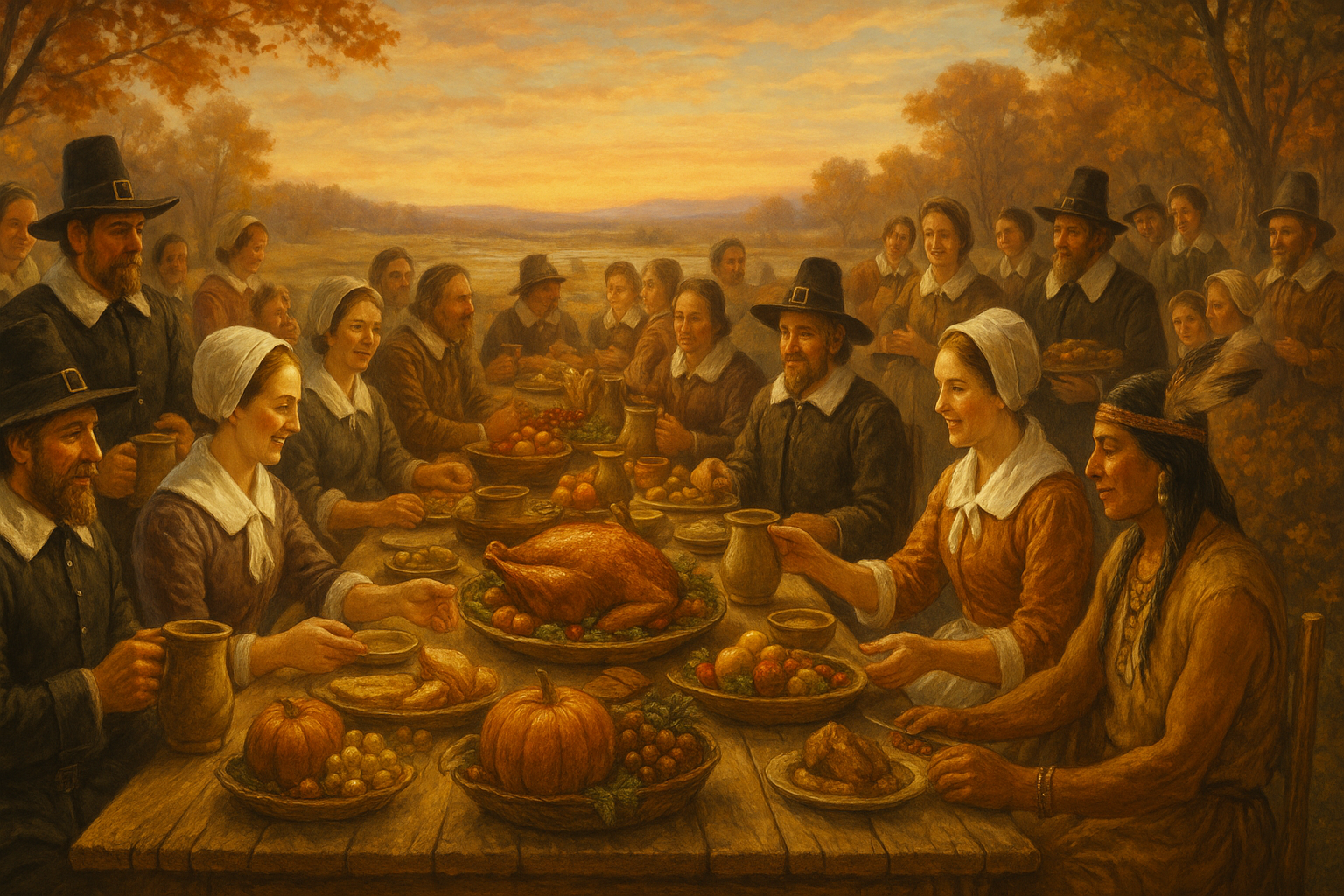
II. The Pilgrims and the First American Thanksgiving: A Story Modern Schools Won’t Tell
Ah, the Pilgrims – those somber, hat-wearing, buckle-obsessed Calvinists that public school textbooks reduce to living crayons. What most people don’t realize is that the Pilgrims were deeply biblical, covenant-minded Christians whose worldview was structured around the same principles God laid out for His people in Scripture.
They weren’t perfect, but they were brave, ordered, disciplined, and serious about covenant obedience. Which already puts them light-years ahead of most modern families.
Their First Year Was Hellish
The Pilgrims arrived in late 1620, just in time to watch winter laugh in their faces. Half of them died before spring. The ones who survived did so by sheer grit, providence, and the mercy of God.
The modern world likes tidy stories. Real life is rarely tidy. Real life is bruising, bleak, and requires a level of courage the average modern probably could not muster even if bribed with free Wi-Fi.
The Miracle of Provision
With the help of Squanto (whose life story is so sovereignly orchestrated it reads like a biblical narrative) the Pilgrims learned how to cultivate unfamiliar soil. Their first harvest in 1621 was abundant.
For the first time in a long time, they had:
- Enough to eat
- Enough to store
- Enough to have a celebration
And so they did what covenant people have always done: They feasted unto the Lord.
They invited their Native neighbors. They gave thanks openly. They shot guns in the air because, well, they were New Englanders and “Americans” before America existed.
Their Thanksgiving feast lasted three days. It included hunting, games, shared meals, and expressions of gratitude to God. It wasn’t perfect. It wasn’t modern. It wasn’t sanitized. But it was biblical.
III. Thanksgiving Throughout American History: A Feasting Tradition that Outlasted Empires
From the Pilgrims onward, Americans continued giving thanks, sometimes as local observances, sometimes nationwide. But fathers, families, and churches were the engines that kept the feast alive.
George Washington: The First Presidential Thanksgiving Proclamation (1789)
After the ratification of the Constitution, Washington called for a national day of thanksgiving, urging citizens to acknowledge God’s hand in the nation’s founding.
Washington did not mince words. His proclamation is dripping with Christian language that would get modern politicians canceled before they could finish reading the first sentence.
Abraham Lincoln: Thanksgiving Made an Annual National Holiday (1863)
In the middle of the Civil War, when America was literally ripping itself apart, Lincoln declared a yearly Thanksgiving.
He called the nation to remember God’s blessings even in the midst of bloodshed. He urged repentance, humility, unity, and gratitude.
It took national suffering to bring back national gratitude.
There is a lesson there.
IV. The Meaning of Thanksgiving: What Modern People Forgot
Modern Thanksgiving has been reduced to three things:
- Food
- Football
- Family arguments
Fine. But biblical thanksgiving is much bigger.
1. Thanksgiving Is a Weapon Against Pride
Gratitude humbles a man. It reminds him that everything he has – food, wife, children, land, strength – flows from the hand of God.
“In every thing give thanks: for this is the will of God.” —1 Thessalonians 5:18
To be thankful is not optional. It is the will of God. And a man who refuses gratitude is a man who denies reality.
2. Thanksgiving Is a Mark of Righteous Households
Psalm 128 paints the Biblical picture:
“Thy wife shall be as a fruitful vine… thy children like olive plants round about thy table.” —Psalm 128:3
Tables matter. Meals matter. Feasts matter. A thankful table is the sign of a household under God’s order.
3. Thanksgiving Is a Covenant Renewal Feast
Every biblical feast involved remembering what God had done. Thanksgiving follows that pattern.
Every year, households declare: “We remember. We acknowledge. We witness to God’s goodness.”
This is covenantal.
4. Thanksgiving Is the Antidote to Consumerism
Consumerism says, “You don’t have enough.” Thanksgiving says, “God has given us more than enough.”
Consumerism creates anxiety. Thanksgiving creates peace.
A man cannot be simultaneously grateful and entitled.
V. The Discipline of Gratitude: Training Wives, Children, and Yourself
Thanksgiving is not merely a feast, it is practice. A liturgy. A training manual for the household.
Teaching Wives Thankfulness
A wife’s gratitude – or lack thereof – will shape the entire home.
A thankful wife is soft, joyful, helpful, and content. An unthankful wife becomes feral faster than you can say “Black Friday.”
Gratitude is training. It is discipline. It is the mark of a woman who recognizes her place in God’s order.
Teaching Children Thankfulness
Children do not become thankful by accident. They are trained – by repetition, correction, and example.
The Thanksgiving table is the perfect annual checkpoint:
- “What are we thankful for this year?”
- “What did God provide?”
- “Who helped you grow?”
- “What work did you accomplish?”
Teaching children gratitude teaches them reality.
Fathers Must Model Thankfulness
A father cannot expect his wife or children to cultivate gratitude if he lives like a grumbling Israelite.
The head sets the tone. The head sets the atmosphere. The head sets the gratitude. If the father does not lead the household in thanksgiving, the household will drift into entitlement by default.
VI. How to Reclaim Thanksgiving in a Biblical, Ordered, Patriarchal Way
The modern world celebrates holidays with thoughtless ritual. Biblical men celebrate with purpose. Thanksgiving should be reclaimed as a high feast of covenant remembrance.
Here is how to restore Thanksgiving properly:
1. Begin with Scripture
Read passages of gratitude, blessing, harvest, and covenant:
- Psalm 100
- Deuteronomy 8
- Psalm 67
- 1 Thessalonians 5
- Colossians 3:15–17
Anchor the feast in God’s Word, not Hallmark sentiment.
2. Tell the History
Children should hear the story every year, how the Pilgrims suffered, survived, built, and feasted. How God provided. How nations rise or fall based on gratitude.
Thanksgiving should not be Disney-fied. Tell it straight. Tell it gritty. Tell it like it was.
3. Require Everyone to Speak Gratitude Aloud
Not silently. Not internally. Aloud. Biblical thanksgiving is vocal.
“I will offer to thee the sacrifice of thanksgiving, and will call upon the name of the Lord.” —Psalm 116:17
Thanksgiving requires words. Spoken. Shared. Witnessed.
4. Feast Generously
Food is not an afterthought. It is central.
Biblical feasts overflow with abundance because God’s provision overflows.
5. Give to Others
Thanksgiving should produce generosity. Share food. Share resources. Share time. A grateful people are a giving people.
6. End with Prayer and Blessing
Close the feast with gratitude to God, blessings over the household, and petitions for strength for the coming year.
Thanksgiving is not just a day, It is a declaration. A proclamation. A household covenant renewal ceremony.
VII. Why Thanksgiving Matters Now More Than Ever
Our world is ungrateful. It is entitled. It is soft. It is confused. It is feral. And nothing reveals a society’s collapse faster than its inability to give thanks.
Romans 1 says the downfall of the ungodly begins with one thing:
“Neither were thankful.” —Romans 1:21
A thankless people become a godless people. A godless people become a lawless people. A lawless people become a collapsing people. Thanksgiving stands as a bulwark against cultural decay.
When a father gathers his household, opens the Scriptures, speaks gratitude, and feasts in remembrance of God’s provision – he wages war against the spirit of the age.
He plants a flag. He draws a line. He raises a standard. Thanksgiving is a feast of order in a world of chaos.
Conclusion: Thanksgiving Is a Feast of Dominion
Thanksgiving is not nostalgia. It is not an American quirk. It is not a polite gesture.Thanksgiving is dominion.
It is the rightful orientation of a household that recognizes God as the giver of all abundance. It is a feast of remembrance, of joy, of covenant renewal, of generational continuity.
When a family gathers around a table in gratitude, they are doing more than eating turkey and stuffing, they are participating in an ancient rhythm established by God Himself. And in a world of ungrateful, undisciplined, feral masses, a thankful household shines like a fire on a hill.
So sharpen your knives. Prepare your feast. Open your Bible. Gather your wives and children. And celebrate Thanksgiving the way God intended – with gratitude, with joy, with remembrance, and with dominion.
For the Lord is good. His mercy is everlasting. And His truth endureth to all generations.
Happy Thanksgiving – from our household to yours.
I really enjoyed this post, there may be some humanity left in you after all.
I love THanksgiving
So it is “Biblical”?
Great Article
We conquered them! END OF STORY
We should all be ashamed to live in this stolen land
Left’s conquer Canada next!
BWAHAHA. Oh, Zane, my sweet summer child.