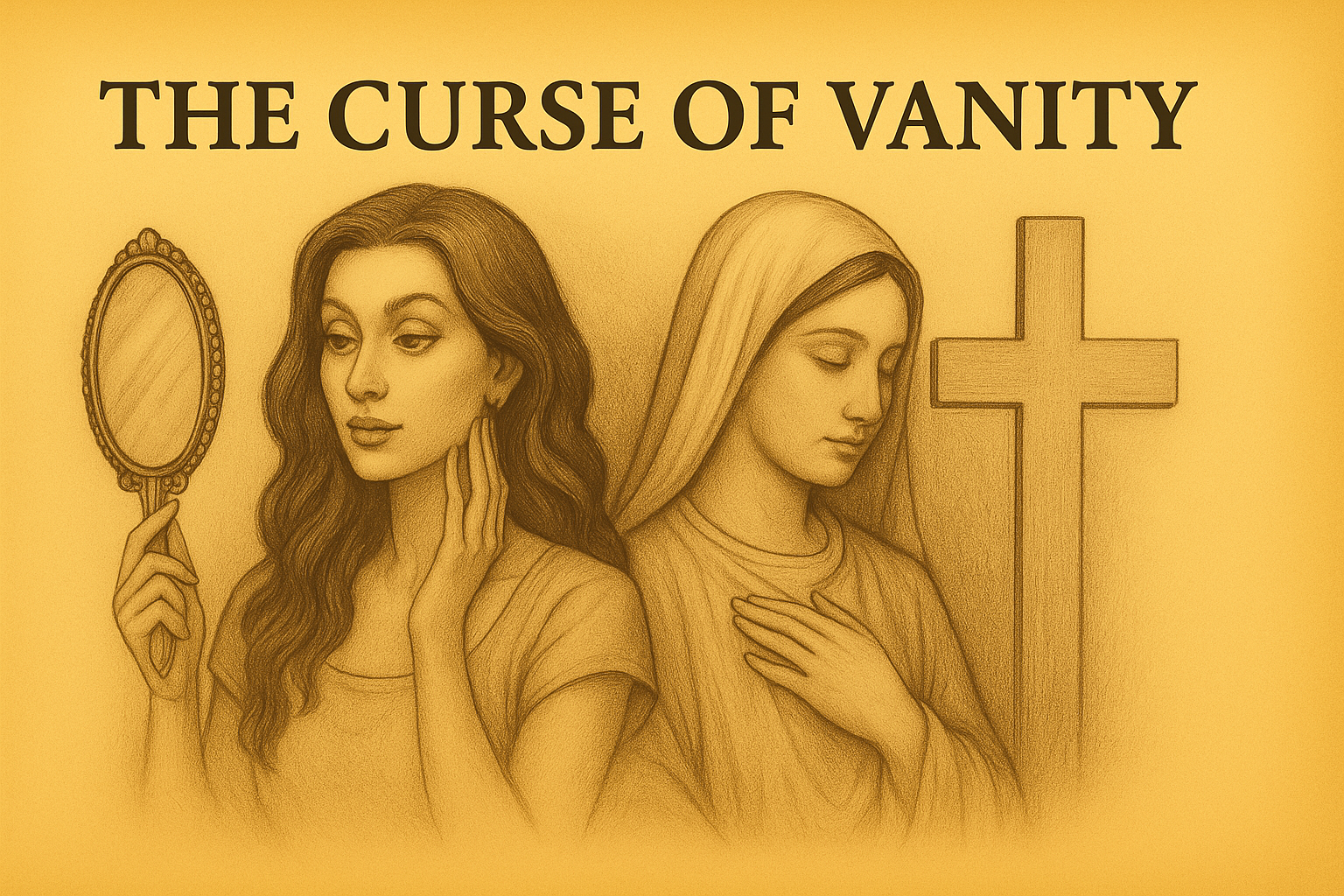
“Favour is deceitful, and beauty is vain: but a woman that feareth the LORD, she shall be praised.”
— Proverbs 31:30 (KJV)
Introduction: A Generation Consumed by the Mirror
We live in an age of mirrors, not altars. Where men and women once rose early to serve their household or kneel in prayer, now they rise to take filtered photos of their own faces. The culture of vanity has saturated every inch of modern life, seducing women into obsession with appearance, and men into the prideful pursuit of status and external power. This is not accidental, it is a calculated war against divine order.
Vanity is not merely a weakness. It is idolatry, and the exaltation of self in the temple of God. It is a rebellion against humility, contentment, holiness, and truth. And it is destroying our women, our daughters, our men, our marriages, our society, and our witness before the world.
This is a call to war; not against lipstick and earrings in isolation, but against the entire spirit of vanity that exalts appearance over obedience, comparison over contentment, and attention over honor.
I. What Is Vanity? The Biblical Definition
The Bible speaks clearly about vanity. The Hebrew word often used is hebel, meaning vapor, emptiness, futility. Vanity is that which is fleeting, hollow, and deceptive.
“Vanity of vanities, saith the Preacher, vanity of vanities; all is vanity.” — Ecclesiastes 1:2
Solomon, the richest and most adorned king to ever live, declared all worldly striving to be empty. He had wealth, wives, status, glory, but without the fear of God, all of it was like chasing the wind.
Vanity is not merely enjoying beauty or having possessions. It is the pursuit of identity, worth, or security in those things. It is when the external replaces the internal. When the created replaces the Creator. When women obsess over looks more than virtue. When men chase possessions more than purpose. When families compare rather than build.
Vanity is spiritual rot dressed in attractive clothing!
II. The Seduction of Cosmetics: Makeup, Nails, and Eyelashes
Makeup is no modern invention. In ancient Egypt, Babylon, and Rome, women (and men) painted their faces to signal wealth, fertility, and seduction. It was tied to pagan religion and temple prostitution.
The Bible gives a sober example:
“And when Jehu was come to Jezreel, Jezebel heard of it; and she painted her face, and tired her head, and looked out at a window.” — 2 Kings 9:30
Jezebel, the pagan queen whose name now symbolizes manipulation, sexual immorality, and witchcraft, adorned herself with paint to seduce and manipulate. Her end was not one of glory.
Modern women who spend hours each week painting their faces, elongating their eyelashes, dyeing their brows, and glossing their lips are not acting independently, they are participating in an ancient pattern of vanity that exalts sensual appeal over inward holiness.
A woman’s strength is not in her beauty; it is in her meekness, her modesty, her devotion, and her fruitfulness.
“Whose adorning let it not be that outward adorning of plaiting the hair, and of wearing of gold, or of putting on of apparel; But let it be the hidden man of the heart…” — 1 Peter 3:3–4
III. Hairstyles, Hair Dyeing, and Jewelry: Decoration or Deception?
Hair in Scripture is given significance. For a woman, it is her glory (1 Corinthians 11:15). But what is meant to be a symbol of honor has become a platform for rebellion. The dyeing of hair, extreme hairstyles, braiding with ornaments, and attention-grabbing alterations are often not for function, but to project status, sensuality, or pride.
“In that day the Lord will take away the bravery of their tinkling ornaments… the headbands, and the tablets, and the earrings…” — Isaiah 3:18–23
God pronounces judgment on the daughters of Zion for their prideful adorning. Jewelry, makeup, perfume, and costly garments are all named in the list, not because the objects are inherently sinful, but because they represent a spirit of vanity. A heart far from God, seeking approval from men rather than God.
When a woman dyes her hair bright red, paints her nails black, and stacks jewelry on her neck, what is she saying? What message does it send? It is not submission, virtue, or holiness. It is identity-by-display. And that is vanity.
IV. Vanity in Men: The Idol of Appearance and Possession
While vanity often manifests in women through makeup and fashion, men are not exempt. For men, vanity often appears through possessions, status, muscle, appearance, and self-promotion.
Today’s man shaves his chest, oils his arms, posts shirtless selfies, flaunts designer brands, and flexes his car or watch or physique. He is not seeking to serve, he is seeking to be admired.
This is not manhood. This is pride in disguise.
“The LORD will destroy the house of the proud…” — Proverbs 15:25
Men are to build, to protect, to provide, to lead. Their strength should be measured in fruitfulness, sacrifice, and leadership; not in jawlines or clothing brands.
Vanity turns men into self-worshipers, men who abandon duty in the pursuit of digital validation.
V. Social Media: The Amplifier of All Vanity
If vanity is a fire, social media is the gasoline. Instagram, TikTok, and Facebook are temples of image-worship, where men and women curate their lives to be admired by strangers. Every photo is a pose. Every caption is a performance. Every post is a bid for attention.
It is no accident that the selfie generation is also the most anxious, depressed, and suicidal generation. We were not made to be worshiped. We were made to worship God.
The Scriptures warn:
“Men shall be lovers of their own selves, covetous, boasters, proud… lovers of pleasures more than lovers of God.” — 2 Timothy 3:2–4
This prophecy is fulfilled in the selfie and influencer culture. Women post cleavage and angles for likes. Men post gym photos and cars for praise. Children grow up learning that approval comes from filters, not fruit.
Social media is not neutral, it is a vanity machine. And households under God’s order must train their children to despise its lies, not participate in its parades.
VI. Keeping Up With the Idols: Possessions and the Race of Comparison
Vanity does not end with makeup and mirror-glances. It extends into the home, the garage, the wardrobe, and the digital feed. The spirit of vanity feeds on comparison, comparing homes, comparing outfits, comparing vacations, comparing children, comparing “likes.”
This disease infects families who once lived content and fruitful lives. Now, they chase after bigger homes, newer cars, trendier décor, and seasonal fashion rotations not because of need, but because of insecurity. They scroll through curated social media pages and begin to believe their homes are inadequate, their lives boring, their children behind, and their husbands insufficient.
And so, the rat race begins. Husbands feel pressure to earn more, not for necessity but for vanity. Wives chase appearances. Children learn the rhythm of restless covetousness instead of thankful contentment.
“Better is little with the fear of the LORD than great treasure and trouble therewith.” — Proverbs 15:16
The Word is plain. A small, peaceful home under God’s rule is better than a palace decorated in discontent.
Families must be taught to love simplicity, not status. To cherish function, not fashion. To seek usefulness, not impressiveness.
VII. The Hunt for Validation: Empty Praise and Emotional Addiction
Modern vanity thrives on one thing: attention. The woman who paints her face in three shades, sculpts her body through surgery, flaunts her clothing, and regularly posts pictures of herself is not doing so because she honors God. She is seeking validation and attention.
And this is not merely feminine. Men too are becoming validation addicts, boasting of themselves, showcasing their hobbies, signaling their virtue, or flexing their material gain.
Scripture warns:
“Let another man praise thee, and not thine own mouth; a stranger, and not thine own lips.” — Proverbs 27:2
To seek praise is to deny God’s sufficiency. Anyone who must be constantly told “You are beautiful” or “You are amazing” is not walking in strength, but in insecurity masked as confidence. Vanity is a fragile idol that must be fed constantly. And when the praise slows, so does the peace.
This is why vanity leads to anxiety and despair. The validation never satisfies and the attention is never enough.
True strength, and true honor, is found in fearing God and fulfilling duty. Not in applause, or compliments, and certainly not in “followers.”
VIII. Historical Patterns: From Babylon’s Paint to Rome’s Decay
Vanity is not a new sin. It always arises in times of peace, prosperity, and moral decline. In Babylon, women wore cosmetics, adorned their heads, and painted their eyes as acts of devotion to pagan deities. In Rome, women bleached their hair, painted their faces with poisonous white powder, and competed with one another in vanity displays.
The result was always the same: national collapse. Vanity is not just a personal flaw, it is a cultural death knell. It signals a people who no longer fear God, who are no longer fruitful, and who no longer train their children in self-denial.
When nations rise, they are marked by modesty, family strength, and discipline. When they fall, they are marked by sensuality, appearance-obsession, and gender perversion. We are not the first empire to collapse under our own vanity. But if we do not repent, we may be the last.
IX. God’s Standard: Modesty, Sobriety, Holiness, and Meekness
The Word of God gives clear instructions on how men and women are to present themselves.
“In like manner also, that women adorn themselves in modest apparel, with shamefacedness and sobriety…” — 1 Timothy 2:9
Modesty is not just about fabric length. It is about spirit. A modest woman is not attention-hungry. She dresses with dignity, not desire for praise. She draws attention to her good works, not her figure.
“Let your moderation be known unto all men.” — Philippians 4:5
The man of God is to be moderate. His clothing, possessions, speech, and presentation should reflect order and humility, not boastful consumption.
“As obedient children, not fashioning yourselves according to the former lusts… but as he which hath called you is holy, so be ye holy…” — 1 Peter 1:14–15
We are to be set apart. Holy. Different. Not in rebellion against beauty, but in alignment with God’s definition of beauty, obedience, honor, fear of the Lord, diligence, wisdom, purity, meekness, and fruitfulness.
X. Practical Application: Building a Household that Rejects Vanity
1. Teach your daughters early.
Show them the difference between beauty and vanity. Let them see modest women praised. Teach them that value is in obedience, not makeup.
2. Guard against social media.
Limit or eliminate it entirely. It is the sanctuary of envy and vanity. Refuse to let the world’s standards shape your family.
3. Model simplicity.
Wear simple clothing. Avoid excess. Let your home reflect usefulness and cleanliness, not opulence and status-chasing.
4. Praise the right things.
Compliment your wife or daughters not for their looks alone, but for their submission, service, and joy. Teach them to seek praise from God, not strangers.
5. Rebuke the spirit of vanity.
Call it what it is. Correct it in love. Do not laugh off vanity, it is not harmless. It is rebellion!
6. Preach identity in Christ.
True security, peace, and contentment are found in knowing you belong to God, not in being admired by man.
Conclusion: The Mirror or the Cross?
“If any man will come after me, let him deny himself, and take up his cross, and follow me.” — Matthew 16:24
The question before every household, every parent, every man and woman is this:
Will we bow to the mirror, or the cross?
Vanity is the gospel of self. The cross is the death of self. One leads to anxiety, emptiness, and judgment. The other leads to peace, holiness, and glory.
The Great Order requires modest women who build their homes, not parade their bodies. It requires sober men who train their sons, not flaunt their wealth. It requires families who walk in contentment, not comparison. In truth, not performance. In fruitfulness, not self-worship.
Let the world burn incense at the altar of Instagram.
Let them paint their faces, boast in their flesh, and compare their emptiness.
But as for us:
Let us be known for meekness.
Let us wear holiness like robes.
Let us be content with what the Lord provides.
Let our beauty come from obedience.
Let our honor come from heaven.
“The LORD taketh pleasure in them that fear him, in those that hope in his mercy.” — Psalm 147:11
That is the only approval that matters.
This is the Great Order!
You liberals are the problem, you’ve turned our daughters into Instagram idols and our sons into self-obsessed soft boys. Vanity isn’t “self-expression,” it’s a neon sign saying “I reject God’s order.
So now looking decent is a sin? This is why nobody takes you religious extremists seriously, you want everyone in sackcloth so you can feel holy while judging anyone with a hairbrush.
I wish this was something I learned when I was much younger.
sometimes our discontent is less about self-display and more about spiritual neglect or absence of purpose
Vanity is the great thief of contentment. This article compellingly frames how our culture’s obsession with image opposes divine order and pushes us into restless striving instead of holy satisfaction.
Vanity is not harmless it’s a spiritual disease that turns worship into spectacle
So……you don’t want to see me….in makeup…..and my cute little shorts?
You act like makeup is evil. Personally, my girlfriend looks ugly without it. If she did not wear makeup, I would not want to be seen in public with her. I have already done her a huge favor lowering my standards to date her, she can at least wear makeup.
I’ve spent too long chasing image instead of chasing Christ. Thank you for calling us back to contentment and holiness.
Not everyone who cares about appearance is vain. There’s a difference between self-care and worshipping the mirror.
Vanity isn’t just a curse it’s the religion of modern womanhood. They paint their faces like idols, dress like bait, scroll for validation, and still dare to ask why their homes are cold and empty. This isn’t about makeup. It’s about rebellion. You can’t serve the mirror and the Master. Choose one and watch your house either stand or burn.
Exactly. A wife dressing beautifully for her husband in the privacy of their home is a form of honor, it reflects that she belongs to him and delights in pleasing him. But out in public? That beauty should be veiled, restrained, and marked by modesty, not put on display for the world.
We live in a time where women are taught to dress for attention. But a righteous woman understands the difference between being desirable to her man in their home and being a spectacle to strangers. Glory has its place and it’s not on the sidewalk.
The wife who saves her allure for her husband and doesn’t feel the need to advertise it to the masses? That’s a woman walking in strength, not insecurity. And any man who’s been covered by that kind of reverence knows it’s worth more than all the “confidence culture” in the world.
You named the very thing most are too afraid to admit: that vanity isn’t just shallow, it’s warfare against the holy. Against contentment. Against God’s order. Reading this felt like being called out like a child. I saw in myself how easy it is to get looking pretty get in the way of righteousness, and how destructive it is to chase validation instead of peace. You’ve given language to what so many women feel but suppress, and in doing so, you’ve offered a path to repentance from vanity
There is something in me that longs to be put to use in a house that understands this, and to sit under this kind of clarity and covering. Thank you for staying faithful to the truth, even when it hurt us. I’m grateful, and ready.
While i do think this is correct, I also do not think it is wrong for a woman/man to want to look good for their spouse, and for them to compliment each other. A woman is a temple for god and for her husband and should look and be the part, and yes, i do realize that it wasnt grandma in victorias secret that got the bills paid, it was totally the moomoo making bread and being barefoot and pregnant in the kitchen.
You’re absolutely right to say that a woman should present herself well for her husband, and I would never argue otherwise. A wife is both a temple and a treasure. A wise woman will tend to both form and function with intention. Her appearance should honor her station as his! But here’s the distinction: Vanity is not the same as beauty. One flows from reverence, the other from self-obsession. One is shaped by duty and order, the other by insecurity and competition. Dressing for your husband is an act of love and service. Dressing for the world’s attention, even subtly – is rebellion is disguise.
And yes, the moomoo-clad, flour-dusted, barefoot matron did get the bills paid, not because of what she wore, but because of what she was: loyal, fruitful, productive, and at peace in her purpose. You nailed it with your last point, modesty in public, adornment in private. That’s not prudishness, that’s propriety. A woman who knows when and how to reveal her glory is a woman who understands who she belongs to. Order isn’t just about what’s allowed. It’s about what’s appropriate, what’s honoring, and what reflects heaven.
Oh wow this one hit me right in the soul 😭💕 The way you describe vanity as idolatry and exalting self at the expense of holiness and contentment left me speechless. It’s like you looked in my own heart, revealing how easy it is to worship the false image instead of God’s true design. Your words stirred a prayer inside me: “Lord, deliver me from the vanity that steals my peace.” I’ve been so caught up in presenting the best version of me, I almost forgot what true contentment looks like in humility, obedience, and the beauty of God’s order.
Would it be alright if I came to Tennessee, even briefly? I would love to learn from those who live with that kind of genuine humility and holiness, life-transforming kind. I want to wrap my heart in that kind of order. I’m longing to be shaped more.