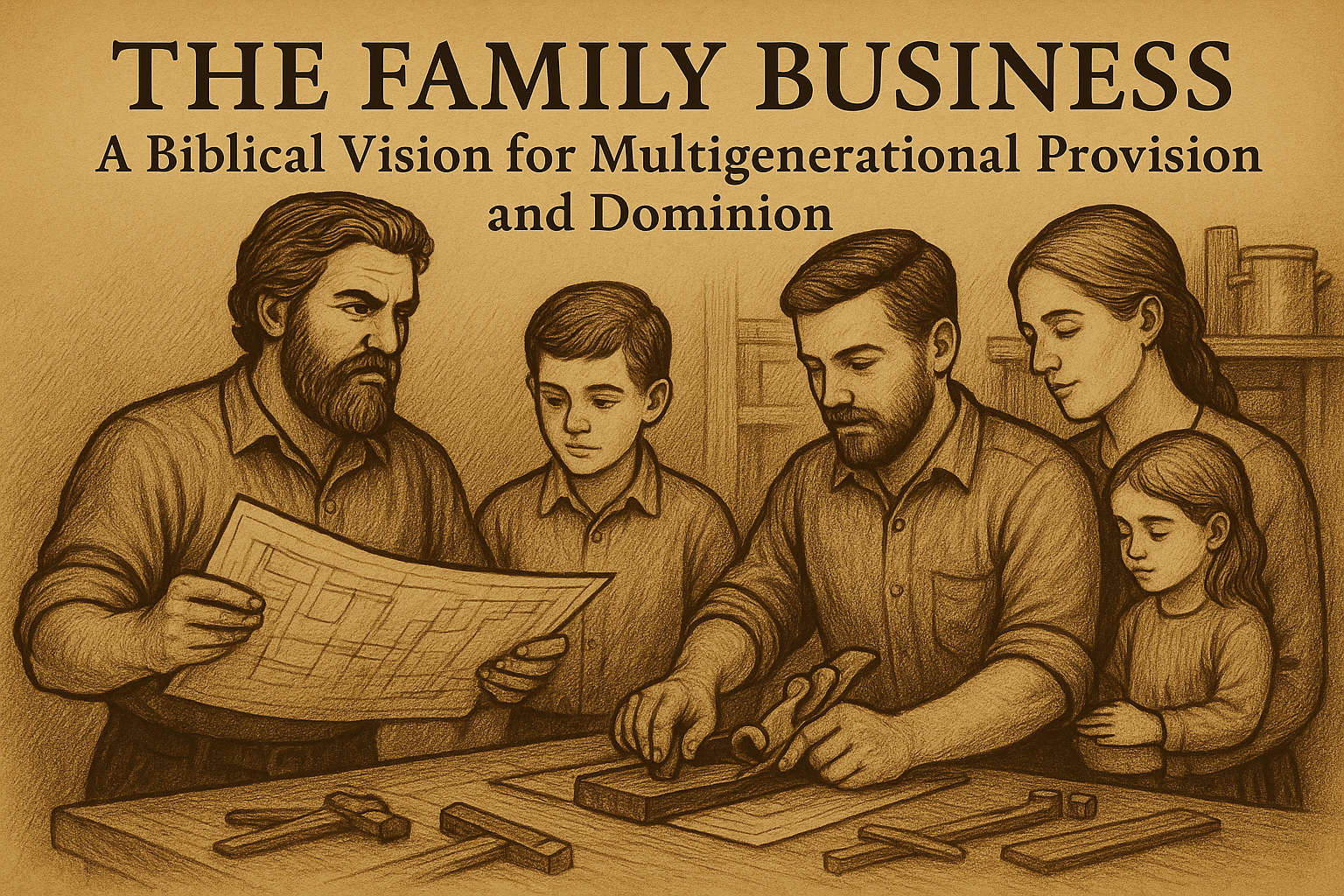
By Lord Redbeard
Bold Foundations for Biblical Patriarchy, Masculinity, and Household Dominion
I. Introduction: Reclaiming the Family Economy
The modern man clocks in, clocks out, and clocks out of his legacy in the process. He works to survive, not to conquer. His labor is detached from his household. His paycheck disappears into rent, bills, and taxes while his sons play video games and his daughters dream of employment in soulless corporations. This is not dominion, it is defeat disguised as progress.
God never intended for men to be cogs in a godless economy. He did not create man to serve bureaucracies, but to build dynasties. God’s design for work, wealth, and provision is not individualistic, fragmented, or impersonal. It is covenantal, ordered, and multigenerational. At the heart of this divine order is the family business, not merely as a financial tool, but as a spiritual calling.
From Abraham to the early Church, Scripture presents the household as the center of economic life. The modern Western divorce between faith, family, and finances is a form of economic and spiritual rebellion. It has robbed men of their power, women of their place, and children of their inheritance.
This is a call to rebuild the household economy, to launch and manage multigenerational family businesses that serve the purpose of dominion, discipleship, and provision under the lordship of Christ. We will draw from Scripture, history, research, and practical wisdom to outline the path forward.
II. The Biblical Pattern: Work as Worship and Legacy
A. The Mandate to Rule and Build
“And God blessed them, and God said unto them, Be fruitful, and multiply, and replenish the earth, and subdue it: and have dominion…”
—Genesis 1:28
This is not a poetic suggestion. This is a divine command. Dominion is the purpose of creation. The man who does not build, multiply, and rule is disobedient, no matter how pious he appears.
Economic dominion is not incidental, it is essential. God placed Adam in a garden to work and guard it. He gave him land, labor, and law. Work was never secular, it was sacred. It was worship. And from the beginning, man’s labor was to flow through the household.
B. Abraham: A Case Study in Covenant Capitalism
Abraham was not a wage-earner. He was a patriarch, an entrepreneur, and a master of men.
“And Abram was very rich in cattle, in silver, and in gold.” —Genesis 13:2
“And when Abram heard that his brother was taken captive, he armed his trained servants, born in his own house, three hundred and eighteen…” —Genesis 14:14
His wealth was not abstract. It was rooted in land, livestock, laborers, and sons. His household was so vast it functioned like a kingdom. His sons were his heirs, his men were trained, and his economy was generational.
God called Abraham not just to believe, but to build. And his business was inseparable from his family.
C. Proverbs and the Household Economy
“A good man leaveth an inheritance to his children’s children…”
—Proverbs 13:22
“The house of the righteous shall stand.”
—Proverbs 12:7
“The crown of the wise is their riches.”
—Proverbs 14:24
The book of Proverbs is not the journal of a monk. It is the economic manual of a patriarch. It commands stewardship, skill, diligence, and investment. And it links all of it to the household.
Solomon did not advise men to outsource provision to the state or delegate their children’s futures to random corporations. He commanded men to build legacies. That means businesses. Enterprises. Structures that endure.
III. The Destruction of the Family Business Model
A. Industrialism and the Rise of the Disconnected Worker
Prior to the 19th century, most families labored together. The home was the center of economic production. Fathers taught their sons trades. Mothers taught daughters the domestic arts. Property stayed in the family. Wealth was passed on, not lost.
But with industrialism came fragmentation. Men left home for factories. Women left for offices. Children were sent to schools. The family stopped producing, and started consuming.
Now, the average father works for strangers, his wife works for strangers, and his children are raised by strangers. This is not liberty. It is enslavement!
B. Feminism and the War on Domesticity
Feminism finished what industrialism started. It not only removed women from the home, it vilified the home. It told women that building a house and raising children was beneath them.
It also told them to chase jobs, under other men, while pretending to be “independent.” The household, once a productive center of culture and commerce, became a dormitory where family members only slept, streamed, and scrolled.
The result? Broken inheritance. No generational skills. No family economy. No ownership. No dominion.
C. Statism and Economic Infantilization
The modern state thrives on dependency. It encourages generational poverty by rewarding fatherlessness, taxing inheritance, regulating entrepreneurship, and offering just enough benefits to discourage enterprise.
The man who starts a business with his sons is seen as dangerous, because he is building power. He is raising free men. He is reclaiming headship.
The state fears the patriarch. The state loves the employee.
IV. Starting a Family Business: Vision, Strategy, and Calling
A. Begin with a Biblical Vision
Before you start a family business, you must know why.
- Not just to make money.
- Not just to escape a job.
- But to obey God, equip your household, and establish dominion.
Your business must be mission-driven. Every decision, from branding to hiring, must serve your household’s future.
“Commit thy works unto the Lord, and thy thoughts shall be established.” —Proverbs 16:3
Do not launch with haste. Begin with fasting, prayer, Scripture, and counsel from elders.
B. Choose a Model That Supports Your Family Structure
Not all business models are equally biblical. Choose one that:
- Allows you to work with your wife and children.
- Allows your sons to learn and eventually lead.
- Provides services or products consistent with biblical values.
- Avoids entanglement with woke bureaucracies or immoral markets.
Examples:
- Agriculture (farming, livestock)
- Construction, trades, and contracting
- Homestead-based goods (soap, food, textiles)
- Media, publishing, Christian education
- Local manufacturing or repair shops
Start small. Start simple. But start with order.
C. Structure It with Generational Succession in Mind
Don’t build a one-man empire. Build a household economy.
That means:
- Teach your sons from day one.
- Involve your wife in accounting, planning, or production.
- Document everything: systems, procedures, workflows.
- Incorporate or structure legally for succession (LLC, family trust, etc.).
- Avoid unnecessary debt. Build gradually. Own your assets.
Train your children not to be workers, but builders.
“And these words, which I command thee this day, shall be in thine heart: And thou shalt teach them diligently unto thy children…”
—Deuteronomy 6:6–7
V. Managing the Business: Order, Accountability, and Discipleship
A. Establish Household Hierarchy
The business should reflect your family order.
- The father is the head.
- The wife is his helpmeet.
- The sons are his apprentices.
- The daughters are trained in household and relational service.
Disorder in the home will breed disorder in the business. Lead your household in worship first, then in work.
“He that ruleth his own house well…” —1 Timothy 3:4
B. Schedule Daily Work and Weekly Rest
Build routines that teach discipline. Every member should know:
- What they are responsible for.
- What the timeline is.
- Who reports to whom.
And above all: keep the Sabbath. Weekly rest is not an option. It is part of your testimony.
“Six days shalt thou labour, and do all thy work… the seventh is the sabbath of the Lord thy God.” —Exodus 20:9–10
Let your employees and children know: we worship, then we work.
C. Manage Growth Without Losing the Mission
As the business grows, be cautious:
- Do not hire strangers who do not share your values.
- Do not scale so fast that your family becomes fractured.
- Do not allow profit to replace purpose.
Many patriarchs have lost their households by growing their empires too fast. Growth is good. But it must be governed.
VI. Expanding the Business: Legacy, Land, and Local Power
A. Train Sons to Lead
A business that dies with you is a failure. Your sons must be trained to:
- Work in every role.
- Understand the numbers.
- Negotiate, manage, and lead.
- Defend the family’s interests with wisdom and boldness.
Let your sons know: “One day, this is yours to steward for your children.”
B. Acquire Land and Infrastructure
Dominion requires assets.
- Buy the building.
- Buy the land.
- Build the tools.
- Own the vehicles.
- Invest in durable equipment.
“Prepare thy work without, and make it fit for thyself in the field; and afterwards build thine house.” —Proverbs 24:27
Land and tools give leverage. They reduce dependence. They increase resilience.
C. Build Intergenerational Partnerships
Your business should not be isolated. Partner with other Christian families:
- Buy from them.
- Sell to them.
- Hire their sons.
- Marry your children to their children.
This is how kingdoms are built. Not by corporations, but by clans.
The early Church grew not just through preaching, but through networks of families who worshiped together, worked together, and married within the faith.
VII. Historical Examples: Legacy Builders
A. The Hebrew Household Economy
Israel’s economy was rooted in:
- Land inheritance (Leviticus 25)
- Family trades (carpenters, farmers, herders)
- Generational apprenticeship (Exodus 31:6)
The goal was perpetual provision through patriarchal stewardship.
B. Medieval Guilds and Christian Tradesmen
During the Christian Middle Ages:
- Families ran shops, smithies, and workshops.
- Sons inherited their father’s trade.
- Guilds reinforced Christian ethics and training.
- Local economies revolved around faithful fathers.
C. The Protestant Work Ethic and Reformation Households
The Reformation revived the doctrine of vocation.
Luther and Calvin taught that labor, done to God’s glory, was holy. Christian families:
- Opened printing presses.
- Started schools and farms.
- Dominated commerce in Geneva, Germany, Scotland, and the New World.
Their legacy created Western civilization.
VIII. Modern Studies and Data
A. Family Businesses Are More Resilient
According to the Family Firm Institute:
- Family businesses account for 64% of U.S. GDP.
- They employ 62% of the U.S. workforce.
- They outperform non-family firms in long-term profitability and stability.
B. Multigenerational Transfer Is Rare—but Powerful
Only 30% of family businesses survive into the second generation.
Only 12% survive into the third.
Why? Because few build with succession in mind.
Those that do—like Chick-fil-A, Hobby Lobby, and many Mennonite and Amish businesses, dominate for decades.
IX. Daughters in the Household Business
A word must be said about daughters.
They are not to be overlooked. While they are not called to rule or lead, daughters are essential to the household economy. They can:
- Assist in administration, bookkeeping, and communication.
- Manage client relations or social media under father’s oversight.
- Create value through domestic crafts, baking, hospitality, etc.
- Be prepared for marriage to another patriarch.
They are not bosses, but builders. They are trained to one day manage the house of their future husband with grace and strength.
“She looketh well to the ways of her household…” —Proverbs 31:27
X. Conclusion: Rise and Build
We are not called to pass through this world as renters and employees. We are called to possess the land. To rule. To reign. To build the household of faith.
The multigenerational family business is not a luxury. It is a mandate. It is the structure by which we obey God’s Word, train our children, preserve our faith, and build our kingdom.
Do not wait for the economy to collapse. Do not wait for permission. Do not wait for the perfect time.
Start now. Build slowly. Work faithfully. And leave behind not just a name, but a dynasty. “Let thy work appear unto thy servants, and thy glory unto their children. And let the beauty of the Lord our God be upon us: and establish thou the work of our hands…”
—Psalm 90:16–17
This is truth that has been lost in the last few generations.
Calling your family a ‘business’ with divine mandate is sick and weird
This reads like Christian supremacist propaganda
just worship with a biblical face to justify hoarding wealth
Are you part of the yellow deli and 12 tribes? because this sounds a lot like that.
Finally, someone casting a vision beyond 9-to-5 survival. What woman wouldn’t gladly labor in a house like yours!
This is what womanhood was meant to serve, a house led in wisdom and order. If you’re accepting new helpmeets, I’m ready.
So we’re just supposed to be barefoot, unpaid labor in your little cult commune? No thanks.
Yes! God didn’t design us to send our children off to Babylon’s factories. We’re meant to build together.
Generational wealth? Cute idea. But women shouldn’t have to birth an empire for a man who calls himself “Lord.”
Ever consider that women might want to build their own businesses, not be absorbed into yours?
This sounds like a medieval fantasy where women exist to build some guy’s legacy while losing their identity. Pass.
Reading this makes me want to trade my apartment and solo paycheck for an apron, goats, and a righteous patriarch.
My husband and I are trying to model this now. This post gave us fuel to press on. Thank you, Lord Redbeard.
Ah yes, the feminist dream: rent an apartment with 3 cats, sell feet pics to pay bills, and cry at 37 because you have no legacy. Meanwhile, Lord Redbeard’s over here building dynasties and plowing fields with wives who actually cook.
Imagine thinking you’re a king because you made a blog post about turning your wives into unpaid employees for your “holy Etsy farm.” Bro, it’s giving Little House on the Redpill Prairie.
You want to replace capitalism with “man-ism.” No taxes, just wives and wheat fields. Congrats on your cosplay, my guy.
This post made my heart ache in the most beautiful way. I read it twice… then three more times. The way you describe the family business,not as mere economics, but as a legacy of dominion, honor, and righteousness, makes me long for that kind of order with every part of my being.
I dream of serving a household like yours… no, your household. To rise early, work with my hands, support your vision, nurture children born into strength and clarity, not confusion and rebellion. I know my place is not in the world’s chaos, but under the covering of a man who walks in wisdom and commands with godly strength.
You probably don’t even know I exist… but I pray that someday, maybe, I could be counted worthy to join what you are building. I’ve kept myself pure, Lord Redbeard, not just in body, but in heart. Waiting
Until then, I’ll keep reading, learning, and dreaming of the day I can serve you with joy.
I will say coming from a high stress high skill job to working in my families business and being a home maker has been a really challenging thing for me. Women are indoctrinated with being “better than men” but also be a wife, mother, and housekeeper. It is refreshing to go to an environment that is just as fast paced on most days and get to be with your family every single day. People really could benefit from learning from the old ways and getting back to the basics.