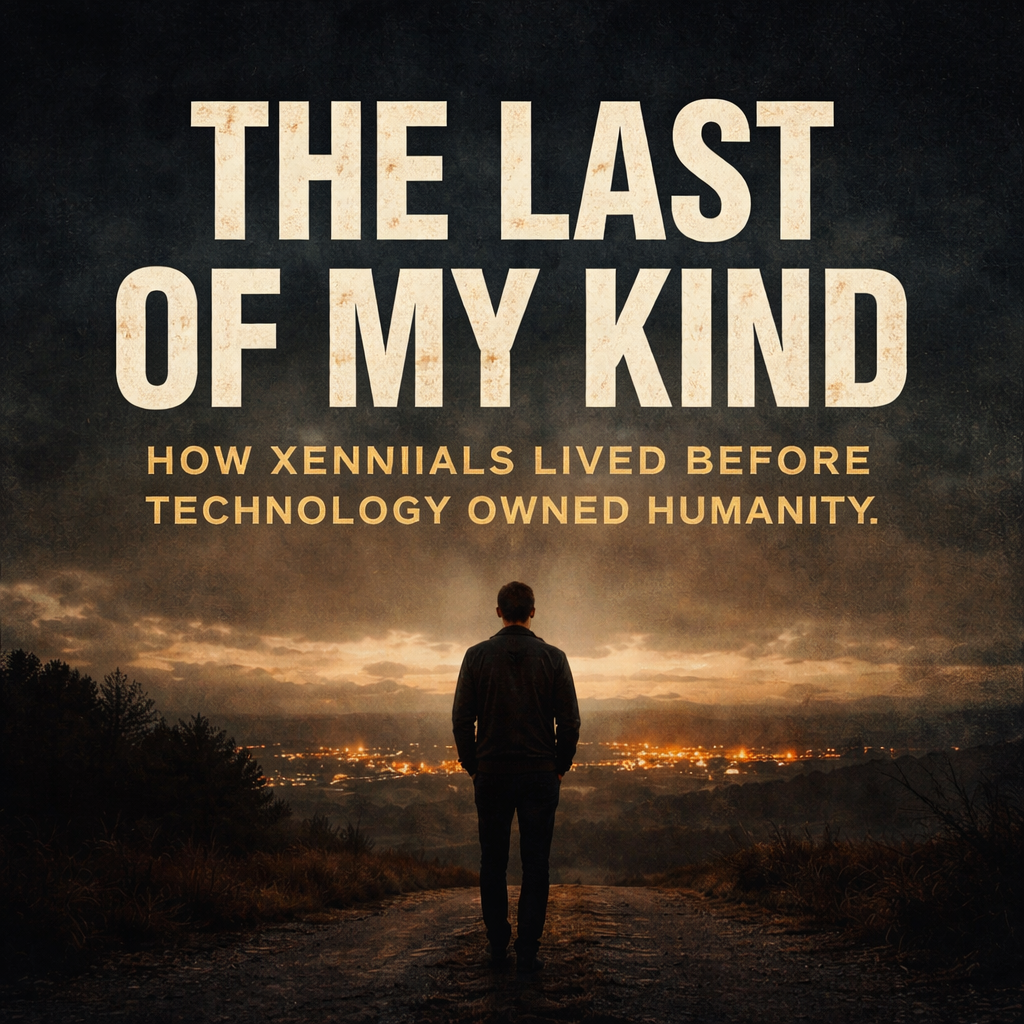
How Xennials Lived Before Technology Owned Humanity
Introduction
There exists a narrow slice of humanity (those born between 1980 and 1983) who occupy a position no future generation ever will. We are not merely older Millennials, nor are we simply late Generation X. We are something very distinct: the last people on earth who came of age before technology irreversibly colonized our daily lives, yet were still young enough to be forcibly absorbed into the digital world as adults. We remember, in our bones, a world where presence mattered, where absence was normal, where knowledge had value, and where silence was a normal part of daily life.
This is not nostalgia or romanticism of a false past, but a factual contrast between two modes of human existence. One demanded patience, effort, self-direction, memory, and competence. The other demands constant availability, passive consumption, shallow recall, and obedience to algorithms. The Xennial generation stands as the hinge point between these worlds, having learned how to function without technology, and then watching, in real time, as technology consumed the minds of future generations like a cancer.
I. Life Before Ubiquity: When Technology Was a Tool, Not an Addiction
For the Xennial generation, technology existed, but it did not dominate, mediate, or define daily life. It was peripheral, occasional, expensive, and unreliable. Communication was deliberate, access was limited, and silence was a normal, healthy part of life. You could not be reached instantly, and no one expected that you should be. This alone produced a radically different psychology, one built around autonomy rather than constant, incessant interruption.
Telephones were anchored to walls. Messages were recorded on physical cassette tapes that had to be played back, rewound, erased, and reused. If you missed a call, you missed it. There was no anxiety spiral, no expectation of immediate response, no interpretive drama about why someone hadn’t replied in ten minutes. You called back when you were home and had time,or you didn’t, and life went on. Even spouses, parents, and employers understood that absence was part of reality, not a personal offense.
Cell phones, when they finally arrived, were not extensions of your identity. They were clunky, fragile, expensive devices with limited minutes, poor reception, and virtually no functionality beyond the voice phone call (and very limited text). I got my first one at 16 (because I paid for it) and the use was minimal. Before these devices, if communication was necessary, you found a payphone, dug for quarters, and made the call. Communication required intentional effort, which filtered out triviality by default.
Commerce functioned the same way. Most daily transactions were conducted in cash. Registers were mechanical or basic, receipts were often handwritten, and invoices were carbon copies. Fraud was much harder, credit cards existed but were minimal. Accounting required competence, and you knew what you spent because you physically handled your money. There was no mindless consumption, no one-click dopamine loop, no invisible subscription bleeding you dry in the background, and you could not order worthless crap on a whim. Spending required presence, movement, thought and decision-making.
Entertainment was scarce and communal. Video games were not omnipresent pacifiers; they were rare, expensive, and shared. You didn’t disappear into private algorithmic feeds, you gathered around a single screen, took turns and then you stopped when it was time to do something else. Boredom existed, and boredom is the ONLY place where imagination, competence, and ambition are born.
When things broke, you didn’t replace them, you repaired them. You called the manufacturer, visited a parts supplier, and learned the name of the component that failed. You waited, and then you installed it yourself or paid someone who actually knew how things worked. Knowledge was embedded in people and places, it had a value and was not floating in an infinite digital fog.
Learning required effort. If you wanted to understand something, you went to a library, you used an index, you opened a dictionary, you read an encyclopedia, you bought manuals and you studied. Information was not infinite, but it was retained, because effort burns knowledge into your memory. Curiosity demanded discipline and answers were earned, not served up by the digital gods.
Even basic navigation required effort and awareness. You planned routes, read maps, got lost, and even asked for directions. You learned geography by necessity and mistakes carried consequences, which is how competence is forged.
This world did not make people perfect, but it made them capable. It inherently trained patience, memory, resilience, and self-reliance. And that is the world the Xennial generation internalized before the digital cancer arrived and quietly eroded every one of those traits, all while insisting it had made life “easier.”
II. Learning Had Weight: When Knowledge Required Effort
For Xennials, knowledge was never passive, it did not arrive instantly, automatically, or effortlessly. It had to be sought, and that act of seeking shaped the mind in ways modern generations cannot comprehend. Learning required time, planning, movement, patience, and (most importantly) commitment. Because access was limited, information had value. You didn’t casually “look something up.” You decided something was worth knowing, and then you worked to acquire that knowledge.
If you needed to understand a subject, you went to a library or a bookstore. You navigated card catalogs and indexes. You scanned tables of contents. You read entire chapters to extract a single answer. Dictionaries, encyclopedias, thesauruses, and reference books were physical objects that occupied space and required attention. They were not endlessly linked distractions pulling you away every ten seconds, they were singular tools that rewarded your focus. The effort required to obtain information forced discernment. You didn’t drown in data; you selected the knowledge that had a purpose.
This process trained memory. Because answers were not instantly retrievable, you retained what you learned. You internalized definitions, procedures, directions, and concepts because forgetting them meant repeating the entire laborious process. Knowledge stuck because forgetting was costly. Today, forgetting is consequence-free, you can always look it up again, so nothing sticks.
When something mechanical broke (especially vehicles) the response was not to google it or watch a YouTubevideo. You bought a repair manual for that exact make and model, you read it, you learned terminology, you followed diagrams and you diagnosed problems through reasoning and logic. That process built comprehension, not just task completion because you didn’t merely replace a part, you understood why it failed and how it works.
This matters because modern learning is almost entirely procedural and transient. People can “do” things while understanding nothing. Xennials were trained to understand first, because action without understanding often led to failure, wasted money, or danger.
Even curiosity was different. Wonder didn’t lead to infinite google searches, it led to sustained inquiry. You might spend weeks chasing an idea through books, conversations, and observation. The slowness allowed synthesis. You weren’t flooded with contradictory opinions in real time. You had space to think, compare, and arrive at conclusions independently. This produced coherence, something glaringly absent in the modern mind, which consumes fragments for every possible source but assembles nothing.
The modern world boasts “unlimited access to information,” yet produces generations that are profoundly ignorant. This is not a paradox, but a consequence, because unlimited access without effort destroys the value. When everything is immediately available, nothing is respected. When answers require no effort, thinking becomes cheap. When learning is entertaining, discipline is non-existent.
Xennials learned in an environment where effort was non-negotiable. That effort trained patience, discernment, critical thinking, and humility. You could not skim your way into competence. You either did the work or remained ignorant, and ignorance had consequences. This produced adults who understood the difference between knowing of something and actually knowing it.
Contrast this with today’s reality: children and adults alike outsource memory, navigation, calculation, spelling, grammar, reasoning, and even decision-making to devices. They mistake familiarity for understanding and access for intelligence. They cannot explain what they believe, repair what they own, or defend what they repeat. They are “informed” yet incapable of basic thought.
The Xennial mind was forged under constraints. And constraints are what sharpen tools. Unlimited access does not liberate the intellect, but destroys it. It replaces mastery with dependency and curiosity with consumption. We did not grow up smarter because we had less information. We grew up stronger thinkers because knowledge had a cost. And that cost trained us to value truth, retain understanding, and respect the difference between surface familiarity and real competence.
III. Presence Was Real: When Absence Was Not a Crisis
One of the most profound differences between the pre-digital world and the modern one is not technological at all, it is relational. Xennials grew up in a time when presence was intentional and absence was normal. Being unreachable was not strange, weird, alarming, suspicious, or rude; it was simply part of life. This reality shaped healthier relationships, stronger boundaries, and a clearer sense of personal sovereignty than anything that exists today.
In the world we came from, no one had an inherent right to your immediate attention. Communication was a privilege, and certainly not demanded. You called someone and hoped they were home. If they weren’t, you left a message and waited. If they didn’t call back that day (or even the next) there was no anxiety, resentment, or interpretive narratives. People were understood to be living their lives, not standing by in a perpetual state of availability.
This applied to everyone: friends, parents, employers, even spouses. You could leave the house for hours or days without explanation. You could be alone with your thoughts, work uninterrupted, travel without constant check-ins, and critically, this did not weaken relationships, it strengthened them. When people met, they were actually present. Conversations were not fragmented by buzzing devices or hijacked by digital interruptions, your attention was given fully and received fully because it was scarce.
Modern culture insists that constant connectivity somehow equals closeness, but the opposite is true. When communication is incessant, it becomes shallow, and when availability is mandatory, attention loses value. Xennials remember when seeing someone required effort, planning, coordination, and travel. Because of that effort, time together mattered. You listened, observed, and remembered details because you weren’t outsourcing your memory to a device that would remind you later.
Solitude was also not pathologized. Being alone was not treated as a problem to be solved with more stimulation. Long stretches of quiet were normal, you sat with your thoughts, you reflected, you replayed conversations, you argued with yourself, you imagined futures and you wrestled with ideas. This internal life (this private mental territory) is where philosophy, theology, creativity, and self-knowledge are formed and it cannot exist under constant interruption.
Today, silence is treated as a threat. Notifications invade every tiny gap where silence could start, and screens fill every pause. The modern person is rarely alone with their thoughts, and when they are, they experience discomfort bordering on panic. This is an addiction no different than a drug addiction, it is the consequence of training the mind to expect constant input and a society that demands constant attention. A mind that cannot tolerate silence cannot and will not reason deeply.
Xennials also learned boundaries naturally. Because communication took effort, and people respected limits. You didn’t call someone late unless it was genuinely important, you didn’t interrupt someone working unless it was absolutely necessary. You didn’t expect instant replies, and you certainly did not “check in” unless there was a purpose. These unspoken norms protected mental space and emotional energy. Today, boundaries must be aggressively enforced (and even then, they are routinely violated) because technology has erased all natural stopping points and people literally treat constant attention and communication as an addict would treat their drug of choice.
The cost of this erasure is staggering. Relationships have become less substantial, almost entirely performative in most cases. People mistake frequency of attention and communication for intimacy, they are constantly “in touch” yet profoundly disconnected from reality and genuine connection. They share endlessly yet understand each other less than any time in human history. And because everyone is always reachable, no one is ever truly present, and no one ever truly has peace.
Us xennials remember a world where attention was given, not constantly demanded. Where conversations ended because they naturally concluded, not because a screen demanded priority over the physical presence of another human being. Where being unreachable meant you were somewhere, doing something useful, not hiding or disengaging. That assumption of good faith is gone now, replaced by surveillance, expectation, and entitlement.
This shift has in no way made us closer, it has made us anxious, distracted, and relationally fragile. We have traded depth for immediacy, trust for tracking, and presence for constant attention. The generation that lived before constant connectivity carries an intuitive understanding that modern culture has lost: that relationships require peace, that silence is not neglect, that absence is not abandonment, and a life without interruption is not isolation, but freedom.
IV. Competence Was Mandatory: When Systems Didn’t Catch You
In the pre-digital world, failure had consequences. Mistakes cost time, money, embarrassment, and sometimes pain. There was no algorithm to cushion your incompetence, no app to silently correct errors, and no automated system to compensate for ignorance. This reality produced a baseline expectation that adults should be capable, not necessarily exceptional, just capable. And capability was not optional.
Xennials grew up in an environment where daily life required basic functional skills. You had to read maps, manage money, remember appointments, maintain equipment, diagnose problems, and make decisions without constant guidance. If you didn’t know how to do something, you learned, or you paid the consequences. This created a culture where self-reliance was not ideological, but practical. You either handled your responsibilities or suffered the result.
Navigation alone illustrates the difference. Getting lost meant you were lost. There was no recalculating voice, no blue dot absolving you of spatial awareness. You had to recognize landmarks, understand direction, read signage, and adapt. This trained situational awareness and decision-making in uncertain surroundings, skills that modern GPS dependency quietly destroyed. Today, many people cannot navigate their own city without a screen, despite having “better tools” than ever.
Mechanical competence followed the same pattern. Vehicles, appliances, tools, and systems required understanding. Warning lights were not explained by pop-ups. If your car made a new sound, you paid attention. You learned to distinguish between normal operation and impending failure. Preventive maintenance wasn’t a suggestion, it was survival. Ignoring small problems led to large ones, and you learned that lesson early.
Even social competence was sharper. Without digital buffers, interactions were direct. You learned to read tone, body language, and timing. You dealt with discomfort face-to-face. You learned restraint, patience, and negotiation because there was no mute button, no block feature, and no curated persona. Your reputation mattered because it traveled through real people, not vague online platforms.
Modern systems now absorb error on behalf of the user, calendars remind you, GPS corrects you, spellcheck thinks for you, autopay hides consequences and algorithms filter choices. These Interfaces are designed to minimize effort and responsibility. While this appears convenient, it atrophies judgment. When systems constantly rescue you, you stop developing the internal skills required to function independently and even accept the consequences of your actions.
This produces adults who are strangely helpless despite unprecedented technological support and access to knowledge. They cannot diagnose problems, anticipate consequences, or recover from minor disruptions without their smartphone. If the digital system was removed, most people would immediately become helpless toddlers. And today we call this empowerment… and progress.
Xennials experienced the opposite formation. We learned because we had to. We became competent because incompetence was punished by reality. This created a quiet confidence, called grounded self-trust, you knew what you could handle because you had handled it before. You didn’t need validation, attention or instruction for every task. You figured things out… on your own.
This is why the modern world feels shallow and brittle. Systems are efficient but fragile, and people are ever connected but woefully incapable. When something breaks (technologically, socially, economically) there is panic rather than calm adaptation. The skills that once allowed humans to respond creatively under pressure have been systematically destroyed by the cancer of technology.
Competence cannot be downloaded from an app, and it cannot be automated. It must be earned through effort, failure, and responsibility. The pre-digital world enforced this whether you liked it or not. And those shaped by it carry an internal resilience that no device can replicate and no later generation can comprehend. Xennials are not superior by nature. We were simply trained by reality instead of protected from it. And that training (hard, inconvenient, and unforgiving) is exactly what modern systems are quietly eliminating.
V. The Cost of Constant Interruption: When Thought Became Impossible
The greatest damage inflicted by the cancer of modern technology is not distraction in the casual sense, it is the destruction of sustained thought. Xennials remember a time when the mind could remain on a single problem, idea, or question for hours, days or even weeks without being interrupted and subverted every few minutes. That capacity is now rare, and its disappearance explains much of the intellectual, moral, and spiritual decay visible in the world today.
In the pre-digital world, attention was not constantly contested. There were natural gaps (waiting, traveling, sitting, resting) where the mind wandered, reflected, and synthesized. These periods were not wasteful, but productive. They allowed ideas to connect, arguments to form, and beliefs to solidify. Theology, philosophy, strategy, and creativity all require uninterrupted mental space. Without it, thought can only be shallow and reactive.
The cancer of modern technology has completely erased these gaps. Every moment of stillness is immediately filled by a screen. Notifications fragment attention into unusable shards, advertisements intrude into thought, constant messages demand response, and feeds refresh endlessly. The result is an addicted mind trained to scan, not contemplate; to react, not reason; and to consume, not create.
The inability to focus has consequences far beyond productivity. People struggle to read long texts, follow complex arguments, or construct coherent worldviews. Beliefs are adopted emotionally on a whim and abandoned just as quickly, opinions are borrowed, not developed through deep mental thought and reflection, and moral frameworks are inconsistent because they were never deeply reasoned through. When attention is constantly broken, true conviction cannot be formed.
Xennials remember doing nothing, and discovering that “nothing” was where everything happened. Long drives without any entertainment, quiet evenings without intrusive stimulation, and manual labor without background noise. These were the environments in which the mind organized itself. You rehearsed conversations, planned futures, confronted fears and you argued internally until clarity emerged. That internal dialogue has now been drowned out by the noise of “communication”.
The modern person lives in a state of permanent cognitive siege. Even when they attempt to focus, their mind expects constant interruption. To the modern man, silence actually feels uncomfortable, he begins to have withdrawal symptoms from his addiction to constant stimulation. Concentration feels effortful, reflection feels unnatural, and so the mind flees back to stimulation, mistaking relief for satisfaction. This cycle produces anxiety, restlessness, and intellectual shallowness on a staggering level.
The tragedy is that technology promised efficiency and delivered cancerous mental fragmentation, it promised connection and delivered complete isolation, it even promised knowledge while delivering moral confusion. By eliminating effort, we have diminished the value of knowledge. Xennials stand as witnesses to what was lost. Not because we are wiser by nature, but because we experienced the conditions required for wisdom to develop. We know what it feels like to think without interruption, to learn without shortcuts, to live without constant surveillance of our attention.
This is why modern generations struggle to produce coherent theories, stable theologies, or durable philosophies. These things cannot be assembled between notifications. They require time, solitude, and sustained effort, conditions that have been systematically consumed by the cancer of modern technology.
The cost of constant interruption is the collapse of the interior life. And once the inner world is hollowed out, no amount of information, connectivity, or entertainment can ever fill it. We are not simply nostalgic for a quieter time. We are warning of a deeper loss: the disappearance of the human capacity to think deeply, live deliberately, and stand internally ordered in a world designed to keep us perpetually distracted.
Conclusion: The Last Witness Before the Fall
I am not reminiscing, but testifying. The world before constant connectivity did not vanish by accident, it was dismantled, piece by piece, and sold back to humanity as convenience. What was lost is our capacity for reason and thought. We have surrendered our manhood, womanhood, thought, and peace to the idol of convenience.
We are the last humans who learned before we were programmed. The last who formed identities, opinions and convictions through mindful thought. Those who followed were not raised, they were conditioned, trained to respond, consume, and to obey notifications rather than conscience. They are mindless addicts of the technological cancer that is destroying them.
The future will not ask whether technology was useful. It will ask why humanity surrendered its intellect so easily. Why fathers forgot how to teach, why sons forgot how to focus, why daughters forgot how to be still, and why everyone mistook constant stimulation for true meaning. A civilization that cannot think cannot govern itself, and a people that cannot be alone cannot be free.
We are the last of our kind not because time passed, but because a line was crossed. After us, there was no silence to grow in, no boredom to sharpen the mind, and no effort to forge the soul. What comes next is either a return to order, or a long, comfortable descent into extinction.
When the reckoning comes, someone will have to remember what humanity was before it asked permission to think, because any species that cannot endure stillness cannot endure truth.
May God’s Great Order be restored.
For the sake of humanity we all hope you are the last misogynistic pig!
As a society we are screwed, as a race we are already doomed. There is no restoring what we squandered at this point.
🙁
Just die already
I actually remember this ancient time you speak of. So glad it’s gone forever.
We really are the last generation that has any hope of restoring what was.
You are definitely one of a kind, Sir. 🙂