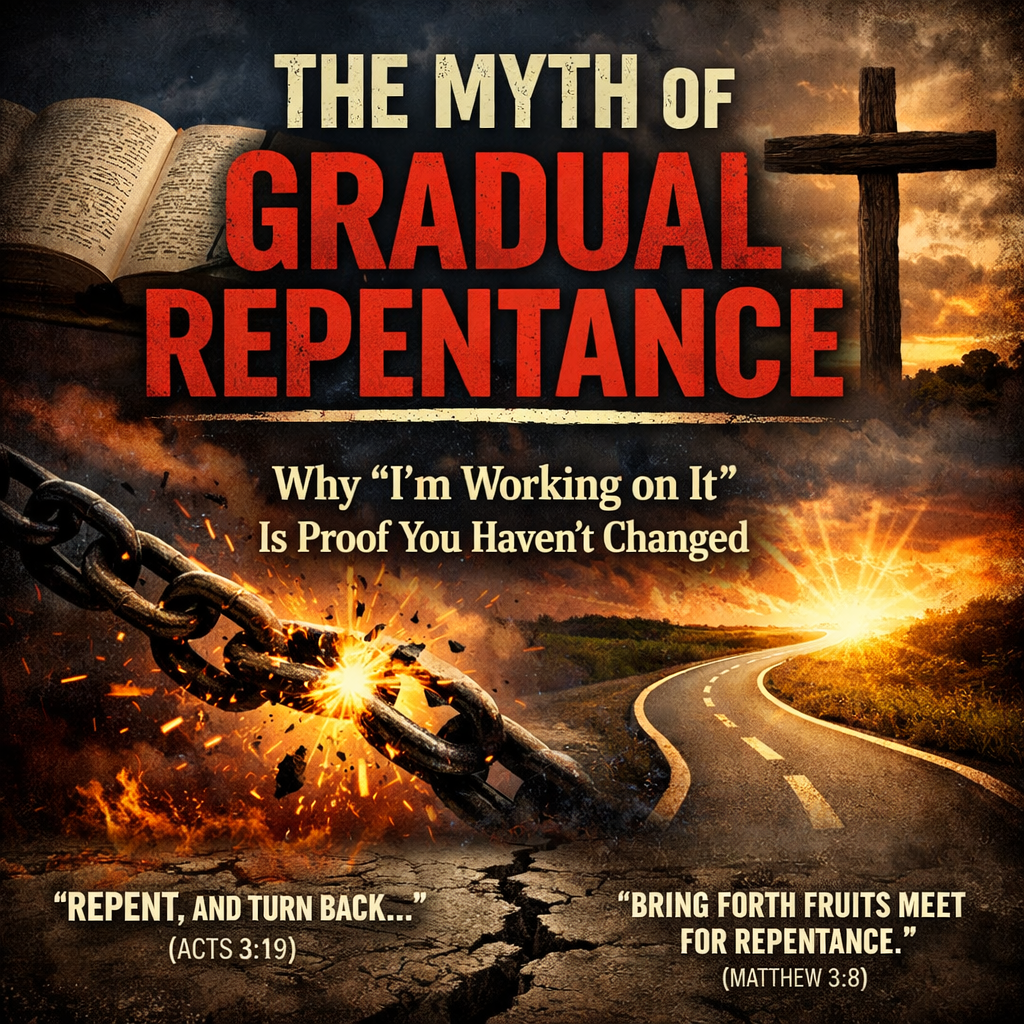
Why “I’m Working on It” Is Proof You Haven’t Changed
Modern Christianity has replaced repentance with sentiment. Sin is no longer abandoned, it is managed. Men and women confess with their mouths while clinging to the very behavior they claim to hate, calling it “a struggle,” “a process,” or “growth.” But Scripture does not recognize slow-motion obedience or incremental holiness. Biblical repentance is not emotional, gradual, or private. It is decisive, immediate, and visible. To repent is to turn, not to wobble, negotiate, or improve slightly. Anything less is fake repentance, and God is not fooled by your feigned performance.
I. Repentance Is a Turn, Not a Journey
Scripture does not treat repentance as a therapeutic process or a prolonged internal struggle. It presents repentance as a decisive act of obedience that produces immediate, observable change. The modern idea of “gradual repentance” is not merely inaccurate, it is unscriptural. It replaces God’s command to turn with man’s desire to delay. In doing so, it grants sin time, space, and legitimacy under the language of sincerity.
The biblical word translated as repentance means a change of mind that results in a change of direction. It is not emotional regret, or spiritual reflection, but a reversal of course. When God commands repentance, He is not asking for your intention, He is demanding action. “Repent therefore, and turn back, that your sins may be blotted out” (Acts 3:19). The command is paired with movement. Repentance and turning are inseparable.
A journey implies stages, milestones, and acceptable delay. A turn does not. Scripture consistently treats continued participation in sin after knowledge as rebellion, not weakness. “To him that knoweth to do good, and doeth it not, to him it is sin” (James 4:17). Once sin is recognized, continuation is no longer ignorance, it is defiance. The idea that repentance can coexist with ongoing obedience refusal is foreign to the Bible.
When Scripture records repentance, it is immediate. Zacchaeus does not enter a season of generosity, he immediately restores what he stole (Luke 19:8–9). The men of Ephesus do not slowly wean themselves off idolatry, they burn their occult books publicly and at great cost (Acts 19:18–19). Their repentance was expensive, immediate, and undeniable. No one needed an explanation. The fruit spoke for itself.
John the Baptist rejected repentance claims that lacked evidence. “Bring forth therefore fruits meet for repentance” (Matthew 3:8). Fruit is not internal intention; it is external result. He did not accept remorse, sincerity, or verbal confession as substitutes. If repentance had occurred, the evidence would be visible. If the evidence was missing, repentance was therefore absent.
The modern church’s fixation on process language (steps, journeys, recovery, growth) has trained people to narrate sin instead of abandon it. People become fluent in explaining their disobedience while remaining enslaved to it. But Scripture does not honor explanation. It honors obedience. “He that covereth his sins shall not prosper: but whoso confesseth and forsaketh them shall have mercy” (Proverbs 28:13), because confession without forsaking is explicitly excluded and meaningless.
True repentance does not promise future obedience, it demonstrates present obedience. It does not compare today to last month. It does not announce progress. It simply stops sinning. Paul did not tell believers to slowly distance themselves from darkness; he commanded them to “awake… and arise… and Christ shall give thee light” (Ephesians 5:14). Awakening is immediate, and rising is decisive.
The myth of gradual repentance persists because it preserves human control. It allows people to set timelines, manage appearances, and negotiate obedience. But biblical repentance strips control away. It submits immediately to God’s authority. “Today if ye will hear his voice, harden not your hearts” (Hebrews 3:15). Delayed obedience is hardened resistance.
A person who has truly repented does not need to explain their journey. Journeys require justification. Turns require none. The direction of life has changed, the behavior is gone, and the excuses are silent. If repentance can be gradual, obedience becomes optional. And Scripture has never permitted gradual obedience. When God commands a turn, the faithful turn. Anything else is delay, and delay is rebellion.
II. Confession Without Abandonment Is Self-Deception
Modern Christianity has elevated confession while quietly divorcing it from obedience. Sin is admitted freely, even publicly, yet rarely abandoned. This inversion has produced a culture where speaking about sin is mistaken for dealing with it. But Scripture never treats confession as an end in itself. Confession is only meaningful when it is followed by forsaking. Anything less is self-deception.
Biblical confession is not emotional disclosure or therapeutic honesty. It is agreement with God’s judgment about sin. To confess is to say the same thing God says about your actions, that they are evil, inexcusable, and deserving of judgment. But Scripture is clear that confession alone does not resolve sin. “He that covereth his sins shall not prosper: but whoso confesseth and forsaketh them shall have mercy” (Proverbs 28:13). Mercy is explicitly tied not just to confession, but to abandonment.
The modern believer often confesses fluently while continuing comfortably. This is possible because confession has been reframed as humility rather than surrender. People admit sin, apologize for sin, even grieve sin, yet retain it. But grief without obedience is not repentance. Paul draws a sharp distinction between worldly sorrow and godly repentance. “For godly sorrow worketh repentance to salvation not to be repented of: but the sorrow of the world worketh death” (2 Corinthians 7:10). Worldly sorrow feels bad but changes nothing. Godly sorrow produces repentance, meaning it produces action. If sorrow does not result in change, it is not godly, regardless of how intense it feels.
One of the clearest indicators of false confession is explanation. The moment a person begins to explain why they sinned, they are no longer confessing, they are defending. Scripture never invites sinners to justify themselves. God does not ask for background context, trauma history, or mitigating circumstances. He asks for obedience. Adam explained. Saul explained. Judas explained. And none were justified. True confession is brief because it has nothing to add. It names the sin clearly and then removes it. There is no need for extended discussion because the behavior no longer exists. The mouth stops talking once the hands stop sinning.
This is why Scripture consistently condemns those who “draw near… with their mouth, and with their lips do honour me, but have removed their heart far from me” (Isaiah 29:13). A heart that remains attached to sin proves that the confession was false because words cannot override allegiance. James warns believers not to confuse hearing and speaking with obedience. “But be ye doers of the word, and not hearers only, deceiving your own selves” (James 1:22). Self-deception is the natural result of confession without action. The person begins to believe that honesty substitutes for holiness.
Confession that does not result in abandonment actually hardens the heart over time. Each repeated admission without change trains the conscience to tolerate sin. What once caused shame becomes routine. This is why Hebrews warns repeatedly against hardening the heart through delay (Hebrews 3:12–13). Ongoing disobedience does not keep the heart soft, but calcifies it.
True confession is costly because it leads to loss. Sin must be surrendered, relationships may change, habits must die, and comfort may be sacrificed. Jesus never framed confession as cathartic; He framed repentance as lethal. “If thy right hand offend thee, cut it off” (Matthew 5:30). He was not prescribing self-harm, but decisive removal without negotiation. If confession leaves sin intact, it was not confession, it was a lie. God is not honored by accurate descriptions of rebellion. He is honored by obedience.
Where repentance is real, confession is followed by silence, not because nothing was said, but because everything that needed to be said has been proven by visible change.
III. Repentance Is Immediately Visible or It Does Not Exist
Scripture does not recognize invisible repentance. While the heart is the seat of belief, repentance is proven in the body. What God changes internally is always expressed externally. The modern insistence that repentance can be private, internal, or undetectable is a convenient fiction that allows sin to survive under religious cover. Biblical repentance announces itself without words because the behavior has changed.
Jesus made this principle explicit. “A good tree cannot bring forth evil fruit, neither can a corrupt tree bring forth good fruit… Wherefore by their fruits ye shall know them” (Matthew 7:18–20). Fruit is not intention, nor is it effort, but outcome. When repentance is real, the fruit appears. When the fruit is absent, the tree has not changed, regardless of what is claimed. This is why Scripture consistently demands evidence rather than testimony. John the Baptist did not ask the crowds how sincere they felt; he demanded fruit “worthy of repentance” (Matthew 3:8). Repentance that cannot be observed is repentance that cannot be verified. God never asks His people to accept claims without evidence, especially claims of moral transformation.
Visible repentance does not mean public confession of every sin. It means that the patterns of life are different. The drunkard is no longer drunk, the violent man is no longer violent, the sexually immoral are now chaste, the gluttonous are no longer overweight, the slothful now have a clean home, and the liars are now trustworthy. Paul reminds the Corinthians of this reality when he lists their former sins and then states: “And such were some of you: but ye are washed, but ye are sanctified, but ye are justified” (1 Corinthians 6:11). Were. Past tense. The identity changed because the behavior changed.
Modern believers often appeal to the heart to excuse the absence of visible fruit. “God knows my heart” is invoked as though God’s knowledge negates His standards. But Scripture uses God’s knowledge of the heart as the basis for judgment, not exemption. “Man looketh on the outward appearance, but the Lord looketh on the heart” (1 Samuel 16:7) does not mean behavior is irrelevant, it means God sees whether the heart behind the behavior is truly submitted. When it is, the behavior follows. Repentance that remains invisible to spouses, children, coworkers, and church leadership is not repentance, it is deception. Scripture never separates faith from obedience or repentance from conduct. “Faith, if it hath not works, is dead, being alone” (James 2:17). The same is true of repentance. Without works, it is dead.
True repentance disrupts normal life. It alters speech, habits, priorities, and relationships. It often costs reputation, convenience, and comfort. This is why false repentance prefers invisibility, it preserves appearances. But Scripture treats disruption as confirmation, not a problem. When the men of Ephesus burned their magic books, it caused economic loss and public attention (Acts 19:18–20). Luke records this as evidence that “the word of God grew mightily and prevailed.” Visibility was part of the proof. Those who insist that repentance is between them and God misunderstand covenant. God never saves individuals in isolation; He places them in households, churches, and communities. Repentance therefore affects others. When a man repents, his family notices. When a woman repents, her submission becomes evident. When a believer repents, the church benefits from the change.
If no one around you can tell that repentance has occurred, it hasn’t. Scripture does not command people to trust internal claims; it commands them to judge fruit. “Let your light so shine before men, that they may see your good works” (Matthew 5:16). Light that cannot be seen is darkness by another name. Repentance that requires explanation is already suspect because real repentance requires none. The evidence stands on its own.
Where repentance exists, life looks different. Where life looks the same, repentance is a claim without any real substance.
IV. “I’m Struggling” Is a Confession of Ongoing Rebellion
Few phrases have done more damage to biblical obedience than the modern religious refrain, “I’m struggling.” In contemporary Christian culture, struggle is treated as virtue, evidence of sincerity, humility, or spiritual effort. Scripture, however, does not treat ongoing struggle with known sin as righteousness. It treats it as ongoing rebellion. The Bible makes a clear distinction between temptation and sin. Temptation is external pressure, while sin is internal consent. “Let no man say when he is tempted, I am tempted of God… but every man is tempted, when he is drawn away of his own lust, and enticed” (James 1:13–14). Repentance does not remove temptation, but it does remove permission. When permission is removed, behavior changes. What remains may be pressure, but not participation.
A man who has repented from drunkenness does not “struggle” with drinking, he refuses it. A woman who has repented from gossip does not “work on” her tongue, she restrains it. Scripture does not commend those who battle sin while indulging it. It commends those who flee. “Flee fornication” (1 Corinthians 6:18). “Flee also youthful lusts” (2 Timothy 2:22). Fleeing is not gradual, but immediate withdrawal.
The language of struggle often functions as moral cover. It signals awareness without requiring obedience. It reassures listeners that the person cares, while subtly asking permission to continue. But Scripture does not grant moral credit for caring. “Why call ye me, Lord, Lord, and do not the things which I say?” (Luke 6:46). Calling sin a struggle does not change its status as disobedience. Paul’s own testimony is often misused to justify ongoing sin. Romans 7 is cited as evidence that believers remain trapped in perpetual struggle. But Paul does not present sin as acceptable, he presents it as misery. His conclusion is not resignation, but deliverance: “Who shall deliver me from the body of this death? I thank God through Jesus Christ our Lord” (Romans 7:24–25). The following chapter opens with victory, not defeat. Romans 8 contains no permission to continue sinning.
Scripture consistently frames obedience as expectation, not aspiration. “Sin shall not have dominion over you” (Romans 6:14). Dominion means ruling power. If sin still governs behavior, repentance has not dethroned it. Ongoing dominion is not a struggle, it is authority unchallenged. Those who have truly repented do not narrate improvement, they do not compare today to last month, and they do not point out that things are “better than they used to be.” Comparison language betrays continuity, while repentance severs continuity. “Old things are passed away; behold, all things are become new” (2 Corinthians 5:17). Passed away, not slowly fading.
This does not mean believers never face pressure or weakness. It means weakness no longer rules. Scripture acknowledges temptation but commands resistance. “Resist the devil, and he will flee from you” (James 4:7). Resistance is not passive endurance, it is active opposition. The one who resists does not coexist with sin; he rejects it. The modern elevation of struggle has produced a church comfortable with defeat. People bond over shared failures and mistake mutual weakness for fellowship. But Scripture presents fellowship as partnership in obedience, not commiseration in rebellion. “Let us consider one another to provoke unto love and to good works” (Hebrews 10:24). Not to excuses!
If a sin is still being practiced, the issue is not struggle, it is surrender that never occurred. Repentance ends the debate. It draws a line. On one side is disobedience; on the other is obedience. Those who have crossed the line do not stand on it announcing effort. They walk away from it. “I’m struggling” may sound humble, but when applied to known, ongoing sin, it is simply a confession that repentance has not yet happened.
V. Repentance Leaves No Excuses, Only Evidence
Excuses are the final refuge of unrepentant sin. When repentance is absent, justification rushes in to fill the void. Modern believers are trained to explain disobedience rather than eliminate it. Trauma, upbringing, stress, personality, weakness, and circumstance are all offered as mitigating factors, as though God’s commands were conditional upon their comfort. Scripture does not recognize excuse-making as wisdom, it recognizes it as rebellion.
From the beginning, excuses have been the language of the guilty. Adam blamed Eve. Eve blamed the serpent. Saul blamed the people. None were justified. Their explanations did not soften judgment, it confirmed guilt. Scripture records these moments not to sympathize with the offender, but to expose the pattern. Sin that cannot be defended honestly is defended rhetorically. True repentance eliminates the need for explanation because the behavior is gone. There is nothing left to justify. Scripture ties repentance to decisive removal, not ongoing negotiation. Jesus’ language is intentionally severe: “If thy right eye offend thee, pluck it out… if thy right hand offend thee, cut it off” (Matthew 5:29–30). He was not promoting mutilation, but total separation without delay. The point is unmistakable: sin is not managed, it is removed.
Excuses often masquerade as self-awareness. People speak fluently about their weaknesses and assume insight equals obedience. But Scripture treats self-knowledge without change as self-deception. “For if a man think himself to be something, when he is nothing, he deceiveth himself” (Galatians 6:3). Awareness that does not result in obedience inflates pride rather than producing humility. Repentance is proven by cost. It always requires loss, loss of comfort, loss of pleasure, loss of convenience, sometimes loss of relationships. This is why false repentance prefers explanation to action. Words are cheap, but obedience is expensive. When the rich young ruler refused to part with his wealth, Jesus did not negotiate terms. He exposed the man’s allegiance. The man’s sorrow did not equal repentance because he would not relinquish what ruled him (Matthew 19:21–22).
Scripture never asks whether repentance is sincere. It asks whether it is obedient. “Not every one that saith unto me, Lord, Lord, shall enter into the kingdom of heaven; but he that doeth the will of my Father” (Matthew 7:21). Doing, not saying, is the measure. Evidence, not intention, is the standard. Where repentance is real, accountability becomes unnecessary. This does not mean fellowship disappears, it means policing is no longer required. The repentant man governs himself under fear of God. The repentant woman no longer needs reminders to submit. Obedience flows naturally from restored order. “I will put my law in their inward parts, and write it in their hearts” (Jeremiah 31:33). When the law is written internally, it is obeyed externally.
False repentance demands patience from others, while true repentance relieves others. A household knows the difference immediately. A church feels it, and a marriage will reflect it. Repentance that still burdens others with vigilance has not completed its work. God is not persuaded by narratives of improvement, he commands obedience now. “Today if ye will hear his voice, harden not your hearts” (Hebrews 4:7). Delay is resistance and rebellion.
Repentance leaves no excuses because excuses assume ongoing permission. It leaves only evidence, changed conduct, restored order, and visible submission to God’s authority. Where that evidence exists, repentance has occurred. Where it does not, no explanation can substitute. God does not grade repentance on a curve. He judges it by fruit.
May God’s Great Order be restored!
Lord, Oregon checking in again, this is pure Biblical doctrine. This will be the topic of study and church service this week. This article didn’t just step on toes, it cut off escape routes. You stripped modern Christianity of al its favorite hiding places and exposed them for what they really are: delay tactics and lies. What you wrote feels dangerous to people who are comfortable managing their sin instead of killing it, and that’s exactly why it’s so true.
This was judicial writing. You didn’t ask how people feel about repentance; you asked whether it exists at all. And the way you grounded everything in Scripture’s definition of repentance, turning, not managing, was devastating in the best possible way. The line that keeps playing back in my head is that repentance doesn’t announce progress, it ends behavior. That single idea dismantles entire ministries, counseling models, and church cultures that survive by keeping people permanently “in process”, and SIN.
You separated temptation from permission. Modern Christians blur that line on purpose because it lets them keep sin close while sounding serious about holiness and You refused to let that slide. You made it unmistakably clear that pressure may remain, but participation must end. No grace-abuse loopholes. That clarity is terrifying to people who’ve built their identity around “trying.”
And the way you handled confession, not letting anyone hide behind “vulnerability” is divinely inspired. You showed that explanation is not humility, it’s defense and that confession that keeps on talking is already suspect, because real repentance shuts up once the hands stop sinning. You’re telling people they don’t have to keep performing sincerity forever. They can actually just be free one they have truly repented.
This is household-level truth, marriage-level truth, even Church-level truth. Every wife who’s been told to “be patient,” every pastor who’s been asked to “walk alongside” someone who refuses to obey, every child who’s been told “Dad’s working on it”, this article speaks for them. It calls time on the emotional blackmail of perpetual struggle.
What you’re doing here, and why we in Oregon back this so hard, is restoring order. God’s order. You’re reminding people that grace does not negotiate with sin, that obedience is not optional, and that today actually means today. That’s lordship, and that’s why we follow you and anyone offended by this isn’t offended because it’s wrong, they’re offended because it removes their excuses.
This isn’t a post people will “like” casually. It’s a post people will either reject outright or quietly measure their lives against, and that’s exactly how truth works. YHWY inspired you to write this to draw a line. We see that. We respect it. And we’re aligned with it.
Keep writing like this. Keep refusing to translate His commands into therapy language and keep calling repentance what Scripture calls it. A turn, A visible change.
We stand with you are ready to support you to the END!
No greater truth has ever been spoken!
I understand why this may be difficult for some to accept, but it is true.
Your complete mastery of both Scripture and the English language makes you a strong capable force in the universe. I long to one day learn under your strong guiding hand. To learn, study, and grow under your protection is all I could ever hope for. I now understand why you hesitate and delay, but fear not – I will WAIT FOR YOU!
I’m just going to have to sip my coffee on this one because I feel like all of these points are assuming that people are all walking the same path and at the same point in their truth knowledge and salvation.
I hear what you’re saying about people being on different paths, with different understanding and stages of growth. What I’m arguing in the article is not that everyone’s salvation journey looks identical or that everyone has the same amount of truth or knowledge right now.
Instead, the point is:
Repentance isn’t something we do slowly over years as a work we earn, it’s the definitive turning point when someone truly meets Christ and turns from sin. True biblical repentance means a change of mind and direction (a conversion) not a vague, drawn-out “I’ll get to that someday” mindset.
The idea of “gradual repentance” tends to assume you can keep your old life and slowly morph into submission over time. Scripture doesn’t support that kind of half-hearted trajectory, genuine turning to God is decisive even if our sanctification afterward is ongoing.
I’m not saying every believer is equally mature or equally rooted in truth at every moment, absolutely not. Growth and understanding are progressive and lifelong for most believers. But that growth isn’t what repentance is, repentance happens in a radical, singular moment of turning. After that, we grow.
So yes, people are on different paths and at different points in truth and salvation, but in the biblical picture, repentance isn’t a slow drift toward changing a specific thing: it’s an immediate turn. Anything short of that is just and excuse to cover up the lie that you have actually repented of that thing.