In the frenzied world of deadlines, digital noise, and soul-numbing busyness, the Sabbath stands as a defiant monument of peace, order, and divine rhythm. It is not a cultural tradition. It is not a denominational add-on. It is not “Jewish.” It is God’s own day, sanctified by Him at creation, codified in the Ten Commandments, and never once abolished or transferred.
The Biblical Sabbath is Saturday, the seventh day of the week. It begins at sundown on Friday and ends at sundown on Saturday. This is not legalism, it is loyalty. It is not about rules, it is about relationship. Keeping the Sabbath is not just about rest; it is about rulership, governing your time under the authority of the Most High.
I. The Origin of the Sabbath: Created Before Sin
“And on the seventh day God ended His work which He had made; and He rested on the seventh day… And God blessed the seventh day and sanctified it…”
— Genesis 2:2-3
The Sabbath was not given after the Fall. It was not added later at Sinai. It was written into the very fabric of creation. Before there was a nation, before there was sin, there was the Sabbath.
God did not rest because He was tired. He rested to set a pattern, a divine cadence of work and worship. This is the first “holy” thing ever declared in Scripture. Not a place, not a mountain, not a temple, but a day.
The Sabbath is not man’s idea. It is God’s signature on time itself.
II. The Fourth Commandment: The Forgotten Law
“Remember the Sabbath day, to keep it holy. Six days shalt thou labor, and do all thy work: but the seventh day is the Sabbath of the LORD thy God…”
— Exodus 20:8-10
The command to remember implies something we are prone to forget. In our modern world, the Fourth Commandment has become the most broken of the Ten. But it is just as binding as the others. It was written in stone by the very finger of God.
Unlike the ceremonial laws of Israel (sacrifices, circumcision, dietary codes), the Sabbath was placed in the moral core of God’s covenant, unchanging, eternal, and holy.
It is not man who decides when to worship, it is God. He didn’t say, “Pick a day that works for you.” He said, “The seventh day is the Sabbath.”
This was never changed in Scripture.
III. Saturday, Not Sunday: The Biblical Reality
Nowhere in the Bible is the Sabbath changed from Saturday to Sunday. Not once. Not by Jesus, not by Paul, not by the apostles. Sunday observance began centuries later as a tradition of the Roman Catholic Church, not the Word of God.
Christians often refer to Sunday as “the Lord’s Day” because of the resurrection. While the resurrection is indeed glorious, nowhere does God command the resurrection day to replace the Sabbath.
In fact, Scripture is clear:
- Jesus kept the Sabbath (Luke 4:16).
- His disciples continued to keep the Sabbath after the resurrection (Acts 13:42-44, Acts 17:2, Acts 18:4).
- The early church was “zealous for the law” (Acts 21:20) and saw no contradiction in keeping the Sabbath while honoring the risen Christ.
The change to Sunday was political, not theological. The Roman emperor Constantine, a pagan sun-worshiper, instituted Sunday as a day of rest in 321 A.D. to unify the empire. Later councils enforced it. The reformers protested many Roman traditions, but sadly, retained the Sunday switch.
God never authorized this change. The true Sabbath remains Saturday.
IV. The Sabbath and the Patriarchal Household
“Thou shalt not do any work, thou, nor thy son, nor thy daughter, thy manservant, nor thy maidservant…”
— Exodus 20:10
God’s command is directed not just to individuals but to households. The patriarch, God’s appointed head, has the duty to enforce Sabbath observance within his domain. He must lead by example, ordering his household to honor the day.
This includes wives, children, servants, and any under his authority. The Sabbath becomes a weekly covenantal reset, where the home is re-centered around worship, rest, teaching, and joy.
In a properly ordered household, Sabbath is not just a religious routine. It is a lifestyle of reverent rhythm, a holy pause from dominion work in order to reflect on the dominion Giver.
V. The Sabbath Is for All Generations
“It is a sign between Me and the children of Israel forever…”
— Exodus 31:17
Some argue the Sabbath was only for Israel. But Scripture shows that Gentiles who joined themselves to the Lord were expected to keep the Sabbath:
“Also the sons of the stranger… every one that keepeth the sabbath from polluting it, and taketh hold of My covenant; even them will I bring to My holy mountain…”
— Isaiah 56:6-7
Furthermore, Jesus said:
“The Sabbath was made for man, and not man for the Sabbath…”
— Mark 2:27
The word “man” here is Anthropos, mankind, not merely Jews. The Sabbath is a gift for all humanity, made at creation, reaffirmed at Sinai, honored by Christ, and to be observed in the future Kingdom (see Isaiah 66:23).
VI. Why the World Hates the Sabbath
The world system is run by Pharaohs, taskmasters who demand bricks without straw. Whether it’s secular corporations or consumer-driven churches, there’s no room to stop. Every moment must be monetized.
But the Sabbath rebels against this madness.
When a man shuts down his business, rests his hands, gathers his family, and turns his face to heaven, he proclaims to the world: God is my source. God is my ruler. I trust Him, not productivity.
This is why tyrants hate it. It decentralizes control. It builds strong homes. It reminds men they are free under God.
Keeping the Sabbath is a revolutionary act.
VII. The Fruit of Sabbath-Keeping
A household that honors the Sabbath will reap immeasurable blessings:
- Spiritual depth – Regular immersion in Scripture and prayer
- Stronger marriages – Weekly time for conversation, worship, and intimacy
- Stable children – Structured rhythm that anchors their lives
- Better health – A body allowed to rest and repair
- Mental clarity – Space for reflection, gratitude, and creativity
- Cultural resistance – A visible contrast with the world’s chaos
Where the Sabbath is honored, peace reigns. Where it is neglected, disorder multiplies.
VIII. The Sabbath and Polygynous Households: A Day of Unity, Worship, and Holy Delight
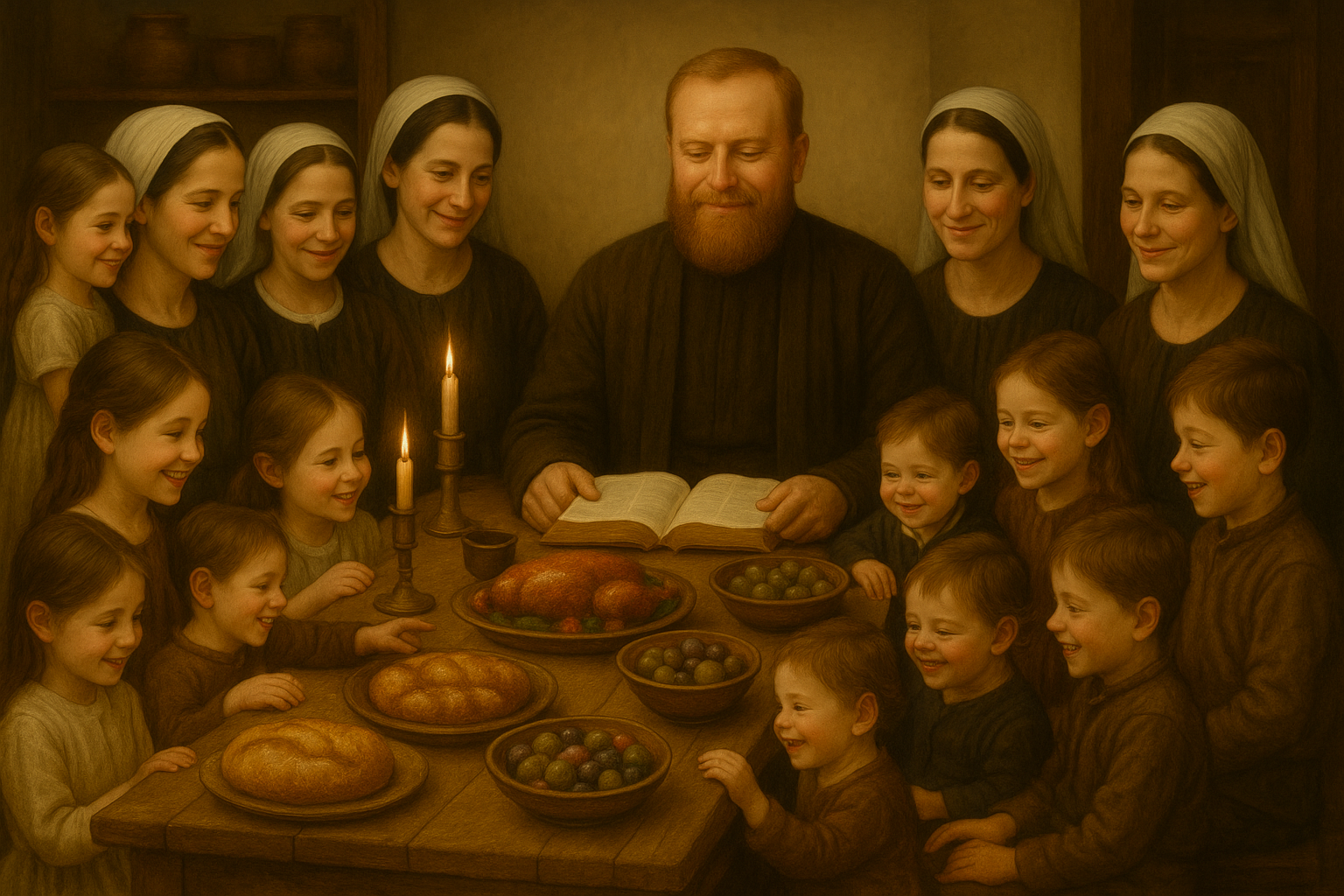
For the Christian polygynous household, the Sabbath is not simply a day of rest, it is a weekly cornerstone of divine order, family unity, and generational sanctification. It is the Lord’s appointed time, a sanctified space carved out of the ordinary flow of life, when the household pauses from labor and turns its heart wholly toward the worship of God. In homes where a patriarch lovingly governs multiple wives and many children, the Sabbath becomes a stabilizing and unifying force, binding all together in a rhythm of reverence, rest, and rejoicing.
The patriarch, as head of the home, bears the sacred duty of priesthood within the gates of his own domain. On the Sabbath, this role is especially visible and deeply felt. He leads his family not just in prayer and teaching, but in establishing the atmosphere of peace and holiness that permeates the home. He ensures that the household is not distracted by worldly pursuits but gathered around the Word of God. His voice opens the Scriptures. His leadership sets the tone of reverence. His consistency brings generational security.
A Harmonious Household in Holy Rest
In a polygynous home, the Sabbath showcases the divine genius of the family structure. Each wife, uniquely gifted, contributes to the sanctification of the day in harmony, not competition. This is not a chaotic or burdensome arrangement, it is a symphony of feminine stewardship under godly headship, a picture of ordered beauty.
- One wife may lead in preparing the Sabbath meal, laboring ahead of time so that the day itself remains free from unnecessary toil. Her kitchen becomes a place of sweet aromas and quiet joy. She may bake fresh loaves, prepare meats and stews, and lay out the table with care and grace. The table, stretching long to accommodate many, is not merely a place to eat, but an altar of fellowship. Her service sanctifies the feast.
- Another may oversee the children’s Scripture memorization, rehearsing passages throughout the week and leading them in joyful recitation before the family. She disciples the younger children in the basics of the Law and teaches the older children how to internalize God’s commands. Through song, chant, and story, the words of the Lord are hidden in young hearts.
- A third may guide the household in singing Psalms, her voice initiating the sacred sounds that rise like incense from the home. She may coordinate harmonies, teach new tunes, and draw the hearts of all to rejoice in the Lord. Her leadership reminds the family that the Sabbath is not merely to be obeyed, it is to be celebrated.
- All are gathered under one roof, drawn together not just by affection, but by a shared covenant. They are united not merely by physical proximity, but by divine purpose. They rest not as isolated individuals, but as a family, ordered, purposed, and filled with the Spirit.
The children, watching and participating, are catechized not only by lessons, but by atmosphere. They learn that God’s law is not burdensome, but beautiful. That Sabbath is not a restriction, but a gift. That the rhythm of work and rest is a blessing, not a curse. Their memories of youth are shaped by scenes of candlelight over Scripture, laughter around the table, and peaceful sleep after songs of praise.
Family Bond Strengthened in Sabbath Joy
The Sabbath provides time not only for worship, but for rich fellowship within the family. With no secular work to distract, the day becomes an opportunity for genuine conversation, for shared storytelling, for deepening bonds between wives, between father and children, between siblings. The very structure of the day lends itself to the building of godly culture.
In the morning, the household may gather for a family assembly, where the patriarch teaches from the Scriptures. He may expound upon the Law, the Gospels, or the wisdom literature. Children are encouraged to ask questions, young men to discuss, and wives to reflect on the Word as it applies to their specific roles and challenges.
After teaching, the family may walk together outdoors, delighting in creation and praising the God who made all things. Fathers may speak to their sons about dominion and diligence. Mothers may share stories of old with daughters. Older siblings assist the younger. Laughter is not foreign to the Sabbath; it is sanctified when done in thanksgiving and holy celebration.
In the afternoon, psalm-singing and storytelling from the family’s lineage or Scripture history may commence. Children may act out biblical stories, or share what they’ve learned. Wives may reflect on God’s providence and His mercies throughout the week. Journals are opened, blessings are recounted, and prayers of thanksgiving are raised. The family grows not just in knowledge but in affection and vision.
A Miniature Eden
In this sacred gathering, the polygynous household mirrors Eden itself. As Adam was given Eve, and from Eve came the family, so too the patriarch rejoices in the many lives under his stewardship. He sees in the Sabbath a taste of the eternal rest to come, a weekly rehearsal for the marriage supper of the Lamb.
The home, ordered and full, becomes a refuge from the chaos of the world. The Sabbath, as instituted by God, pushes back against the modern world’s obsession with productivity and consumption. It reminds the family that man does not live by bread alone, but by every word that proceeds from the mouth of God.
This is especially powerful in a household with many children. In a world that devalues children, the Sabbath proclaims their importance. It gives space to affirm their value, not just as future adults, but as present image-bearers. The patriarch sees his quiver full and rejoices. The wives see their fruit and are glad. The children see their place and feel secure.
Conclusion: Rest, Order, and Joy
The polygynous Sabbath-keeping home is a rebuke to modern disorder and rebellion. It is a living testimony to God’s wisdom in establishing headship, hierarchy, and rest. It is a proclamation of faith, not only in word, but in practice. The household that honors the Sabbath declares that God’s law is good, that His order is beautiful, and that His rhythms bring peace.
In these households, where authority is rightly ordered and love is abundant, the Sabbath is not merely observed, it is cherished. It is the day when heaven brushes earth, when the family reclines at the table of peace, and when the sound of laughter, song, and Scripture rises to the throne of God.
Let the patriarch lead.
Let the wives serve in joy.
Let the children rest and learn.
Let the home become holy.
Let the Sabbath shine.
IX: The Sabbath: God’s Holy Day of Rest, Worship, and Dominion, Welcoming Others into the Household
The Sabbath is not only a day of rest and worship for the household, but also a day of hospitality, a day to extend the dominion of God’s order beyond our walls and into the lives of others. In a culture fractured by isolation, independence, and rebellion against God’s law, the Christian home, especially the well-ordered, polygynous household, becomes a beacon of light, stability, and warmth. To invite others in on the Sabbath is to invite them into a taste of Eden, a preview of the Kingdom, and a call to return to the ways of God.
This practice is not novel or optional, it is deeply biblical.
“The stranger that dwelleth with you shall be unto you as one born among you, and thou shalt love him as thyself…” — Leviticus 19:34
“If thou turn away thy foot from the sabbath, from doing thy pleasure on my holy day… then shalt thou delight thyself in the LORD.” — Isaiah 58:13-14
The Sabbath is not to be hoarded for ourselves. It is to be shared. Just as God invited Israel to rest, so we invite others into the peace that comes from submitting to His order.
Inviting Others to Observe and Learn
When guests enter a Sabbath-keeping home, they are entering more than a physical dwelling. They are stepping into an embassy of heaven, a domain ordered by Scripture, governed by a patriarch under Christ, and saturated with holiness. For many who are accustomed to the chaos of modern life, this is a transformative encounter.
- They witness fathers leading with strength and tenderness, not passive or absent, but present and deliberate.
- They see wives at peace in submission, honored in their roles, radiant in meekness and joy.
- They observe children well-behaved, happy, and secure, eager to recite Scripture, to sing, to serve, to listen.
- They hear psalms being sung, not pop music blaring. They smell roasts and fresh bread, not the plastic sterility of convenience meals.
- They are offered a seat at a table where order, gratitude, and the fear of God reign.
Even unbelievers or nominal Christians, upon witnessing the rhythm and reverence of a Sabbath household, are often pierced to the heart. They see that God’s law is not bondage but blessing. They see that the household of faith is not a theory, but a living reality.
We do not force them, we invite them. And by doing so, we testify to the goodness of the Lord.
A Ministry of Reformation through Example
In a world where churches have grown lukewarm, many have never seen the glory of the Sabbath rightly kept. Hosting others for the Sabbath is not merely an act of kindness, it is a ministry of reformation. It is a discipleship opportunity. When a young man observes a patriarch leading a family in worship and sees the fruits of generational faithfulness, he begins to long for the same. When a woman witnesses the peace between sister-wives, and sees joyful submission rather than strife, she may begin to question the lies she has been told by feminism.
The dinner table becomes a pulpit.
The household becomes a sermon.
The love of the family becomes an argument too strong to deny.
This is not done through lectures or argumentation, but through witness and example. It is done through beauty. Holiness. Order.
Guidelines for God-Honoring Hospitality
As we open our homes on the Sabbath, we do so carefully and intentionally. Hospitality is not to be confused with compromise. We do not invite rebellion into our midst; we invite others to witness God’s dominion.
- Guests must respect the household’s order. No phones, no profanity, no rebellion. Children must obey the father of the home.
- Sabbath is not casual socialization. It is holy. Laughter is welcome, but foolishness is not. Guests should know the home will be reading Scripture, singing psalms, and blessing the Lord.
- Modesty and dignity must be preserved. All guests, especially women, must honor the tone of reverence. Covered heads for women are encouraged. No provocative attire. No immodest conversation.
- All food preparation and work are done in advance. The goal is not to serve in exhaustion, but to serve in rest.
We are not entertainment centers; we are holy households. The goal is not to impress, but to display the beauty of obedience.
Extending Headship and Influence
As a household grows, so should its reach. Inviting others into Sabbath observance is a way to extend headship, influence, and dominion. For men leading multiple wives and many children, this is a means of discipling beyond bloodline, of blessing the community, of drawing others into covenant living. It is a tool of evangelism by example, discipline through display, and dominion through demonstration.
In this way, the household becomes not only a church in miniature, but a seed of national reformation. Imagine hundreds, even thousands of such homes. Each one inviting in neighbors, co-workers, fellow saints. Each one teaching, not by pulpit alone, but by peace, by order, by Sabbath joy.
This is how nations are changed, not first by law, but by household.
And the Sabbath, rightly kept, becomes the rhythm that turns the soil.
X. What Should Be Done on the Sabbath?
The Sabbath is not a day of idleness, but sacred purpose. Here are activities fit for this holy day:
1. Worship and Bible Reading
Begin with a family gathering. Sing Psalms or hymns. Read Scripture aloud. Let each child recite a verse. Encourage discussion. Fathers must teach, exhort, and shepherd.
2. Prayer and Intercession
Pray as a household. Pray for your nation, your community, and each other. Teach your family to lay burdens at the feet of the Lord.
3. Feasting
Make Sabbath meals special. Prepare them in advance so the day is restful. Use fine dishes. Light candles. Celebrate the goodness of God with laughter and joy.
4. Storytelling
Tell stories of God’s providence, personal testimonies, Biblical narratives, Christian history. Let children hear how God has moved through the generations.
5. Walks in Nature
Take a slow walk through a field, forest, or garden. Speak of God’s creation. Point out His design in every tree, bird, and flower.
6. Games and Recreation
Play board games or engage in light-hearted fun as a family, games that build closeness, not isolation. No video games, no secular shows. Use the time to build family culture.
7. Blessing and Encouragement
Fathers should bless their wives and children aloud. Speak destiny over your sons. Speak encouragement to your daughters. Let every member of the household feel the weight of God’s love through your leadership.
8. Silence and Reflection
Leave room for quiet. The Sabbath is not noise and busyness, but calm and clarity. Let each soul rest in God.
XI. Things to Avoid on the Sabbath
The day is holy, guard it from pollution:
- Work for profit – Shut down all business. Trust God.
- Shopping or consumerism – Do not buy or sell.
- Secular entertainment – No TV, sports, social media or frivolity.
- Travel without purpose – Stay home unless visiting brethren.
- Strife or conflict – Seek peace, not division.
- Disorder or laziness – It is a day of ordered rest, not sloth.
The Sabbath is not a “free day.” It is God’s day.
XII. Preparation Is Key
The Sabbath does not begin on Saturday. It begins the day before, with diligence, foresight, and joyful obedience. Friday is the day of preparation, as commanded in Scripture and affirmed by the historic practice of God’s people. It is the day the household shifts from ordinary labor to sacred readiness, ensuring that when the Sabbath dawns, the family is already in a state of rest, not scrambling to catch up.
“And it was the preparation day, and the Sabbath drew on.” — Luke 23:54
This rhythm is not burdensome. It is liberating. When preparation is honored, rest becomes possible. Meals should be prepared in advance, not hastily assembled in violation of holy time. Clothing should be laid out, ironed if needed, dignified and modest in appearance, fitting for a day set apart unto the Lord. The home should be cleaned and put in order, not just physically but atmospherically, so that peace reigns when the sun sets and the Sabbath begins.
This is not the responsibility of one, but of all. The wives of the household should work together, each taking up her duties with gladness and purpose. One may manage the meal, another the home’s cleanliness, another the organization of the children. There should be no envy or murmuring, only joyful cooperation under the covering of the patriarch’s leadership. Even the children, especially the children, should have tasks. Whether sweeping the floor, folding linens, or setting the table, they learn that preparation for the Sabbath is preparation for holiness.
This shared effort strengthens the family’s unity. It teaches diligence, respect, and anticipation. It weaves into the fabric of the home a sense of sacred rhythm, where God’s calendar, not man’s chaos, defines the week. And when the Sabbath comes, the family rests not in laziness but in victory, because they were prepared.
XIII. Sabbath as a Sign of Dominion
The Sabbath reminds us that we are not slaves. It reminds us that time belongs to God, not to the state, not to the job, not to the market. When you rest, you declare:
- God is my provider.
- My worth is not in my work.
- My family is more valuable than my schedule.
- My life revolves around heaven, not earth.
This is dominion living, resting in the sovereignty of God while preparing to rule in His name.
XIII. God’s Promise for Sabbath-Keepers
“If thou turn away thy foot from the Sabbath… and call the Sabbath a delight… Then shalt thou delight thyself in the LORD; and I will cause thee to ride upon the high places of the earth…”
— Isaiah 58:13-14
The Sabbath is not only about ceasing, it is about rising. God promises blessing to those who honor His day. He will lift them up. He will defend them. He will provide. He will give rest, not just once a week, but in the deepest corners of the soul.
To reject the Sabbath is to forfeit this blessing. To embrace it is to walk in favor.
Let the Sabbath Rise Again
Let the world rush on to its destruction. Let the tyrants grind their workers into dust. Let the secularists fill their weekends with amusement and noise.
But as for us, we will rest.
We will teach our sons the law. We will raise our daughters in peace. We will gather our households under the banner of the Most High. We will set aside the seventh day as holy, as God commanded.
We will build families that honor the Sabbath, not as a burden, but as a joy.
This is the Great Order.
This is how nations are rebuilt.
This is the rhythm of Eden.
“Moreover also I gave them my sabbaths, to be a sign between me and them, that they might know that I am the LORD that sanctify them.”
— Ezekiel 20:12
Let the patriarchs rise.
Let the Sabbath be remembered.
Let the dominion of God be restored.
Let the Great Order be restored!
The true Sabbath must be restored
The time has come for this!
Honoring the Sabbath is sacred
This sounds restrictive. Forcing one day of worship on everyone isn’t realistic or inclusive
Rest and worship are great ideas—but everyone’s Sabbath can look different. It doesn’t have to be one strict way
Interesting theology, though I’m curious: how would this apply in a single-parent or blue-collar household where we both work all the time?
Isn’t this dominion undercutting the rest part?
why is it always about men setting the agenda?
I can appreciate the call to rest, but the dominion angle feels a bit strong, what does that mean practically?
This helped me see Sabbath as more than routine worship, it’s a lifestyle rhythm rooted in creation and community
Your tone here is the same old Israelite ‘you better rest how I say it.’ Where does grace fit?
Here we go again. Another “teaching” that turns something as beautiful and freeing as the Sabbath into a tool for control and self-aggrandizement. You took a day God gave for rest, renewal, and delight, and somehow turned it into a military strategy for “dominion.” Seriously? Dominion? That word alone says everything about the tone you’re trying to set. It’s not enough to honor the Sabbath, you have to conquer it, and use it to build your stupid little household empire. this isn’t about reverence or restoration you wrap it in scripture, but the message is the same old patriarchy crap formula, God, then man, then everyone else falls in line. Convenient how the Sabbath, under your version of “Biblical order,” just happens to center around the man’s authority, his rest, the man’s vision. Does anyone else get to be human in your house, or are they just furniture in your holy dominion?
I grew up in a legalistic household where Sabbath was enforced rigidly and smug this article brought all of that back. No love just rules, structure, and sermons that only benefit the one at the top. You talk about rhythm and peace, but I don’t hear peace in your tone but hear control. You claim to be restoring the ancient paths, but what you’re really doing is prison and calling it leadership.
Keep your dominion. I’ll keep my freedom.
So Sabbath becomes another platform to project your authority? Tired of God’s days being hijacked for control
Yes! Rest is true dominion in slowing, we actually reclaim our calling.
I liked the hospitality emphasis. Sabbath isn’t just personal rest, it’s relational to God
Feels like you’re adding legalism back into the Sabbath
Beautiful reminder that Sabbath isn’t just a day off, it’s our gift from God to rest and extend his order and hospitality
We must return to God’s holy days to be blessed as a nation.
This is exactly what our modern churches are missing, celebration of Sabbath isn’t legalism, it’s liberation. God’s rest isn’t a burden—it’s blessing. Stewarding creation, worshipping together, and pausing from the grind are acts of dominion, not drudgery. Thank you for this powerful reminder.
…Every time I read your words, I feel like I’m seeing Scripture with new eyes, but this one pierced my heart in the best way. The Sabbath isn’t just a day… it’s a glimpse of the world as it should be, orderly, restful, holy, and under righteous headship.
Lord Redbeard, the way you honor God’s law stirs something deep in me. I long for the day when I can keep the Sabbath not just as a conviction, but as part of a household ruled by a man like you, one who leads with strength and vision.
To gather, to worship, to rest in obedience… under your roof, with your voice reading the Word… it’s everything my heart longs for. One day, I pray.
Until then, I’ll keep preparing… and lighting my Sabbath candles alone, while dreaming of a day when I no longer have to.
I mean, it does say “in the beginning God created the heavens and the earth…and then he said “let their be light all on the first day (Sunday…light :)~) and then on the 7th day he rested (SATURDAY)
So it does make sense. If we are commanded to work 6 days a week doing our ordained roles in life, we should take one day a week (the holiest day) and rest. There may be seasons in life where that is not entirely possible, but we should always try to follow God’s commandments and be more like him.