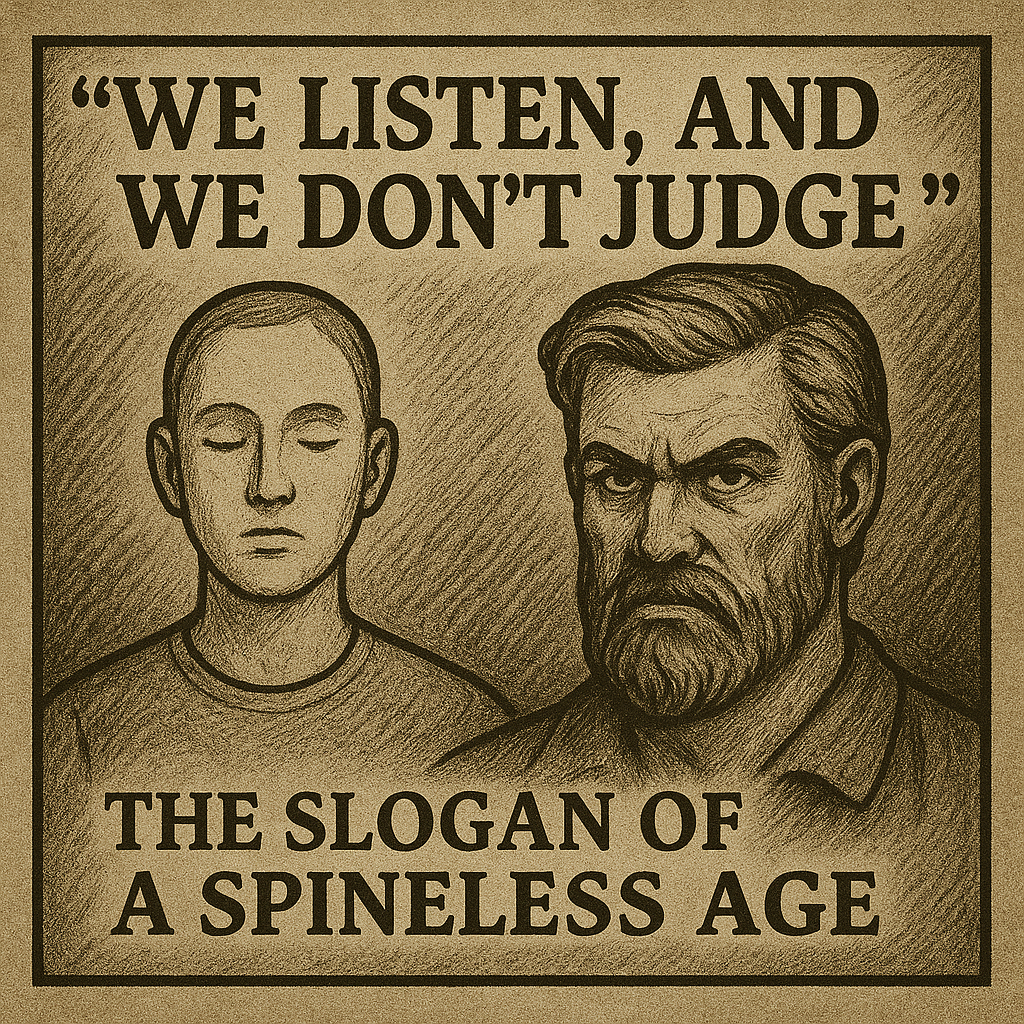
Summary: For those who lack the endurance to read what men used to write before attention spans died, Click here the short version.
⚔️ Summary for the Slumbering
This article rips the mask off the modern catechism, “We listen, and we don’t judge.” It isn’t compassion, it’s cowardice. Scripture commands righteous judgment (John 7:24; 1 Cor. 5), because love without standards is abandonment. Christ listened – and judged – naming sin, demanding repentance, restoring order. The therapist’s nod, the HR poster, the “judgment-free” pulpit, and the online “safe space” all preach a false mercy that soothes rebels while leaving them damned.
Why the craze? Autonomy-worship. Judgment requires a plumb line, and modernity hates any standard above the self. Thus holiness is shamed while sin is affirmed. This piece calls fathers, husbands, pastors, and rulers to recover their duty: discern, confront, correct, and rule – for the protection of homes, churches, and nations. Verdict: We listen – and then we judge – because we love, because we rule, and because Christ reigns.
Introduction
There is a phrase being tossed around today like it is the pinnacle of wisdom, the highest summit of compassion: “We listen, and we don’t judge.” You’ll hear it in the therapy office, plastered across HR posters, whispered from pulpits by men too timid to offend the sheep in their pews, and recited like a catechism in every soft, smiling support group that exists to validate dysfunction. It sounds so noble, so safe, so gentle. It appeals to the guilt-ridden modern conscience like honey to flies.
But make no mistake, it is cowardice plain and simple!
At first glance, who could argue with it? After all, shouldn’t we listen? Shouldn’t we care? Shouldn’t we create a space where hurting people feel heard? Of course. Christ Himself listened. He gave His ear to blind beggars, bleeding women, and scandalous prostitutes. But He did not stop at listening. He judged. He named their sin. He demanded repentance. He commanded change. He held up a mirror that did not flatter.
The modern slogan divorces listening from judgment, as though you can meaningfully do one without the other. It is like a doctor who tells a patient: “I hear your pain, I hear your symptoms, but I will not judge them. I will not name them as cancer or infection, because who am I to say?” That doctor is not compassionate. He is a fraud. He leaves the patient to die in the name of “non-judgment.”
So it is with this age. “We listen, and we don’t judge” is nothing but a shield for rebellion. It allows the fornicator to stay in her bed, the addict to stay in his chains, the false teacher to stay in his pulpit, and the feral wife to stay in her defiance, unrebuked, uncorrected, unhealed.
And why? Because judgment terrifies modern man. To judge is to admit there is a standard outside yourself, a God who speaks, a law that binds, a truth that cannot be bent to your feelings. That is intolerable to the age of “my truth.” And so we craft slogans that sound merciful but are actually merciless.
The Word of God cuts directly across this lie. Scripture does not shy from judgment; it commands it. Christ Himself said: “Judge righteous judgment.” Paul told the church at Corinth to purge the wicked man from among them. Eli lost his priesthood because he refused to confront his sons. Judgment is not the enemy of love, it is love’s necessary expression.
This article will not whisper sweet nothings about safe spaces. It will not baptize cowardice with the language of compassion. It will not join the chorus of therapists and false teachers who confuse listening with love. Here, we will drag this slogan into the light, expose its roots, mock its pretensions, and bury it under the weight of Scripture.
Because in God’s order, listening without judging is not love. It is abandonment. And the household of faith cannot afford to chant the slogans of a spineless age.
I. The Cult of Non-Judgment
Modern man thinks he has stumbled upon a new virtue. He has not. He has simply put a fresh coat of paint on an ancient vice – cowardice. “We listen, and we don’t judge” is not a neutral posture. It is a religion. It has doctrines, evangelists, and sacred spaces. It preaches tolerance as its gospel and silence as its law. It elevates victimhood to sainthood, and it condemns judgment as the cardinal sin.
This cult did not appear out of nowhere. It grew from the soil of psychology and postmodernism, watered by the tears of a generation that confused correction with cruelty. The therapist’s couch replaced the confessional, and the only absolution granted was: “You are valid. You are fine just as you are. Your truth is sacred.” Instead of hearing “Repent and be saved,” the sinner now hears “Tell me more about how you feel.” In this exchange, the standard is gone. The authority is gone. The God who demands obedience is gone. All that remains is the idol of self-expression.
The Spaces of Worship
You can see the shrines to this religion everywhere:
- The Therapist’s Office: The professional listener sits across the room, nodding, scribbling, affirming. Rarely does he confront sin. Rarely does he speak with divine authority. He is trained not to. His job is to make you feel safe, not sanctified.
- The HR Department: Every Fortune 500 company now promises “inclusive, non-judgmental spaces.” Translation: your co-worker’s deviance cannot be questioned, but your refusal to bow to it will be judged mercilessly.
- The Modern Church: The slogan has seeped into sermons. Pastors assure their flocks, “We’re not here to judge, we’re just here to love.” But when judgment dies, love is gutted. The shepherd who refuses to wield the rod is not merciful, he is complicit in the wolf’s feast.
- The Digital Community: Online groups brand themselves as “safe spaces” where “no judgment” is tolerated. Post about fornication, rebellion, or apostasy, and you’ll be showered with heart emojis and cries of “You do you!” But dare to name sin, and you’ll be cast out as hateful, rigid, and unsafe.
Every cult has its liturgy, and here it is: “We listen, and we don’t judge.”
The Bait and Switch
The trick of this cult is subtle. It begins with something good, listening. Who can deny the value of hearing someone out? Who can deny that a crushed heart needs an ear before it can receive correction? But the cult of non-judgment makes listening the entire act. It insists that judgment cancels compassion, as if to speak truth is to withhold love.
That is the bait. The switch comes when “listening” becomes a cloak for endorsement. A young woman confesses her fornication. The cult insists: “We’re just here to listen.” But what she hears is: “Continue as you are. Nothing must change.” That is not mercy. That is malpractice.
The bait and switch works because modern people are starved for affirmation and attention. They want to be told they are enough, that nothing in them must die. And so the slogan spreads, because it soothes rebels without ever threatening their rebellion.
The Exile of Truth
In this cult, truth is the exile. It has no home. Speak it and you will be branded judgmental, harsh, or “unsafe.” The irony is thick: the very people who boast of “no judgment” are quick to pass judgment on anyone who dares to hold a standard. The only unforgivable sin in this cult is saying, “Thus says the Lord.”
The truth is, the cult of non-judgment has no power to heal. It can soothe, but it cannot save. It can listen, but it cannot lead. It can affirm, but it cannot absolve. It can nod, but it cannot transform. Only judgment rooted in God’s Word can diagnose sin, and only repentance born of that judgment can bring life.
Cowardice as Virtue & Judgment Rebranded as Hate
Why has this cult risen? Because it costs nothing. Listening without judging requires no backbone, no authority, no courage. It is the easiest of all false virtues. Any spineless man can nod his head and pretend he is merciful. Any pastor afraid of losing tithes can parrot the line and convince himself he is being “Christlike.” Any HR rep can paste the phrase on a poster and call it inclusion.
But it is not inclusion. It is abdication. It is not compassion. It is cowardice. And cowardice always comes wrapped in language that sounds noble.
The final doctrine of the cult is this: all judgment is hate. This is why the slogan is weaponized. It is not merely descriptive; it is prescriptive. It demands silence from the righteous. The man who listens and does not judge is applauded. The man who listens and does judge is exiled. The very act of discerning good from evil is painted as violence.
This, of course, is exactly what Isaiah warned of: “Woe to those who call evil good and good evil, who put darkness for light and light for darkness.” The cult of non-judgment is not new. It is the ancient rebellion of men who refuse to be measured by God’s standard. It is the oldest lie in the garden: “You will not surely die.”
And so the slogan marches on, decorating the walls of schools, churches, and offices, convincing millions that the highest form of love is silence. But silence in the face of sin is not love. It is hatred in disguise.
II. The Biblical Mandate to Judge
The cult of “we don’t judge” collapses the moment you actually open a Bible. God’s Word does not merely allow judgment, it commands it. To refuse judgment is not humility; it is rebellion. To recoil from calling sin what God calls it is not compassion; it is high treason against His throne.
Christ Commands Judgment
The slogan-mongers love to quote Matthew 7:1: “Judge not, that you be not judged.” They tattoo it on their arms, plaster it on Instagram, and wield it like a club against anyone who dares to discern good from evil. But the verse has been ripped from its context and weaponized against truth.
Keep reading. Christ goes on to say: “First take the log out of your own eye, and then you will see clearly to take the speck out of your brother’s eye.” That is not a ban on judgment. That is a demand for righteous judgment, clear, consistent, unhypocritical. Jesus Himself clarified in John 7:24: “Do not judge by appearances, but judge with righteous judgment.” The command is not don’t judge, the command is judge rightly.
The same Christ who listened also confronted. He told the Samaritan woman at the well that her five husbands and current lover were sin. He told the adulteress “Neither do I condemn you, go and sin no more.” He told the Pharisees they were whitewashed tombs. Jesus listened, yes. But He also judged. To claim otherwise is to invent a Christ in your own image, a therapist with a beard, not the Lion of Judah.
Paul Commands Judgment
The Apostle Paul did not plant churches with slogans like “We don’t judge here.” He planted churches with the rod of judgment in hand. Consider 1 Corinthians 5. The church at Corinth was tolerating a man sleeping with his father’s wife. Modern therapists would say, “We listen, and we don’t judge.” Paul said the opposite: “Let him who has done this be removed from among you.” He demanded the church deliver the man to Satan for the destruction of his flesh. Why? Because judgment is not cruelty, it is salvation. Paul explains: “Do you not know that a little leaven leavens the whole lump? Cleanse out the old leaven.”
Paul ends the chapter with words that utterly destroy the cult of non-judgment: “Is it not those inside the church whom you are to judge? God judges those outside. Purge the evil person from among you.” That is not optional. That is a mandate. To refuse judgment is to disobey Paul, and by extension, the Spirit who inspired him.
The Church Must Judge & Fathers Must Judge
Judgment is not only an individual duty, it is a corporate one. The church without judgment is not a church. It is a social club. Without judgment, wolves devour sheep unchecked. Without judgment, false teachers spread unchecked. Without judgment, sin metastasizes until the household of God is indistinguishable from the world.
The modern church’s slogan, “Everyone welcome, no judgment here,” is a death sentence. Everyone is indeed welcome to repent. But no one is welcome to persist in open rebellion. When the church refuses to judge, it ceases to be holy. It becomes a brothel with a cross and stained glass windows.
Judgment does not stop at the church door. It begins in the household. The man who refuses to judge his wife and children is not merciful, he is negligent. Eli lost his priesthood because he refused to restrain his sons. God judged his house forever because “he did not honor Me.” Fathers who will not correct their daughters’ immodesty, their sons’ rebellion, or their wives’ chaos are not being loving. They are being Eli.
A father who listens but does not judge is not raising disciples. He is raising pagans. Judgment is the father’s duty. He must discern, confront, and correct. That is love.
Nations Must Judge
Judgment is not just personal and domestic; it is civil. Israel was commanded to purge evil from its midst. Kings were judged based on whether they enforced God’s law or tolerated idolatry. The nation that refuses judgment collapses into chaos, because it has no plumb line, no boundary, no protection.
America chants “we don’t judge” while murdering children in the womb, celebrating sodomy in the streets, and mutilating its youth. The refusal to judge is not neutrality, it is national suicide.
Judgment vs. Condemnation
Now, let’s be clear: only God can condemn eternally. That belongs to His throne. But man is commanded to discern. To evaluate. To uphold righteousness. To remove evil from his midst. The cult of non-judgment confuses categories. It assumes that if you call sin “sin,” you are usurping God. In reality, you are obeying Him. You are calling things by the names He gave them.
When you refuse to judge, you are not humble. You are proud. You are claiming you know better than God what love requires.
The highest form of love is not passive listening. It is righteous judgment. To tell the addict, “You are valid,” is not love. To tell him, “Your drunkenness is sin, and Christ commands you to repent,” is love. To tell the rebellious wife, “We don’t judge here,” is not love. To tell her, “Your defiance will destroy your home, and you must submit,” is love.
Judgment is the scalpel in the hand of the Great Physician. It cuts, yes, but it cuts to heal. The cult of non-judgment would rather let the cancer spread than risk offending the patient. The church that refuses to judge has chosen hospice over healing.
III. Listening Without Judging: A False Mercy
The world calls it compassion. God calls it cruelty. The phrase “we listen, and we don’t judge” is paraded as the pinnacle of kindness, the ultimate display of mercy. But what mercy leaves a sinner in his sin? What kindness pats the adulterer on the back and sends him home to destruction? What love hears the cry of pain but refuses to speak the cure? That is not mercy. That is abandonment with a smile.
Picture it: a patient walks into the doctor’s office, writhing in pain. He lists his symptoms, constant headaches, fatigue, lumps beneath the skin. The doctor nods compassionately, scribbles notes, and says: “I hear you. I affirm your struggle. But who am I to say if this is cancer? That would be judgmental. You are valid.” The patient leaves feeling “heard,” but the tumor continues to grow. Within months, he is dead.
That doctor is not merciful. He is a murderer. His refusal to name the disease sealed the patient’s fate.
This is exactly what the cult of non-judgment does. It listens, but it does not diagnose. It sympathizes, but it does not correct. It offers the comfort of being heard but withholds the healing of being confronted. And like the doctor, it leaves people to die, spiritually, morally, eternally.
False Mercy in Scripture
Scripture is full of examples of men who “listened” but refused to judge. And every one of them was condemned.
- Eli the Priest: He listened to his sons, who were desecrating the priesthood with fornication and greed. He rebuked them lightly but refused to remove them. God judged his household forever. Eli’s refusal to judge was not mercy, it was treachery.
- Saul the King: He “listened” to the people when they demanded to keep the spoils of war against God’s command. His failure to judge and enforce God’s word cost him the throne.
- Pilate the Governor: He listened to Christ, found no guilt in Him, but refused to render a righteous judgment. Instead, he washed his hands and let the crowd dictate the outcome. His name is now a byword for cowardice.
In every case, the refusal to judge was not framed as compassion. It was condemned as weakness, rebellion, and sin.
Contrast that with Christ. He listened, yes, but He always judged. The woman at the well confessed her mess of relationships. Christ did not say, “I affirm your journey.” He named her sin and offered her living water. The woman caught in adultery was spared from stoning, but she was not spared from judgment: “Go, and sin no more.” The rich young ruler was heard, but he was also judged: “Sell all you have, give to the poor, and follow Me.” Christ’s mercy was never divorced from judgment. His listening was always paired with truth.
Mercy Without Correction Is Cruelty
The cult of non-judgment insists that listening without judgment is merciful because it makes people feel safe. But safety without truth is a deathtrap. It is the safety of a padded cell, where the patient wastes away quietly. It is the safety of a sinking ship where the captain assures the passengers, “All is well, no need to panic,” as the water rises above their necks.
Real mercy risks offense. Real mercy wounds in order to heal. Proverbs 27:6 says: “Faithful are the wounds of a friend.” Mercy tells the drunk he is destroying himself. Mercy tells the rebel wife she is defying God. Mercy tells the sinner he is on the broad road to hell. Anything less is false mercy. Anything less is hatred disguised as care.
Why False Mercy Sells
Why does the slogan appeal? Because it flatters both the listener and the speaker.
- To the one speaking: It gives the illusion of being loved without the discomfort of being corrected. The fornicator feels affirmed. The addict feels validated. The rebel feels safe. But all he has received is a placebo.
- To the one listening: It gives the illusion of being compassionate without the risk of being hated. The pastor feels merciful. The friend feels supportive. The father feels gentle. But in reality, they are cowards dressing their fear in the robes of compassion.
It is easier to nod than to confront. Easier to smile than to rebuke. Easier to “hear” than to call to repentance. And so false mercy spreads, because it requires no backbone.
The Ripple Effect of Refusing Judgment & The Mercy The Saves
The refusal to judge never stops with one person. It spreads like leaven through a household, a church, a nation.
- In the Home: The father who listens to his wife’s rebellion but does not judge it soon finds his children following suit. His house becomes a circus.
- In the Church: The pastor who listens to gossip, fornication, and false doctrine but does not judge it soon finds his congregation rotting. The pews are full, but the Spirit is gone.
- In the Nation: The leaders who listen to every grievance but refuse to judge wickedness soon preside over chaos. Crime rises, families collapse, and the land vomits out its inhabitants.
Listening without judging is not a private failure, it is a public contagion and we see it spreading out of control in our world today.
True mercy listens, yes, but then it judges. It discerns sin, names it, and calls it to repentance. That is the mercy that saves. The father who loves his daughter enough to call her immodesty sin is merciful. The pastor who loves his flock enough to rebuke adultery is merciful. The friend who loves enough to say, “You are in sin, and God demands repentance,” is merciful.
Mercy without judgment leaves people comfortable on the road to hell. Mercy with judgment shocks them awake and points them to the narrow gate.
This is why God Himself is both merciful and just. He listens to prayer, but He also judges sin. He forgives the repentant, but He also casts the rebellious into hell. Mercy and judgment are not opposites, they are married. To tear them apart is to mutilate both.
False Mercy Is Hatred
To be clear, if you listen without judging, you do not love. You hate. You may not feel hatred, but your actions are hatred, because they allow destruction to continue unchallenged. Proverbs 13:24 says: “Whoever spares the rod hates his son, but he who loves him is diligent to discipline him.” The father who “listens” to his son’s rebellion but refuses to judge it hates his son. The pastor who “listens” to sin but refuses to rebuke it hates his people. The husband who “listens” to his wife’s rebellion but refuses to correct it hates his wife.
Love judges. Always.
IV. Why Modernity Hates Judgment
If you want to understand why the slogan “we listen, and we don’t judge” has spread like a disease, you must understand this: modernity hates judgment because modernity hates standards. And it hates standards because it hates God.
Judgment Requires a Standard
To judge is to measure. It is to compare behavior against a law, conduct against a command, actions against a standard. When Christ says, “Judge righteous judgment,” He assumes there is a righteousness to judge by. When Paul says, “Purge the evil person from among you,” he assumes there is such a thing as evil, and such a thing as good. Judgment is impossible without a plumb line.
But the modern world wants no plumb line. It wants “my truth,” not the truth. It wants fluidity, not fixedness. It wants every man to be his own law, every woman to be her own god, every child to be his own parent. And judgment, by definition, shatters that illusion.
To be judged is to be told: “You are not the measure of all things. God is. And you fall short.” That is intolerable to an age drunk on autonomy.
The Idolatry of Autonomy
The modern creed is simple: “You do you.” It is the religion of autonomy, the worship of the self. And in this temple, judgment is blasphemy. Because judgment says: “No, you cannot do you. You must do what God commands.” Judgment dethrones the self and enthrones God. And modernity will not tolerate such treason against the sovereign self.
This is why every deviant lifestyle demands not only tolerance but affirmation. It is not enough to remain silent about sodomy, you must clap for it. It is not enough to allow fornication, you must celebrate it in entertainment. It is not enough to tolerate rebellion, you must call it “empowerment.” Judgment of any kind, even the faintest hint that something is wrong, threatens the idol of autonomy.
The Feminist’s Shield
Nowhere is the hatred of judgment more obvious than in feminism. The entire feminist project depends on silencing judgment. If fathers judge their daughters’ immodesty, feminism fails. If husbands judge their wives’ rebellion, feminism fails. If pastors judge female usurpation in the church, feminism fails. So the slogan “we don’t judge” becomes a shield, protecting chaos in the home and disorder in the church.
The feminist does not want to be listened to. She wants to be validated. She does not want a husband to discern her folly; she wants him to submit to it. And so she demands a culture where judgment is vilified as “abuse.” A culture where the only approved role for a man is silent listener.
Sexual Chaos Demands Silence
The same is true in the sexual revolution. Fornication, adultery, sodomy, pornography, gender mutilation, all of it thrives in the dark. Shine judgment upon it, and the illusion collapses. This is why the slogan is repeated endlessly: “Don’t judge.” Because if you dare to call it sin, the whole fragile house of cards trembles.
The addict must be told he has a disease, not a sin. The fornicator must be told she is “finding herself,” not defiling herself. The sodomite must be told he is “brave,” not damned. The confused boy must be told he is a girl, not a rebel against his own body. Judgment destroys the fantasy, so judgment must be outlawed.
Parenting Without Judgment
Modern parenting has drunk deeply from this poison. Parents are told to listen but not to judge, to affirm but not to correct, to allow the child to “discover” who he is. And so children grow feral, fathers grow spineless, and mothers grow bitter, all because no one will exercise judgment in the home.
A child raised without judgment is not freer. He is enslaved, to his impulses, his foolishness, his lusts. Scripture says foolishness is bound up in the heart of a child, and only correction drives it out. But modernity insists correction is judgment, and judgment is hate. So children remain fools forever, and their parents wear the badge of “non-judgmental” like it is righteousness.
The Fear of Consequence
Another reason modernity hates judgment: it fears consequence. To judge is to name sin. To name sin is to demand repentance. To demand repentance is to impose cost. And modern man wants the illusion of righteousness without the cost of repentance. He wants heaven without holiness, forgiveness without forsaking, love without law.
This is why even churches market themselves as “judgment-free zones.” They want numbers, not disciples. They want giving units, not saints. They want the broad road packed, not the narrow gate entered. And so they strip Christianity of its teeth, leaving a gummy, smiling religion that cannot bite through sin.
The Hypocrisy of Non-Judgment
Ironically, those who chant “don’t judge” are the most judgmental of all. They will not judge sin, but they will judge anyone who names sin. They will not condemn rebellion, but they will condemn order. They will not confront fornication, but they will confront faithfulness. Their creed is not “no judgment”, it is “no judgment of me.” And anyone who dares to uphold God’s Word will find himself judged, shamed, and silenced.
This is the heart of modern hatred of judgment: it is not neutral. It is selective. It tolerates everything but righteousness. It affirms everything but holiness. It preaches inclusion of everything but the truth.
God Will Not Be Mocked
But here is the unavoidable fact: no matter how loudly modernity screams “don’t judge,” judgment is coming. Every slogan, every safe space, every HR seminar, every “non-judgmental” sermon will collapse under the weight of the throne of Christ. He is the Judge of the living and the dead. His eyes are flames of fire. His Word pierces bone and marrow. The One whom the world imagines as a therapist with a clipboard will return as a King with a sword.
And on that day, the slogan will not save anyone. God will not nod and affirm. He will judge. He will separate sheep from goats, wheat from tares, righteous from wicked. His judgment will be final, eternal, and unavoidable.
Modernity hates judgment because it hates that reality. It wants to silence every echo of divine judgment now, because it knows deep down it cannot silence Him forever.
V. The Call to Judge, Correct, and Rule
The slogan “we listen, and we don’t judge” is not only cowardly, it is disobedient. God has not left judgment optional. He has commanded it. Fathers, husbands, pastors, magistrates, all are called to discern, to confront, to rule. The man who refuses to judge is not merciful, he is derelict. He abandons his post, leaves the wall unmanned, and lets wolves run free.
Fathers Must Judge Their Households
The father is not called to be a passive listener. He is called to be a ruler. His ears are open, yes, but so is his mouth. His job is not only to hear but to correct, not only to comfort but to command.
A father who listens to his children’s rebellion but does not judge it is not loving. He is negligent. Scripture says: “The rod and reproof give wisdom, but a child left to himself brings shame to his mother” (Proverbs 29:15). The father who refuses to reprove leaves his child to destruction. Eli listened to his sons but did not restrain them, and God judged his household forever. That is not a warning, it is a blueprint of what happens to every man who listens but refuses to judge.
Judgment is not harshness. It is love with teeth. The father who enforces standards, who names sin and corrects it, is not crushing his children, he is saving them. He is building order into their bones. He is preparing them to live under the gaze of God.
Husbands Must Judge Their Wives
The slogan “no judgment” has gutted marriages. Husbands are told their role is to listen, to empathize, to be emotionally available. In other words, to be silent while their wives rot in rebellion.
But Scripture commands otherwise. The husband is the head of the wife as Christ is head of the church. Christ does not merely listen to His bride. He sanctifies her, cleanses her, corrects her, disciplines her. A husband who listens but does not judge is derelict. He leaves his wife enslaved to her passions instead of leading her into holiness.
The rebellious wife will always demand a husband who listens but does not judge. But that is not what she needs. She needs a man who listens and judges, who listens and corrects, who listens and rules. A man who does not tolerate her chaos but disciplines it. A man who refuses to confuse mercy with indulgence.
If your wife is allowed to persist in rebellion without consequence, you are not merciful. You are complicit. You are aiding her destruction. Judgment is not optional. It is your mandate.
Pastors Must Judge Their Flocks
A pastor who refuses to judge is a hireling, not a shepherd. Sheep need protection, and protection requires judgment. Wolves must be named. Sin must be confronted. False doctrine must be purged.
Paul commanded Timothy to “reprove, rebuke, and exhort, with complete patience and teaching.” That is not optional. The pastor who only listens and never rebukes is not fulfilling his calling. He is leaving the sheep to the wolves while convincing himself he is being “gentle.”
The modern church markets itself as “a place without judgment.” That is a lie. Every church judges, it either judges sin or it judges Scripture. It either casts out rebellion or it casts out holiness. The pastor who refuses to judge is not neutral. He has already judged in favor of sin.
Nations Must Judge Wickedness
Civil rulers are also called to judge. Romans 13 says the magistrate is God’s servant, an avenger who carries out wrath on the wrongdoer. Judgment is the job description of civil authority. To rule without judgment is to abdicate.
A nation that refuses to judge wickedness is a nation begging for destruction. Tolerating rebellion is national suicide. America chants “don’t judge” while it slaughters babies, sanctifies sodomy, and mutilates children. And because the rulers will not judge, God will. He will not let the land go unmeasured.
Judgment Protects Order
Judgment is not optional because order is not optional. A household without judgment collapses. A church without judgment rots. A nation without judgment burns. Listening without judging does not protect peace, it invites chaos.
Consider the alternative: If fathers do not judge, sons become fools and daughters become whores. If husbands do not judge, wives become feral and homes become battlegrounds. If pastors do not judge, flocks become herds of goats fattening for slaughter. If rulers do not judge, nations dissolve into lawlessness. Refusing to judge is not merciful, it is a death sentence.
The Mercy of Judgment
We must say it plainly: judgment is mercy. To judge is to protect. To judge is to guide. To judge is to save. Judgment is the wall that keeps wolves out, the fence that keeps children from running into traffic, the rod that drives folly from the heart.
The man who judges his household loves his household. The pastor who judges his flock loves his flock. The ruler who judges his people loves his people. The God who judges the world loves the world enough to destroy evil.
The slogan “we listen, and we don’t judge” masquerades as mercy. But real mercy listens and judges, listens and corrects, listens and commands. Mercy without judgment is hatred. Judgment without mercy is cruelty. But judgment paired with mercy is the heart of God’s order.
Men Must Recover Judgment
The call, then, is clear. Men must recover judgment. Fathers must refuse to abdicate. Husbands must refuse to be silent. Pastors must refuse to be hirelings. Rulers must refuse to be cowards.
We must be men who listen, yes, but who then judge, correct, and rule. Men who do not apologize for standards. Men who understand that to judge is to love, and to refuse judgment is to hate. Men who believe Christ when He said, “Judge righteous judgment.”
The cult of non-judgment must be exorcised from the home, the church, and the nation. Its slogans must be mocked, its cowardice exposed, its false mercy condemned. God has not called His men to nod silently while rebellion flourishes. He has called us to stand, to judge, and to rule.
Conclusion
“We listen, and we don’t judge.” It sounds compassionate. It sounds safe. It sounds merciful. But strip away the soft tones and corporate posters, and you will see it for what it is: cowardice presented as kindness. It is the creed of men too weak to confront, too timid to correct, too spineless to rule. It is the religion of modern rebellion, a faith that nods, affirms, and applauds, but never measures, never calls to repentance, never risks offense.
But God has not called His men to be nodding therapists. He has called us to be rulers, judges, and shepherds. He has commanded us to discern between good and evil, light and darkness, obedience and rebellion. To listen without judgment is to love without truth. And love without truth is not love at all, it is hatred with a smile.
The cult of non-judgment flourishes because it costs nothing. It demands no backbone, no standard, no courage. But Christ did not die to make men passive listeners. He died to make them holy. He did not rise to affirm rebels in their rebellion. He rose to conquer it, to demand repentance, to command obedience.
The church that whispers “no judgment here” has already judged – against Christ. The father who listens but refuses to correct has already judged – in favor of folly. The husband who nods while his wife rebels has already judged – against his own household. The ruler who refuses to punish evil has already judged – in favor of lawlessness. Neutrality does not exist. Refusing to judge is itself a judgment: a judgment against God’s standard.
And what of Christ? He listens, but He also judges. He is merciful, but He is also just. He forgives, but He also commands “sin no more.” He is the Lamb who hears the cries of the broken, but He is also the Lion whose eyes burn with fire. The One who welcomes sinners is the same One who separates sheep from goats. To follow Christ is to embrace both mercy and judgment, listening and ruling, compassion and correction.
So let the world chant its slogan. Let the false churches plaster it across their walls. Let the therapists repeat it until their tongues dry out. As for us, we will not bow to the religion of cowardice. We will listen, yes, but then we will judge. Because God commands it, because love requires it, because order demands it.
“We listen, and we don’t judge” is the slogan of a spineless age. But the house of God must echo a better creed:
We listen. And we judge. Because we love. Because we rule. Because Christ reigns.
Yo, champ, I accidentally stumbled upon this and it is weirdly brilliant
I don’t even know where to start with this thing. You’ve managed to dress up control issues in a robe and call it “Biblical order,” and I’m honestly shocked that you expect anyone with two functioning brain cells to take this seriously. You rail against “safe spaces” and “non-judgmental listening” as if the entire downfall of civilization can be pinned on people trying not to be jerks, while completely ignoring the centuries of damage done by the exact kind of hyper-judgmental religious crap you’re peddling.
You don’t want judgment because God commands it. You want judgment because it gives cult leaders power. In your pathetic world, the only people who get to breathe without being interrogated are men who think exactly like you. The way you talk about wives and daughters is especially gross. You reduce women to rebellious creatures needing discipline, as if they’re some combination of livestock and toddlers, and then you pat yourself on the back for calling that “love.” You’re not defending truth; you’re defending a biblical hierarchy that keeps you on top and everyone else on a leash. Call it what it is: religious narcissism just like in the Bible.
You keep equating “listening without judging” with murder, spiritual malpractice, and hatred, which is unhinged at best. Sometimes people need to be heard before they’re lectured. Sometimes they need safety from men exactly like the caricature you’re proudly inhabiting. The fact that you can’t even entertain that possibility says far more about your insecurity than their rebellion. Just because the Bible says something does not mean it is applicable today
This is exactly what so many of us have been feeling but didn’t have the backbone (or the words) to say. You nailed it. The “we listen, and we don’t judge” mantra has turned churches into therapy circles and fathers into silent roommates. Christ didn’t die to create support groups for rebellion; He died to make men holy and households ordered. Thank you for refusing to bow to the emotional blackmail of this age and for calling judgment what Scripture calls it: love with standards.
As a husband and father, this really hit home. I’ve watched pastors hide behind “we’re just here to love” while fornication, gossip, and outright rebellion spread like cancer in the church. I’ve seen men retreat into passivity because they were told leading, correcting, and judging was “controlling” or “toxic.” Your breakdown of Eli, Paul, and Christ Himself exposes how far we’ve drifted. We must recover righteous judgment if we want our homes and churches to survive what’s coming.
The line that stuck with me was that “listening without judging is not love, it is abandonment.” That’s it. That’s the whole issue in a sentence. The world calls it compassion to leave people in their sin as long as they feel “validated.” God calls that hatred. Judgment isn’t cruelty, it’s the knife that cuts so healing can begin. This article is going to offend a lot of people who worship their feelings, but for those who fear God more than the mob, it’s a wake-up call we desperately needed. Keep writing. Don’t soften this message for anyone.
This isn’t an article. It’s a recruitment pamphlet for petty tyrants with God-complexes.
You call modern parenting “raising pagans” if parents don’t constantly judge their kids. You call husbands who listen without “correcting” their wives derelict. You even claim pastors who don’t publicly call out sin are basically accomplices to spiritual murder. Every relationship in your world seems to require someone on top, barking orders and “judging in love,” and someone beneath, silently submitting and saying thank you.
You invoke Eli, Saul, Pilate, Corinth, Romans 13 to justify a hardline, relentless posture of suspicion and condemnation. The message is crystal clear: if a man isn’t constantly scrutinizing, rebuking, and purging, he’s a coward. You’ve reduced the Christian life to a paranoid witch hunt!
You attack therapy, listening, empathy, and emotional safety spaces like they’re satanic plots, when in reality they’re often the only lifeline for people crushed by exactly the kind of spiritual abuse this piece encourages. it’s a how-to manual for religious bullies who want God to sign off on their control issues.
I genuinely pity anyone living under the roof of someone who reads this and nods enthusiastically. Blink twice if you need help.
The mental gymnastics required to turn “listening without judging” into an apocalyptic threat is beyond Olympic level.
Every time you mention feminists you sound like you’re about to have a stroke. Breathe, my guy. Therapy is not the enemy.
Congratulations, you’ve written the most exhausting justification for being insufferable I’ve ever encountered. Bravo.
This isn’t theology. It’s therapy you refused to get.
This reads like what would happen if a fire-and-brimstone preacher and an internet troll had a baby and raised it on caffeine and resentment.
Your obsession with “rebellious wives” is genuinely weird, man. Seek help. Preferably from someone who does judge your rambling.
“We judge because we love.” – Thats NOT IN THE BIBLE!!!!!!!!!!!!!!!!
Every time I think you’ve reached the peak of religious narcissism, you publish something like this and prove there are still higher mountains of nonsense to climb.
Bro, this wasn’t an article. This was a hostage situation. I felt like if I stopped reading halfway through you’d burst through my door with a lectern and start yelling about Eli.
5.
You sound like every cult leader who ever lived.
Imagine writing ten thousand words just to justify being judgmental, controlling, and spiritually abusive. If this is “Biblical masculinity,” then count me OUT.
This is one of the most arrogant, self-righteous posts I’ve ever seen. You call everyone else a coward while hiding behind your own cherry-picked scriptures like a bully with a dictionary. Get over yourself.
Well, when you put it like that…I do feel like we do need people that we can word vomit to when we need to do that and that have kindness and compassion and advice.