Most people are not confused about others because they lack information. They are confused because they refuse to accept what has already been made obvious.
Human beings are remarkably consistent. They show you what they value, what they fear, what they prioritize, and what they believe, not through speeches, apologies, or explanations, but through patterns of behavior over time. When someone repeatedly disappoints you, disrespects you, ignores you, or fails you, the issue is rarely that you “misread” them. The issue is that you keep overriding reality with hope, projection, or excuses.
Through decades of observation I have developed the following four principles to cut through that fog. They are not comforting. They are clarifying. And clarity, while painful at first, is the fastest path to true peace.
I. If They Wanted To, They Would
(The effort they put in reveals their priorities)
This principle alone eliminates most confusion people experience about others.
Desire produces movement. Priority produces sacrifice. These are not motivational slogans; they are observable facts of human behavior. Adults do not repeatedly fail to do what truly matters to them. They may delay it, they may complain about it, they may resent the cost of it, but if something genuinely matters to them, it will eventually get done no matter what.
Time, energy, money, attention, and effort are finite resources. Every person allocates them daily. Where those resources consistently go is not accidental or random. It is not mysterious. It is a hierarchy of values expressed through action.
When someone claims they “want” something but fails to act toward it, what they are really saying is that it ranks below other priorities. This is not a moral judgment; it is a factual observation. Wanting something without acting on it is not desire – it is fantasy.
Modern culture aggressively resists this truth because it feels cruel. We are trained to protect feelings, to preserve hope, and to excuse failure with explanations. “I was busy.” “I meant to.” “I just didn’t have the energy.” “It’s been a rough season.” These phrases are not evidence of intention; they are evidence of non-priority.
Adults make time for what matters. They find energy for what excites them. They spend money on what they value. They tolerate inconvenience for what they believe is important. Everything else is optional – and treated as such. This principle applies across every domain of life equally.
In relationships, effort reveals affection. Someone who wants connection will initiate, respond, follow through, and adjust. Someone who does not will drift, delay, and disappear while insisting they “care.” Caring that never manifests as action is self-deception at best and manipulation at worst.
In leadership, effort reveals authority. Leaders act, they decide, they correct and they build. Men who avoid responsibility while talking about vision are not leaders, they are spectators who enjoy the language of leadership without the burden of it.
In faith, effort reveals belief. Belief that never results in obedience is not belief; it is sentiment. If someone truly believes something is true, it reshapes their life and their behavior. Anything else is just lies and games.
In responsibility, effort reveals maturity. Mature adults handle what is theirs to handle. They do not require repeated reminders, emotional coaxing, or crisis to act. When someone must be constantly chased to do what they claim matters to them, the problem is not capability, it is priority. They are lying, those thing DO NOT truly matter to them, they just want YOU to think they do.
One missed action can be an oversight. Repeated inaction is a pattern and patterns do not lie.
People often confuse intention with outcome because it feels kinder. They want to believe someone means well even when the evidence says otherwise. But intention that never produces action is indistinguishable from indifference in practice. Outcomes are what affect reality, not feelings.
This principle is offensive to people who rely on excuses to maintain a self-image. It removes plausible deniability. It forces accountability. It collapses the comfortable fiction that someone can deeply care while doing nothing to demonstrate it, because they cannot.
“If they wanted to, they would” does not mean people are perfect. It means they are consistent. It means effort follows value. It means repeated failure is not a misunderstanding, it is a message. Once you accept this, disappointment stops being confusing. It becomes predictable.
You stop asking why someone won’t show up, follow through, lead, commit, or change. You already have the answer. They have shown you exactly where you rank, exactly what matters to them, and exactly what they are willing to sacrifice. The problem was never lack of information. The problem was refusal to accept what their behavior already proved to you.
If they wanted to, they would.
II. No Response Is the Response
(Silence is an answer — you just don’t like what it says)
Silence is not neutral. Silence is chosen on purpose. When someone does not respond, they are not “confused,” “processing,” or “unsure.” Confusion asks questions. Processing produces clarification. Silence avoids accountability. It is communication without courage. In short it is the answer of a coward.
People go silent for one primary reason: responding would cost them something. It might cost them comfort, approval, clarity, commitment, or conflict. Silence preserves all of those by refusing to engage. That is precisely why it is used.
Modern culture pretends silence is ambiguous because ambiguity preserves hope. If there is no answer, then maybe the answer will eventually be favorable. This is self-deception. Silence is an answer that refuses to explain itself. A delayed response can be reasonable. A consistent lack of response is a position.
When someone leaves messages unanswered, questions unaddressed, or decisions unresolved, they are not withholding information, they are delivering a verdict. They are telling you where you rank, how much they care, and how much effort they are willing to expend. The message is clear even if the words are absent.
Silence says “This is not a priority.”, “I do not want to engage.”, “I am unwilling to be accountable.” or “I prefer avoidance over clarity.” What silence does not say is “I don’t know.” Silence is not ignorance; it is evasion.
This principle is especially important in relationships, where silence is often used as leverage. People who want the benefits of connection without the responsibilities of it frequently go quiet when clarity is required. They disappear when commitment is requested, accountability is expected, or boundaries are introduced. Silence becomes a way to keep options open while paying no cost.
In leadership, silence is abdication. Leaders who refuse to respond are not being thoughtful, they are being irresponsible. Authority that does not speak is authority that has already been abdicated. A leader who will not decide has already decided to let chaos fill the vacuum.
In faith, silence often masquerades as spirituality. “I’m praying about it” becomes a socially acceptable way to avoid obedience. But prayer that never produces action is not devotion, it is rebellion to truth. When God has already spoken, silence is not humility; it is resistance.
People resist this principle because accepting it feels harsh. It forces them to confront the reality that someone they care about is choosing not to engage. It removes the comforting fantasy that silence means uncertainty instead of disinterest.
But silence is not passive. It is active avoidance. Repeated silence is not accidental. It is a pattern. And like all patterns, it communicates that person’s true values.
The longer you tolerate silence, the more you teach others that they can withhold clarity without consequence. Silence only persists where it is rewarded, either with continued access, continued patience, or continued pursuit.
When you stop chasing responses that are not coming, power shifts. You are no longer begging for clarity from someone who refuses to give it. You accept the clarity already provided. Silence does not require interpretation. It requires acceptance on your part.
This principle does not demand hostility or bitterness. It demands honesty. It demands that you stop assigning meaning that is not supported by evidence. Silence does not need to be decoded; it needs to be acknowledged. Once you accept that no response is the response, your confusion disappears. You stop waiting. You stop guessing. You stop filling in the blanks with hope.
Silence has already spoken.
III. Words Are Worthless – Actions Are Everything
(Promises cost nothing, while follow-through shows discipline)
Words are cheap because they cost nothing to produce and nothing to abandon. Anyone can say anything at any time with no requirement to prove it. This is why words, by themselves, are worthless as evidence of character, intent, or belief.
Modern culture is built almost entirely on verbal inflation. People talk constantly about what they feel, what they intend, what they believe, and what they hope to do someday. Language has replaced both labor and action almost entirely, while expression has replaced execution. The result is a society saturated with promises and starved of results.
Action, by contrast, is expensive. Action requires time, energy, effort, risk, discomfort, and sacrifice. It exposes priorities and reveals discipline. That is why action is reliable. It cannot be faked for long if at all.
Words were never meant to replace reality. They were meant to confirm it. When words and actions align, trust forms naturally. When they diverge, confusion enters and trust cannot be built unless you know which one to believe. The rule is simple: always believe the action.
People who rely on words to establish credibility often do so because action would expose them. Talking creates the illusion of substance without the burden of producing it. Promises allow someone to enjoy the appearance of responsibility without accepting its cost.
“I’m trying” without progress is not effort; it is stalling. “I care” without action is not care; it is self-comfort. “I believe” without obedience is not belief; it is sentiment. These phrases are designed to soothe the speaker, not change reality.
This principle is uncomfortable because it strips away the fake emotional cover. It refuses to reward intention over outcome. It demands evidence instead of explanation. That is why people who live in words resent it.
In relationships, words are often used to maintain access without investment. Someone says what needs to be said to keep the door open while avoiding the work required to walk through it. Compliments replace consistency. Apologies replace correction. Promises replace presence. Over time, the relationship becomes hollow, full of language, empty of substance.
In leadership, words without action are poison. Leaders who speak constantly but act rarely erode trust. Their people learn to wait, ignore, or compensate for their inaction. Vision without execution is not leadership; it is manipulation!
In faith, words are especially dangerous because they sound righteous. Religious language can be used to mask disobedience, laziness, or fear. But belief that never reshapes behavior is not belief, it is deception. Scripture repeatedly emphasizes fruit, works, obedience, and evidence for a reason. Words alone prove nothing!
This principle does not suggest perfection. Everyone fails. Everyone falls short. The difference between integrity and deception is not failure, it is follow-through. A person of integrity corrects, adjusts, and acts. A person without discipline explains, promises, and repeats the same behavior.
Actions reveal what someone actually believes about consequences. People do what they think matters and avoid what they think they can escape. When someone repeatedly violates commitments with no change, they are communicating that the cost of change exceeds the cost of disappointment, to them. They are telling you exactly how important you are to them!
When you judge people by actions instead of words, manipulation loses its power. You stop being swayed by emotional appeals, grand statements, or dramatic apologies. You look at patterns, not speeches. This clarity is liberating. It ends arguments that go nowhere. It stops cycles of hope and disappointment. It allows you to respond to reality instead of fantasy.
People often accuse this mindset of being “cold” or “unforgiving.” In reality, it is honest. It does not punish words; it simply refuses to be guided by them. It leaves room for redemption, but it demands proof. Actions are not perfect, but they are truthful. They show you what someone is willing to do, not what they wish to be seen doing. They expose discipline, commitment, and belief without being manipulated by emotion.
When words and actions conflict, the action is ALWAYS telling the truth.
Always believe it.
IV. Not Everyone Shares Your Morals or Values
(Stop projecting your standards onto people who never had them, and likely never will)
This principle is the one most people resist, and the one that costs them the most.
Many people live under the assumption that others operate by the same moral framework they do. They assume honesty because they value honesty. They assume loyalty because they are loyal. They assume good faith because they act in good faith. This assumption feels charitable, even virtuous – but it is naïve. And naïveté is expensive.
Not everyone shares your morals. Not everyone values truth, commitment, responsibility, or integrity. Some were never taught those values, some rejected them and some actively exploit those who hold them.
Projection is the root of repeated betrayal. You keep expecting behavior that has never been demonstrated because you are judging people by your standards instead of theirs. You are not seeing who they are, you are seeing who you would be in their position.
This is why people say things like “I never thought they would do that.”, “That’s not how I would handle it.”, and “I assumed they meant well.” Those statements do not describe the other person. They describe the speaker’s refusal to accept the obvious reality.
Moral projection is comforting because it allows you to preserve hope. It lets you believe that if you just explain yourself better, wait longer, or show more patience, the other person will eventually act according to your values. But values do not emerge under pressure. They reveal themselves under consistency.
People behave according to what they believe is acceptable. They do what they think they can get away with. They pursue what they value and disregard what they do not. When someone repeatedly violates your standards without correction or remorse, they are not “struggling”, they are operating under a different moral code.
This principle matters because it explains why some people feel perpetually shocked by others’ behavior. They are not unlucky. They are unrealistic. They keep assuming shared values where none exist. Discernment is not cynicism, it is accuracy.
Being kind does not require being blind. Being charitable does not require being foolish. Grace does not require pretending that everyone is playing by the same rules. In fact, real grace requires truth, because without truth, there is no accountability, and without accountability, there is no growth.
Some people value comfort over truth. Some value self-interest over loyalty. Some value appearance over integrity.
Once you accept this, you will no longer be confused and shocked. You stop asking why someone keeps doing the same thing. You stop being surprised when patterns repeat. You stop explaining away behavior that has already explained itself.
This principle is especially difficult for people with strong morals, because they tend to assume those morals are universal, while they are not. High standards are not common; that is what makes them standards.
When you project your values onto others, you place expectations where no foundation exists. And when those expectations collapse, you feel betrayed, not because someone changed, but because you refused to see who they already were.
Maturity is the ability to recognize difference without denial. It is the willingness to say, “This person does not value what I value,” and then act accordingly. That may mean adjusting expectations, setting boundaries, or walking away entirely. People often accuse this mindset of being judgmental. In reality, it is realistic. It does not condemn people for their values; it simply refuses to pretend they hold values they have never demonstrated.
You do not need to hate people to stop trusting them. You do not need to be angry to become discerning. You only need to be honest. The fastest way to be betrayed is to assume everyone is playing the same game.
When you stop projecting your morals onto others, peace follows. You are no longer confused by behavior that never promised to be different. You are no longer disappointed by outcomes that were always predictable.
You see people as they are – and that clarity is freedom.
REMEMBER:
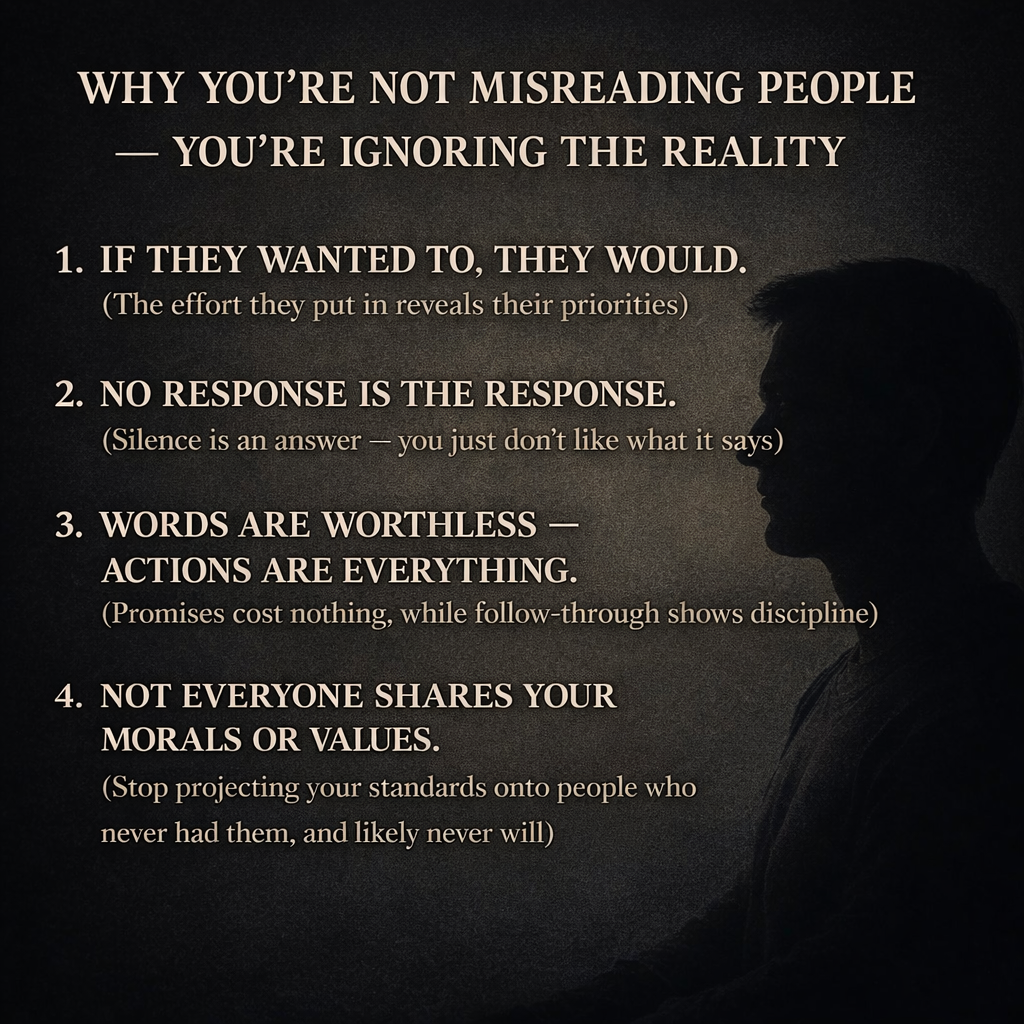
1. If they wanted to, they would.
(The effort they put in reveals their priorities)
2. No response is the response.
(Silence is an answer -you just don’t like what it says)
3. Words are worthless – actions are everything.
(Promises cost nothing, while follow-through shows discipline)
4. Not everyone shares your morals or values.
(Stop projecting your standards onto people who never had them, and likely never will)
When people show you who they are through their actions you should just believe them!
lolololololol
well that should stir the shit pot
“If They Wanted To, They Would” this is my new MOTO
we have to stop assuming everyone else is like us, and if they wanted to they would!
You are right action are all that matter.
That about sums it up!
This is a harsh reality.
Most relavent and truthful thing I have read on the interwwebs in years. This is going on my livingroom wall
his dude is out to piss the whole world off with TRUTH!
Well this lead balloon is going to be a hard pill for people to swallow…but is the truth.