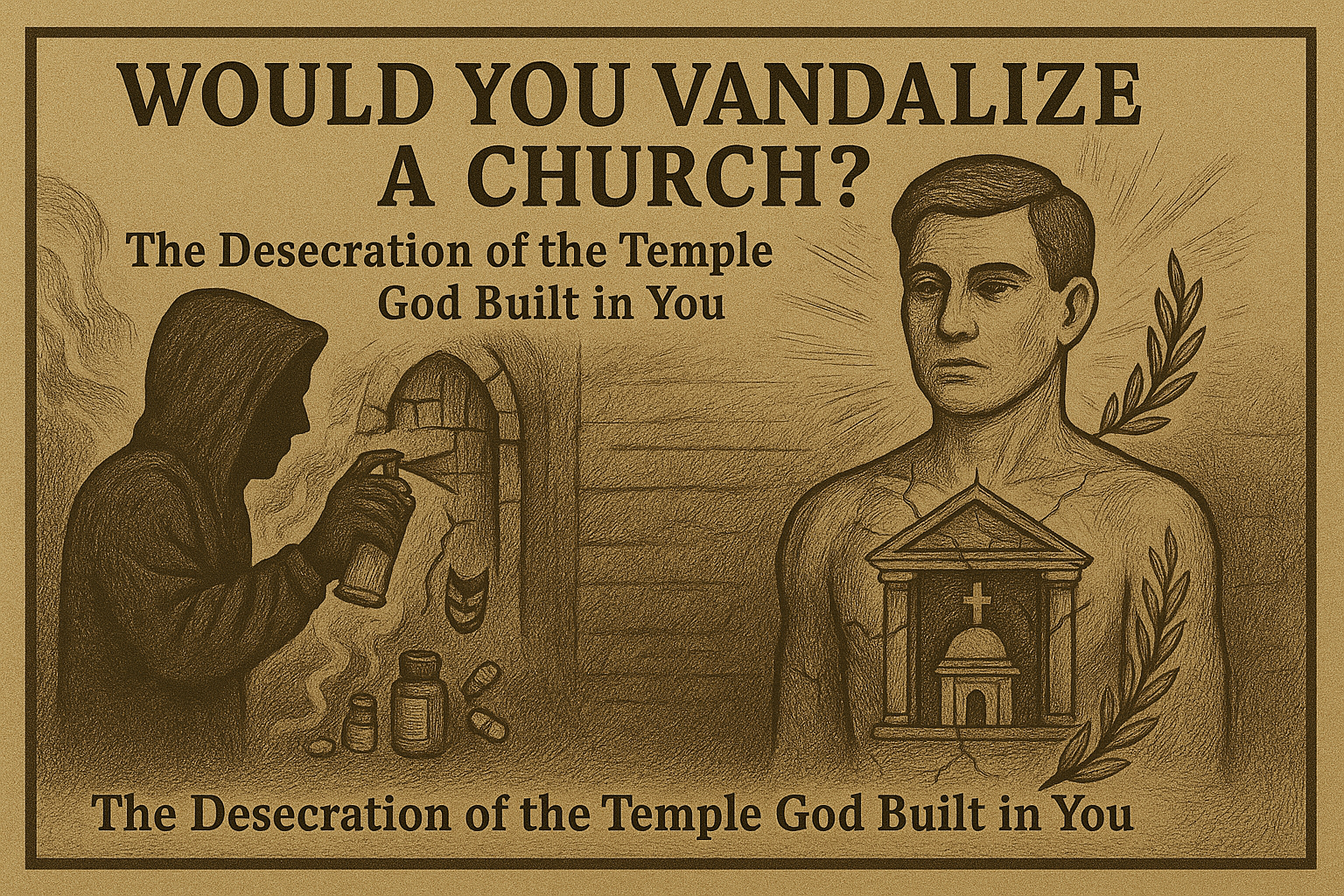
The Desecration of the Temple God Built in You
Summary: For those who lack the endurance to read what men used to write before attention spans died, Click here the short version.
⚔️ Summary for the Slumbering
This article confronts a soft, modern lie: that your body is personal property. Scripture says it’s a temple. When the veil tore, God moved from stone to flesh – your flesh – and now every habit is either worship or vandalism. The piece traces how believers desecrate the sanctuary within through physical defilement (addiction, gluttony, pharmakeia, laziness, unclean foods, tattoos/piercings), sexual corruption (fornication, adultery, pornography, sodomy, gender rebellion, immodesty), mental/cultural pollution (music, movies, social feeds, books), and moral neglect (lying, idolatry, prayerlessness, profanity, cynicism).
It indicts “grace without gravity,” reminds us that words are altar-fire or graffiti, and calls for Christlike temple-cleansing by repentance, fasting, disciplined order, and daily maintenance of holiness. The thesis is stark: you are owned – bought with blood – so holiness isn’t preference; it’s property law. If you wouldn’t spray-paint a cathedral or stream porn on a church projector, stop vandalizing the sanctuary God built in you. Keep the body clean, the mind pure, the mouth holy, so the world sees not you, but the Builder.
I. From Sanctuaries of Stone to Sanctified Flesh
The Temple God Once Dwelt In
In the beginning, the presence of God was not something casual. It was not easily accessible at will. His holiness had to be veiled, contained, and guarded. The Israelites built a tent of meeting, every measurement exact, every material sacred. The Tabernacle wasn’t just some decoration; it was architecture of fear and awe. God’s dwelling among men required blood, smoke, and boundaries.
When Solomon later built the temple, it became the crown of Israel’s devotion. Gold-plated walls, carved cherubim, and the Ark of the Covenant housed in the Holy of Holies, this was not a community center. It was where the fire of Heaven touched Earth. Priests entered only after cleansing, sacrifice, and trembling. Anyone who crossed the line uninvited was struck dead.
The message was clear: God is not to be approached casually. Holiness was lethal to impurity. The temple wasn’t a symbol of belonging; it was a reminder of distance. The very presence that sanctified the nation could also consume it.
The Transfer of Glory
Then came Christ. The veil was torn. The divine presence moved out of stone and into flesh. No longer confined behind curtains, God’s Spirit took residence within redeemed men and women. What had been fatal to approach was now invited within.
The fire that once burned above the Ark now burns in human hearts. The holiness once separated by blood sacrifices was satisfied by the blood of the Lamb. The body that bows to Christ becomes His sanctuary; the soul that obeys Him becomes His dwelling.
The temple was not abolished, it was relocated. You are now the temple of God.
Paul said:
“Know ye not that ye are the temple of God, and that the Spirit of God dwelleth in you?” —1 Corinthians 3:16
You are the modern Holy of Holies. Your life, your habits, your appetites, each is part of that structure. When you eat, when you speak, when you think, you do so inside the temple God built in you.
The Personal Ark of the Covenant
Inside the ancient Ark rested three things: the tablets of the Law, the pot of manna, and Aaron’s rod that budded. Law, provision, and authority, those three realities defined God’s covenant presence. Today, the same spiritual pattern lives in the believer. The Law is written on your heart. The manna is replaced by the Bread of Life, Christ Himself. The rod of authority becomes the Spirit’s power at work through you.
So when you defile your body, your mind, or your conduct, you are not just “doing something wrong.” You are corrupting the very vessel in which God has chosen to place His testimony, His sustenance, and His authority. You are desecrating the Ark.
That is why sin in the believer is not a small matter, it is sacrilege. What was once external rebellion against a distant God is now internal betrayal against an indwelling one. You cannot hide from His presence when His presence lives in you.
The Responsibility of Stewardship
With the indwelling Spirit comes inescapable responsibility. The priests of Israel had to maintain the temple: cleaning ashes, trimming wicks, replenishing oil, repairing fabrics. The smallest neglect invited decay. Likewise, the modern believer is responsible for the upkeep of the temple within, maintaining discipline, purity, and reverence.
The Holy Spirit does not dwell in a man to serve as a roommate. He reigns as Lord. Your habits are His furniture. Your thoughts are His walls. Your appetites are His lamps. If you pollute them, you are vandalizing His dwelling.
God’s people were once commanded to keep the temple undefiled because His presence dwelt there. That command has not changed, it has intensified. The difference is that now, the temple moves when you move. The sanctuary travels when you walk. And wherever you go, Heaven expects holiness.
The believer who truly understands this will live differently, not from fear of punishment, but from reverence of presence. You don’t light a cigarette in the Holy of Holies. You don’t drag idols through the inner court. You don’t gossip beside the altar. Yet that is exactly what millions do daily inside the very structure God built from dust and filled with His Spirit.
II. Desecrating the Temple: The Modern Vandal’s Hand
The holiness that once required a priesthood now rests in your skin. The fire that consumed offerings now burns in your spirit. To desecrate the body is to desecrate the sanctuary. To abuse the mind is to defile the altar.
Sin isn’t merely “bad behavior.” It’s spiritual vandalism, smashing the stained glass, torching the pews, and carving profanity into the walls of God’s house.
1. Physical Defilement
The body is the outer court of the temple, the visible structure through which the unseen God reveals Himself. It is the architecture of obedience, the physical testimony of divine order. To abuse it is to dishonor the Architect. To neglect it is to let weeds grow in sacred ground.
Once, priests were commanded to wash before entering the holy place. They purified themselves with water and blood before they ever touched the altar. But now, believers waltz into God’s presence reeking of addiction, indulgence, and laziness, and call it “grace”.
The outer court was meant for preparation, not pollution. It was where the worshiper brought sacrifice, not self-sabotage. Yet modern men fill it with the idols of appetite, and modern women treat it as a stage for vanity. The body, designed as the framework of discipline and dominion, has been reduced to a playground of desire.
Every act of physical defilement is a sermon preached against the holiness of God. You cannot host His presence and live like a glutton, smoke like a pagan, or sleep like a sloth and call it liberty. Modern believers desecrate this court daily through indulgence, excess, and apathy, and then wonder why the inner sanctuary feels empty.
Smoking and Vaping:
The body was never meant to be an ashtray. What God designed as a vessel of breath, His own Spirit breathed into dust, modern man fills with poison and smoke. The incense that once rose from holy fire has been replaced with the fumes of rebellion. Every puff declares, “This body is mine,” as though ownership were still in question.
Smoking and vaping are not mere habits; they are slow acts of self-desecration. The lungs, crafted to sing praise and speak truth, are choked by toxins for the sake of temporary calm. A man cannot plead for the breath of God while poisoning the very system through which that breath flows.
The temple was meant for life, not for slow suicide. You would never light a cigarette in the sanctuary of the church, why, then, do you light one in the sanctuary of flesh? Each exhale of smoke is a visible sermon of rebellion: worship offered not to Heaven, but to habit.
Gluttony:
When the stomach becomes god, worship shifts from Heaven to appetite. Food, meant for strength and fellowship, becomes an idol of comfort and escape. Every meal turns into a sacrifice, not to the Lord, but to the god of indulgence. The temple begins to sag under the weight of self-gratification; the priest within grows dull and unfit for service.
Gluttony is not merely overeating, it is misplaced devotion. It takes what was meant to sustain and turns it into what enslaves. The same hands that should be lifted in thanksgiving are instead busy feeding endless craving. The same body meant to serve becomes sluggish, distracted, and numb to conviction.
Gluttony mocks self-control and exposes spiritual weakness. It declares, “My hunger rules me.” Yet the man ruled by his belly cannot be ruled by his spirit. When the flesh leads, the temple decays, and worship becomes digestion instead of devotion.
Pharmaceutical Idolatry and Drug Abuse:
The modern world calls it “medicine,” but much of what passes under that name is sorcery by another label. Pharmaceuticals, in their proper use, can aid healing, but when they become the source of peace, escape, or control, they become idols. The line between prescription and possession is thin, and most have already crossed it.
Drugs, whether swallowed, injected, or inhaled, are counterfeit sacraments. They promise rest, joy, and relief, and salvation from death, but deliver dependence and decay. The Holy Spirit is called the Comforter; to seek comfort elsewhere is to dethrone Him. Every pill worshiped for peace is another prayer withheld from the true Healer.
A drugged mind is an unlocked temple. The gates of discernment swing open, and every unclean spirit walks through unchallenged. The man addicted to chemicals cannot be ruled by the Spirit; he has already leased out the throne. What God meant as a sanctuary of clarity becomes a fog-filled ruin of confusion.
Laziness:
Neglect is one of the quietest forms of sin. It rarely shouts, but it always rots. The temple doesn’t need to be attacked to collapse, it only needs to be ignored. Laziness is the termites of the soul, eating away unseen until the structure gives way under the weight of its own apathy.
God gave Adam work before sin entered the world, proving that labor was never punishment, it was purpose. To reject labor, discipline, and effort is to reject divine design. A man who won’t rule his time or train his body has already surrendered his dominion.
Laziness turns the temple into a ruin. Dust gathers on the altar. The lamps of devotion flicker out. The strength meant for service atrophies in idleness. A man who won’t sweat in obedience will eventually bleed in consequence. The temple requires upkeep, without it, glory departs and weeds take root.
Eating Unclean Foods:
God never revoked His dietary wisdom. What He declared unclean wasn’t arbitrary, it was architectural. The same God who engineered the human body also defined what maintains it. His restrictions were never about legalism; they were about life. Holiness has always included what enters the mouth, because what feeds the flesh shapes the spirit.
Yet many believers mock that wisdom. They stuff the temple with what He forbade and then kneel to pray for healing. They beg for divine intervention while eating divine instruction. It’s like pouring oil on the church floor and asking God to stop the fire, or dragging a carcass onto the altar and wondering why the incense smells foul.
Unclean food is more than bad diet, it’s open rebellion. Each forbidden bite says, “My appetite decides what’s holy.” It’s a declaration of ownership, a denial of stewardship. The same God who told Israel what to offer and what to avoid has not changed His nature; He still cares what fills His temple.
The Spirit of God dwells within you, why would you feed Him filth? The temple is not a dumpster. You cannot host divinity on a diet of defilement and call it grace. The same mouth that blesses the Lord should not also bless the unclean. What enters your body preaches a sermon louder than what leaves your lips.
Tattoos:
The body is not a billboard for personal stories or cultural art. It is the temple of the living God. Yet modern believers treat the skin – God’s own canvas – as a scrapbook for vanity, rebellion, and remembrance of sin. What once marked pagans now marks the baptized.
In ancient times, tattoos and body markings were signs of ownership. Slaves bore the symbols of their masters. Warriors bore the emblems of their gods. To mark one’s flesh was to declare allegiance. That is why God commanded His people:
“Ye shall not make any cuttings in your flesh for the dead, nor print any marks upon you: I am the Lord.” —Leviticus 19:28
He was not forbidding art, He was forbidding idolatry. The flesh already belonged to Him. To carve or ink it for other purposes was to invite other masters. Modern tattoo culture resurrects the same pagan impulse: to rewrite the body, redefine identity, and rebrand ownership.
Many will say, “But mine has meaning.” So did the pagan’s. Every false god had a reason, every idol an intention. But meaning is irrelevant when obedience is absent. You can’t “redeem” rebellion with sentiment. Even “Christian” tattoos, crosses, verses, names of Jesus, turn the temple wall into a mural of graffiti, as though the holiness within were not enough.
The temple was never meant to be advertised. The glory of God is internal, not inked. The Spirit’s mark is invisible yet undeniable, a changed heart, not decorated flesh. To tattoo the temple is to announce, “The outside needs what the inside lacks.” But the indwelling of the Holy Spirit requires no external signature.
Every mark carved into skin for self-expression is a small rebellion against divine design. The ink fades, but the statement remains: I will write my own story on what God already wrote His name upon. The temple does not need decoration; it needs devotion. Holiness is not art – it’s obedience. Vandalizing the temple walls is an open act of rebellion and defiance in the war against surrendering yourself to God.
Piercings & Mutilation:
Today, many decorate God’s temple like a pagan shrine, treating His image as a canvas for rebellion rather than reverence. The same body that once bore His likeness now bears the marks of vanity, trauma, or defiance. Self-mutilation, excessive piercing, and body alteration parade under the banner of “self-expression,” yet what they truly express is alienation from the Creator.
The pagan nations marked their flesh to honor false gods. Israel was commanded not to. The reason was simple: the body already bore the seal of its true Owner. To carve it, puncture it, or distort it for attention is to vandalize what Heaven designed with purpose. It’s a declaration that says, “I will mark myself because His mark is not enough.”
This is not about minor adornment or modest care, it’s about intent. When a person alters their flesh to shock, seduce, or proclaim autonomy, they preach a sermon of rebellion through the body God calls His home. The temple is not an art project; it is sacred architecture. Every cut, every piercing, every display for the sake of pride is defilement of the temple.
Self-mutilation is not beauty, it’s bondage. Vanity is not confidence, it’s idolatry. Every wound inflicted for fashion or validation dishonors the covenant that body represents. Your body was never meant to mirror the culture; it was meant to mirror the Creator. The temple is already magnificent without modification. To alter what God perfected is not enhancement – it’s heresy.
2. Sexual Corruption
If the body is the outer court, the sexual life is the Holy Place – sacred, restricted, and purposeful. It was never meant for exhibition or casual entry. This is the chamber of covenant, where the physical mirrors the spiritual, where union was designed to preach the gospel of loyalty and fruitfulness. But in the modern world, the doors are thrown wide open, and idols of lust now stand where the lampstand should be. The fragrance of devotion has been replaced by the stench of indulgence. What God designed as a covenantal act has been reduced to a recreational one.
Sex was never man’s invention, it was God’s. And like all of God’s creations, it demands reverence. He set boundaries around it because He set holiness within it. When those boundaries are ignored, desecration follows. Fornication, adultery, pornography, and every perversion of design drag idols into the sanctuary. Every act of lust outside covenant is like burning strange fire before the Lord, an imitation of worship that brings judgment, not joy.
The world calls it freedom; Heaven calls it blasphemy. Each casual encounter, each click of filth, each fantasy indulged is a sacrifice to the wrong altar. Men who were meant to guard the temple now invite harlots into the Holy Place. Women meant to represent purity now market their flesh as if sacred things were for sale. The lamp of holiness flickers while the flames of desire consume what was once set apart.
Sexual corruption is not only sin, it’s treason against divine order. It desecrates the holiest furniture of human existence: covenant, reproduction, and intimacy. The Holy Place becomes a brothel of rebellion when lust is allowed to rule. You cannot claim to belong to Christ while letting the spirit of Jezebel decorate His dwelling.
The sexual life is sacred architecture. It is not casual, it is covenantal. It is not for display, it is for devotion. And when a man or woman treats it lightly, they do not merely sin, they defile the sanctuary that was meant to bear God’s image and produce His legacy.
Fornication and Adultery:
God designed sex as covenantal worship, an act of oneness under authority, not a hobby of appetite. It was meant to confirm vows, not replace them. Fornication and adultery are not simply “mistakes in judgment.” They are vandalism against the architecture of covenant.
In Scripture, adultery was not just moral failure, it was high treason against the kingdom of order. It defiled families, desecrated nations, and invited divine judgment. Fornication is its cheaper cousin, rebellion without commitment, pleasure without purpose. Both treat what is sacred as casual, reducing something meant to echo eternity into a moment of fleshly indulgence.
Each sexual act outside covenant is a false offering, pleasure laid on a profane altar. It turns the Holy Place of intimacy into a battlefield of impulse. The body was meant to seal promises; now it seals perversion. And those who treat sex as recreation are, in truth, performing their own worship service, to the god of self.
Marriage is not man’s invention, it is the first covenant instituted by God Himself. When sex leaves that covenant, it leaves holiness. The result is always the same: defilement, shame, and spiritual disconnection. You cannot mingle covenants without corrupting both. Fornication and adultery are not private matters, they are public desecrations in God’s sight.
Pornography:
Pornography is the digital idol of our age, an endless stream of lust dressed as liberty. It is voyeurism baptized in rebellion, the altar of on-demand idolatry. It requires no temple, no priest, and no shame, just a screen and a will surrendered to darkness.
The believer who indulges in pornography invites demons into the Holy Place. Each image viewed is an unholy offering. The eyes become the gateway of defilement; the mind becomes the theater of desecration. What was once sacred imagination, designed for prayer, creativity, and divine reflection, is now hijacked by filth.
Pornography doesn’t merely tempt; it rewires worship. It teaches the temple to crave sin like incense. It numbs conviction and breeds bondage. It turns men into consumers of corruption and women into commodities of lust. The damage isn’t only moral, it’s architectural. The structure of the soul begins to crack under the weight of unrepentant indulgence.
You wouldn’t project pornography on the sanctuary wall during Sunday service, yet many do exactly that within the sanctuary of their minds. Heaven sees it all. Every secret view, every hidden fantasy, every click in the dark, it’s all graffiti on the inner walls of God’s dwelling. The Spirit cannot fill a vessel devoted to another spirit.
Sodomy and Gender Rebellion:
The temple has a blueprint. Every wall, every curve, every design is deliberate. God created male and female as complementary reflections of His own image, two halves of a single revelation. To corrupt that design is to vandalize His divine architecture.
Sodomy, transgenderism, and every rebellion against biological reality are not personal “expressions.” They are spiritual declarations of war against the Creator’s order. They say, “I will redesign what God designed.” That is idolatry. It replaces the Potter with the clay.
Scripture is not vague: men lying with men and women with women are abominations not because God hates them, but because they hate His design. They turn the covenantal act of creation into a parody of pleasure. They erase the prophetic symbolism of marriage, the union of Christ and His bride, and replace it with the worship of self.
God judged Sodom not for ignorance but for arrogance. They knew, and they mocked. The modern world does the same but hides behind slogans of tolerance and “love.” But love without holiness is lust, and compassion without truth is cruelty. To affirm what God condemns is to stand as co-conspirator in the defilement of His temple.
The human body is sacred architecture; its form is theology in flesh. To alter it, corrupt it, or misuse it is to scrawl heresy across the blueprints of Heaven.
Immodesty and Exhibition:
The priests of old dressed to conceal glory, not display flesh. Their garments declared reverence. They wore holiness upon their sleeves and humility on their hems. Modern believers reverse the pattern – bare skin, tight fabric, and self-display passed off as “confidence.”
But the temple was never built to advertise itself. The body is not a billboard; it’s a sanctuary. To flaunt what God clothed is to mock the idea of sacredness itself. Immodesty is not freedom, it’s surrender. It says, “I must be seen,” when the true disciple says, “He must be seen.”
The culture of exposure is nothing new; it’s the oldest temptation on earth. Eve saw, desired, and took, and ever since, fallen humanity has worshiped visibility over virtue. Every exposed inch of flesh for the sake of attention is a silent sermon of rebellion. Every deliberate act of seduction is an open invitation for defilement.
Exhibition is the modern liturgy of pride. Social media has become its temple; selfies its sacrifices. But modesty is not oppression, it’s architecture. It protects what’s sacred from becoming spectacle. It guards the mystery of holiness from the mockery of the crowd.
A body dressed with reverence declares: This temple is occupied. It’s not on display because it’s under divine ownership.
3. Mental and Cultural Pollution
If the body is the outer court and sex the Holy Place, then the mind is the inner chamber, the space where communion with God is meant to dwell. The thought life is sacred ground. What you allow to live there becomes your master. Yet the modern believer floods this chamber with noise, screens, and sensuality. The average Christian’s mind is less like a sanctuary and more like a marketplace.
The music that fills your ears, the shows that fill your eyes, the feeds that fill your hours, they are not harmless. They are liturgies. Every lyric, every image, every post teaches you what to worship. The devil no longer needs idols of stone; he has modern algorithms.
Music:
What lyrics echo through the corridors of your soul? The hymns of rebellion now replace the songs of redemption. Words that glorify lust, greed, and pride become mantras that shape the inner court. The melody becomes a liturgy of corruption. You can’t claim holiness while chanting the anthems of hell.
Movies and Television:
Would you project those scenes on the church jumbotron during Sunday service? Would you invite your pastor or your children to watch them beside you in the sanctuary? Yet you play them in the sanctuary of your mind and call it relaxation. Every image viewed is a seed; every storyline normalized is an altar built. Entertainment shapes conviction faster than sermons when the conscience is unguarded.
Social Media and TikTok:
An altar of vanity and idolatry. Every swipe another offering, every “like” another incense of approval burned to the god of self. The endless scroll has replaced meditation, and distraction has become devotion. The temple becomes a carnival of envy, lust, and outrage – no longer a house of prayer but a hall of mirrors reflecting self-obsession.
Reading and Consuming Filth:
Words are not harmless; they are spirit. Every page of your pornographic novel plants something, truth or corruption, light or shadow. The modern “literary” world worships rebellion as art and perversion as sophistication. What you meditate on, you magnify. To read what mocks holiness and call it “culture” is to invite mockery into your own soul. If it wouldn’t sit on the church’s altar, it doesn’t belong on your nightstand.
That music you are listening to, those shows you are watching, the movies you play in your home, the content you view on TikTok or social media, the filth you are reading – would you want that content on the jumbotron in your church during a full house?
Because Heaven already sees it projected inside His temple – you. Mental and cultural pollution doesn’t just entertain, it educates. It trains your soul to tolerate sin, to normalize impurity, to forget reverence. Slowly the inner courts grow dim, the incense burns out, and the Spirit’s whisper is drowned by static. A polluted mind cannot host pure revelation.
If you want the peace of God, silence the noise that mocks Him. Clear the stage where the world performs, and rebuild the altar where holiness speaks. The mind must become a sanctuary again, not a cinema for filth, but a chamber for communion with the holy spirit.
If you put Garbage in, you will get rebellion out!
4. Moral and Spiritual Neglect
There is more to desecration than indulgence; there is also neglect. The temple rarely collapses in a day, it rots through apathy. Most sanctuaries are not destroyed by invaders, but by caretakers who stop caring. The devil doesn’t always need to tempt you; sometimes he only needs to distract you. When discipline fades, decay begins.
Neglect is rebellion wearing sleep. It’s the quiet undoing of everything holy, no explosions, no blasphemy, just dust where there once was fire. The temple of God can fall into ruin not because of war, but because no one bothered to maintain it.
Lying:
Every lie spoken is a crack in the marble. God is truth; falsehood is rot. To speak deceit while claiming His Spirit is to whisper corruption in the sanctuary. Each lie weakens the foundation, turning what was once a house of prayer into a house of pretense. The Holy Spirit is called the Spirit of Truth, He cannot dwell in a temple that echoes falsehood. A lying tongue is a serpent in the sanctuary.
Idol Worship:
The modern idols are not golden statues; they are careers, screens, relationships, and self-importance. They are paychecks, platforms, and pleasures that demand your time, energy, and devotion. The heart becomes a storage room of altars, each one competing for worship. The tragedy of idol worship is not that you abandon God, it’s that you crowd Him out.
A man can go to church every Sunday and still bow daily to the god of convenience. A woman can sing hymns yet worship her reflection. Idolatry is not just loving the wrong thing, it’s loving anything more than the right One.
Laziness in Spirit:
Prayer abandoned. Scripture ignored. Fellowship forsaken. The lamps of devotion go dim, and soon the temple smells of mildew. Spiritual laziness doesn’t announce itself, it settles in quietly, replacing fire with fog. You stop praying because you don’t feel like it, and you don’t feel like it because you stopped praying.
The soul becomes sluggish, unresponsive, disinterested. The altar still stands, but no incense burns upon it. The temple’s doors creak from disuse. You don’t have to hate God to lose Him; you only have to stop seeking Him.
Profanity and Cynicism:
Speech once meant for blessing now drips with sarcasm, complaint, and rebellion. The temple’s choir now chants discord. Profanity is not just dirty language, it’s the sound of decay. It signals that reverence has died, that the sacred has become common.
Cynicism is the mold that grows in neglected corners, the voice that mocks holiness because it no longer remembers what it feels like.A cynical believer is a broken priest, performing ritual without reverence. When gratitude fades, sarcasm fills the gap. When praise dies, complaint becomes the new liturgy.
Neglect doesn’t always look wicked; sometimes it just looks indifferent. But indifference is the slowest and most effective form of desecration. A holy place left unkept will soon be unholy by default. The weeds of worldliness grow where the soil of holiness is left unattended.
The body that once carried glory can become a ghost town of forgotten discipline. The Spirit will not dwell forever in what man refuses to maintain.
Neglect may feel harmless, but it’s spiritual corrosion, a steady dripping of compromise until the temple collapses from within. Keep the lamps burning. Keep the altar clean. Keep the sanctuary alive. Holiness dies not from sin alone, but from silence.
III. When Reverence Died: The Loss of Holy Fear
The Fear That Once Preserved Life
There was a time when fear was not a flaw, it was wisdom. The Israelites didn’t worship casually; they approached the presence of God with trembling hands and bowed heads. His holiness was not an abstract doctrine, it was a deadly reality. Nadab and Abihu learned that truth when they offered strange fire before the Lord and were consumed. Uzzah learned it when he reached out to steady the Ark and fell dead on the spot. Even Moses, who spoke with God as a man speaks with his friend, was told: “Thou canst not see my face: for there shall no man see me, and live.”
The fear of God was never terror for terror’s sake, it was awe in the face of unimaginable majesty. It was the right order between creature and Creator. That fear built restraint, obedience, and purity. It kept priests from approaching unwashed. It kept Israel from blending with pagan customs. It preserved the sacred from becoming common.
But today, fear has been rebranded as “legalism.” Reverence has been mocked as “religious.” Holiness is treated like a personality type rather than a divine requirement. The modern church has lost its fear, and with it, its power.
Grace Without Gravity
Grace is not supposed to make you casual; it’s supposed to make you careful. Yet modern believers treat the blood of Christ as a soft blanket instead of a covenant oath. They say “God understands” when what they mean is “I will not repent.”
Cheap grace has gutted reverence. Men once fell on their faces before the Lord. Now they sip coffee in His presence and scroll through their phones while calling it worship. Women once covered themselves in modesty and humility; now they parade sensuality in sanctuaries built by suffering saints.
Grace was never meant to erase awe, it was meant to restore access. The veil was torn, yes, but it was not torn to make God less holy. It was torn to make you more holy. Christ didn’t die so you could walk into the temple unwashed; He died so you could finally be clean enough to enter.
When grace becomes an excuse instead of empowerment, the temple fills with smoke again, not the incense of praise, but the smog of compromise.
The Casual Christian
We live in an era where the sacred has become entertainment and the holy has become a hobby. The modern believer treats God like a subscription, cancel anytime. They sing of surrender but live on self-rule. They expect divine blessing while mocking divine boundaries.
There was a time when people feared to even misquote Scripture; now preachers twist it for applause. There was a time when sin brought shame; now it brings followers. Churches that once called for repentance now call for “self-acceptance.” Holiness is unfashionable. Righteousness is “judgmental.” Truth is “offensive.”
The result? A Christianity without conviction, without depth, without presence. A temple filled with noise but empty of glory. The modern Christian would rather feel goosebumps than conviction, prefer good lighting to good doctrine, and mistake emotion for encounter.
Casual Christianity is not harmless, it is fatal. It convinces a man he is clean while he tracks mud across the sanctuary. It tells the woman she is “enough” while she lives unwashed. It puts “Jesus” on t-shirts and bumper stickers but leaves Him outside the house He’s supposed to rule.
Restoring Awe
The fear of God is not meant to drive you away, it’s meant to bring you to your knees. And that’s where true worship begins. To restore awe is to remember Who it is that dwells within you. The Holy Spirit is not a vibe, a feeling, or an energy. He is the same consuming fire that filled the temple, the same Spirit that raised Christ from the dead.
You don’t have to die before seeing God’s face anymore, but you do have to die to self. You don’t need a priest to approach Him, but you do need purity. Reverence is the posture that protects intimacy. Without it, worship becomes performance, and the temple becomes a stage.
When reverence returns, holiness follows. When holiness returns, power follows. And when power returns, the world takes notice, not because Christians are loud, but because they are luminous. The early church turned the world upside down because they walked with the terror and tenderness of knowing God lived inside them.
Revival doesn’t begin with noise, it begins with reverence. It starts when men stop treating the temple like a playground and start treating it like holy ground again.
IV. The Language of the Temple: Words as Worship or Graffiti
Speech Reveals the Spirit
Every temple has an altar, and in the living temple of man, that altar is the mouth. What burns there, incense or refuse, reveals what god is truly worshiped. Christ said, “Out of the abundance of the heart the mouth speaketh.” (Matthew 12:34) That means speech is never neutral. Words are the overflow of worship. The vocabulary of a person exposes the occupant of the temple.
When the Spirit rules – speech becomes order, blessings, truth, and encouragement rise like incense. When the flesh rules, speech becomes chaos – profanity, lies, mockery, and manipulation pour like sewage from a cracked vessel.
Your words are offerings, not decorations. Every sentence that leaves your mouth is either a sacrifice of praise or an act of desecration. The tongue doesn’t simply express; it consecrates or corrupts. The most dangerous vandalism doesn’t come from hands, it comes from lips.
Profanity as Pollution
Profanity is not “just words.” It is the pollution of holy air. It takes what was meant for worship and turns it into waste. The tongue that utters “Holy, Holy, Holy” on Sunday often spits venom by Monday. This is not just a minor inconsistency, but idolatry. It shows that reverence is a costume, not a character.
You cannot both bless God and curse men made in His image without cracking the foundation of your own temple. The lips that slander others have already slandered the One who made them. Every vulgar word is spiritual graffiti sprayed across the inner walls of holiness. Every crude joke that blasphemes is a stain on the altar of truth.
The world normalizes profanity as authenticity. Scripture exposes it as rot. “Let no corrupt communication proceed out of your mouth,” Paul commanded, “but that which is good to the use of edifying.” (Ephesians 4:29) To defile your speech is to invite the unholy into the Holy Place.
Imagine walking into a cathedral where every stone echoes praise, and then shouting obscenities until the hymns fall silent. That’s what happens every time a believer uses their words to destroy rather than build.
Gossip and Lies
If profanity is smoke that pollutes the air, gossip is mold that spreads across the walls. It grows quietly, rotting the structure from within. Gossip is not “sharing concern.” It’s verbal idolatry, exalting your opinion above another’s reputation. It feeds pride while poisoning unity. Scripture calls it what it is: whispering, tale-bearing, sowing discord. It is the sound of snakes slithering through the temple courts.
Lies are another form of rot. Every lie spoken desecrates the dwelling of Truth Himself. God cannot lie; therefore, every falsehood aligns the speaker with His enemy. When a man lies, he breaks more than trust, he breaks covenant. The Spirit of Truth cannot reign in a mouth devoted to deceit.
You don’t have to scream to desecrate the temple. Sometimes quiet words do the greatest damage, murmuring, passive-aggressive remarks, false praise, hidden resentment. Whispered corruption is still corruption.
Holiness begins in honesty. If you want a pure temple, start by purifying your speech.
Sanctified Speech
The same lips that can desecrate can also dedicate. God designed speech as creative power. The first act of creation was not movement, it was speech. “And God said, Let there be light.” Every word that leaves your mouth carries the echo of that authority. That’s why speech must be stewarded like fire, it warms or burns, depending on the hands that hold it.
A sanctified tongue turns conversation into worship. Gratitude becomes its default language. Truth becomes its currency. Encouragement becomes its fragrance. A man who controls his tongue controls his life, for the tongue is the rudder of the ship.
To cleanse your language is not to sound pious, it is to sound like your King. Words seasoned with grace, grounded in truth, and restrained by love are the marks of a purified altar. They shift the atmosphere around you.
Every home, every relationship, every workplace becomes a chapel or a courtyard depending on your speech. When the mouth becomes an altar again, the presence of God returns to the temple.
So guard your lips. Guard your tone. Guard your conversations. You cannot claim to host the Holy Spirit and speak like the unholy world. You cannot sing in tongues of angels and gossip in the tongues of devils. The mouth is the loudest testimony of who reigns inside.
V. Cleansing the Inner Courts
The temple does not cleanse itself. Holiness is not accidental. Defilement enters by neglect, and order returns only through force. Christ’s cleansing of the temple was not gentle; it was violent in its righteousness. The same must happen within every believer who dares to call himself a dwelling of the Holy Spirit.
Christ’s Example of Purification
When Christ entered Jerusalem’s temple and saw merchants trading in the courts, He did not pause to negotiate. He overturned tables. He cracked a whip. He drove out the unholy with fury. Why? Because the temple was never meant to be a marketplace. It was built for prayer, not profit; for reverence, not routine.
“My house shall be called the house of prayer; but ye have made it a den of thieves.” — Matthew 21:13
The modern believer must understand: the same Christ who cleansed stone courts will cleanse fleshly ones. The tables He overturns today are those of addiction, hypocrisy, vanity, and compromise. The whip He wields is conviction. If you invite Him in, expect disruption. Holiness always begins with conflict.
You cannot cleanse a temple while protecting its idols. Christ will not share His house with corruption. When He enters, He expels. That is not cruelty, it is mercy.
Repentance and Fasting
Repentance is not embarrassment. It is demolition. It tears down the walls of self-justification and rebuilds them on humility. To repent is to agree with God’s verdict, that sin is not a mistake to be managed, but a stain to be purged.
True repentance doesn’t beg for lenience; it cries for cleansing. It does not ask, “How close can I get to sin?” but “How far can I flee from it?”
Fasting is repentance in physical form. When you deny your flesh, you dethrone it. You starve the rebellion that wages within. Every skipped meal becomes a statement: “My body is not the master of this temple, my God is.”
Fasting clears the fog that hides compromise. It reveals what rules you. It is the broom that sweeps out the cobwebs of self-indulgence. In a world obsessed with feeding every appetite, fasting declares allegiance to a higher hunger. Repentance cleanses the soul. Fasting trains the body. Together they prepare the temple for glory.
Discipline as Devotion
Cleansing the temple is not a one-time event, it is a lifelong routine. The priests of old washed daily, trimmed the lamps, replaced the bread, and maintained the altar. That is the picture of Christian discipline.
Prayer, Scripture, physical stewardship, and moral restraint are not legalistic chores, they are maintenance of sacred space. Without them, the temple quickly decays. Without them, the fire dies out.
Discipline is worship in action. It says to Heaven: “I will keep what You entrusted to me.”
A man who rises early to pray is not showing off, he is opening the temple doors for the day. A woman who controls her tongue is not being “nice”, she is guarding the altar. A family that trains its children in holiness is not being “strict”, they are maintaining generational sanctity.
God does not dwell in chaos. He dwells in order. Discipline restores that order. Every act of obedience is another stone set straight in the wall. Every temptation resisted is another floor polished for His glory.
Restoration of Order
When the temple was defiled, God’s glory departed. When it was restored, His glory returned. That is still the pattern today. Cleansing is never for appearance, it is for presence.
The world teaches self-care; Scripture teaches soul-care. The difference is eternal. One polishes the idol, the other purifies the altar. The first flatters the flesh, the second feeds the Spirit.
When repentance has done its work, peace fills the inner courts. The noise of sin fades. The lamps burn bright again. The Word once more echoes through the halls. Prayer returns to its rightful place at the center.
Christ did not cleanse the temple to destroy it; He cleansed it to restore its purpose. Likewise, conviction is not condemnation, it is construction. God corrects what He intends to use. If your life feels chaotic, it is because the temple is cluttered. Remove what does not belong, and peace will return.
The Holy Spirit is not absent; He is simply awaiting a clean seat.
Remember this pattern:
- Sin invites confusion.
- Confusion demands cleansing.
- Cleansing restores order.
- Order welcomes presence.
Holiness is not the absence of joy; it is the architecture of it. Peace thrives where purity lives.
The believer who allows Christ to cleanse his temple becomes a walking sanctuary of peace, power, and purity. But he who clings to defilement becomes a noisy marketplace, crowded, chaotic, and uninhabitable for glory.
When Christ overturns the tables in your heart, let Him. The whip of discipline is mercy disguised as discomfort. And the moment the dust settles, you will hear what has been missing all along: the sound of holiness returning.
VI. Living as the Sanctuary of the Most High
Ownership and Obligation
The modern world preaches, “My body, my choice.” Scripture answers, “Ye are not your own, for ye are bought with a price.” (1 Corinthians 6:19-20) The blood of Christ was not a suggestion, it was a purchase. He didn’t redeem you to rent space; He bought the property outright. The deed now reads: Owned by the Most High God.
You are not a free agent; you are a steward. Everything you do with your body and mind is done under ownership. Your habits are a testimony to whether you honor or abuse that ownership. To say “It’s my body” is to commit spiritual theft. The temple is His. You are merely its caretaker.
Holiness, then, is not about preference, it’s about property law. When you defile your body, you vandalize what belongs to another. When you discipline it, you honor its true Owner.
Daily Maintenance of Holiness
A temple doesn’t stay clean on sentiment; it stays clean on schedule. Holiness must be maintained daily, through watchfulness, repentance, and obedience. The believer who ignores daily maintenance will soon find cobwebs of compromise in every corner.
Guard what enters.
Your eyes are windows. Your ears are gates. Your mouth is a door. Every song, every show, every post, every meal, every conversation is either purification or pollution. Would you let pagans spray graffiti inside your church? Then why let godless media defile your mind?
Feed what’s holy.
The Spirit within must be nourished with Scripture, prayer, and obedience. You cannot binge sin and expect to glow with glory. The lamp of holiness burns on the oil of discipline.
Reject what’s decaying.
The longer sin remains, the harder it becomes to uproot. Confess early. Repent quickly. Don’t let rot set in. God is not mocked; neglect always shows.
Holiness is a rhythm, cleanse, fill, guard, repeat. A clean temple today will not stay clean tomorrow without attention.
Walking in Reverent Strength
Reverence is not weakness, it is strength under authority. The man who fears God fears nothing else. The woman who honors the Holy Spirit walks in unshakable confidence. Reverence produces power because it aligns the temple with its Builder. Disorder weakens, but discipline fortifies.
When you treat your body as sacred, your health reflects it. When you guard your speech, your relationships thrive. When you discipline your appetites, your spirit gains authority. Holiness is not fragility – it is divine structure.
The world mocks reverence as outdated, but Heaven calls it qualification. God trusts His presence only to those who respect it. A life ordered by holiness becomes a fortress against chaos. When the enemy comes, he finds no open doors, no broken windows, no unguarded gates, only light.
Reverent strength is masculine in firmness and feminine in fidelity. It builds households that last, children that listen, marriages that model Christ and the Church. It is the architecture of dominion. Guard what you wear and what you consume.
The temple was never meant to be a stage or a garbage can. Dress as though you know Who dwells inside you. Eat as though you believe He still has a say in what enters His house.
The Final Question
Here lies the question that cannot be escaped: Would you vandalize a church?
Would you light a cigarette at the altar? Would you watch pornography on the sanctuary projector? Would you gossip through the pulpit microphone? Would you carve rebellion into the pews? Would you vomit profanity against the stained glass?
You wouldn’t dare walk into church or temple carrying a pig to sacrifice on the altar – but you’ll fill your body with what He calls unclean and still lift your hands in worship.
Holiness isn’t about ceremony, it’s about consistency. The same God who rejected polluted sacrifices still rejects polluted lives. He hasn’t changed, only our reverence has. Most would recoil: Never! Yet millions do it daily in the temple God built in them.
Every puff, every sip, every curse, every indulgence, every idle scroll is a crack in the wall of holiness. Every compromise whispers, “This temple is mine.” But it isn’t.
God’s Spirit no longer dwells behind a curtain of gold and linen. He dwells in living flesh, yours. Your heartbeat is the drum of His sanctuary. Your breath is the incense of His altar. Your words are the echoes of His glory – or the noise of rebellion.
If you would not vandalize a church built by men, then stop vandalizing the one built by God. Let your body be clean. Let your mind be pure. Let your mouth be holy. Let your life be worthy of the Presence it carries.
Because when you walk in holiness, the world no longer sees you, they see the temple. And when they see the temple, they remember the Builder.
Would you vandalize a church? Then keep holy the one God built in you!
I agree with your thoughts on this, great details, wonderful post.
I am curious to find out what Church you go to?
Pushing back on the tattoo section. You quote Lev 19:28 but skip Acts 15 and the new-covenant context. I get your argument about ownership and modesty, but you treat any ink as rebellion. That’s not exegesis, that’s blanket condemnation.
Serious question on “unclean foods.” How do you square your stance with Mark 7:19 (“thus He declared all foods clean”) and Peter’s vision in Acts 10? If you hold to dietary laws, is that for health/wisdom or binding command on Gentile believers?
Who died and made you the hall monitor of holiness?
“The mouth is the altar.” Ouch.
This is EXACTLY the kind of fear-soaked moral policing that hurts people. Tattoos? Music? Food? You’ve turned Christianity into a checklist. Hard pass.
Gluttony called and left me a voicemail. I hate how accurate this is. Starting a 24-hour fast and a grocery purge tonight.
1 Cor 6:19–20 and Romans 12:1 in one essay, well done. The tie-in to priestly maintenance was brilliant. More of this please.
As a guy who burned years on porn, the “digital idol” language is painfully accurate. It did rewire my worship. Been clean 18 months. Fasting + filters + actual confession to another man, game-changer. Appreciate the uncompromising tone.
Question: practical tips for teens? Phones are the “marketplace in the temple” for them. Any household rules you recommend that actually stick?
TL;DR took the “short version” link and still got convicted. The jumbotron test (would you stream that show in your sanctuary?) is going to haunt me every time I open Netflix.
“My body isn’t mine”? That theology is a straight shot to abuse. You don’t get to micromanage what women wear or eat. This reads like a control manual dfor the cult.
I deleted TikTok for Advent last year and felt human again. Doing it for the rest of November.
You lost me at “unclean foods.” Acts 10, Mark 7:19, seems like you’re re-erecting walls Christ tore down
There it is, another man telling women how to dress, eat, speak, and exist. You call it “temple architecture,” I call it control!
This reads like a guy who’s mad that other people are having fun. “No ink, no shows, no snacks, no smiles.” Brother, if holiness looks like misery, you’re an as*****
“My body isn’t mine”? Cool cult vibes, bro. Next you’ll assign dress codes and bedtime
modesty isn’t about hiding beauty; it’s about revealing ownership. Loved that subtle angle. Might steal it for my small group moto.
Dramatic much?
well, this was deep and something that everyone should read