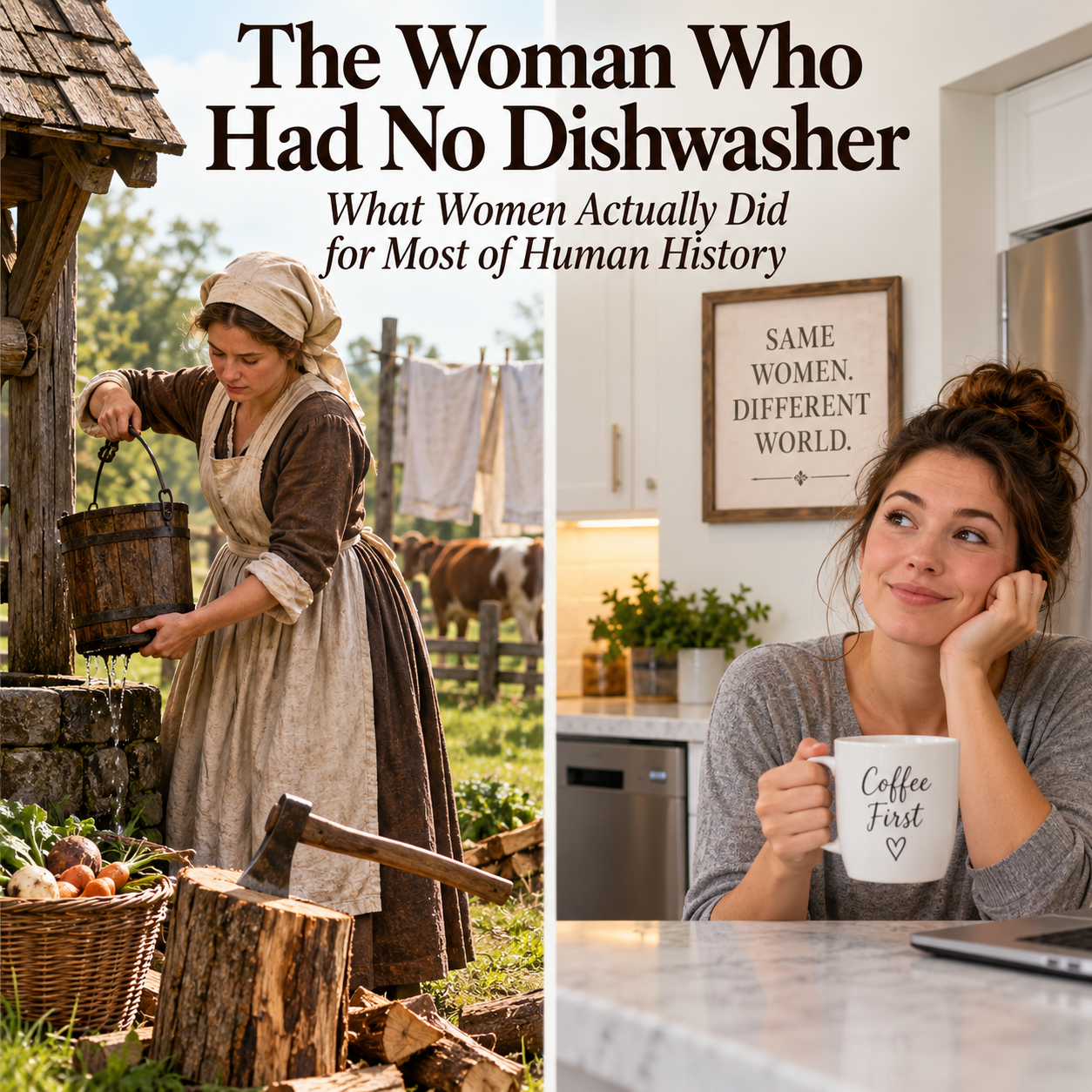
What Women Actually Did for Most of Human History
Introduction
For the sake of this discussion, I am going to work from the premise that the earth is roughly 10,000 years old. I am perfectly aware that some readers will put the number below 6,500 and others will ridiculously add several billion years to it, although that would in-fact only strengthen my argument. Whether you begin the clock six thousand years ago, ten thousand years ago, or six billion years ago, the overwhelming majority of human existence occurred without electricity, automobiles, refrigeration, indoor plumbing, washing machines, telephones, supermarkets, air conditioning, microwaves, dishwashers, Amazon Prime, or a glowing rectangle capable of delivering groceries, gossip, entertainment, and validation without requiring its owner to put on shoes. Modern domestic life is not merely somewhat easier than historical domestic life. It belongs to an entirely different technological universe.
Modern Western civilization has eliminated enormous portions of the physical labor necessary to maintain a household while simultaneously convincing us that minimum basic household life has become unbearably exhausting. Nowhere is the contradiction more striking than in the transformation of women’s domestic work. This is not an argument that women of the past universally lived identical lives. A wealthy Roman matron with servants, an enslaved woman, a medieval peasant, an eighteenth-century farmwife, and a nineteenth-century factory worker occupied radically different circumstances. But across agrarian societies (and particularly among ordinary rural households) the home was not never a place of leisure and consumption. It was a productive economic institution, and the wife/wives was its principal laborer and manager. This historical reality should therefore be understood before declaring that loading six plates into an electric dishwasher after dinner constitutes an unprecedented burden upon womankind.
I. The Household Was a Workshop, Not a Lounge
For most women throughout history, “staying home” did not mean sitting inside waiting for a husband to return. The home was a workshop, kitchen, schoolroom, laundry, dairy, garden headquarters, food-processing facility, textile shop, nursery, infirmary, and small commercial enterprise compressed into one economic unit. National Park Service material on early nineteenth-century American farm women describes women cooking, cleaning, raising children, tending kitchen gardens, caring for poultry and dairy animals, preserving and pickling food, making soap and candles, producing blankets and quilts, sewing and mending clothing, and assisting with work in fields, barns, and forests. Their basic production would supply roughly one-half to two-thirds of a family of 5’s food, while surplus goods generated cash or barter credit for the things not made/grown by her.
Laundry alone makes the modern complaint department look rather pampered. Without indoor plumbing, fresh water had to be hauled into the household and dirty water carried back out. The Smithsonian documents nineteenth-century laundress Catherine Lynch hauling approximately 25 pails of water for a single load, each weighing about 21 pounds. Clothes were soaked, scrubbed in hot lye (lye that she also made) suds, boiled, repeatedly rinsed, starched, dried, and then ironed the following day. The Library of Congress likewise records women drawing water from rivers, melting snow when cisterns froze, splitting material for fuel when wood ran short, and rubbing clothing against washboards until hands and knuckles bled from the combination of lye and friction. There was no button marked DELICATES, and these women were certainly not “delicate”.
Scripture’s description of the industrious wife was perfectly recognizable in such a world. Proverbs 31 portrays her seeking wool and flax, working with her hands, providing food for her household, planting a vineyard from her earnings, making her arms strong, producing garments, selling merchandise, and watching diligently over her household. She is explicitly contrasted with idleness. This is not the portrait of a dependent, but of productive domestic authority.
Historically, the household consumed only because it produced. Food had to be grown, processed, preserved, cooked, and stored. Clothing had to be produced and maintained. Water had to be obtained. Fuel had to be gathered and fires maintained. Children required instruction and supervision. Animals required daily care. Nothing happened because it was outsourced or done by an appliance overnight.
The historical homemaker did not just “keep house.” In a very real economic sense, she helped manufacture the household’s existence every morning and kept manufacturing it until nightfall.
II. Before the Faucet, the Refrigerator, and the Magic Buttons
Modern women speak of “making dinner” as though preparing the food constitutes the entire operation. Historically, preparing the food was simply the final act of a much longer production. Before a woman could boil potatoes, wash vegetables, make bread, clean dishes, bathe a child, scrub a floor, or wash clothing, she first required two things the modern household receives t invisibly: water and heat. Neither came through a pipe or wire. Both required her labor.
The Library of Congress describes mid-nineteenth-century household life as involving “exhausting physical labor from sunup to sundown.” Women chopped and hauled wood, tended fires, carried and heated water, cooked meals, canned and pickled food, and performed the endless cleaning surrounding those activities. One woman recorded in her 1855 diary, “We have to work ourselves nearly to death to keep victuals on the table.” That sentence should be printed above every modern refrigerator beside the family calendar.
Water might come from a well, spring, cistern, pump, creek, or river. Wherever it came from, it possessed one particularly inconvenient characteristic: it did not walk into the house by itself. Every gallon required somebody to draw it, carry it, store it, use it carefully, and frequently heat it. When the cistern or stream froze, the family resorted to melting snow, an operation one woman summarized with magnificent understatement as “tedious.” Today women become irritated and impatient when the faucet takes twelve seconds to heat up while they are wasting 20 gallons of water..
Then there was fire. Cooking required wood to be cut, gathered, hauled, stored, and continually replenished. Open-hearth cooking meant manipulating heavy pots around flames and hot coals while controlling temperature through experience rather than a digital thermostat. The Library of Congress notes that women boiled food in large pots suspended over fires, baked in covered vessels nestled among coals, and fried in iron pans placed directly over them. Burns and scalds were regular hazards. Cast-iron cooking stoves were increasingly available during the nineteenth century, but they still demanded wood or coal and constant attention.
And after obtaining the food, water, and fire, she then faced preservation. Without electric refrigeration, seasonal abundance had to be transformed into something that could survive the off season: drying, salting, smoking, pickling, fermenting, preserving, and eventually home canning were essential components of domestic economy. Historical scholarship on early American technology consequently treats food preservation as a significant household technology, closely connected to women’s labor and family dietary decisions.
Nor did the woman of the household simply reach beneath the sink for a brightly colored bottle promising to remove grease, disinfect countertops, whiten laundry, and leave everything smelling vaguely like a tropical waterfall. The cleaning products had to be made. In most households, wood ashes (already produced by the fires necessary for heating and cooking) were leached with water to produce an alkaline solution used in cleaning and traditional soapmaking. Fats saved from slaughtering and cooking could then be rendered and combined with lye to produce soap. Historical accounts of household production consequently place soapmaking alongside other basic domestic tasks such as candle making, preserving, spinning, and textile work.
The process was hardly equivalent to ordering a twelve-pack of detergent online: traditional lye mixtures would be caustic, proportions varied, fats required preparation, and the resulting soap required considerable labor before it ever cleaned a shirt, floor, dish, or human being. Even cleanliness had an entire chain of production behind it. The historical housewife not only scrubbed the laundry, scoured the cookware, cleaned the house, and washed the family, she would first have to manufacture the substances with which she did the scrubbing. Modernity quietly eliminated another occupation from the household and then placed the finished product in a plastic bottle beneath the sink.
Modern civilization has reduced much of this chain to opening a refrigerator, turning a knob, or pressing START, and complaining that the grocery delivery substituted the wrong brand of sour cream. Our foremothers would have regarded the modern kitchen as something approaching sorcery.
III. Your Closet Used to Be a Manufacturing Project
Walk into a modern American home and count the textiles. Shirts, pants, dresses, underwear, socks, towels, sheets, blankets, curtains, tablecloths, children’s clothing, work clothes, winter clothes, the average household possesses a small mountain of fabric that arrived already woven, cut, stitched, dyed, sized, packaged, and ready to use. When something wears out, or even gets a small defect we just replace it. For all of history, however, clothing represented accumulated material, money, and labor. The National Park Service notes that until the middle of the nineteenth century, only the wealthiest women could afford not to sew; for ordinary women, sewing, knitting, and mending were necessary simply to keep the family properly clothed.
Before industrial production, the process would extend far beyond just sewing. Depending upon place, period, and household, textile production involved processing wool or flax, spinning fiber into thread, weaving or obtaining cloth, cutting garments, sewing seams by hand, knitting, patching, darning, and repeatedly altering clothing so that expensive material was reused. Even by the mid-nineteenth century, the Smithsonian notes that 91% of women’s clothing was still custom-made in the home. Sewing machines dramatically accelerated the work after their introduction, but the Smithsonian’s collections explicitly describe them as labor-saving devices that freed time for (naturally) other household chores. Progress had arrived. Congratulations, madam: you may now finish sewing sooner so you can begin washing.
And washing was not “throwing a load in the washer.” Before indoor plumbing, fresh water had to be carried in and dirty water carried out. Household laundry, overwhelmingly women’s work, relied upon tubs, wash sticks, washboards, soaps, physical scrubbing, rinsing, wringing, drying, and finally pressing. The Smithsonian preserves these implements because laundering was such a substantial component of domestic labor.
Then came ironing. There was no lightweight electric iron with selectable temperature, steam burst, and automatic shutoff. The aptly named sad iron (“sad” deriving from an older sense meaning solid or heavy) was a substantial piece of metal heated for use. Later designs such as Mary Potts’s detachable-handle irons allowed several iron bodies to be heated and rotated through the work, improving efficiency and providing crude temperature management. Such irons remained in manufacture well into the mid twentieth century.
Consider what modern technology has condensed. We purchase finished clothing with a few taps on a telephone. We throw dirty garments into one machine, transfer them to another, and complain bitterly about folding them afterward.
Our great-grandmothers would probably have sympathized. Right after they stopped laughing.
IV. Mother, Teacher, Nurse, and Household Economist
Physical labor was only one small portion of a woman’s historical responsibilities. While bread was rising, clothing needed mending, animals required attention, and tomorrow’s water and fuel still had to be gathered, there remained the inconvenient matter of raising human beings. Children were not sent away into institutional care for eight or ten hours while their mother completed her work. For most of history they lived, learned, worked, worshiped, and matured within the household economy. Mothers therefore performed not only maternal duties but substantial educational, moral, medical, and vocational ones. Children learned prayers, manners, household skills, basic literacy, and the practical competencies necessary for adult life through family and community instruction. In America, for example, childhood instruction occurred in homes, churches, apprenticeships, and small local schools rather than through anything resembling the modern educational system.
The household was also an economic enterprise. Historians have well documented women’s participation in dairy production, poultry keeping, gardening, textile work, food preservation, boarding, market trading, and innumerable forms of home manufacture. The National Park Service notes that nineteenth-century women would contribute between one-half and two-thirds of the family’s food (family of 5-6) while selling or bartering surplus butter, eggs, vegetables, cloth, and other goods for an additional one-third. (nps.gov) A competent wife was therefore not simply consuming her husband’s income while performing chores in exchange. Husband, wife, children, land, animals, tools, and accumulated skills constituted an interconnected productive unit. The household produced most of what it consumed, and exchanged some of its surplus for what it could not produce. Ultimately only purchasing 10-25% of the total goods consumed.
Scripture reflects this economic conception of capable womanhood. The Proverbs 31 woman evaluates and purchases a field, plants a vineyard, manufactures linen garments, sells them, supplies merchants, provides food for her household, and “looketh well to the ways of her household, and eateth not the bread of idleness” (Proverbs 31:27). Her domesticity is government, stewardship, production, and enterprise. And all of this occurred while children were home with her.
There was no daycare drop-off followed by six uninterrupted hours, no grocery delivery scheduled between appointments, no pediatric nurse line, no YouTube tutorial, and no group chat of forty-seven mothers debating whether little Ezekiel’s runny nose required an emergency room. The household was the institution. And the woman was the principal administrator.
V. Then, Almost Overnight, the Machines Arrived
This world did not disappear in some misty, prehistoric age. Our grandparents and great-grandparents lived through its disappearance. In 1940, 60% of American homes still lacked what the Census Bureau now calls “indoor plumbing” – hot and cold piped water, a bathtub or shower, and a flush toilet. By 1950 roughly one-half still lacked it; even in 1960 the figure remained about one-third. The transformation of basic domestic life is not ancient history. There are Americans alive today who were born into homes without facilities we now regard as the minimum requirements of civilization.
Then the machines came, and one by one they began abolishing entire categories of women’s labor.
Consider 1960, hardly the Middle Ages. The Census reported that approximately two out of four American households had a clothes washing machine, meaning mechanized washing had become widespread within living memory. Yet air conditioning was found in only 8% occupied housing units. Most of those had a single air conditioned room rather than central systems. Only 10 percent of Southern homes had air conditioning. The modern American woman who walks from her climate-controlled bedroom into her climate-controlled kitchen, throws clothing into an automatic washer, retrieves food from an electric refrigerator, and complains that the house is two degrees too warm inhabits a domestic environment that would have been luxurious beyond imagination to most women who ever lived.
And every invention eliminated a chain of labor. Running water did not merely eliminate walking to the well; it eliminated every trip associated with every gallon used. The washing machine did not merely replace scrubbing; it replaced soaking, boiling, beating, rinsing, and wringing. Refrigeration reduced the relentless necessity of preservation and altered food storage. Electric and gas ranges removed much of the labor of building, feeding, and regulating cooking fires. Vacuum cleaners mechanized sweeping. Electric irons eliminated stove-heated sad irons. Automobiles reduced miles into minutes. Telephones enabled communication from days into seconds. Supermarkets outsourced enormous portions of food production, processing, slaughtering, preserving, packaging, and storage.
Modern women now spend more time complaining about how hard they have it, how tired they are, and how they have “too much” to do, than they actually spend doing anything productive.
We inherited machines that perform the labor of servants, infrastructure that would have astonished kings, and instant communication that would have appeared supernatural. And somehow we turned all that saved labor into being “overwhelmed” and lazy.
Conclusion: We Have More Help (and Less Excuse) Than Ever Before
None of this requires us to pretend that every woman in history lived the same life, that every woman personally performed every task described in these pages, or that modern women experience no legitimate hardship. Wealthy women had servants; poor women frequently worked both inside and outside their homes; urban households differed from rural ones; and industrialization created its own brutal forms of labor.The argument is the past was far more difficult, yet the women were happier and more content. Daily existence demanded physical competence, endurance, patience, resourcefulness, and a willingness to perform necessary work whether one felt particularly inspired that morning or not. The historical woman could not postpone carrying water because she was emotionally drained by carrying water. The cow remained unimpressed by her anxiety. Bread did not knead itself in recognition of her need for “self-care.” Winter showed no interest in whether splitting kindling felt overwhelming. Necessity imposed discipline because failure produced consequences. Scripture praises this kind of diligent woman: “She girdeth her loins with strength, and strengtheneth her arms” and “eateth not the bread of idleness” (Proverbs 31:17, 27). Strength, productivity, stewardship, and service are treated not as extraordinary achievements worthy of perpetual applause, but as basic minimum characteristics of mature womanhood.
Modern Western women inherited mechanical servants. Water arrives under pressure. Sewage disappears through pipes. Electricity illuminates the night. Machines wash clothing and dishes. Refrigerators preserve food. Climate-control systems defeat summer heat and winter cold. Automobiles erase distance. Supermarkets place the agricultural production of an entire continent at her fingertips. A telephone provides immediate access to husbands, mothers, sisters, friends, entertainment, libraries, maps, banking, shopping, and nearly the accumulated knowledge of civilization. Yet convenience has a peculiar ability to become invisible once we grow accustomed to it. Yesterday’s unimaginable luxury has become today’s minimum expectation, and today’s minimum will become tomorrow’s grievance. Perhaps, then, the lesson our foremothers offer is not that women should abandon washing machines and march toward the creek carrying buckets in some theatrical reenactment of 1850 (although that is certainly tempting). Keep the washing machine. Keep the refrigerator. Praise God for the air conditioner. The lesson is that extraordinary convenience should produce extraordinary gratitude, greater productivity, and higher expectations for what we accomplish with the time technology has returned to us. We possess more tools, more comfort, more information, more mobility, and more assistance than any generation in the history of the world. The appropriate response is to look at everything we have been given, straighten our backs, tend faithfully to the people and responsibilities entrusted to us, and perhaps stop behaving as though folding the laundry after a machine washed and dried it for you constitutes persecution.