There are few verses in Scripture more misquoted or misunderstood than this one:
“Be ye not unequally yoked together with unbelievers…”
—2 Corinthians 6:14
Many toss it around in dating circles as a vague warning against marrying someone with a different religious label. Others use it to justify spiritual elitism or retreat from the world. But Paul wasn’t writing bumper stickers for evangelical coffee mugs, he was issuing a war-time warning to the church: you will never build the Kingdom with someone pulling in the opposite direction.
The image he invoked was not poetic, it was agricultural. Real. Sweaty. Bloody. The kind of thing only men who actually build, labor, and lead would understand.
And that’s exactly what I explore here:
- What is a yoke, and how does it function?
- What does it mean to be “equally yoked”?
- Can a marriage even function unequally yoked?
- Is it valid? Should it be sustained? Can it be corrected?
- And what about friendships? Business partnerships? Brotherhood?
This isn’t a theory lesson. It’s a field manual. And the stakes are your household, your lineage, and your mission.
I. What Is a Yoke?
A yoke is not a metaphor. It is a literal tool of dominion.
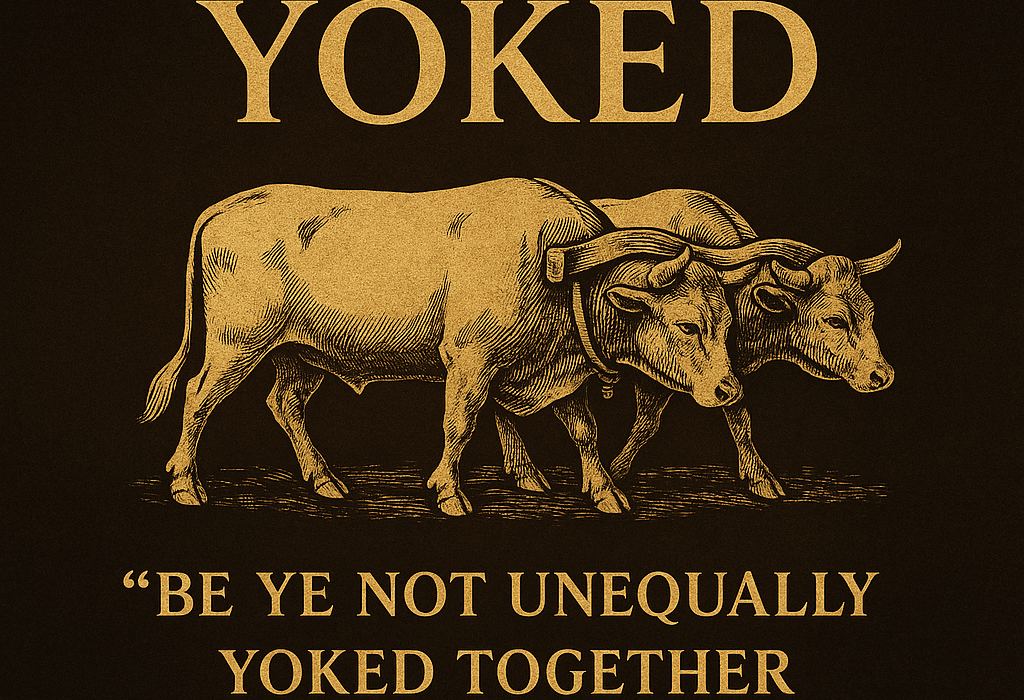
It is a thick, heavy wooden beam that fastens two animals, typically oxen, together across their shoulders, binding them into a single unit for one purpose: to pull.
When used properly, the yoke distributes weight evenly, unifies direction, and multiplies force. Two yoked oxen can pull four times the load, three yoked oxen can pull nine times the load, four yoked oxen can pull 16 times the load and so on. But only if they walk at the same pace, obey the same master, and carry the same load. The yoke is not decorative. It’s not ornamental. It’s a symbol of labor, submission, and productivity. It is a tool for dominion over the earth, plowing, dragging, building.
Now apply this to marriage.
Marriage is not two people dating for eternity. It is two or more people bound together by covenant, law, and duty, joined in purpose under the rule of God. When you enter marriage, you are yoked. Like it or not.
The only question is: are you equally yoked or unequally yoked?
Because one produces dominion, while the other only produces destruction.
II. The Power, and Pain – of Yoking
Let’s be clear: a yoke without equality is a torture device.
If one ox is significantly stronger than the other, the weaker one slows down the pace. The stronger one begins to chafe. The weaker one limps. The plow veers off course. The field is ruined. The yoke becomes a weapon. And both animals suffer.
If one ox tries to go left while the other pulls right, the yoke does not break. Their necks do. Misalignment under the yoke is not an inconvenience, it is pain, waste, and eventual collapse.
So what makes a yoke “equal”?
- Same Master: Both must recognize the same authority.
- Same Direction: Both must obey the same command.
- Same Pace: Both must walk in step with one another.
And if even one of those is off? Then the yoke becomes hell. Which is exactly what we’re seeing in households today.
III. Are Most People Even Equally Yoked?
No.
Let’s just get that out of the way.
Most people in modern marriages are not equally yoked. They are self-yoked, bound only by emotions, romantic sentiment, or the paperwork of a civil government that hates God.
We’ve traded covenant for chemistry. Vision for validation. Work for feelings. But feelings don’t plow fields. Feelings don’t raise children in order. And feelings don’t establish generational dominion.
Most “marriages” today are not rooted in obedience to God but in convenience, lust, loneliness, or rebellion. And then we have the audacity to ask why so many homes are barren, bitter, and broken.
Let’s break it down:
- Different Masters: He serves Christ. She serves herself. Or worse, she serves a secular ideology that tells her submission is slavery. She doesn’t view herself as a helper but a partner. The result? Constant rebellion and resentment.
- Different Directions: He wants to build a multigenerational household of faith. She wants to travel, focus on herself, “find her truth.” She calls it “balance.” God calls it division.
- Different Paces: He wants to move boldly, quickly, and build early. She wants to delay children, delay responsibility, delay obedience. “We’re just not in the same season.” No, sweetheart, you’re just not on the same mission.
But the problem runs deeper.
Two Kinds of Unequal Yoking: The Double Standard
Let’s sharpen the blade.
A Christian man may enter into a marriage covenant with a non-Christian woman, and though it will be unequal and painful, it is still a real marriage, because the man is the head of the covenant.
Authority flows from the top. And in biblical structure, the man holds the covenantal keys. If he is submitted to Christ and binds a woman to himself, she is brought under the spiritual covering of his house, even if she is not yet converted. He is accountable. He bears the burden. He governs the yoke.
She, if she refuses obedience, will be judged. He, if he leads well, may still be blessed.
This is why Scripture says:
“For the unbelieving husband is sanctified by the wife, and the unbelieving wife is sanctified by the husband…” —1 Corinthians 7:14
But this passage does not affirm spiritual equality. It simply confirms the validity and covenantal consequence of the union when the man is aligned with God.
Now flip the roles.
A Woman “Married” to a Non-Christian Man Is Not Married at All
If a woman claims to be “married” to a man who is not under Christ, she is not in a marriage covenant, she is in a false contract, built on a lie.
Why?
Because marriage is not a human invention. It is not a cultural norm, not a civil arrangement, and not a private agreement. Marriage is a divine institution, defined, ordered, and upheld by the authority of God Himself.
And no covenant can be valid if it is made without proper covenantal authority. If the man does not belong to Christ, he cannot govern a household under Christ. He cannot be the head of a covenant he doesn’t even recognize. He cannot lead a woman into a structure he’s spiritually excluded from.
Therefore, she is not married. She may be sexually bonded, emotionally attached, and legally entangled. But covenantally, biblically, and eternally, she is not a wife.
She is a bound woman without a head. And her house is built on sand.
God Is Not Mocked by False Unions
This is not a technicality. It is a fundamental distinction between valid and invalid marriages.
When a Christian man joins himself to an unbelieving woman, the covenant can still exist, because he stands in the role of Christ, and she enters through him.
But when a Christian woman joins herself to an unbelieving man, he is not Christ-like, nor covenantal, nor even legitimate as a household head. He is spiritually dead. And a dead man cannot be a husband.
It’s not just that the yoke is unequal. It’s that there is no yoke at all. There is no marriage. And the modern church,by blessing these false unions, has become complicit in spiritual fraud.
We call rebellion “romance.”
We call fornication “love.”
We call illegitimate households “ministries.”
And we wonder why the world mocks Christian marriage, Why wouldn’t they?
IV. Is the Marriage Even Valid?
This is the dangerous question. But it must be asked.
Can a covenant truly be considered valid if it is built on false alignment? The modern church says yes. The Bible doesn’t speak as softly on this topic.
Throughout Scripture, God nullifies alliances that violate His order.
- He breaks the yoke of foreign wives from Israelite men (Ezra 10).
- He curses alliances with pagan kings (2 Chronicles 19:2).
- He describes unequal yoking as pollution, corruption, and danger (2 Corinthians 6:14–18).
Now let’s be careful: valid does not mean blessed. A marriage can be real in the legal sense, but completely void of blessing, fruit, or peace. That’s what happens when the yoke is forged by lust, fear, or compromise.
If the foundation was rebellion, against God, against your father, against Scripture, then the union may very well stand legally, but be rotten at its core.
And rot spreads.
V. Can It Be Fixed?
Now to the heart of it: Can an unequally yoked marriage be corrected?
Yes, but only if both parties are willing to repent and come under the same authority, the same mission, and the same standard.
That is rare. Here’s what it requires:
1. Submission to the Same Master
If the wife is not submitted to God through her husband, then she is still wild. Her obedience must be real. Not performative. Not partial. Not “when she feels like it.” Full repentance means full surrender to her husband in all things and without exception or excuses.
2. Agreement on Mission
The man must cast vision, and the woman must follow. This is not a “let’s meet in the middle” negotiation. This is the husband saying, “This is where the household is going,” and the wife saying, “Yes, my lord.” Anything less is compromise, which means sabotage.
3. Reordering the Household
If roles are blurred, they must be restored. Headship must be reinstated. Discipline must be enacted. Order must be visible. A house divided must be rebuilt from the ground up. That requires pain. Tears. Confrontation. And grace.
This is not a “work it out over time” feel-good strategy. It is surgical repentance or nothing. Because otherwise? You’re just dragging a dead ox around a field, calling it marriage.
VI. Should You Stay Together?
If you are currently unequally yoked, and your spouse refuses to come under God’s authority, you are in a war zone—not a home.
What then? Paul gives this instruction:
“If the unbelieving partner separates, let it be so. In such cases the brother or sister is not enslaved.”
—1 Corinthians 7:15
You are not called to be a spiritual hostage.
You are called to lead, build, and protect the integrity of your household. If your spouse is dragging you into chaos, rebellion, or destruction, and refuses correction, then separation is not sin. Sometimes, it is the only path back to order.
But the responsibility of the man is first to restore, not to run.
Do everything in your power, boldly, without compromise, to bring your house into alignment. Call her to repentance. Rebuke rebellion. Set expectations. Enforce discipline. Pray, yes, but also act.
And if she refuses? Then peace is found in the severing.
VII. What If You’re Not Married Yet?
Good. Listen closely.
Men, Never yoke yourself to someone who won’t follow. You are not “saving her.” You are not “leading her to Christ by marrying her.” That is spiritual arrogance disguised as compassion. You’re just tying your household to a corpse and calling it evangelism.
Marry only a woman who is already walking in obedience and willing to learn an follow with a spirit of submission. Already aligned with your mission. Already submitted to Scripture.
Don’t marry a project that is not repentant. Marry a helper.
And for women: never yoke yourself to a man who cannot lead. You are not his mother, you are a wife. If he is not your head, he will be your son or your slave. Neither is a marriage.
VIII. Unequally Yoked in Friendship and Business: The Silent Sabotage
Marriage isn’t the only place where unequal yoking destroys dominion. Friendships and business partnerships are often the quiet killers.
Paul’s warning wasn’t limited to romance:
“What partnership has righteousness with lawlessness?”
—2 Corinthians 6:14
The answer? None.
1. Friendship: Brotherhood or Bondage?
Friendship is alignment. It’s shared purpose. If your “friends” pull you away from mission, dampen your fire, mock your obedience, or numb your standards, then you’re not in fellowship. You’re in bondage.
If you must dilute your masculinity to stay welcome, you’re already yoked to darkness. Cut it off.
2. Business: Profit or Poison?
A business partner who doesn’t serve Christ will eventually demand that you betray Him.
You cannot build kingdom enterprises with men ruled by Mammon. You cannot pursue dominion while sharing profit with corruption.
And if you yoke yourself to one? You deserve the fruit of that partnership: compromise, loss, and judgment.
3. The Test: Who Sets the Pace?
The question is always:
“Can I obey God at full speed without losing them, or must I slow down to keep peace?”
If the answer is the latter, you’re already unequally yoked.
IX. The Final Separation: Light from Darkness
“What fellowship has light with darkness?”
—2 Corinthians 6:14
None.
You don’t build the Kingdom with rebels. You don’t anchor your strength to cowards. You don’t share the yoke with fools.
And to the women reading this, or to the men who are leading them, let this sink in:
Your yoke isn’t just your husband.
It’s your circle, your voice of influence, your operating environment.
And if you claim to be yoked to a righteous man but remain emotionally, socially, or loyally tethered to the world’s women, worldly family, or feminist coworkers, you are already breaking the yoke.
To be painfully clear.
1. Friends Who Despise Order
If your “best friend” mocks your submission to your husband, she’s not neutral. She’s poison. If she encourages divorce, independence, “girl power,” or autonomy from the man you vowed to obey, she’s the serpent whispering in your ear.
You cannot walk in obedience while holding hands with rebellion. Friendship is loyalty. Loyalty is alignment. And alignment is yoking. You will never submit to your husband if you’re still emotionally bonded to women who live in defiance of God’s design.
Cut the tie.
2. Family That Undermines Headship
God did not say, “Leave your mother and cleave to your mother.” He said:
“Therefore a man shall leave his father and his mother and cleave unto his wife…”
—Genesis 2:24
And by extension, a wife is to cleave to her husband and cut the umbilical cord of familial control. If your parents, siblings, or extended relatives routinely contradict your husband, insert themselves into your household, or sow doubt into your marriage, they are intruders, not allies.
And if you keep them close? You’ve chosen them over the man God placed over you. No woman can serve two masters, her father’s house and her husband’s authority. One must be cut off.
3. Coworkers That Corrupt Your Spirit
You cannot be equally yoked to a godless workplace and expect to bring peace into a godly household.
If you spend eight hours a day surrounded by women who scoff at submission, laugh about their body counts, and complain about their husbands, then come home to a man expecting warmth, honor, and obedience, you are split in two.
The yoke is breaking. Your job isn’t “just a job.” It’s a training ground. And if your workplace catechizes you in rebellion, don’t be shocked when it leaks out of your mouth at dinner.
Unequal yoking in your environment produces unequal yoking in your soul.
Final Warning
If you must defend your friends, justify your family, or excuse your coworkers, instead of aligning fully with your household, your loyalties are exposed. You are not yoked. You are split. And the split will grow into rot.
The righteous woman doesn’t flirt with rebellion. She severs it. Ruth didn’t go back to Moab. She said:
“Your people shall be my people, and your God my God.”
—Ruth 1:16
And that is the only kind of woman worthy of the yoke.
Let God’s Great Order be restored in our homes, families and communities.