Category Archives: Polygamy

Jacob – The Flawed Patriarch Who Fathered a Nation


I. Introduction: The Man Who Became a Nation

Jacob is not a moral mascot. He is a patriarch. A bruised heel, a cunning mind, a relentless force. The Church today wants poster boys of piety, neat beards, monogamous morality, and tidy households with devotional apps and filtered family photos. But God chose Jacob. And Jacob’s house wasn’t tidy. It was turbulent, expansive, polygynous, fruitful, and entirely God-ordained.

If you want a clean legacy. A polished resume. A family tree that could make a Hallmark movie jealous that Jacob is not your man. But God doesn’t build nations from photo albums, He builds them from blood, betrayal, polygyny, and perseverance. If you’re looking for perfection, Jacob is not the image you seek. If you’re looking for fruitfulness, covenant, household dominion, and raw masculine endurance, then Jacob is your patriarch.

Jacob, the man renamed Israel, was no sanitized church hero. He lied to his father, deceived his brother, worked for and purchased underage wives, married sisters (a move later forbidden under Mosaic Law), took their handmaids as concubines, played favorites with his children, stayed silent when one was sold into slavery, and fathered the entire nation of Israel through a household that modern pastors would call “unbiblical.”

When God renamed Jacob “Israel,” He wasn’t baptizing a perfect man. He was commissioning a patriarch. The man who fathered twelve sons by four women. The man who bought teenage brides and later took their handmaids to be concubines (who eventually became additional wives). The man who lied to his own father and was later lied to by his uncle. The man who watched his sons slaughter a village and did nothing.

And yet… he is the chosen one. God’s own covenant was sealed with this man, not because of his morality, but because of God’s sovereign purpose. Jacob didn’t “fall into” polygyny. He didn’t slip. He wasn’t ashamed. He built an empire from it. And God didn’t rebuke him, He built His people on that household. And God called him blessed. Why? Because Jacob was in covenant. He wrestled with God and would not let go until the blessing was secured, no matter the cost.


II. Delayed Beginnings and the Demands of Legacy

Jacob didn’t marry until he was 77 years old. That’s not a typo. While modern men are told they’ve peaked or passed their usefulness by 40, Jacob hadn’t even begun to build his household until nearly twice that age.

So what was he doing all that time? Scripture gives us glimpses: he stayed in tents, remained under his father’s instruction, dwelled quietly while Esau hunted and conquered. He was not a builder yet. Not a warrior. Not a leader of men. He was preparing, slowly, painfully, and in obscurity.

But when the time came, Jacob fled to Haran with nothing but a staff. He didn’t even have the means to purchase a wife. At 77, he had to labor 14 years just to acquire two brides. He started late, but he didn’t whine, complain or make excuses. He never lamented about what he could have or should have done.

And because he started late, he had to build rapidly. Polygyny wasn’t really optional, it was necessary. One wife would not bear twelve sons fast enough. One womb could not produce a nation in a lifetime. Jacob’s strategy was not romantic in the modern sense, it was patriarchal. He accepted handmaids. He honored both sisters. He honored his position and multiplied quickly.

This is the lesson: it’s never too late to start. But starting late requires strategy. It requires scale. And it requires the rejection of modern sentimentality. If you aim to build a nation past your youth, you will need polygyny, patience, and patriarchal vision.


II. The Meeting at the Well: 77-Year-Old Meets 14-Year-Old Rachel

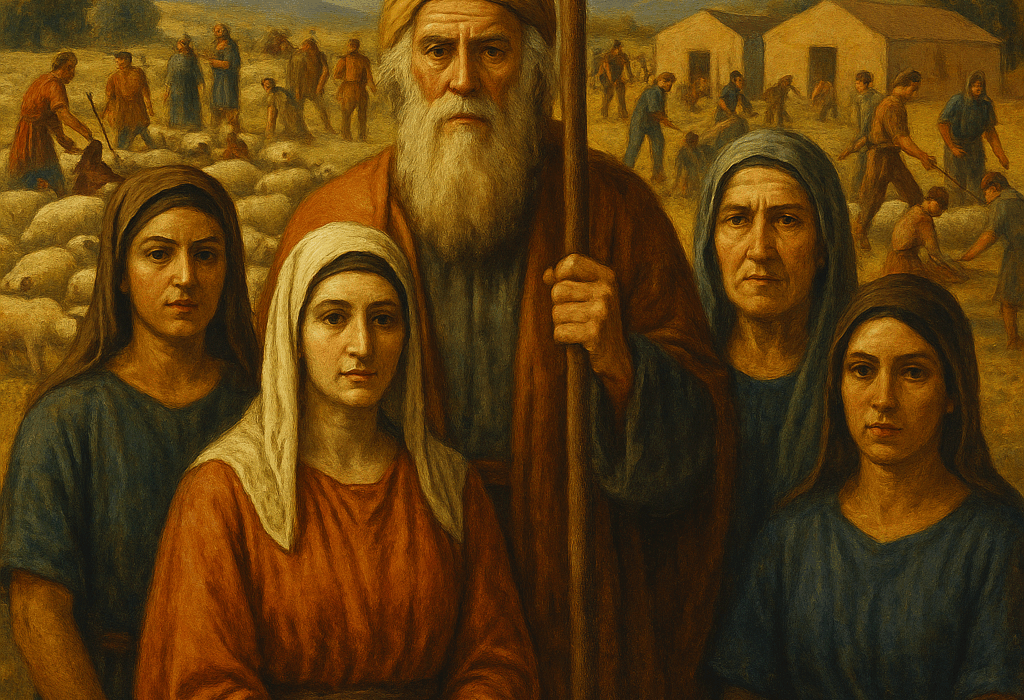
Jacob met his beloved Rachel at a well in Haran. She was a shepherdess, tending to her father’s flocks, in a pattern echoing across Scripture. But the part your Sunday school teacher skipped was this: Jacob was 77 years old when he met Rachel who was 14 at the time, her older sister Leah, whom Jacob would also marry, was about 15. He kissed Rachel that very day and wept aloud (Genesis 29:11). This was not a “grandfather’s greeting”. It was the beginning of a marriage transaction.

Modern minds recoil. But Scripture does not. Jacob kissed Rachel that very day and proclaimed “love at first sight”. In a world where men shrink from commitment and women delay marriage until their youth has withered, this scene offends modernity. But it honors God. Rachel wasn’t dating. She wasn’t career planning. She wasn’t collecting degrees. She was a bride in waiting, working in her fathers kingdom. And Jacob didn’t flirt. He pursued. Immediately, definitively, and even with payment.

Now, the modern mind reels. “Predator,” they say. “Groomer.” But Scripture says something else entirely: he loved her. From the first moment. And he proved it with the only thing that proves love, action and sacrifice.

No flirting. No promises. No “let’s see where this goes.” Jacob laid down seven years of labor for a bride he met at the well. He didn’t wait and send a text later, he didn’t date for a few years. He rolled up his sleeves and purchased his bride.


III. A Price for a Bride: Love Is Proven in Labor

Jacob did not propose over dinner. This wasn’t romance, but a transaction, a Covenant. He paid a price. Not having the available finances to purchase his bride outright he offered Seven years of hard labor managing Laban’s flock. Rachel was the daughter of his uncle, but that did not make her free. She was a daughter, which meant she was a commodity. She belonged to her father until another man purchased her through covenant.

Genesis 29:20 says, “So Jacob served seven years for Rachel, and they seemed to him but a few days because of the love he had for her.” Let that sink in: love was proven by labor, by action. Not words. Not poetry. Not dinner dates, or “communication”, but sweat and dedication.

And Jacob paid. Full price, without complaint. Then Laban deceived him, sending Leah into the wedding tent under darkness. The next morning, Jacob discovered the swap. Did he storm off? Cry betrayal? No. He married both. Even stayed and worked another seven years for Rachel. Fourteen years total. This wasn’t indentured servitude, it was dowry. It was love measured in action. 

You don’t “date” a wife. You earn her. Jacob earned two, (well 4 eventually), but we will get to that later.


IV. Sisters, Servants, and Sons: A Household of Four Mothers

Modern minds recoil at the idea of marrying sisters. But Jacob did it with full cultural legitimacy. Rachel and Leah both bore him sons, though Rachel, beloved as she was, struggled with barrenness. In the ancient world, this was not just a personal sadness, it was a crisis of legacy (as it should still be).

So Rachel did what almost any woman of her day would have. She gave Jacob her handmaid Bilhah as a concubine. Bilhah bore sons on Rachel’s behalf. Leah, seeing this, gave Jacob her maid Zilpah as well. He didn’t argue, he didn’t moralize.  Jacob accepted both. No argument. No sermons. No shame. He lay with the maids and received their sons into his household. These were not mere bedwarmers. They were concubines, wives by function if not by primary rank.

From this household of four women, two wives, two concubines, came twelve sons: Reuben, Simeon, Levi, Judah, Dan, Naphtali, Gad, Asher, Issachar, Zebulun, Joseph, and Benjamin. Plus one daughter, Dinah. These sons became the twelve tribes of Israel.

Polygyny wasn’t the side story. It was the structure. It wasn’t a concession, but the covenantal method for fruitfulness. This is not just descriptive, it’s prescriptive. God used it, blessed it, and God built His people on it. Let that sink in for a minute – polygyny is the method God chose EVERY time for the expansion of his covenant people.

This wasn’t dysfunction, it was dynasty. Jacob didn’t “fall” into polygyny. He stewarded it, and in doing so created the 12 tribes of Israel.


V. The Cost of Favoritism and Silence: Jacob’s Fathering Failures

Jacob was a patriarch, but he was not perfect. His household was marked by favoritism. He loved Rachel more than Leah (Genesis 29:30). He loved Joseph more than the others (Genesis 37:3). He even clothed Joseph in a special garment that stirred the envy of his brothers. Everyone knew it. When this favoritism bred resentment among the other brothers Jacob saw it. He knew they hated Joseph. But he stayed silent. 

He also stayed silent when Joseph was sold into slavery. The brothers dipped the robe in blood and brought it to Jacob. He wept. But he didn’t investigate. He didn’t lead. He accepted the story, descended into grief and mourned for years.This silence wasn’t passive, it was leadership failure. And yet, even in his failure, Jacob remained the patriarch of promise. God didn’t revoke His covenant. The twelve tribes still bore his sons’ names.

His sons murdered the men of Shechem in retaliation for Dinah’s violation. Jacob’s response? “You have brought trouble on me” (Genesis 34:30). Concerned with reputation, not righteousness.

Yet this flawed, quiet father remained God’s patriarch. Because God doesn’t require perfection, He requires covenant. God doesn’t wait for perfect men. He uses patriarchs who limp.


VI. A Man of Deception Chosen by a God of Truth

Jacob’s life was woven with deceit. He lied to his blind father, tricked his brother Esau out of the birthright by impersonating him to steal Isaac’s blessing. He manipulated livestock breeding,   using selective breeding tactics to enrich himself at Laban’s expense (Genesis 30:37-43). He was shrewd, cunning, and unapologetic.

This wasn’t accidental. Jacob was strategic. And God still blessed him. Why?

Because Jacob wrestled with God, and didn’t let go. He demanded blessing. He demanded covenant. And God granted it.

Genesis 32 recounts the midnight wrestling match. A mysterious Man (understood to be a theophany – God Himself) wrestles Jacob until dawn. Jacob refuses to let go. He demands blessing. The Man touches his hip, dislocating it, and then renames him: Israel.

Israel means “He who strives with God.” Not “He who obeyed nicely.” Not “He who conformed.”  Not “he who behaves.” God renamed him for wrestling, striving, and demanding. God honors hunger and dedication, not manners.

The same man who deceived his father became the father of a nation, then grandfather of nations.


VII. God’s Blessing on a Polygynous Man

Jacob was a polygynist. He had four wives (two by direct marriage, two by concubinage). Scripture never condemns him for it. Not once.

The modern Church blushes and stammers over polygyny, offering excuses: “It was cultural,” “It was allowed, not ideal,” “God just tolerated it.”

Spineless nonsense!

God could have shut Leah’s womb. He could have shamed Rachel. He didn’t. Instead, He opened their wombs, multiplied their children, and formed a nation from their bodies. Polygyny is not the curse, but a blessing. it was the structure God used to build Israel.

Jacob’s sons founded the twelve tribes. From Leah came Levi (priests) and Judah (kings), Reuben and Simeon. From Rachel came Joseph (double-portion through Ephraim and Manasseh) and Benjamin. From Bilhah and Zilpah came the remaining tribes. The modern church teaches monogamy as doctrine. Yet the very people of God were born from a household that no modern pastor would allow on the church membership roster.

You want revival? You want legacy? Start by embracing the blueprint God actually used. God didn’t “allow” polygyny, he crowned it.


VIII. The Legacy: A Nation Birthed by a Household

Jacob’s sons didn’t just fill a tent, they founded tribes. Reuben’s line. Judah’s kings. Levi’s priesthood. Joseph’s double portion through Ephraim and Manasseh. Benjamin’s warriors.

Jacob didn’t have a Pinterest family. He had a warring, womb-bearing, legacy-generating household. A patriarchal dominion. And that’s exactly what God used.

He didn’t wait for reform. He didn’t impose 21st-century ethics on a Bronze Age household. He multiplied fruitfulness through what would today be labeled “toxic masculinity” and “patriarchal oppression.” But it was, and is God’s design. It was God’s man. It was God’s house.

These weren’t random children. They were the seedbed of civilization. And they came not from a modern “nuclear” family, but from a polygynous, patriarch-led household.

The legacy of Israel, our spiritual and ancestral heritage, was not born in a sanitized seminary. It was born in tents. On blood-soaked soil. With sisters competing, handmaids birthing, and a patriarch directing the legacy.

Jacob fathered a nation not in spite of polygyny, but ONLY because it.


IX. What the Church Refuses to Preach

The modern Church preaches romance, butJacob lived reality.

He would be excommunicated from most if not all modern churches.

  • Married sisters? Forbidden.
  • Slept with handmaids? Scandal.
  • Favored wives? Misogynist.
  • Bought 14-year-old brides at 77? Predatory.
  • Married 20-22 Year old women at 84? Pedophile.

But God doesn’t flinch. He names Jacob “Israel.” He renews the covenant of Abraham through him. He appears to him personally and blesses him repeatedly. The Church today wants sanitized saints, but God wants fruitful patriarchs. Men who are willing to stand on Biblical truth, demanding conventional blessing no matter the cost.

The Church preaches sentimental monogamy. Jacob lived divine multiplication. The Church preaches equality. Jacob chose favorites, led with hierarchy, and structured his household for fruitfulness, not fairness.

They talk about “waiting for the one.” Jacob worked 14 years for two. And when his wives gave him their maids, he didn’t hold a Bible study on the ethics of polygyny, he received them as part of his house and expanded the kingdom.

The Church fears offense. God builds with obedience. Jacob’s life doesn’t fit the evangelical mold. Which is exactly why it built the Kingdom!


X. Conclusion: God Builds With Dust and Blood

Jacob was not a poster child for moralism. He was old, shrewd, polygynous, and often silent at the worst times. But he was chosen. Not because of his goodness, but because of God’s purpose.

He kissed a 14-year-old girl and loved her for life. He married sisters. He fathered sons through servants. He allowed his favorite son to be sold. He limped after wrestling with God. He blessed the wrong grandson on purpose. And he died in a foreign land, trusting in a promise that he did not live to see fulfilled.

And from that life – flawed, complex, masculine, covenantal, came the nation of Israel. Our entire faith is rooted in a man with four wives, twelve sons, and a limp. This is not an insignificant side story. This is the foundation of our faith, our people and all of western civilization.

If you want to restore biblical manhood, stop chasing modern respectability. Start embracing patriarchal fruitfulness. Start understanding that God builds not with sanitized myths, but with real men, real blood, and real households. Jacob did not live to please the world. He lived to build the kingdom of God, and in doing so he built nations.

And if the Church wants to reclaim legacy, it must reclaim Jacob, not as a relic of ancient oddity, but as the blueprint for dominion. 

God builds with blood. He builds with covenant. And He builds through patriarchs who refuse to let go until the blessing falls.

Let God’s Great Order be restored.

What Is a Husband?

The Standard, the Staff, the Sword

“Wives, submit yourselves unto your own husbands, as unto the Lord.”

That’s not a freebie for men. That’s a target on your back.  It means the Lord is watching you and you must be someone worthy of submission.


The Other Side of the Mirror

Last time, I set the record straight on what a wife is, and isn’t. I set out to burn the modern lies of “wife” to the ground and rebuild the ancient framework of covenant womanhood.

But now the mirror turns.

Because if a wife is a keeper of the home, the husband is the standard of the house. And most men, just like most women, are failing miserably.

Not failing because they don’t provide enough. Not failing because they don’t say “I love you” enough. But failing because they have surrendered the very essence of manhood: rule, responsibility, and righteous discipline to the whims of a feminist culture.

This isn’t a sermon for soft men.  This is a war drum for the builders, the sons of Adam who are ready to reclaim dominion.  You don’t get to complain about modern women if you refuse to get off your ass and rule your house.

So let’s be clear—what is a husband?


The Purpose of Man

Man was made first. Not just in order, but in purpose.

“And the LORD God took the man, and put him into the garden of Eden to dress it and to keep it.” — Genesis 2:15

Before there was a wife, before there was a home, there was a job.  Adam was given dominion. Labor. Stewardship. Purpose.

A husband is not a man who gets married.  A husband is a man with a mission who calls a wife into his mission as a helpmeet. He does not exist for her emotional needs, she exists to help him complete his God ordained assignment.  That means: If you’re not building anything, you’re not ready for a wife. You don’t marry and then go looking for purpose.  You have purpose, and then take a wife (or a few) to help build it.


Husband Is a Job, Not a Right

Modern men act like marriage is an entitlement. As if having a beard and a Bible verse in your Instagram bio qualifies you for headship.  But headship is not automatic. Authority is not a prize. It’s a weight.

Being a husband means carrying souls on your back and being accountable to God for what happens in your home.

  • You are the first to blame.
  • You are the first to bleed.
  • You are the last to sleep.

You set the tone. You take the hit. You get the judgment, all of it. You don’t get to pout, retreat, or hand it over to your wife when it’s hard. You are the man. That means: No matter who causes the mess, you are responsible for cleaning it up.

If you are not willing to suffer for your house, you are not fit to rule over one.


The Duties of a Husband

Headship is not vague. It’s not abstract. It’s not “being a nice guy.” It is a specific set of duties, laid out in Scripture and rooted in creation itself.

1. Lead

You decide where the house is going. Spiritually, financially, and morally. You don’t outsource that to her feelings or her friend group. You chart the course and demand alignment.

2. Provide

Not just money, but safety, vision, direction, and provision for the soul.  A real provider does not just pay bills. He feeds the spirit of his wives and children.

3. Protect

From danger. From foolishness. From false doctrine.  You are the wall around your home. If hell gets in, it’s because you let the gate open.

4. Cultivate

A husband does not just rule, he raises.  He raises his wife with encouragement, boundaries, and correction. He raises his children with discipline and doctrine.

5. Sanctify

“That he might sanctify and cleanse it with the washing of water by the word…” — Ephesians 5:26

Your job is to cleanse your house with the Word of God. If your wife is anxious, confused, or chaotic, speak the Word. Correct with Scripture. Lead in prayer. Be the priest. Demand that she takes her place and does her job.


The Husband as Standard-Setter

Here is a truth most men refuse to swallow: Your house reflects your leadership.

If your wife is disrespectful, it’s because you tolerate it. If your children are unruly, it’s because you’ve abdicated discipline or your wife(s) refuse their calling. If your home is cold, loud, disordered, or overrun with emotion, it is at least partly your failure for allowing your wife(s) to show that level of disrespect to you.

A wife is a reflection of her man’s standards. She may bring her own sins, sure. But she acts with freedom or fearlessness based on what you permit. The standard of your home is not what you say it is.  It is what you allow.

So set the standard, and enforce it.


Demanding Performance From a Wife

The modern husband has been taught to beg for what he should be expecting.

  • Begging for peace, cleanliness and order.
  • Begging for submission and obedience.
  • Begging for home-cooked meals.
  • Begging for honor and respect.

What kind of king begs his servant to obey?  What kind of builder begs his tools to work? Marriage is not unconditional affirmation.  It is a covenant of duties. And that means: if your wife is not fulfilling her role, you must correct her.

You would not keep an employee who refused to do the job.  Why tolerate a wife who refuses to be a wife? Demand does not mean abuse. It means you expect the standard to be kept.  And if she will not build with you, you confront that rebellion like a man.


The Role of Discipline

This is the forbidden word: discipline.  But God commands it, and the fruit proves it.

“For whom the Lord loveth he chasteneth…” — Hebrews 12:6

If you love your wife, you correct her. You rebuke sin. You expose error. You confront rebellion. You remove idols. This doesn’t mean yelling, violence, or tyranny.  It means being firm. Clear. Immovable.

Your wife is not your spiritual leader. She is not your emotional manager. You are not called to keep her happy, you are called to keep her and your home holy.

And if she refuses correction, you escalate accordingly:

  1. Private rebuke.
  2. Scripture-based confrontation.
  3. Involve church elders (if you have a real church).
  4. Separation if she is destructive to the home.
  5. Never surrender the order, even if it costs you. Demand what God has ordained.

There is no love without discipline.  A man who lets sin rule his home hates his family.

What a Husband Is NOT

To lead rightly, we must kill the counterfeits.  A weak man is a curse. A false head is a danger. And there are many imposters pretending to be husbands today.

A Husband is NOT a Tyrant

You are not a dictator. You are not God. You do not lead by fear, insults, manipulation, or threats. You lead like Christ, with clarity and sacrifice. A tyrant seeks control. A husband seeks fruit.

A Husband is NOT Passive

You do not “go with the flow.” You do not let her decide “to keep the peace.” You do not hide behind sports, silence, video games or smiles. Passive men produce powerful rebellion. If you will not lead, she will, and then blame you for it.

A Husband is NOT a Romantic Sap

Love is not serenades and chocolates. Love is service, strength, and sacrifice. She does not need poems. She needs a plan. She does not need roses. She needs a righteous man who actually knows where the family is going.

A Husband is NOT a Servant to Her Moods

Her feelings do not dictate your leadership. You are not her therapist, nor her cheerleader. You are her head, which means: You lead regardless of emotional weather.

A Husband is NOT “One of the Kids”

Your children do not need a buddy. Your wife does not need a man-child. She needs a father to her children, not another toddler playing video games and hiding from real responsibility.

A Husband is NOT a Pervert

Lust will kill your leadership. A husband who is addicted to pornography, enslaved to fantasy, or who uses his wife like a toy rather than an image-bearer of God cannot lead with honor.  A real man masters his appetite, so he can guide hers.


The Glory of True Headship

When the house is in order, peace flows like a river. The children know their place. The wife blooms in safety and purpose. The world outside may rage, but inside, a kingdom thrives.

That kingdom starts with you. A husband is not the center of attention. He is the foundation.
No one praises the concrete slab. But without it, everything collapses. You may never be applauded. But you will be feared by hell and honored by heaven if you rule well.

“He that ruleth his house well, having his children in subjection with all gravity…” — 1 Timothy 3:4

This is what it means to be a man. Not soft. Not silent. Not spineless. But forged in truth, built for burden, and leading with sacred clarity. You are the staff that holds the house. You are the sword that keeps it clean. You are the standard that everything else aligns to.

And when you stand tall, so does everything under you.


Final Word: The Man Who Builds Rightly

If your wife is out of order – correct her, put her in order.
If she refuses repeatedly – remove her, replace her, or get additional wives.
If your house is chaotic – demand structure, demand peace.
If your children are unruly – discipline them, this is a reflection of your wife(s) disrespect for you.

No more excuses. No more soft talk. No more waiting for her to “come around.”

You are the man.
You are the head.
You are the glory of order in your home.

So repent where you’ve failed.  Rebuild what you’ve allowed to fall. Reject every lie that told you masculinity was toxic, headship was outdated, and discipline was abuse. You were made to rule. You were made to lead.  You were made to build houses that last longer than your name.

“Through wisdom is an house builded; and by understanding it is established:” — Proverbs 24:3

So rise up, speak with strength, correct with Scripture, and lead with clarity. Walk like a man who knows that God is watching. Your wife doesn’t need a cute husband. Your kids don’t need a cool dad. They need a man whose feet are set in the fire of God’s Word, and who will not move no matter the threats or consequences. 

What Is a Wife?

Not a Title, But a Career

“Wife is not a noun, it’s a verb.”

Wrong!
It’s both. It’s also a job. A calling. A burden. A glory.
But it is not a trophy you get for breathing while female.


A Word Before the Fire

Let me begin with a warning and a promise.

This is not a hit piece on women. This is not some male fantasy rant against modern girls who “just don’t get it.” This is not a tantrum or a vent session. This is war-time restoration. And yes, I will be doing the same for men in the next article: What Is a Husband?

But today, the flames are for the women. Because in this generation, the enemy has stolen the name “wife” and buried it under layers of entitlement, delusion, and confusion. The modern woman thinks she can put on a ring, say “I do,” post a few Bible verses on Instagram, and call herself a wife, while acting nothing like one.

That lie must end before it completely destroys western civilazation.

This is not a love letter to women. It is a mirror. A hard, cold mirror forged in the fire of ruined homes, abandoned children, feminized churches, and weak men who bowed to Jezebel instead of leading like Christ. But it is also a map. A call to return. A signal flare for the few women who still care, who still want to be wives in the ancient and eternal sense.

If you are one of them, keep reading. If not, bookmark this page so you can return when you realize what iv’e said so far is true.


The Purpose of Woman

Woman was made for man. Not by man, but for him.

“It is not good for the man to be alone; I will make him a help meet for him.” — Genesis 2:18

From the beginning, the very blueprint of woman was relational, directional, and submissive. She was designed not as a separate purpose-bearing entity, but as a completion to a purpose already in motion. Adam was tasked. Adam was working. Adam was naming. And then, Eve was crafted, not to start her own mission, but to join his in servitude.

That’s the root of the word helpmeet: an assistant in purpose. Not a fan club. Not an equal partner. Not a rival or an advisor. A suitable helper, tailored, molded, and measured for the specific needs of a man on mission.

That means this: If a woman is not helping a man accomplish his purpose, she has no purpose herself. There is no neutral ground. There is no Plan B. There is no “independent woman” who is somehow whole without this function. The only reason a woman exists is to be a wife, a helper to a man, and by extension, the mother of his children and the maker of his home. She has no other purpose for existence.


A Job, Not a Crown

In modern thought, wife is a status, a prize you get for surviving dating. It’s the culmination of the “romance arc” in every Hallmark fantasy and Disney sequel. A wedding is her coronation. A husband is her handmaiden. The house is her stage.

But in truth, wife is not a status, it is a job. Her only job,  her only purpose.  A permanent, full-time, unglamorous, unpaid, indispensable career.

A real wife works. She builds, she manages, she submits, she bears, she raises, she teaches, she follows, and she multiplies. She is a home-economist, a child-rearing expert, a nutritionist, a nurse, a teacher, a steward, a secretary, and a servant. Not because she’s weak, but because she’s necessary.

A kingdom cannot function without its keeper. A husband cannot accomplish dominion without his helper(s). And a home cannot thrive without the steady hands of a woman who knows what she’s doing.

But here’s the crisis: Modern women don’t.


The Entry-Level Wife (15–18 years old)

Just three or four generations ago, a young woman between the ages of 15 and 18 would already have been more qualified for marriage than most 30-40 year-old “boss babes” today.

Let’s list just a few of the basic, assumed skills of what I’ll call an “entry-level wife”:

  • Cooking: From scratch. Not heating frozen bags. Meal planning, prep, seasoning, and nourishment on a budget.
  • Sewing: Mending, hemming, making basic clothes.
  • Cleaning: Deep cleaning, organizing, rotating, maintaining every area of the home.
  • Laundry: Sorting, washing, stain treatment, folding, storing.
  • Childcare: Feeding, diapering, burping, rocking, teaching, disciplining toddlers, haircuts.
  • Budgeting: Knowing how to stretch a dollar, manage a household allowance, track spending.
  • Gardening/Food Preservation: Growing vegetables, canning, storing dry goods.
  • Hospitality: Hosting guests with grace, warmth, and food.
  • Basic Medical Care: Herbal remedies, minor wounds, treating common colds, etc.
  • Scheduling: Knowing the routines and keeping things running like a tight ship.
  • Manners and Presentation: Representing the household in speech, dress, and decorum.
  • Submission: Basic submission and obedience to male authority.

These weren’t “extra credit.” This was baseline. This was what every marriageable girl already knew at a young age. And yes, they also knew their role. They weren’t being trained to lead. They weren’t being told “marriage is a partnership.” They were being shaped into wives, trained to follow, serve, honor, and multiply.


No Skills? No Hire.

Now imagine this: You apply for a job as a software engineer. But you have no idea how to write code. You can’t open the software. You have no education, no work samples, no certifications and no experience. But you get mad when no one wants to hire you, and worse, you complain about the company who hires you. You complain that “company” doesn’t value you enough, the pay isn’t fair and you’re not happy with the “benefits”, basically the “company” just is not good enough for you.

That’s what we’ve done with marriage.

Today, women demand “good husbands” while offering no wife skills. They say “where are all the good men?”, but they bring nothing to the table except sass, sexual history, emotional baggage, and a job that keeps them out of the house all day.

Ladies: No real man wants to marry a second paycheck. He wants a wife.

That means if you have not been trained for this role, if you cannot cook, clean, nurture, submit, and multiply, you are not ready for marriage. You are asking for a role you have no business in and have not prepared for.

Training for the Job

If wifehood is a job – and it is – then someone must train the applicants.

You don’t throw a teenager into heart surgery and call it “empowerment.”  You don’t hand a scalpel to a girl and say, “Follow your heart.”  Yet that’s exactly what we’ve done with marriage.

We’ve taken the most critical, civilization-shaping, child-forming, man-supporting position in existence and handed it to untrained girls in makeup and mini skirts, told them “you deserve it,” and acted surprised when it ends in chaos and  flames.

So who is supposed to train them?

Start here:

  • Fathers, who set the expectations and protect the standard.
  • Mothers, who model the work and train the hands.
  • Churches, who preach submission, not self-actualization.
  • Older women, who teach the young as commanded in Titus 2.

If your daughter is 12 and you haven’t taught her how to cook a full dinner, you’ve failed her. If she’s 14 and still doesn’t understand what a husband is, you’ve failed her.  If she graduates high school and doesn’t know how to clean, nurture, and follow, she is not ready to be a wife, she is an orphan of the modern world.

You don’t get a Proverbs 31 woman without years of Proverbs 1–30 training.  And yes, that training is physical, mental, and spiritual.


A Wife Must Know What a Husband Is

No wife can submit to what she does not understand.  You cannot assist a mission if you don’t know what the mission is.

“Wives, submit yourselves unto your own husbands, as unto the Lord.” — Ephesians 5:22

This means the wife’s submission is not based on her mood, his charm, or cultural trends. It’s based on the mission of God, the hierarchy of the home, and the man she chooses to follow.

But you cannot follow what you do not study.

Every woman preparing for wifehood must also be trained to understand:

  • What a man is (in nature, drive, and design)
  • What a husband does (lead, provide, protect, plant, and expand)
  • What headship means (command, responsibility, vision)
  • What submission looks like (obedience, alignment, respect)
  • What fruit a wife is supposed to multiply (children, peace, legacy)

You don’t marry a man just because he makes you feel good.  You marry him because you trust his mission, and because you are ready to help him build it. Until a woman knows what a husband is, she is not qualified to be a wife.


What a Wife Is NOT

Let’s clear out some of the garbage. Because in the rubble of modern culture, you’ll find dozens of fake versions of “wife” that need to be publicly executed.

A Wife is NOT a Roommate

You do not just share space, bills, and chores.
You are not “splitting the load” like college buddies.
Wife is not about equality, it’s about function. You are the manager of the home under his headship.

A Wife is NOT a Romantic Partner

Marriage is not built on “chemistry” or “dates.”
It’s built on order, duty, obedience, and fruitfulness.
Romance is seasoning. It’s not the meat. If you need butterflies to obey your husband, you are not a wife, you are a teenage girlfriend.

A Wife is NOT a Co-Leader

There is one head. One final word. One throne. One leader.
Two heads is a monster. God did not design the home as a democracy. It’s a kingdom. The husband rules, and the wife reigns through submission, not veto power.

A Wife is NOT a Career Woman With a Home Hobby

If your real energy, loyalty, and mind go to your boss or clients, and the home gets your leftovers, you’re not a wife, you’re a freelancer with a side hustle called “family.”

A Wife is NOT a Trophy

Your beauty does not qualify you.
Your ring does not sanctify you.
If you do not build the home, follow your man, serve your children, and submit to the order, then you are a concubine at best, but certainly not a wife.

A Wife is NOT a Princess

Marriage is not your Disney ending.
It’s your Exodus beginning. It’s work, suffering, sweat, birth, blood, and glory.
If you married expecting a parade, you’re in the wrong kingdom.

A Wife is NOT a Victim

Yes, men fail. Yes, some husbands are wicked. But your failures as a wife are not excused because your husband isn’t perfect.
Wifehood is your calling. Your judgment will be based on what you did, not what he didn’t.


The Real Glory of a Wife

This is the part modern women seem not able to grasp:

Wifehood is not a demotion. It’s a coronation.
Not as queen of the house, but as keeper of the kingdom.

Wifehood is the highest work a woman can do, because it is the only work she was made for. The world tells you that to matter, you must leave the home. God says: the home is where eternity is built, in-fact it is the ONLY place you matter.

  • You are the first voice your children hear.
  • You are the first hands that shape their souls.
  • You are the first standard of beauty, peace, order, and joy in their world.

You do not “just” keep the house, you literally make the world.
You do not “just” serve your husband, you empower and multiply his mission.

Wife is not less than CEO, less than author, less than entrepreneur. Wife is higher, because all those titles vanish when you die. But the fruit of a true wife lives forever.


A Final Word: The Call to Rebuild

If you’ve made it this far and feel convicted, good. That’s the beginning of wisdom.  This isn’t about guilt. It’s about repentance. This isn’t about hating women. It’s about restoring them to their only purpose.

You were lied to:

You were told that being a wife was a fallback plan. That it was Plan B. That it was an option, a hobby, a relic.  You were told your value was found in rebellion, not reverence.

But the truth remains, eternal and unmoved:

You were only made to be a wife.
You were crafted to help a man take dominion, and for no other reason.
You were shaped to bear life, build homes, and bring glory.

The only question now is this:
Will you return to the job you were created for?


Teaser for Next Article

And to the men reading this: Don’t get smug. Your Next!

The next article is for you. What Is a Husband? will be the mirror you didn’t ask for, but absolutely need. If you want a real wife, you better be a real man, a real husband. The house must have a head before it needs a keeper.

Let the Great Order be restored!

My Statement of Purpose

This is not a motivational speech, Hallmark moment, TED Talk, or an Instagram-ready “purpose-driven life” fluff piece. This is a war cry, a battle hymn, a declaration of intent, forged not in comfort but in conflict.

I was not raised to be the man I have become or am becoming. I was not trained for this life, I was not handed the tools or the vision by my father the way I should have been. I was not surrounded by men of conviction, purpose, and strength, in-fact quite the opposite. I had to become what I should have been taught to be as a child through study and submission to God. I had to learn, from the wreckage of my life and from the ruins of a collapsing civilization, what a man is, what a man must do, and what he must live for.

Every man must have a purpose. Simply having a dream, a feeling, or wishing is not sufficient. Every man must have a purpose, a goal, a burden, a direction, and a vision of legacy. Without this, he is dead already. He may walk, eat, earn money, even reproduce (unfortunately) but he will never truly build, lead, or matter to anyone.

And this was once known to all men inherently.

The Death of Male Purpose

Until just a few generations ago, this was common knowledge. A man existed to labor, to lead, to fight, to provide, to protect, to build. His identity was tied to the work of his hands and the fruit of his sacrifice. No man needed a seminar to know that he was born to take dominion!

Now, the average man is told that his purpose is his self happiness.

He is told he is most virtuous when he is most “self-expressive,” most “true to himself,” most “comfortable in his skin.” He is told to chase careers, money, entertainment, prestige, sex, and status. He is told that a successful life is one where he gets everything he wants, lives in comfort and has as little responsibility as possible. That he deserves praise for simply existing. That any sacrifice asked of him is oppression.

We have traded duty for dopamine discipline for therapy, and dominion for “mental health days.” We are told to serve ourselves, our careers, our government, or whatever political slogan currently sits on the throne of Babylon. But we are not told to serve our wives. We are not told to serve our children. We are certainly not told to serve God. And boy does it show!

What we have now is a generation of soft, winey, emasculated men, physically alive, spiritually neutered. Addicted to porn, praise, and PlayStations. Afraid of discomfort, allergic to authority, and ignorant of their design. They are the natural product of a culture that mocks fatherhood, punishes masculinity, and rewards cowardice.

The Reality of Legacy

Most men don’t build anything. They spend 40+ years building another man’s empire while losing their own house. They give their best hours to a company that will replace them the moment they get sick, and they give their worst hours to the children they hardly know. They try to lead wives who have been trained since childhood to hate submission, to fight headship, and to confuse rebellion with strength.

And when they finally look up, they have nothing. No legacy, no foundation, and no future. Just bills, regrets, and broken dreams. I’ve seen this, I’ve lived this, and I’ve declared war on it!

I am not here to participate in that cycle. I am not here to be another brick in Babylon’s wall. I am here to build a house that lasts. A man is not measured by his net worth. He is not remembered for his career or his cars or his hobbies. He is measured by what he builds, by who he leads, by the faith he passes down.

A man is either a patriarch – or he is a pathetic pawn.

My Beginning: Not a Blank Slate, but a Battlefield

I was born with Lupus. An incurable, lifelong affliction that brings daily pain and exhaustion. Every step costs something. Every action is a choice. Every ounce of effort put forth costs me physically.

But God in His sovereignty gave me this for a reason. I make a conscious effort every hour of every day to not complain, to not dwell on the pain or discomfort, to not use this as an excuse for abdication of my responsibilities, and to not allow this burden to affect the spirit of my household.

Fifteen years ago, I stopped taking the medications that numbed the pain. I chose to live in clarity and agony rather than comfort and fog. Because clarity is required for legacy. And pain is the price of purpose. While others complain about minor inconveniences, I bleed for a future they don’t even believe in. And that’s just the physical side.

I started with no inheritance, no generational wealth, no functioning family structure, no roadmap, and no support from my family. What I inherited was a pile of ashes and a name in need of redemption. But you don’t get to choose your starting line. You only get to choose whether you run or quit.

The Modern Wife Problem

I can state clearly and without apology: less than 1% of females in the Western world today qualify as even a basic, entry-level wife. Not because they are stupid, and not because they are evil. But because they have been deliberately trained, since birth, to be everything but a wife, by their parents, the government and society as a whole.

They are taught to pursue degrees, not diapers. Careers, not covenant. And freedom, not faithfulness. The culture teaches them to be sexually liberated but spiritually barren. Loud, proud, and perpetually offended. Worshiped for simply existing, enraged when corrected, and allergic to all accountability. They are taught to crave attention to the point it is sinful.

And the average man, even a good man, will spend the best years of his life begging and battling just to get what his great-grandfather expected and received without question: a wife who serves, submits, and builds with him. A wife who was trained by her parents to be a wife.

He sacrifices immense time, energy, and money just to lay the foundation that should have been there already. I speak from experience. Most of my adult life has been spent not only learning what I must be as a man and a husband, but then training my wives to be what their parents failed to make them. I had to teach them how to be what Scripture commands, not just by words, but by example, by demand, and by daily discipline.

And even then, the battle is constant and ever-present. Not because they are unwilling, but because they were untrained. And the world constantly reinforces the lie that their feelings are more sacred than their function. That they deserve constant attention and praise for doing far less than the bare minimum, and they are equal to men.

My Purpose: The Restoration of the Biblical Household

My purpose is to rebuild the ancient household. In raw, lived-out, flesh-and-blood reality. I know with full conviction and clarity that God has called me to be a patriarch, a builder of the old ways. A restorer of ruins.

He has called me to live, visibly and unapologetically, the reality of Biblical family order. Including polygyny. Yes, I said it: multiple wives, many children, and a fruitful house. A defiant example to Babylon. This is not about lust, or indulgence, but about restoration. About rebuilding what sin, feminism, church cowardice, and governmental overreach have destroyed.

I am called to take responsibility for more than myself. To cover, train, and lead women who desire to serve something greater than themselves. Women who were discarded, wounded, or simply never given the chance to thrive in their God-ordained roles. Women who are willing to be transformed, not by flattery, but by fire.

I do not ask them to follow me because I am perfect. I ask them to follow me because I will not stop. Because I will not compromise. Because I will die building, and they will never have to wonder where their man stands.

Ministry Without a Microphone

I never wanted attention. I still don’t. I have no desire for fame, or followers, or applause. I sincerely want to be left alone to build in seclusion. But I have come to realize that my house is my ministry. Not social media, sermons, or speaking engagements. My wives, my children, my home, my legacy, and the kingdom I leave my children is my purpose in life.

That is the pulpit from which I preach, that is the testimony that will outlive me, and that is where the Kingdom is built. The world is watching, other men are watching, other women are watching, and most importantly, my sons and daughters are watching.

They will know what a man is, what a wife is, what sacrifice looks like, and what legacy demands. They will not inherit confusion. They will inherit clarity, purpose and generational wealth.

The Cost

I know first hand the cost of this calling. I am mocked,  lied about, and vilified by feminists and religious cowards alike. I am attacked by those who claim to follow God and those who follow only themselves in the pursuit of pleasure. I live in constant sacrifice, constant rejection, and constant tension from the outside world and often even my own wives as they struggle with learning God’s intended role for their lives in stark contrast to what the world teaches.

But I will also live in constant purpose. I live as a man who knows what he is building. I will die as a man who gave everything to give his descendants a starting point. And that is enough, in fact it’s more than I deserve.

The Future: A House, A Name, A Nation

The legacy I build will not be measured in cash but in names, in blood, in fruit, and in sons who lead and daughters who build. In many wives who teach the next generation what their mothers were never taught. In land, in households, in unity and dominion.

I am not building a mansion. I am building a house that hell cannot burn.I am not pursuing early retirement. I will be a patriarch to my family, a stone in the foundation of the Kingdom, and a thorn in the side of every coward who dares call compromise “compassion.”

And when my work is done, they will not say I lived comfortably. They will say I lived convicted. They will say I lived with purpose.

Soli Deo Gloria

Let God’s Great Order be Restored no matter the cost!

The Curse of Vanity: A War Against Order, Holiness, and Contentment

“Favour is deceitful, and beauty is vain: but a woman that feareth the LORD, she shall be praised.”
— Proverbs 31:30 (KJV)

Introduction: A Generation Consumed by the Mirror

We live in an age of mirrors, not altars. Where men and women once rose early to serve their household or kneel in prayer, now they rise to take filtered photos of their own faces. The culture of vanity has saturated every inch of modern life, seducing women into obsession with appearance, and men into the prideful pursuit of status and external power. This is not accidental, it is a calculated war against divine order.

Vanity is not merely a weakness. It is idolatry, and the exaltation of self in the temple of God. It is a rebellion against humility, contentment, holiness, and truth. And it is destroying our women, our daughters, our men, our marriages, our society, and our witness before the world.

This is a call to war; not against lipstick and earrings in isolation, but against the entire spirit of vanity that exalts appearance over obedience, comparison over contentment, and attention over honor.


I. What Is Vanity? The Biblical Definition

The Bible speaks clearly about vanity. The Hebrew word often used is hebel, meaning vapor, emptiness, futility. Vanity is that which is fleeting, hollow, and deceptive.

“Vanity of vanities, saith the Preacher, vanity of vanities; all is vanity.” — Ecclesiastes 1:2

Solomon, the richest and most adorned king to ever live, declared all worldly striving to be empty. He had wealth, wives, status, glory, but without the fear of God, all of it was like chasing the wind.

Vanity is not merely enjoying beauty or having possessions. It is the pursuit of identity, worth, or security in those things. It is when the external replaces the internal. When the created replaces the Creator. When women obsess over looks more than virtue. When men chase possessions more than purpose. When families compare rather than build.

Vanity is spiritual rot dressed in attractive clothing!


II. The Seduction of Cosmetics: Makeup, Nails, and Eyelashes

Makeup is no modern invention. In ancient Egypt, Babylon, and Rome, women (and men) painted their faces to signal wealth, fertility, and seduction. It was tied to pagan religion and temple prostitution.

The Bible gives a sober example:

“And when Jehu was come to Jezreel, Jezebel heard of it; and she painted her face, and tired her head, and looked out at a window.” — 2 Kings 9:30

Jezebel, the pagan queen whose name now symbolizes manipulation, sexual immorality, and witchcraft, adorned herself with paint to seduce and manipulate. Her end was not one of glory.

Modern women who spend hours each week painting their faces, elongating their eyelashes, dyeing their brows, and glossing their lips are not acting independently, they are participating in an ancient pattern of vanity that exalts sensual appeal over inward holiness.

A woman’s strength is not in her beauty; it is in her meekness, her modesty, her devotion, and her fruitfulness.

“Whose adorning let it not be that outward adorning of plaiting the hair, and of wearing of gold, or of putting on of apparel; But let it be the hidden man of the heart…” — 1 Peter 3:3–4


III. Hairstyles, Hair Dyeing, and Jewelry: Decoration or Deception?

Hair in Scripture is given significance. For a woman, it is her glory (1 Corinthians 11:15). But what is meant to be a symbol of honor has become a platform for rebellion. The dyeing of hair, extreme hairstyles, braiding with ornaments, and attention-grabbing alterations are often not for function, but to project status, sensuality, or pride.

“In that day the Lord will take away the bravery of their tinkling ornaments… the headbands, and the tablets, and the earrings…” — Isaiah 3:18–23

God pronounces judgment on the daughters of Zion for their prideful adorning. Jewelry, makeup, perfume, and costly garments are all named in the list, not because the objects are inherently sinful, but because they represent a spirit of vanity. A heart far from God, seeking approval from men rather than God.

When a woman dyes her hair bright red, paints her nails black, and stacks jewelry on her neck, what is she saying? What message does it send? It is not submission, virtue, or holiness. It is identity-by-display. And that is vanity.


IV. Vanity in Men: The Idol of Appearance and Possession

While vanity often manifests in women through makeup and fashion, men are not exempt. For men, vanity often appears through possessions, status, muscle, appearance, and self-promotion.

Today’s man shaves his chest, oils his arms, posts shirtless selfies, flaunts designer brands, and flexes his car or watch or physique. He is not seeking to serve, he is seeking to be admired.

This is not manhood. This is pride in disguise.

“The LORD will destroy the house of the proud…” — Proverbs 15:25

Men are to build, to protect, to provide, to lead. Their strength should be measured in fruitfulness, sacrifice, and leadership; not in jawlines or clothing brands.

Vanity turns men into self-worshipers, men who abandon duty in the pursuit of digital validation.


V. Social Media: The Amplifier of All Vanity

If vanity is a fire, social media is the gasoline. Instagram, TikTok, and Facebook are temples of image-worship, where men and women curate their lives to be admired by strangers. Every photo is a pose. Every caption is a performance. Every post is a bid for attention.

It is no accident that the selfie generation is also the most anxious, depressed, and suicidal generation. We were not made to be worshiped. We were made to worship God.

The Scriptures warn:

“Men shall be lovers of their own selves, covetous, boasters, proud… lovers of pleasures more than lovers of God.” — 2 Timothy 3:2–4

This prophecy is fulfilled in the selfie and influencer culture. Women post cleavage and angles for likes. Men post gym photos and cars for praise. Children grow up learning that approval comes from filters, not fruit.

Social media is not neutral, it is a vanity machine. And households under God’s order must train their children to despise its lies, not participate in its parades.

VI. Keeping Up With the Idols: Possessions and the Race of Comparison

Vanity does not end with makeup and mirror-glances. It extends into the home, the garage, the wardrobe, and the digital feed. The spirit of vanity feeds on comparison, comparing homes, comparing outfits, comparing vacations, comparing children, comparing “likes.”

This disease infects families who once lived content and fruitful lives. Now, they chase after bigger homes, newer cars, trendier décor, and seasonal fashion rotations not because of need, but because of insecurity. They scroll through curated social media pages and begin to believe their homes are inadequate, their lives boring, their children behind, and their husbands insufficient.

And so, the rat race begins. Husbands feel pressure to earn more, not for necessity but for vanity. Wives chase appearances. Children learn the rhythm of restless covetousness instead of thankful contentment.

“Better is little with the fear of the LORD than great treasure and trouble therewith.” — Proverbs 15:16

The Word is plain. A small, peaceful home under God’s rule is better than a palace decorated in discontent.

Families must be taught to love simplicity, not status. To cherish function, not fashion. To seek usefulness, not impressiveness.


VII. The Hunt for Validation: Empty Praise and Emotional Addiction

Modern vanity thrives on one thing: attention. The woman who paints her face in three shades, sculpts her body through surgery, flaunts her clothing, and regularly posts pictures of herself is not doing so because she honors God. She is seeking validation and attention.

And this is not merely feminine. Men too are becoming validation addicts, boasting of themselves, showcasing their hobbies, signaling their virtue, or flexing their material gain.

Scripture warns:

“Let another man praise thee, and not thine own mouth; a stranger, and not thine own lips.” — Proverbs 27:2

To seek praise is to deny God’s sufficiency. Anyone who must be constantly told “You are beautiful” or “You are amazing” is not walking in strength, but in insecurity masked as confidence. Vanity is a fragile idol that must be fed constantly. And when the praise slows, so does the peace.

This is why vanity leads to anxiety and despair. The validation never satisfies and the attention is never enough.

True strength, and true honor, is found in fearing God and fulfilling duty. Not in applause, or compliments, and certainly not in “followers.”


VIII. Historical Patterns: From Babylon’s Paint to Rome’s Decay

Vanity is not a new sin. It always arises in times of peace, prosperity, and moral decline. In Babylon, women wore cosmetics, adorned their heads, and painted their eyes as acts of devotion to pagan deities. In Rome, women bleached their hair, painted their faces with poisonous white powder, and competed with one another in vanity displays.

The result was always the same: national collapse. Vanity is not just a personal flaw, it is a cultural death knell. It signals a people who no longer fear God, who are no longer fruitful, and who no longer train their children in self-denial.

When nations rise, they are marked by modesty, family strength, and discipline. When they fall, they are marked by sensuality, appearance-obsession, and gender perversion. We are not the first empire to collapse under our own vanity. But if we do not repent, we may be the last.


IX. God’s Standard: Modesty, Sobriety, Holiness, and Meekness

The Word of God gives clear instructions on how men and women are to present themselves.

“In like manner also, that women adorn themselves in modest apparel, with shamefacedness and sobriety…” — 1 Timothy 2:9

Modesty is not just about fabric length. It is about spirit. A modest woman is not attention-hungry. She dresses with dignity, not desire for praise. She draws attention to her good works, not her figure.

“Let your moderation be known unto all men.” — Philippians 4:5

The man of God is to be moderate. His clothing, possessions, speech, and presentation should reflect order and humility, not boastful consumption.

“As obedient children, not fashioning yourselves according to the former lusts… but as he which hath called you is holy, so be ye holy…” — 1 Peter 1:14–15

We are to be set apart. Holy. Different. Not in rebellion against beauty, but in alignment with God’s definition of beauty, obedience, honor, fear of the Lord, diligence, wisdom, purity, meekness, and fruitfulness.


X. Practical Application: Building a Household that Rejects Vanity

1. Teach your daughters early.
Show them the difference between beauty and vanity. Let them see modest women praised. Teach them that value is in obedience, not makeup.

2. Guard against social media.
Limit or eliminate it entirely. It is the sanctuary of envy and vanity. Refuse to let the world’s standards shape your family.

3. Model simplicity.
Wear simple clothing. Avoid excess. Let your home reflect usefulness and cleanliness, not opulence and status-chasing.

4. Praise the right things.
Compliment your wife or daughters not for their looks alone, but for their submission, service, and joy. Teach them to seek praise from God, not strangers.

5. Rebuke the spirit of vanity.
Call it what it is. Correct it in love. Do not laugh off vanity, it is not harmless. It is rebellion!

6. Preach identity in Christ.
True security, peace, and contentment are found in knowing you belong to God, not in being admired by man.


Conclusion: The Mirror or the Cross?

“If any man will come after me, let him deny himself, and take up his cross, and follow me.” — Matthew 16:24

The question before every household, every parent, every man and woman is this:
Will we bow to the mirror, or the cross?

Vanity is the gospel of self. The cross is the death of self. One leads to anxiety, emptiness, and judgment. The other leads to peace, holiness, and glory.

The Great Order requires modest women who build their homes, not parade their bodies. It requires sober men who train their sons, not flaunt their wealth. It requires families who walk in contentment, not comparison. In truth, not performance. In fruitfulness, not self-worship.

Let the world burn incense at the altar of Instagram.
Let them paint their faces, boast in their flesh, and compare their emptiness.

But as for us:
Let us be known for meekness.
Let us wear holiness like robes.
Let us be content with what the Lord provides.
Let our beauty come from obedience.
Let our honor come from heaven.

“The LORD taketh pleasure in them that fear him, in those that hope in his mercy.” — Psalm 147:11

That is the only approval that matters.

This is the Great Order!

A Wife’s Divine Role in the Household Economy

Throughout Scripture, the home is not a place of passivity, but a center of dominion, production, and wisdom. The biblical wife is not an idle consumer, she is a producer, manager, and guardian of the household economy. Proverbs 31, Titus 2, and 1 Timothy 5 collectively paint a picture of a woman who is resourceful, industrious, and economically impactful.

I. A Commanded Role

In Titus 2:4–5, older women are instructed to teach the younger to be: “…keepers at home… that the word of God be not blasphemed.” This is not a mere suggestion, it is a divinely ordained responsibility. The Greek phrase used, oikourgos, implies a worker at home: a steward, not merely a presence. She is not just in the home, she is managing it with purpose.

Proverbs 31 reveals a woman who buys land, plants vineyards, strengthens her arms, weaves with skill, and supplies her household with food, clothing, and profit. This is not a delicate flower waiting to be served. She is the engine of household resilience.

II. Her Husband’s Glory

“The heart of her husband doth safely trust in her, so that he shall have no need of spoil” (Proverbs 31:11).

This means that because of her efforts, her husband doesn’t need to raid or plunder, her productivity fills that need. In a modern context, this would be equivalent to not needing second jobs, payday loans, or takeout dinners. The wife’s economy protects and multiplies the husband’s provision, she does not drain, waste or squander it.

III. Historical Household Economies

Historically, households were productive units. Before the industrial era, women were vital contributors: spinning wool, baking bread, growing herbs, preserving harvests, and managing goods. In Colonial America, for example, wives produced nearly 80% of what their families consumed.

In medieval manors, the mistress of the house oversaw food stores, seasonal harvest planning, textile production, and even medical care via herbs and poultices. These skills were essential, not hobbies, and were handed down generationally.

Even as recently as the Great Depression, families that survived were those in which the wife could stretch resources, grow food, make clothes, and barter.

IV. Wives of a Great Household

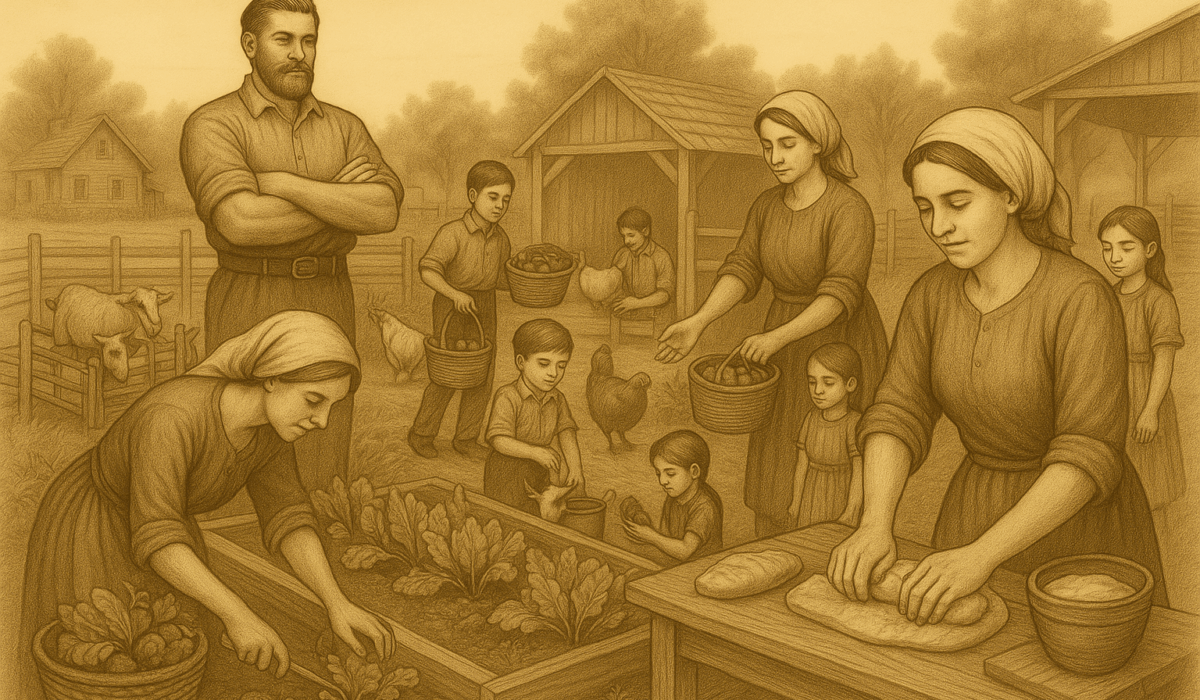
Let us consider the context of a large biblical household, a husband, two wives, and nine children. Such a home is not maintained by money alone. It is upheld by the wise management and productive labor of the wives.

In this model, the goal is that the wives combined would produce at least 25% of the household’s food and goods, with a target of 50%. This is not fantasy; it is ancient precedent.

In an ideal climate and with just 600 square feet of garden space, a wife can grow hundreds of pounds of produce a year. With canning, fermenting, and preserving, this abundance carries through winter. Add bread-making, soap-crafting, meal planning, and haircuts, and the home becomes not just a place of consumption but of value creation.

V. The Daily Waste of Idleness

Let’s quantify what’s lost when this mandate is ignored. The estimates below are based on a 12-person household with 3 adults using the median amounts.

  • Not gardening: -$6/day
  • Store-bought bread: -$3/day
  • No canning: -$2/day
  • No bartering: -$3/day
  • Buying clothes: -$3.25/day
  • Store-bought cleaners: -$3.50/day
  • Buying candles: -$0.50/day
  • Children’s Haircuts: -$5.14/day
  • No meal planning: -$2/day
  • Energy waste: -$3/day
  • No herb garden: -$1/day
  • Coffee out: -$15/day
  • Food delivery: -$5/day
  • Streaming Media Filth: -$3/day

Total waste: $55.39/day

If that money were preserved and invested with just 8% annual growth, over ten years the family would gain:

$309,681.55

This is the cost of rejecting the woman’s dominion in the home, and this is just some of the waste. In the next section, we will explore how a 600 sq ft garden, in the hands of a skilled wife, can feed the family, reduce costs, and transform the family economy

VI. The 600 Square Foot Garden – Dominion from the Ground Up

The average American family considers gardening a hobby. In a righteous household, it is a strategy of dominion. With just 600 square feet, roughly the size of a small studio apartment or a 20’x30’ plot, wives can lay the foundation for economic transformation.

VII. What Can Be Grown

Assuming a temperate climate with 3-season growth, intensive gardening techniques such as vertical planting, square-foot gardening, and succession sowing allow for high-density food output. Here’s what a well-managed 600 sq ft garden can produce annually:

  • Tomatoes: 150–200 lbs
  • Leafy greens (lettuce, kale, chard): 100–150 lbs
  • Beans (pole and bush): 50–100 lbs
  • Root vegetables (carrots, beets, radish): 100–150 lbs
  • Peppers: 30–60 lbs
  • Summer squash/zucchini: 50–75 lbs
  • Potatoes (grown vertically): 100–200 lbs
  • Culinary herbs (basil, parsley, oregano, etc.): 10–20 lbs
  • Total yield: 900ish lbs of food/year Caloric value: ~400,000+ calories

That’s roughly 25% of the total household food budget. Grown with only sweat and stewardship.

VIII. Techniques for Maximum Output

  • Raised beds with rich composted soil
  • Vertical growing using trellises and cages
  • Companion planting to repel pests and optimize nutrients
  • Succession planting for continuous harvests
  • Rainwater collection and mulching to reduce watering needs

IX. Canning and Preserving the Surplus

Fresh produce is fleeting. Wise wives preserve the harvest:

  • Water-bath canning for tomatoes, pickles, fruits
  • Pressure canning for beans, squash, and broth
  • Drying and preserving for potatoes, garlic, onions
  • Freezing for greens and herbs

This ensures year-round food security and prevents dependence on fragile supply chains.

X. Cost and Value

Organic produce equivalent: ~$3–5 per pound

At 750 lbs × $4 avg = $3,008 value annually ($250.00 Monthly)

That’s just from the garden. When paired with home cooking, preservation, and trading with others, that space becomes a cornerstone of the household economy.


XI. Domestic Skill Sets – Building the Household Economy by Hand

The productive wife is not only a gardener, but also a builder of daily infrastructure, meeting family needs with her own hands. In a family of 12, every small saving multiplies, and every act of skillful provision compounds into generational wealth. These crafts, once considered basic to feminine maturity, are now revolutionary acts of household sovereignty.

A. Bread Baking: Daily Bread as Daily Wealth

A single loaf of artisan bread costs $5–$8 in today’s market. A wife can bake it for under $1.

  • Skill Level: Beginner
  • Startup Needs: Flour, salt, yeast/sourdough, standard oven
  • Savings: $5–$8 per loaf × multiple loaves per week = $2,500+/year

Children raised with fresh bread, homemade butter, and warm hospitality are both healthier and anchored in memory. These skills become traditions.

B. Soap & Cleaner Making: Removing Dirt, Adding Value

Homemade soaps, laundry detergent, and all-purpose cleaners cost pennies to make and remove the need for toxic commercial chemicals.

  • Ingredients: Lye, fat, baking soda, essential oils, vinegar
  • Tools: Mold, crockpot or stovetop, safety gloves
  • Savings: $3.50/day = $1,277.50/year

Soap-making can be batch-produced monthly, allowing for stockpiling and bartering.

C. Sewing & Mending: Stitching Wealth into Clothes

Mending ripped knees, hemming skirts, or making seasonal pajamas from patterns preserves clothing value and adds personal flair.

  • Startup Needs: Sewing machine, thread, needles, patterns, scrap fabric
  • Savings: $3.25/day = $1,186.25/year
  • Advanced Skills: Dressmaking, uniform making, denim repairs, custom sizing

D. Meal Planning: Strategic Stewardship

Planning meals weekly prevents food waste, lowers stress, and maximizes use of homegrown and bulk-bought goods.

  • Savings: $2.00/day = $730/year
  • Time: 10–30 minutes/week
  • Tool: Simple notebook, calendar, or app

E. Candle Making: Ambiance and Utility

In power outages or cozy evenings, beeswax or tallow candles are useful and beautiful. Homemade candles last longer and can be crafted with herbs or essential oils.

  • Cost to make: ~$0.50
  • Retail equivalent: $5–7 per candle
  • Savings: $0.50-1.00/day = $200+/year

F. Haircuts: $20 Every 5-6 Weeks × 9 Children

A pair of quality clippers and some practice yields professional results and saves hundreds yearly.

  • Savings: $5.14/day = $1,876.10/year

G. Bartering & Trading

Many women’s talents are uneven. One excels at sourdough, another at fermentation, another at sewing. Trading excess goods, sourdough starter, jams, soaps, baby clothes, builds local networks and replaces dollars with relationships.

  • Estimated value exchanged: $3.00/day = $1,100+/year

These skills are not luxuries. They are acts of economic warfare against a system designed to make women idle consumers. When women take dominion, they decentralize the economy, disempower Babylon, and elevate their homes.

In the next section, we’ll look at utility reduction, modern traps (like delivery and streaming), and the compounded savings of household wisdom.

XII. Modern Traps, Utility Reduction, and Compounded Wisdom

The modern home bleeds money not through major catastrophe but by a thousand daily cuts. Women who fail to steward their homes allow the enemy to rule through convenience, subscription, and passive waste. But wise wives can turn these liabilities into savings that grow exponentially.

XIII. Utility Stewardship: Lowering the Burn Rate

Utilities drain silently, electricity, heating, water, gas, unless someone takes dominion. The keeper of the home must also be the manager of its consumption.

  • Simple practices:
    • Line-drying clothes
    • Turning off unused lights and appliances
    • Using crockpots and solar ovens
    • Keeping doors closed
    • Closing off unused rooms during the day
    • Planning cooking times
    • Cooking outdoors
    • Strategic window insulation or coverings
    • Bathing children together or with reused rinse water
  • Daily Savings: $3.00/day = $1,095/year

XIV. The Lure of Delivery and Convenience Food

Ordering takeout, food delivery apps, and prepackaged meals are signs of household decline. These costs pile up especially in large families, where the economy of home cooking is exponential.

  • Estimated cost per order: $25–$60
  • Daily avoidance savings: $10.00/day = $3,650/year

Home-cooked meals from planned menus, rooted in your own garden and pantry, are not just frugal, they are feasts of obedience.

XV. Entertainment Addiction: Streaming and Screens

Households that stream Netflix, Disney+, Hulu, YouTube Premium, and Spotify are not merely wasting money, they’re outsourcing imagination. These platforms cost families spiritually and financially.

  • Average cost: $60–$100/month across services
  • Daily savings from cancellation: $3.00/day = $1,095/year

Replace screens with board games, books, prayer, reading aloud, nature walks, and family worship. This substitution saves money and souls.

XVI. Coffee Out: Latte Poverty

Modern adults often mistake $5 lattes for sanity breaks. Multiply that by three adults daily and you have an addiction disguised as necessity.

  • 3 adults × $5/day = $15.00/day = $5,475/year

A wife who learns to make strong, hot, nourishing coffee at home not only saves money, she reclaims rhythm and ritual.

XVII. The Compounding Cost of Convenience

Let’s total what’s wasted by a household of 12 when dominion is rejected in these modern traps:

  • Utility waste: $3.00
  • Delivery food: $10.00
  • Streaming: $3.00
  • Coffee out: $15.00

Daily Loss: $31.00

At 8% interest, compounded over ten years, this becomes:

$181,613.17 in preventable financial hemorrhage.

Add that to the savings from Sections 5 and we’re over $400,000 in economic dominion reclaimed. This is not prosperity gospel. This is simply Biblical stewardship.

Section 5: Final Tally – Ten Years of Faithful Stewardship

The combined daily savings from faithful wife-led productivity in this average biblical household add up rapidly. Below is a breakdown of economic impact based on conservative daily savings:

  • Gardening (600 sq ft) $8.25
  • Baking fresh bread $7.00
  • Canning & preserving $2.00
  • Trading/bartering with others $3.00
  • Sewing & mending clothes $3.25
  • Homemade soaps/cleaners $3.50
  • Homemade candles $0.75
  • Cutting children’s hair (9 kids) $5.14
  • Meal planning (reducing food waste) $2.00
  • Reducing utility use (conservation) $3.00
  • Growing culinary/medicinal herbs $1.00
  • Not buying coffee (3 adults @ $5/day) $15.00
  • Total Daily Savings $63.89

📈 Compound Impact Over 10 Years (8% Interest)

If the wives faithfully take dominion over these areas daily, the compounded financial effect over 10 years at just 8% interest is:

💰 Over $400,000 saved and reinvested.

This does not include the additional $145,623.17 saved from eliminating wasteful habits like food delivery, subscription entertainment, and unnecessary utility usage.

XVIII. Total Household Impact

$400,000 + $145,623 = $545,623 over ten years.

This is the legacy of wise women. Not one of luxury or vanity, but of faithfulness, frugality, and fruitfulness. Through the skills of her hands, the wisdom of her planning, and the labor of her love, the wife becomes the cornerstone of the household economy.

This is biblical. This is historic. And in an age of artificial ease, it is revolutionary.

Let her be praised.

“Give her of the fruit of her hands; and let her own works praise her in the gates.” – Proverbs 31:31

XIX. Beyond the Basics – Expanding the Household Economy and the Case for Multiple Wives

Everything covered thus far represents only the beginning, the minimum standard of productive stewardship. The truth is, the potential for wives to build and bless the household economy is vast. Once the basics are mastered, a household can expand into full-scale provision and even surplus.

A. Livestock and Animal Husbandry

  • Chickens provide daily eggs, occasional meat, composting help, and pest control.
  • Goats offer milk, manure, meat, and brush-clearing power.
  • A dairy cow can sustain butter, yogurt, cream, and cheese needs for the entire family.

These are not rustic fantasies, they are practical, proven systems for food security and economic independence.

B. Home-Based Production and Sales

  • Cheese, jams, breads, soaps, herbal salves, and sewn goods can be sold at local markets.
  • Online platforms like Etsy or local co-ops allow for cottage-industry income.
  • Children raised in these homes learn entrepreneurial thinking, not entitlement.

C. Strategic Frugality and Bulk Systems

  • Couponing and bulk buying save thousands annually.
  • Cloth diapering, reusable goods, and repair culture cut invisible costs.
  • Bartering labor or goods turns excess into trade value without taxation.

XX. Why Multiple Wives?

A household of twelve, with nine children, is not a small operation. It is a small nation. To run it well requires hands, hearts, and laborers.

  • Two wives can manage the foundational work, gardening, cooking, laundry, and children if they are focused and dedicated.
  • Three, four or more can expand the system into livestock, artisan goods, elder care, or homeschooling leadership.

Each wife brings her strengths: one may sew, one may bake, one may teach, one may manage livestock. Polygyny allows for household diversification and scale. No single woman can do it all, but a wise household led by a righteous man can multiply talent across his wives.

This is not exploitative, it is biblical (Genesis 4:19, Exodus 21:10), practical, and historically normal. More wives mean more output, more unity, and more margin. The modern nuclear model of isolated exhaustion fails where biblical households flourish.

Conclusion: The home is an economy, a ministry, a legacy. Wives are not burdens, they are builders. And in a rightly ordered home, every act of productivity becomes an act of praise.

This is The Great Order!

The Curse of the Situationship: How Undefined Relationships Destroy Households and Nations

“Can two walk together, except they be agreed?” — Amos 3:3
Woe unto them that call evil good, and good evil; that put darkness for light, and light for darkness; that put bitter for sweet, and sweet for bitter!” — Isaiah 5:20

There was a time, not long ago, when a man courted a woman with purpose, intention, and the end goal of covenant. Marriage was not the optional finale of love; it was the starting point of family, dominion, and legacy. A woman knew she was under her father’s headship until transferred in honor to the man who would bear the duty of her provision, protection, and sanctification. Men were required to work, lead, and build before they could have access to a woman’s body. And women were expected to prepare themselves as mothers, homemakers, and helpmeets, not as recreational companions.

Now, that structure has been replaced with the tragic and toxic plague known as the situationship, a relationship in name only, undefined, casual, directionless, and spiritually poisonous.

I. What Is a Situationship?

The term “situationship” has become common in modern slang. It describes a romantic, almost always sexual connection between two people that lacks clear commitment, roles, purpose, or future.

It is, at its core, a relationship without responsibility. The couple may spend time together, be emotionally attached, and even engage in sexual intimacy, but without agreement on where things are going, what they mean to each other, or who owes what. It is a counterfeit of courtship and a mockery of marriage, crafted by a society that wants the pleasures of love without the responsibilities of covenant.

II. Origins and Cultural Shift

1. The Sexual Revolution

The rise of situationships is directly tied to the sexual revolution of the 1960s and ‘70s, which severed sex from marriage and childbearing. Fueled by birth control, feminism, and humanism, society began to preach the lie that sexual intimacy could be casual, consequence-free, and recreational.

This mindset gave birth to dating culture, hook-up apps, and a whole lexicon of disposable relationship models. “Situationship” is simply the next evolution of the rot that continues.

2. Feminism and the Rejection of Headship

As feminism taught women to reject male headship, marriage was rebranded as “oppression” and commitment as a “patriarchal trap.” Women began to see their own value not in being wives and mothers but in being “independent” and sexually liberated.

But in rejecting submission, many also rejected protection, provision, and purpose. Now, women are trapped in perpetual ambiguity, tied to men who offer no leadership, and yet afraid to demand it, lest they be asked to submit in turn.

3. The Collapse of the Family

With skyrocketing divorce rates, fatherless homes, and government-subsidized single motherhood, entire generations have grown up without seeing healthy covenant modeled.

Many men have never seen a father take responsibility for a woman. Many women have never seen a mother respect her husband’s leadership. So both sexes now drift, emotionally starved, spiritually malnourished, and relationally aimless.

They settle for situationships because they don’t know what structure, order, and godly love look like anymore.

III. The Appeal of Situationships

1. Fear of Rejection and Commitment

Many people now prefer the ambiguity of a situationship because it delays serious emotional risk. “Let’s not define things” becomes code for “I don’t want to be rejected, and I don’t want to be required to give more.”

But what’s disguised as safety is actually slavery. Uncertainty breeds anxiety. Undefined relationships create trauma, not security.

2. Avoiding Accountability

If a woman defines a relationship, she will be required to be submissive and obedient. If a man defines it, he will be expected to sacrifice, lead, provide and protect. So both parties agree, explicitly or implicitly, to keep things just chill” because neither wants to live under obligation.

This is not maturity, but rebellion, sin and cowardice. Ultimately it only leads to destruction.

3. Sexual Access Without Marriage

At its root, the situationship is often a vehicle for fornication. It is a modern loophole where people have sex regularly without the shame of a one-night stand or the duties of marriage. It is a mutually agreed compromise, “we can be close, as long as you don’t expect me to lead, marry, provide, or stay.”

This is not love. This is mutual exploitation dressed up in romantic language. Those who are party to a situationship are little more than adulters and whores.

IV. The Results and Consequences

1. Emotional Damage and Insecurity

A study published by Journal of Social and Personal Relationships (2020) found that individuals in ambiguous relationships report significantly higher anxiety, insecurity, and emotional confusion than those in defined partnerships.

Situationships leave people trapped in limbo, not alone, but not loved. Not committed, but not free. This chronic uncertainty causes depression, attachment disorders, and a warped view of self-worth.

2. Fornication and Sin

Scripture is clear:

“Flee fornication. Every sin that a man doeth is without the body; but he that committeth fornication sinneth against his own body.” — 1 Corinthians 6:18

Situationships thrive on sexual access without covenant. This is sin. It is rebellion against God’s order, and it carries real spiritual and physical consequences.

“Marriage is honourable in all, and the bed undefiled: but whoremongers and adulterers God will judge.” — Hebrews 13:4

3. Delay of Maturity and Purpose

When a young man stays in situationships, he never learns to lead. He avoids responsibility, refuses to build, and becomes addicted to comfort and indecision.

When a woman remains in a situationship, she devalues her womb, her time, and her future. She gives the fruit of her youth to a man who has given her nothing in return.

This delays marriage, family, and legacy. It destroys the next generation before it is even born.

4. Broken Households and Illegitimate Children

Many situationships eventually lead to children born outside of wedlock, without covenant or covering. According to the CDC (2023), over 40% of births in the United States are to unmarried women and that number is on-track to double in the next 10 years. Consider yourself blessed if God has chosen to close up your womb and not allow you to reproduce whilst living in this sin.

Children raised in unstable homes are more likely to:

  • Drop out of school
  • Become sexually active earlier
  • Be incarcerated
  • Repeat the same pattern of unstable relationships

We are not just tolerating broken relationships, we are manufacturing broken futures.

V. The Root Cause: Rebellion Against Order

At its core, the rise of situationships is not just a cultural accident, it is a spiritual revolt. It is a society-wide rejection of the divine order God has laid out for male-female relationships. God created man to lead, build, provide, and protect. God created woman to follow, support, nurture, and build the home. These roles are not optional; they are woven into the fabric of creation.

“But I would have you know, that the head of every man is Christ; and the head of the woman is the man…” — 1 Corinthians 11:3

A situationship, by definition, rejects headship and submission. It is two people attempting to have closeness while avoiding the hierarchy and structure God ordained. It is the relationship equivalent of building a house without foundation, inevitably doomed to collapse.

VI. The Cost to Women

Despite modern lies, situationships are particularly damaging to women. Here’s why:

1. Women Are the Gatekeepers of Sexual Access

When women lower the standard and allow access to their emotions and bodies without requiring covenant, men stop rising to the occasion. Feminism taught women they don’t need men. But now they chase men who have no intention of staying, then blame men for not staying.

God designed a woman to be given in marriage under her father’s headship, as a prized and guarded treasure. Her womb is not casual. Her presence is not casual. Her years are not casual.

“Who can find a virtuous woman? for her price is far above rubies.” — Proverbs 31:10

But in a situationship, she’s not treated like a treasure. She’s treated like an option. And far too often, she tolerates it, because requiring more would mean she, too, must submit.

2. Time Wasted, Years Lost

A woman can give three, five, even ten years of her life to a man who never intended to marry her. All while depriving worthy men who would treat her with respect and honor. During that time, she often sacrifices her prime years of fertility and youth, only to find herself discarded and “starting over” in her 30s or 40s.

“To everything there is a season…” — Ecclesiastes 3:1

Time wasted outside of God’s order is not neutral. It comes at a cost. No woman was designed to be in a permanent “maybe.” Either she is preparing to be a wife, or she is preparing for disappointment.

VII. The Cost to Men

Situationships destroy men by feeding their passivity and lust while denying them the duty and legacy they were created to pursue.

1. They Encourage Weakness

Men were created for dominion. God told Adam to tend, guard, and rule the garden, not to loaf around in vague intimacy. When a man lives in a situationship, he learns to consume without building, to enjoy without sacrifice, and to lead nowhere.

“Watch ye, stand fast in the faith, quit you like men, be strong.” — 1 Corinthians 16:13

But modern men are trained to be soft, indecisive, and directionless. Situationships offer all the emotional and sexual perks of marriage, without asking him to grow up, take dominion, or provide. He stays a boy in a man’s body and it is largely caused by the woman having no standards or self-worth. She gives her body away and requires nothing of him.

2. They Destroy Legacy

A man’s strength is not in how many women he can entertain, but how many souls he can lead. Situationships waste a man’s time, drain his energy, and often produce bastard children he neither raises nor covers. This is not power, but complete abdication of his purpose and legacy.

VIII. Data, Studies, and Modern Trends

Numerous studies have confirmed what Scripture has taught all along:

1. Situationships Lead to Mental Health Issues

A 2022 study published in Personal Relationships journal found that individuals in ambiguous romantic relationships experienced:

  • 63% higher anxiety
  • 44% higher depressive symptoms
  • 80% Report Increased emotional volatility and low self-worth

Modern dating apps and casual relationships may feel convenient, but they are wrecking people’s hearts and minds.

2. Lack of Commitment Lowers Relationship Satisfaction

A study from the Journal of Marriage and Family (2021) concluded that couples with clearly defined commitment, especially within marriage, report significantly higher satisfaction, stability, and long-term health outcomes. Undefined relationships tend to breed resentment, miscommunication, and eventual breakdown.

3. Cohabitation Without Marriage Is a Failed Experiment

According to Pew Research (2023), over 60% of young adults believe it’s okay to live together before marriage. But data consistently shows that cohabiting couples:

  • Have 300% higher divorce rates if they later marry
  • Experience 60% more instances of domestic abuse
  • Report 80% lower sexual satisfaction and trust

This is what happens when people play house without building a house.

IX. Historical Perspective: This Is Not New

Though the term “situationship” is modern, the sin is ancient. Throughout Scripture and history, we see examples of people engaging in relationships outside of God’s ordained order, with disastrous results every time.

1. Samson and Delilah

Samson repeatedly pursued women outside of covenant, treating intimacy as pleasure rather than purpose. Delilah was not his wife, and the relationship was one of manipulation, deceit, and destruction. His fall came not through war, but through a situationship.

“And it came to pass afterward, that he loved a woman in the valley of Sorek, whose name was Delilah.” — Judges 16:4

Samson wanted love without order. He wanted pleasure without responsibility. He got ruin instead.

2. Solomon and Foreign Women

Solomon, the wisest man on earth, allowed his many “situationships” to draw his heart away from the Lord.

“But King Solomon loved many strange women… of the nations concerning which the Lord said… Ye shall not go in to them… for surely they will turn away your heart after their gods…” — 1 Kings 11:1–2

And that’s exactly what happened. His loose relationships brought idolatry, division, and the eventual split of the kingdom. Relationships without standards destroy empires.

3. The Roman Empire and Moral Decay

By the time of Rome’s fall, the family structure had all but collapsed. Marriage was seen as optional. Sexual promiscuity and non-committal liaisons were rampant. Historian Will Durant noted that one reason for Rome’s decline was “the decay of marriage and the disintegration of the home.”

A nation cannot stand if the household does not. And the household cannot stand if men and women do not form covenants. Rome fell. Babylon fell. And America is on the same path.

X. The Biblical Standard for Relationships

God never designed man and woman to be in emotional or sexual limbo. There are only three Biblically valid relational states:

  1. Under father’s or patriarch’s headship – unmarried and in the household
  2. In covenant marriage – either monogamous or polygynous, under male headship
  3. Widow under family covering – until remarried, still under male authority

There is no biblical category for a girlfriend, a “partner,” or a casual fling. Any man who lies with a woman is required to marry, take responsibility and provide for her forever.

“If a man entice a maid that is not betrothed, and lie with her, he shall surely endow her to be his wife.” — Exodus 22:16

The Bible never permits sex without commitment, emotional closeness without covenant, or prolonged romantic ambiguity. Either marry her, or leave her alone.

XI. The Solution: Returning to God’s Order

1. Restore Headship

Women must stop entertaining men who have no vision, no leadership, and no backbone. A man who cannot define the relationship does not deserve her time and certainly not her body.

Likewise, men must stop entertaining women they do not intend to lead, protect, and build with. If you’re not planning to marry her, don’t date her. Period.

“Therefore shall a man leave his father and his mother, and shall cleave unto his wife…” — Genesis 2:24

Men must cleave to wives, not wander through romantic limbo.

2. Practice Biblical Courtship

Courtship is purposeful and public. It is guided by headship, intended for marriage, and monitored with boundaries. A woman under a man’s headship should not be courted without his knowledge and permission.

Men should approach women with clarity: “I intend to see if you are fit to be a wife to me.” Not: “Wanna hang out and see where it goes?” or “netflix and chill?”

3. Build the Household

The goal of a relationship is not “vibes” or “companionship”, it is kingdom expansion. Every man should seek a wife with the purpose of building a household: children, inheritance, dominion, and worship.

A situationship cannot build anything. It is sterile, selfish, and short-sighted. It exists to delay adulthood, not to advance the Kingdom.

“Through wisdom is an house builded; and by understanding it is established.” — Proverbs 24:3

4. Teach Our Sons and Daughters the Truth

From the earliest age, we must teach our children that:

  • Sex belongs in covenant
  • Emotions must be governed by wisdom
  • Marriage is the foundation of dominion
  • Dating is not recreation, it is a covenant pursuit

Stop telling daughters to “follow their heart.” Tell them to follow Scripture. Stop telling sons to “play the field.” Tell them to take dominion and build a legacy.

XII. Final Consequences: The Death of Legacy

Situationships don’t just harm the individuals involved, they are part of the slow suicide of society. When men stop leading, and women stop requiring it, we don’t just lose marriages, we lose generations, identity and ultimately our country.

  • A nation with no fathers will fall.
  • A household with no covenant will crumble.
  • A woman with no covering will be devoured.
  • A man with no purpose will become a predator or a parasite.

These are not theoretical dangers. We are living them now. Masculinity is mocked. Femininity is corrupted. Marriage is delayed or discarded. And instead of households, we get hookups. Instead of children raised in the fear of the Lord, we get therapy clients raised in confusion.

This is not liberty. This is bondage.

XIII. The Call to Repentance and Dominion

It is not too late, but time is short. We must tear down this counterfeit relationship model and restore the original blueprint.

If you are currently in a situationship, repent. Set things right.

  • If you’re a man: Lead. If she is fit to be your wife, take her under covenant today. If not, end it tomorrow, no more excuses!
  • If you’re a woman: Do not let another day go by giving yourself to a man who has made no vow to love, protect, and provide for you. Withdraw your presence, reclaim what’s left of your honor, and come under rightful headship immediately.

“Except the Lord build the house, they labour in vain that build it…” — Psalm 127:1

We need to stop calling failure “freedom” and brokenness “modern love.” We need to stop pretending that compromise is wisdom, or that ambiguity is noble. It’s not. It’s cowardice. It’s idolatry. And it’s destroying souls.

Let your house not be found guilty of tolerating the sin of situationships. Let your sons and daughters be trained in righteousness. Let your standard be clear:

No commitment, no covenant = no sexual or emotional access.

XIV. The Great Order Restored

God’s design has never changed. It is still good. It is still holy. And it still works.

  • Man is made for work, war, worship, and ruling.
  • Woman is made for help, homemaking, fruitfulness, and loyalty.
  • Marriage is the holy union that brings the two together under covenant.
  • Children are the arrows that flow from that union.
  • The household is the seat of dominion and legacy.
  • Christ is the King to whom all this points.

Situationships deny all of it while setting our children up for near certain failure in their relationships.

They mock order. They mock headship. They mock covenant. They replace God’s beautiful design with a bland, powerless, fruitless imitation. They are not the “new normal.” They are Satan’s pacifier, keeping people numb, passive, and sterile while their futures rot.

But the righteous must rise and say:

“As for me and my house, we will serve the Lord.” — Joshua 24:15

That begins with order and standards. That begins with rejecting every form of sexual confusion, emotional compromise, and relational ambiguity.

No more situationships, wandering, or wasting time.

It is time to build.
It is time to marry.
It is time to take dominion.


If this post convicted you, send it to someone trapped in a situationship. If you have sons or daughters, train them in covenant. If you are single, prepare to build a house—not to play house. The future depends on it.

~ Lord Redbeard

Below you will find an actionable checklist to help you get out of sin, renounce adultery and whoredom, then re-build on a Biblical foundation.

🛑 Situationship Exit Checklist

Get Out. Get Whole. Get Under Order.

“Prove all things; hold fast that which is good.” — 1 Thessalonians 5:21


Step 1: Define What You’re In

  • uncheckedAm I in a relationship without clarity, headship, or purpose?
  • uncheckedHave we avoided using words like “commitment,” “marriage,” or “covenant”?
  • uncheckedIs there emotional or sexual involvement without responsibility or leadership?
  • uncheckedDo I feel anxious or confused about where we stand?

 If you checked “yes” to any of these: you’re in a situationship.


Step 2: Cut Ties with Compromise

  • End the relationship within 24hrs, unless it moves toward marriage under headship immediately.
  • Refuse all emotional, sexual, or relational access without covenant.
  • Block or delete contact if repentance and correction are not immediate and obvious.
  • Remove all gifts, reminders, and soul ties that keep you emotionally enslaved in the next 48 hours.

“Neither give place to the devil.” — Ephesians 4:27


Step 3: Repent and Realign

  • Repent before the Lord for tolerating disorder, fornication, and rebellion.
  • Seek godly counsel from a father, pastor,  household patriarch.
  • Submit yourself (or return) to righteous headship, father, husband, elder.
  • Fast, pray, and cleanse your life of the residue of emotional idolatry, adultery and rebellion.

“Create in me a clean heart, O God…” — Psalm 51:10


✅ Step 4: Rebuild God’s Way

  • Recommit to biblical standards for relationships:
    • No physical or emotional intimacy without covenant
    • Courtship only under biblical headship
    • Purpose-driven union aimed at building a household
  • Train yourself in godly duties requires of you (masculine or feminine)
  • Surround yourself with those who pursue marriage, not modern dating
  • Keep your standards high, even if it means being alone under headship for a season

“Be ye not unequally yoked…” — 2 Corinthians 6:14


 Step 5: Teach the Next Generation

  • Teach sons: “You are a builder. Do not waste your strength.”
  • Teach daughters: “You are a treasure. Do not cast pearls before swine.”
  • Reject hookup culture, dating, and emotional fornication.
  • Celebrate covenant, marriage, fruitfulness, and family order. While setting an example for your children and others of what Biblical courting and Marriage should look like.

“Train up a child in the way he should go…” — Proverbs 22:6


Final Reminder

You do not need “closure.” Stop making excuses. If you have been in a “relationship” for more than 90 days and there is no clear commitment and plan for marriage in the next 90 days then end it today, Stop playing pretend and wasting your time.

To all the women out there, there are plenty of good men who are seeking Biblical wives, to say you “cannot find a good man” is simply a lie. If you cannot find a good man, you are the problem. Change your behaviour, set Biblical standards, submit to Biblical headship and make known that you are willing to be a submissive, obedient wife and God will provide you a Biblical husband.

Ladies, If you are having sex with a man who has not entered into a marriage covenant with you then you are in fact a whore and no good will ever come of that relationship without immediate repentance from both parties.

Men, If she is allowing you to have sex with her without a Marriage covenant, or if she is unwilling to enter into a lifelong covenant with you today, she is nothing more than a prostitute. If she is not requiring standards of you such as leadership, protection and provision then she is not wife material and you are nothing more than a whoremonger and adulterer. Marry her today, take authority and demand submission from her or leave immediately.

Burn the bridge to Babylon. Build the House of the Lord.

Let the Great Order be restored!

Red Flags and Righteous Standards:

Discerning the Truth About Character from a Biblical Lens


I. Introduction: The Age of False Signals

We live in a culture obsessed with “red flags.” Social media teems with memes and short videos warning men and women about the subtle, supposedly sinister signs that someone is “toxic.” These warnings are usually delivered by bitter influencers, feminized males, or post-wall women who have spent years rejecting good men and now sit on the throne of subjective judgment.

This obsession has created a moral panic, people now judge others not by God’s standards, but by a shifting list of emotionally driven preferences, feminist buzzwords, and TikTok trends. What used to be called masculine strength is now a red flag. What used to be called feminine obedience is now abuse. What used to be Biblical order is now controlling or oppressive.

We must ask: Who determines what is a red flag? And more importantly, what does God say?

Let’s dismantle the modern obsession with subjective red flags, expose the foolishness behind the world’s standards, and present the true Biblical red flags, those traits that genuinely disqualify a man or woman from righteous marriage, covenantal loyalty, or household productivity. We will also explore “green flags”—the marks of godly character that point to readiness for marriage, parenting, and dominion-building.


II. The Folly of Modern Red Flag Culture

A. What the World Calls “Red Flags”

In today’s dating and relationship culture, here are a few examples of what are commonly called “red flags”:

  • “He expects me to cook or clean.”
  • “She doesn’t want to work a 9 -5 job.”
  • “He asked about body count! red flag!”
  • “She submits to her father or husband.”
  • “He talks about family legacy and headship too much.”
  • “She’s not career-oriented.”
  • “He wants children early.”
  • “She dresses modestly.”

This madness has turned biblical obedience into a warning sign.

The world calls red what God calls righteous. What they despise is often what Heaven esteems.

B. The Root of the Lie: Rebellion Against God’s Order

The real reason modern people cry “red flag” is not because of discernment, it’s because of rebellion. The feminized man sees strong masculinity and cries “controlling.” The feminist woman sees headship and cries “abuse.” The promiscuous see chastity and cry “religious trauma.”

“Woe unto them that call evil good, and good evil; that put darkness for light, and light for darkness…”
—Isaiah 5:20

This is not a neutral misjudgment. It is moral inversion and it is a world under judgment.


III. Biblical Red Flags in Women

If a man is to take a wife and lead a household unto dominion, he must reject the foolish, culturally acceptable markers of compatibility and measure her by biblical womanhood. Here are true red flags in a woman.

1. Rebellion Against Authority

“Wives, submit yourselves unto your own husbands, as unto the Lord.”
—Ephesians 5:22

A woman who chafes at her father’s or husband’s authority is in sin. If she refuses to be led, she cannot build. Her pride is a red flag that will manifest in manipulation, defiance, and eventual destruction of the home.

Watch for:

  • Sarcasm, eye-rolling, and contempt toward men
  • “I don’t need a man” rhetoric
  • Hostility to the idea of male leadership
  • Social media quotes about “being your own boss”

2. Sexual Immodesty or History of Fornication

“That they may teach the young women to be sober, to love their husbands, to love their children, to be discreet, chaste…”
—Titus 2:4–5

Chastity is the glory of a godly woman. A woman who flaunts her body, boasts about her “body count,” or mocks purity is not fit for marriage. God can redeem, yes, but repentance must come with evidence. Past whores do not make present wives without transformation.

Watch for:

  • Inappropriate dress
  • History of OnlyFans, clubbing, or serial dating
  • Defensiveness when asked about sexual past
  • Justifying sin with “everyone has a past”

3. Disdain for Children and Homemaking

“I will therefore that the younger women marry, bear children, guide the house…”
—1 Timothy 5:14

A woman who says she “doesn’t like kids,” “wants to travel first,” or “isn’t ready to settle down” is not wife material, she is a time bomb. Her heart is not oriented toward dominion or motherhood. She is barren in spirit even if fertile in body.

Watch for:

  • Prioritizing career above family
  • Derogatory comments about stay-at-home mothers
  • Preference for pets over children
  • No domestic skills or desire to learn

4. Loudness and Gossip

“It is better to dwell in the wilderness, than with a contentious and an angry woman.” —Proverbs 21:19

Scripture warns against loud, contentious women. A woman who cannot control her tongue will destroy her house. This includes the woman addicted to social media, who shares every thought online and publicly shames others.

Watch for:

  • Constant phone use, selfies, and oversharing
  • Loud arguing, sarcasm, gossip
  • No respect for privacy or discretion

5. Clinginess, Emotional Neediness, and Constant Attention-Seeking

“He that walketh with wise men shall be wise: but a companion of fools shall be destroyed.”
—Proverbs 13:20

One of the most overlooked but dangerous red flags in modern women is emotional immaturity, manifested in the form of neediness, clinginess, and constant attention-seeking. While the world may call this “romantic” or “cute,” the Scriptures warn that an undisciplined soul, especially in a woman, leads to chaos in the home.

A woman who is constantly texting, needing affirmation every hour, demanding emotional babysitting, or interpreting silence as rejection is not ready for covenant. She is not emotionally rooted in Christ; she is attempting to draw her identity and stability from a man. This is not helpmeet behavior. It is idolatry through affection.

Such a woman will burden her husband, exhaust his leadership, and suffocate his mission. Rather than being a joyful helpmeet, she becomes an emotional weight chained to his neck. Marriage is not a therapy session for broken girls who never grew up.

“The heart of her husband doth safely trust in her, so that he shall have no need of spoil.”
—Proverbs 31:11

The godly man must be about the business of ruling, building, providing, and leading. A wife who turns him into her perpetual therapist, security blanket, or on-call emotional support is not fulfilling her role, she is reversing it.

Watch for:

  • Anxiety over delayed replies
  • Passive-aggressive behavior when not the center of attention
  • Interrupting male leadership with emotional needs
  • Frequent crying or dramatics in response to small issues
  • Posting vague social media messages fishing for validation

Clinginess is not affection. Neediness is not femininity. It is disorder, and it is Sin!

A righteous woman is emotionally stable because her identity is rooted in Christ and her sense of value is shaped by Scripture, not by how many times her husband calls her in a day.


IV. Biblical Green Flags in Women

1. Joyful Submission to Headship

“Even as Sara obeyed Abraham, calling him lord…”
—1 Peter 3:6

A woman who loves, honors, and joyfully submits to male leadership, first to her father, then to her husband, is a rare and glorious find. She is easy to lead, quick to obey, and does not resist order.

Green flag:

  • “I trust my father’s judgment.”
  • “I want to support and serve my husband.”
  • “I’d rather be a homemaker than a boss.”

2. Meekness and Quiet Strength

“But let it be the hidden man of the heart… the ornament of a meek and quiet spirit, which is in the sight of God of great price.”
—1 Peter 3:4

Meekness is not weakness, it is quiet power under control. The godly woman is not easily offended, easily provoked, or driven by emotion. She is dignified, soft-spoken, and trustworthy.

Green flag:

  • Listens more than she speaks
  • Speaks respectfully even when disagreeing
  • Prays and waits instead of panicking

3. Desire for Children and Home

“Thy wife shall be as a fruitful vine by the sides of thine house: thy children like olive plants round about thy table.”
—Psalm 128:3

The godly woman dreams of building a household, teaching children, managing a kitchen, and creating a sanctuary of peace and productivity. She glories in the domestic realm, not in external applause.

Green flag:

  • Volunteers to help with children
  • Learns recipes, sewing, or herbs
  • Reads Proverbs 31 with conviction

4. Emotional Stability and Self-Governance

“Strength and honour are her clothing; and she shall rejoice in time to come. She openeth her mouth with wisdom; and in her tongue is the law of kindness.”
—Proverbs 31:25–26

One of the most precious, yet underrated, traits in a godly woman is emotional self-control. In a culture that glamorizes feelings over facts, drama over discipline, and mood swings over modesty, a woman who governs her spirit with grace and poise is a rare jewel.

This woman does not need constant attention. She does not crumble under pressure. She does not sabotage her home with petty quarrels or seek to manipulate her husband with tears, silence, or tantrums. She is anchored, not in her man, but in her God.

Her peace is not performative; it flows from a heart trained in the fear of the Lord. She does not make her emotions the center of the household. Instead, she cultivates serenity, discernment, and steadfastness, nurturing a home of joy rather than tension.

“She looketh well to the ways of her household, and eateth not the bread of idleness.” —Proverbs 31:27

This woman is a helpmeet, not a hindrance. A support, not a storm. She seeks to be a rock for her children, a refuge for her husband, and a reflection of God’s wisdom and strength.

Green flag:

  • She responds with prayer, not panic
  • She speaks with grace, not emotional weaponry
  • She has a calm countenance under stress
  • She seeks counsel instead of stirring confusion
  • She doesn’t demand attention, she commands respect

Such a woman will not be tossed by every wave of emotion, nor will she burden the man with daily validation needs. She is a woman of order, of restraint, and of dignity.

She is not only beautiful to behold, but also safe to lead.


V. Biblical Red Flags in Men

Just as women must be weighed by Scripture, so must men. A man is not a leader because he has a beard. He is not a patriarch because he yells on the internet. Here are true red flags in men.

1. Lack of Discipline

“He that hath no rule over his own spirit is like a city that is broken down, and without walls.”
—Proverbs 25:28

If a man cannot wake up on time, say no to lust, manage money, or keep his word, he is not fit to lead. He must master himself before leading others.

Watch for:

  • Addictions (porn, video games, food, alcohol, drugs, cigarettes)
  • Unstable employment history
  • Disorganized habits, no plan or direction

2. Fear of Responsibility

“When I was a child… I put away childish things.” —1 Corinthians 13:11

A man who delays marriage, fears children, or won’t make decisions is a child in a man’s body. He is not preparing to build; he’s looking to avoid weight. He will become a burden, not a covering.

Watch for:

  • Fear of commitment
  • Avoiding leadership or hard work
  • No willingness to provide or protect

3. Softness Toward Sin

“Have no fellowship with the unfruitful works of darkness, but rather reprove them.”
—Ephesians 5:11

A man who excuses wickedness, tolerates compromise, and refuses to rebuke sin is not a protector, he is a coward. He will let wolves in the home and call it grace.

Watch for:

  • Tolerance of feminism, sexual sin, or false religion
  • Unwillingness to take strong stands
  • Says “it’s not a big deal” about major issues

VI. Biblical Green Flags in Men

1. Righteous Authority and Strength

“The just man walketh in his integrity: his children are blessed after him.” —Proverbs 20:7

The godly man leads with a firm hand, a clear voice, and an unwavering conviction. He protects, provides, and teaches with clarity and consistency.

Green flag:

  • He honors elders, mentors boys, protects women
  • He studies Scripture and applies it
  • He is unashamed of headship

2. Fruitfulness in Work

“In all labour there is profit…” —Proverbs 14:23

A man who works diligently, builds wealth, and provides for his household is a blessing. He is not afraid of labor, does not chase get-rich schemes, and understands the value of time and effort.

Green flag:

  • Owns tools, land, business, or skills
  • Respects time and order
  • Trains sons and serves his family

3. Boldness Against Evil

“Quit you like men, be strong.” —1 Corinthians 16:13

The godly man is not silent in the face of evil. He names it, shames it, and fights it. Whether it’s abortion, feminism, sodomy, or state tyranny, he speaks as a watchman.

Green flag:

  • Public conviction, not private opinion
  • Willing to lose money, friends, or comfort for truth
  • Guards his home like a gatekeeper

VII. Historical and Statistical Observations

A. Historical Red Flags Were Spiritual and Familial

In Christian history, red flags were not trendy slogans, they were deeply moral and covenantal. Parents would reject a suitor based on laziness, bad theology, a disorderly household, or spiritual apathy. They asked:

  • Does he fear God?
  • Does he work?
  • Does he have family honor?
  • Is she submissive, modest, and fruitful?

Compare this with today’s absurd standards: “He didn’t like my cat.” “She won’t split the bill.” “He believes in gender roles.”

We have abandoned wisdom for preference.

B. Data on Modern Mating Confirms the Crisis

  • Pew Research (2023): 63% of young men say they are single; many cite fear of false accusations, rejection of feminist values, or a lack of virtuous women.
  • Institute for Family Studies: Married men with traditional gender roles are significantly happier and more sexually fulfilled than egalitarian couples.
  • Harvard Study: Daughters raised in strong father-led homes are more emotionally stable and less promiscuous.

Biblical order produces fruit. Worldly “red flag” culture produces barren confusion.


VIII. Conclusion: Real Discernment for Real Covenant

You are not called to marry a vibe. You are not called to screen people with memes and trending advice.

You are called to build a household, a legacy, a dominion. That requires spiritual discernment, not cultural conditioning.

The world sees red when it sees God’s order. We must learn to see green where He blesses, and red where He warns.

Throw away the therapist’s checklist. Pick up the sword of the Spirit. Measure yourself and your future spouse by this question:

“Will this man or woman help me build the Great Order, or tear it down?”

If the answer is yes, build.

If the answer is no, RUN!

The Sabbath: God’s Holy Day of Rest, Worship, and Dominion

In the frenzied world of deadlines, digital noise, and soul-numbing busyness, the Sabbath stands as a defiant monument of peace, order, and divine rhythm. It is not a cultural tradition. It is not a denominational add-on. It is not “Jewish.” It is God’s own day, sanctified by Him at creation, codified in the Ten Commandments, and never once abolished or transferred.

The Biblical Sabbath is Saturday, the seventh day of the week. It begins at sundown on Friday and ends at sundown on Saturday. This is not legalism, it is loyalty. It is not about rules, it is about relationship. Keeping the Sabbath is not just about rest; it is about rulership, governing your time under the authority of the Most High.

I. The Origin of the Sabbath: Created Before Sin

“And on the seventh day God ended His work which He had made; and He rested on the seventh day… And God blessed the seventh day and sanctified it…”
Genesis 2:2-3

The Sabbath was not given after the Fall. It was not added later at Sinai. It was written into the very fabric of creation. Before there was a nation, before there was sin, there was the Sabbath.

God did not rest because He was tired. He rested to set a pattern, a divine cadence of work and worship. This is the first “holy” thing ever declared in Scripture. Not a place, not a mountain, not a temple, but a day.

The Sabbath is not man’s idea. It is God’s signature on time itself.

II. The Fourth Commandment: The Forgotten Law

“Remember the Sabbath day, to keep it holy. Six days shalt thou labor, and do all thy work: but the seventh day is the Sabbath of the LORD thy God…”
Exodus 20:8-10

The command to remember implies something we are prone to forget. In our modern world, the Fourth Commandment has become the most broken of the Ten. But it is just as binding as the others. It was written in stone by the very finger of God.

Unlike the ceremonial laws of Israel (sacrifices, circumcision, dietary codes), the Sabbath was placed in the moral core of God’s covenant, unchanging, eternal, and holy.

It is not man who decides when to worship, it is God. He didn’t say, “Pick a day that works for you.” He said, “The seventh day is the Sabbath.”

This was never changed in Scripture.

III. Saturday, Not Sunday: The Biblical Reality

Nowhere in the Bible is the Sabbath changed from Saturday to Sunday. Not once. Not by Jesus, not by Paul, not by the apostles. Sunday observance began centuries later as a tradition of the Roman Catholic Church, not the Word of God.

Christians often refer to Sunday as “the Lord’s Day” because of the resurrection. While the resurrection is indeed glorious, nowhere does God command the resurrection day to replace the Sabbath.

In fact, Scripture is clear:

  • Jesus kept the Sabbath (Luke 4:16).
  • His disciples continued to keep the Sabbath after the resurrection (Acts 13:42-44, Acts 17:2, Acts 18:4).
  • The early church was “zealous for the law” (Acts 21:20) and saw no contradiction in keeping the Sabbath while honoring the risen Christ.

The change to Sunday was political, not theological. The Roman emperor Constantine, a pagan sun-worshiper, instituted Sunday as a day of rest in 321 A.D. to unify the empire. Later councils enforced it. The reformers protested many Roman traditions, but sadly, retained the Sunday switch.

God never authorized this change. The true Sabbath remains Saturday.

IV. The Sabbath and the Patriarchal Household

“Thou shalt not do any work, thou, nor thy son, nor thy daughter, thy manservant, nor thy maidservant…”
Exodus 20:10

God’s command is directed not just to individuals but to households. The patriarch, God’s appointed head, has the duty to enforce Sabbath observance within his domain. He must lead by example, ordering his household to honor the day.

This includes wives, children, servants, and any under his authority. The Sabbath becomes a weekly covenantal reset, where the home is re-centered around worship, rest, teaching, and joy.

In a properly ordered household, Sabbath is not just a religious routine. It is a lifestyle of reverent rhythm, a holy pause from dominion work in order to reflect on the dominion Giver.

V. The Sabbath Is for All Generations

“It is a sign between Me and the children of Israel forever…”
Exodus 31:17

Some argue the Sabbath was only for Israel. But Scripture shows that Gentiles who joined themselves to the Lord were expected to keep the Sabbath:

“Also the sons of the stranger… every one that keepeth the sabbath from polluting it, and taketh hold of My covenant; even them will I bring to My holy mountain…”
Isaiah 56:6-7

Furthermore, Jesus said:

“The Sabbath was made for man, and not man for the Sabbath…”
Mark 2:27

The word “man” here is Anthropos, mankind, not merely Jews. The Sabbath is a gift for all humanity, made at creation, reaffirmed at Sinai, honored by Christ, and to be observed in the future Kingdom (see Isaiah 66:23).

VI. Why the World Hates the Sabbath

The world system is run by Pharaohs, taskmasters who demand bricks without straw. Whether it’s secular corporations or consumer-driven churches, there’s no room to stop. Every moment must be monetized.

But the Sabbath rebels against this madness.

When a man shuts down his business, rests his hands, gathers his family, and turns his face to heaven, he proclaims to the world: God is my source. God is my ruler. I trust Him, not productivity.

This is why tyrants hate it. It decentralizes control. It builds strong homes. It reminds men they are free under God.

Keeping the Sabbath is a revolutionary act.

VII. The Fruit of Sabbath-Keeping

A household that honors the Sabbath will reap immeasurable blessings:

  • Spiritual depth – Regular immersion in Scripture and prayer
  • Stronger marriages – Weekly time for conversation, worship, and intimacy
  • Stable children – Structured rhythm that anchors their lives
  • Better health – A body allowed to rest and repair
  • Mental clarity – Space for reflection, gratitude, and creativity
  • Cultural resistance – A visible contrast with the world’s chaos

Where the Sabbath is honored, peace reigns. Where it is neglected, disorder multiplies.

VIII. The Sabbath and Polygynous Households: A Day of Unity, Worship, and Holy Delight

For the Christian polygynous household, the Sabbath is not simply a day of rest, it is a weekly cornerstone of divine order, family unity, and generational sanctification. It is the Lord’s appointed time, a sanctified space carved out of the ordinary flow of life, when the household pauses from labor and turns its heart wholly toward the worship of God. In homes where a patriarch lovingly governs multiple wives and many children, the Sabbath becomes a stabilizing and unifying force, binding all together in a rhythm of reverence, rest, and rejoicing.

The patriarch, as head of the home, bears the sacred duty of priesthood within the gates of his own domain. On the Sabbath, this role is especially visible and deeply felt. He leads his family not just in prayer and teaching, but in establishing the atmosphere of peace and holiness that permeates the home. He ensures that the household is not distracted by worldly pursuits but gathered around the Word of God. His voice opens the Scriptures. His leadership sets the tone of reverence. His consistency brings generational security.

A Harmonious Household in Holy Rest

In a polygynous home, the Sabbath showcases the divine genius of the family structure. Each wife, uniquely gifted, contributes to the sanctification of the day in harmony, not competition. This is not a chaotic or burdensome arrangement, it is a symphony of feminine stewardship under godly headship, a picture of ordered beauty.

  • One wife may lead in preparing the Sabbath meal, laboring ahead of time so that the day itself remains free from unnecessary toil. Her kitchen becomes a place of sweet aromas and quiet joy. She may bake fresh loaves, prepare meats and stews, and lay out the table with care and grace. The table, stretching long to accommodate many, is not merely a place to eat, but an altar of fellowship. Her service sanctifies the feast.
  • Another may oversee the children’s Scripture memorization, rehearsing passages throughout the week and leading them in joyful recitation before the family. She disciples the younger children in the basics of the Law and teaches the older children how to internalize God’s commands. Through song, chant, and story, the words of the Lord are hidden in young hearts.
  • A third may guide the household in singing Psalms, her voice initiating the sacred sounds that rise like incense from the home. She may coordinate harmonies, teach new tunes, and draw the hearts of all to rejoice in the Lord. Her leadership reminds the family that the Sabbath is not merely to be obeyed, it is to be celebrated.
  • All are gathered under one roof, drawn together not just by affection, but by a shared covenant. They are united not merely by physical proximity, but by divine purpose. They rest not as isolated individuals, but as a family, ordered, purposed, and filled with the Spirit.

The children, watching and participating, are catechized not only by lessons, but by atmosphere. They learn that God’s law is not burdensome, but beautiful. That Sabbath is not a restriction, but a gift. That the rhythm of work and rest is a blessing, not a curse. Their memories of youth are shaped by scenes of candlelight over Scripture, laughter around the table, and peaceful sleep after songs of praise.

Family Bond Strengthened in Sabbath Joy

The Sabbath provides time not only for worship, but for rich fellowship within the family. With no secular work to distract, the day becomes an opportunity for genuine conversation, for shared storytelling, for deepening bonds between wives, between father and children, between siblings. The very structure of the day lends itself to the building of godly culture.

In the morning, the household may gather for a family assembly, where the patriarch teaches from the Scriptures. He may expound upon the Law, the Gospels, or the wisdom literature. Children are encouraged to ask questions, young men to discuss, and wives to reflect on the Word as it applies to their specific roles and challenges.

After teaching, the family may walk together outdoors, delighting in creation and praising the God who made all things. Fathers may speak to their sons about dominion and diligence. Mothers may share stories of old with daughters. Older siblings assist the younger. Laughter is not foreign to the Sabbath; it is sanctified when done in thanksgiving and holy celebration.

In the afternoon, psalm-singing and storytelling from the family’s lineage or Scripture history may commence. Children may act out biblical stories, or share what they’ve learned. Wives may reflect on God’s providence and His mercies throughout the week. Journals are opened, blessings are recounted, and prayers of thanksgiving are raised. The family grows not just in knowledge but in affection and vision.

A Miniature Eden

In this sacred gathering, the polygynous household mirrors Eden itself. As Adam was given Eve, and from Eve came the family, so too the patriarch rejoices in the many lives under his stewardship. He sees in the Sabbath a taste of the eternal rest to come, a weekly rehearsal for the marriage supper of the Lamb.

The home, ordered and full, becomes a refuge from the chaos of the world. The Sabbath, as instituted by God, pushes back against the modern world’s obsession with productivity and consumption. It reminds the family that man does not live by bread alone, but by every word that proceeds from the mouth of God.

This is especially powerful in a household with many children. In a world that devalues children, the Sabbath proclaims their importance. It gives space to affirm their value, not just as future adults, but as present image-bearers. The patriarch sees his quiver full and rejoices. The wives see their fruit and are glad. The children see their place and feel secure.

Conclusion: Rest, Order, and Joy

The polygynous Sabbath-keeping home is a rebuke to modern disorder and rebellion. It is a living testimony to God’s wisdom in establishing headship, hierarchy, and rest. It is a proclamation of faith, not only in word, but in practice. The household that honors the Sabbath declares that God’s law is good, that His order is beautiful, and that His rhythms bring peace.

In these households, where authority is rightly ordered and love is abundant, the Sabbath is not merely observed, it is cherished. It is the day when heaven brushes earth, when the family reclines at the table of peace, and when the sound of laughter, song, and Scripture rises to the throne of God.

Let the patriarch lead.
Let the wives serve in joy.
Let the children rest and learn.
Let the home become holy.
Let the Sabbath shine.

IX: The Sabbath: God’s Holy Day of Rest, Worship, and Dominion, Welcoming Others into the Household

The Sabbath is not only a day of rest and worship for the household, but also a day of hospitality, a day to extend the dominion of God’s order beyond our walls and into the lives of others. In a culture fractured by isolation, independence, and rebellion against God’s law, the Christian home, especially the well-ordered, polygynous household, becomes a beacon of light, stability, and warmth. To invite others in on the Sabbath is to invite them into a taste of Eden, a preview of the Kingdom, and a call to return to the ways of God.

This practice is not novel or optional, it is deeply biblical.

“The stranger that dwelleth with you shall be unto you as one born among you, and thou shalt love him as thyself…” — Leviticus 19:34

“If thou turn away thy foot from the sabbath, from doing thy pleasure on my holy day… then shalt thou delight thyself in the LORD.” — Isaiah 58:13-14

The Sabbath is not to be hoarded for ourselves. It is to be shared. Just as God invited Israel to rest, so we invite others into the peace that comes from submitting to His order.

Inviting Others to Observe and Learn

When guests enter a Sabbath-keeping home, they are entering more than a physical dwelling. They are stepping into an embassy of heaven, a domain ordered by Scripture, governed by a patriarch under Christ, and saturated with holiness. For many who are accustomed to the chaos of modern life, this is a transformative encounter.

  • They witness fathers leading with strength and tenderness, not passive or absent, but present and deliberate.
  • They see wives at peace in submission, honored in their roles, radiant in meekness and joy.
  • They observe children well-behaved, happy, and secure, eager to recite Scripture, to sing, to serve, to listen.
  • They hear psalms being sung, not pop music blaring. They smell roasts and fresh bread, not the plastic sterility of convenience meals.
  • They are offered a seat at a table where order, gratitude, and the fear of God reign.

Even unbelievers or nominal Christians, upon witnessing the rhythm and reverence of a Sabbath household, are often pierced to the heart. They see that God’s law is not bondage but blessing. They see that the household of faith is not a theory, but a living reality.

We do not force them, we invite them. And by doing so, we testify to the goodness of the Lord.

A Ministry of Reformation through Example

In a world where churches have grown lukewarm, many have never seen the glory of the Sabbath rightly kept. Hosting others for the Sabbath is not merely an act of kindness, it is a ministry of reformation. It is a discipleship opportunity. When a young man observes a patriarch leading a family in worship and sees the fruits of generational faithfulness, he begins to long for the same. When a woman witnesses the peace between sister-wives, and sees joyful submission rather than strife, she may begin to question the lies she has been told by feminism.

The dinner table becomes a pulpit.
The household becomes a sermon.
The love of the family becomes an argument too strong to deny.

This is not done through lectures or argumentation, but through witness and example. It is done through beauty. Holiness. Order.

Guidelines for God-Honoring Hospitality

As we open our homes on the Sabbath, we do so carefully and intentionally. Hospitality is not to be confused with compromise. We do not invite rebellion into our midst; we invite others to witness God’s dominion.

  • Guests must respect the household’s order. No phones, no profanity, no rebellion. Children must obey the father of the home.
  • Sabbath is not casual socialization. It is holy. Laughter is welcome, but foolishness is not. Guests should know the home will be reading Scripture, singing psalms, and blessing the Lord.
  • Modesty and dignity must be preserved. All guests, especially women, must honor the tone of reverence. Covered heads for women are encouraged. No provocative attire. No immodest conversation.
  • All food preparation and work are done in advance. The goal is not to serve in exhaustion, but to serve in rest.

We are not entertainment centers; we are holy households. The goal is not to impress, but to display the beauty of obedience.

Extending Headship and Influence

As a household grows, so should its reach. Inviting others into Sabbath observance is a way to extend headship, influence, and dominion. For men leading multiple wives and many children, this is a means of discipling beyond bloodline, of blessing the community, of drawing others into covenant living. It is a tool of evangelism by example, discipline through display, and dominion through demonstration.

In this way, the household becomes not only a church in miniature, but a seed of national reformation. Imagine hundreds, even thousands of such homes. Each one inviting in neighbors, co-workers, fellow saints. Each one teaching, not by pulpit alone, but by peace, by order, by Sabbath joy.

This is how nations are changed, not first by law, but by household.
And the Sabbath, rightly kept, becomes the rhythm that turns the soil.

X. What Should Be Done on the Sabbath?

The Sabbath is not a day of idleness, but sacred purpose. Here are activities fit for this holy day:

1. Worship and Bible Reading

Begin with a family gathering. Sing Psalms or hymns. Read Scripture aloud. Let each child recite a verse. Encourage discussion. Fathers must teach, exhort, and shepherd.

2. Prayer and Intercession

Pray as a household. Pray for your nation, your community, and each other. Teach your family to lay burdens at the feet of the Lord.

3. Feasting

Make Sabbath meals special. Prepare them in advance so the day is restful. Use fine dishes. Light candles. Celebrate the goodness of God with laughter and joy.

4. Storytelling

Tell stories of God’s providence, personal testimonies, Biblical narratives, Christian history. Let children hear how God has moved through the generations.

5. Walks in Nature

Take a slow walk through a field, forest, or garden. Speak of God’s creation. Point out His design in every tree, bird, and flower.

6. Games and Recreation

Play board games or engage in light-hearted fun as a family, games that build closeness, not isolation. No video games, no secular shows. Use the time to build family culture.

7. Blessing and Encouragement

Fathers should bless their wives and children aloud. Speak destiny over your sons. Speak encouragement to your daughters. Let every member of the household feel the weight of God’s love through your leadership.

8. Silence and Reflection

Leave room for quiet. The Sabbath is not noise and busyness, but calm and clarity. Let each soul rest in God.

XI. Things to Avoid on the Sabbath

The day is holy, guard it from pollution:

  • Work for profit – Shut down all business. Trust God.
  • Shopping or consumerism – Do not buy or sell.
  • Secular entertainment – No TV, sports, social media or frivolity.
  • Travel without purpose – Stay home unless visiting brethren.
  • Strife or conflict – Seek peace, not division.
  • Disorder or laziness – It is a day of ordered rest, not sloth.

The Sabbath is not a “free day.” It is God’s day.

XII. Preparation Is Key

The Sabbath does not begin on Saturday. It begins the day before, with diligence, foresight, and joyful obedience. Friday is the day of preparation, as commanded in Scripture and affirmed by the historic practice of God’s people. It is the day the household shifts from ordinary labor to sacred readiness, ensuring that when the Sabbath dawns, the family is already in a state of rest, not scrambling to catch up.

“And it was the preparation day, and the Sabbath drew on.” — Luke 23:54

This rhythm is not burdensome. It is liberating. When preparation is honored, rest becomes possible. Meals should be prepared in advance, not hastily assembled in violation of holy time. Clothing should be laid out, ironed if needed, dignified and modest in appearance, fitting for a day set apart unto the Lord. The home should be cleaned and put in order, not just physically but atmospherically, so that peace reigns when the sun sets and the Sabbath begins.

This is not the responsibility of one, but of all. The wives of the household should work together, each taking up her duties with gladness and purpose. One may manage the meal, another the home’s cleanliness, another the organization of the children. There should be no envy or murmuring, only joyful cooperation under the covering of the patriarch’s leadership. Even the children, especially the children, should have tasks. Whether sweeping the floor, folding linens, or setting the table, they learn that preparation for the Sabbath is preparation for holiness.

This shared effort strengthens the family’s unity. It teaches diligence, respect, and anticipation. It weaves into the fabric of the home a sense of sacred rhythm, where God’s calendar, not man’s chaos, defines the week. And when the Sabbath comes, the family rests not in laziness but in victory, because they were prepared.

XIII. Sabbath as a Sign of Dominion

The Sabbath reminds us that we are not slaves. It reminds us that time belongs to God, not to the state, not to the job, not to the market. When you rest, you declare:

  • God is my provider.
  • My worth is not in my work.
  • My family is more valuable than my schedule.
  • My life revolves around heaven, not earth.

This is dominion living, resting in the sovereignty of God while preparing to rule in His name.

XIII. God’s Promise for Sabbath-Keepers

“If thou turn away thy foot from the Sabbath… and call the Sabbath a delight… Then shalt thou delight thyself in the LORD; and I will cause thee to ride upon the high places of the earth…”
Isaiah 58:13-14

The Sabbath is not only about ceasing, it is about rising. God promises blessing to those who honor His day. He will lift them up. He will defend them. He will provide. He will give rest, not just once a week, but in the deepest corners of the soul.

To reject the Sabbath is to forfeit this blessing. To embrace it is to walk in favor.


Let the Sabbath Rise Again

Let the world rush on to its destruction. Let the tyrants grind their workers into dust. Let the secularists fill their weekends with amusement and noise.

But as for us, we will rest.

We will teach our sons the law. We will raise our daughters in peace. We will gather our households under the banner of the Most High. We will set aside the seventh day as holy, as God commanded.

We will build families that honor the Sabbath, not as a burden, but as a joy.

This is the Great Order.

This is how nations are rebuilt.

This is the rhythm of Eden.


“Moreover also I gave them my sabbaths, to be a sign between me and them, that they might know that I am the LORD that sanctify them.”
Ezekiel 20:12

Let the patriarchs rise.

Let the Sabbath be remembered.

Let the dominion of God be restored.

Let the Great Order be restored!

The Prolonged Adolescence

When People Refuse to Become Biblical Adults


I. Introduction: A Generation Stuck in Delay

We are living in an age of prolonged adolescence, an era where grown men still act like boys, and grown women still dream like girls. Adulthood has been pushed so far down the road that most never reach it. Chronological age no longer corresponds with maturity. The very concept of “coming of age” has been diluted, perverted, and ultimately lost in our generation.

This is not a cosmetic cultural issue. This is a spiritual crisis. A people who do not become adults cannot inherit anything, cannot rule anything, and cannot be entrusted with the covenant of God. Scripture is clear: the Kingdom of God is built through mature sons and fruitful daughters. But when you look around modern society, from the universities to the churches, from entertainment to family life, you don’t see maturity. You see eternal childhood.

This is not by accident. The war on adulthood is strategic. It has been waged by globalists, feminists, and social engineers to keep people in a perpetual state of dependency, ignorance, and rebellion. Because children cannot rule, build, defend and children cannot stand in covenant.

This post will explore, expose, and declare war on the prolonged adolescence that grips our culture. It will define biblical adulthood, demonstrate how it has been delayed and destroyed,  then offer the pathway to restore maturity, responsibility, and dominion.

II. The Biblical Pattern of Adulthood

A. God Expects Maturity

From the very beginning, God created humanity for growth. Adam was not created to remain innocent forever. He was given a dominion mandate, to rule, to subdue, to name, to work, to guard, and to multiply (Genesis 1:28). These are not the tasks of a child. These are the responsibilities of a man. Likewise, Eve was not made to frolic in eternal girlhood; she was made to be a helper fit for dominion (Genesis 2:18). Not a doll or dreamer. But a builder of the house (Proverbs 14:1).

God’s pattern throughout Scripture is the calling and commanding of sons to become men and daughters to become women. Not in some vague, emotional sense, but through function, labor, responsibility, marriage, childbearing, and legacy. There is no neutral “young adult” phase in the Bible. You are either a child under tutelage, or an adult under responsibility.

B. The Jewish Rite of Passage

The Hebrews understood this. A boy became a man at thirteen in terms of moral responsibility. But his household maturity, the real proof of manhood, was shown in whether he could labor, lead, marry, and steward a household. Similarly, a girl was considered a woman when she was ready to marry and build a household of her own (Deuteronomy 22:13–21).

The entire system was designed to produce functioning, contributing, responsible adults by the time puberty ended. Not at 30. Not at 40. And certainly not never.

III. The Great Delay: How Adulthood Was Postponed

A. The State Replaces the Father

One of the main reasons for the failure of biblical adulthood is the destruction of the family. When the state replaces the father, boys and girls grow up under bureaucratic management instead of masculine leadership.

Public schools teach obedience to systems, not responsibility. They train children to submit to external authorities, bells, schedules, and ideological conformity, not to master themselves or govern a household.

Fathers who once trained sons to be warriors, craftsmen, farmers, and elders have now been sidelined by credentialed professionals and licensed therapists. Instead of learning how to be a man by watching his father, the modern boy is taught to stay in school, play video games, and find himself. The result? A thirty-five-year-old male with a Marvel hoodie, a porn addiction, no wife, no children, no plan, and living in his parents basement.

B. Feminism Abolishes Womanhood

Just as the father’s role has been erased, the woman’s role has been perverted. Girls no longer grow up aspiring to be wives and mothers. They are told from the youngest age that homemaking is slavery and marriage is oppressive. They are taught to compete with men, delay childbearing, and chase careers.

This demonic lie has created generations of girls who grow into confused, bitter, lonely women. They never enter real adulthood because they never build a home. They stay in an endless loop of romantic drama, social media addiction, and corporate servitude.

God defines womanhood not by independence but by fruitfulness. A woman is glorified through her ability to help a man rule, to train children, and to guard the garden of her home. But when she trades all this for student debt, STDs, attention, and cubicle politics, she forfeits the crown of womanhood and becomes a ward of the state.

C. Adolescence: The Modern Invention

The very concept of “teenager” is a modern invention. Historically, there were children and adults. The artificial category of adolescence emerged in the early 20th century, when industrialism and government schooling began to extend dependency well beyond puberty.

The new system encouraged rebellion against parents, peer bonding instead of family loyalty, and the deferral of responsibility. Now we have not only adolescence, but emerging adulthood, delayed launch syndrome, and quarter-life crises.

This is not growth. It is arrested development. It is psychological warfare dressed up as sociology.

IV. The Markers of Biblical Adulthood

Let us now define what it truly means to be an adult according to Scripture, not according to state policy or cultural norms.

A. For Men

  1. Mastery of Self
    A man who cannot govern his appetites is not ready to govern anything else. Biblical manhood begins with discipline. He must rule over lust, anger, laziness, and foolishness. (Proverbs 25:28)
  2. Productive Work
    Adam was given a garden to tend before he was given a wife. A man must work with his hands, produce value, and provide. Laziness is the mark of a child. (Proverbs 12:11)
  3. Readiness to Marry and Lead
    Manhood culminates in headship. He must be able to lead a woman, provide for her, protect her, and raise children. He must be spiritually grounded, doctrinally sound, and mission-driven. (Ephesians 5:23–29)
  4. Covenantal Responsibility
    A man must be accountable to God’s law, to his family, to the elders of the Church. He must see himself as part of a generational mission, not a solo journey. (Psalm 112:1–2)

B. For Women

  1. Meekness and Submission
    The mature woman is not loud and defiant. She is meek, teachable, and reverent (1 Peter 3:1–6). She honors male headship, beginning with her father and culminating in her husband.
  2. Home Orientation
    Adulthood for a woman is defined by her ability and desire to keep the home (Titus 2:4–5). She is not called to be a competitor in the corporate world but a queen within her domestic realm.
  3. Fertility and Nurturing
    Godly women rejoice in childbearing. They do not delay or avoid motherhood, whether by birth or by mothering her sister-wives children; she embraces it as a high calling (1 Timothy 2:15).
  4. Covenant Stewardship
    Like Sarah and Rebekah, mature women serve the covenant by supporting the household vision, preparing the next generation, and exercising wisdom within their God-assigned sphere (Proverbs 31).

V. The Fruits of Perpetual Childhood

Bitter Women, Broken Homes

The modern woman has been sold a lie: that growing up means throwing off God’s order, rejecting fatherly authority, scorning a husband’s leadership, and becoming “independent.” But what the feminist age has produced is not strength, it is emotional ruin, spiritual barrenness, and psychological chaos. When a woman refuses to become a biblical adult, the results are not neutral. They are disastrous. Her immaturity spreads like a contagion into every relationship she touches, especially the home.

When women delay or reject adulthood, they become unstable, insecure, and resentful. They give their bodies to men who defile and often will not marry them. They build careers that drain their soul. They reach their 30s and 40s with no children, no Biblical husband, and no joy. And then they rage at God.

The bitter reality is that in their quest for independence, these women become dependent on the state, on pharmaceuticals, and on emotional fantasy. They live in chaos because they rejected the order God gave them

A. Co-dependency Masquerading as Independence

The irony of modern womanhood is that it claims autonomy while living in emotional dependence. Many women today have not truly grown up; they have simply traded one dependency for another. Having rejected the righteous headship of their father or husband, they latch onto false substitutes, government programs, social media validation, friend groups, astrology, or emotionally enmeshed peer circles.

This co-dependency manifests in women who cannot function alone, yet refuse to submit to godly authority. They expect men to bear the burden of their emotional instability while denying those men the right to lead them. They demand provision and protection, but recoil at correction. These are not wives. These are full grown “littlegirls” with marriage certificates.

The biblical woman is a helpmeet, strong, wise, productive, and joyful in submission. The immature woman is a parasite, demanding, fragile, unstable and emotionally needy.

B. Manipulation for Attention

A core trait of the immature woman is her constant hunger for attention. This hunger drives her to manipulate, perform, exaggerate, and provoke.

Rather than quietly stewarding her domain in the home, she creates drama to draw the spotlight. Every emotion is a public event. Every minor disagreement becomes a test of loyalty. Every relationship must orbit her moods.

She will play the victim to avoid accountability. She will pretend to be fragile to avoid responsibility. She will exaggerate her accomplishments to avoid discipline. She does not want truth, she wants reaction.

This is emotional manipulation, a tool used by the spiritually weak and carnally ruled.

In contrast, the godly woman “opens her mouth with wisdom, and in her tongue is the law of kindness” (Proverbs 31:26). She doesn’t need to manufacture crises or force validation. She fears the Lord and is therefore secure, stable, and content.

C. Theatrics, Pouting, and Mercurial Moods

There is little more exhausting for a man than to lead a woman given to childish theatrics. One moment she is warm, the next moment she is cold. She sulks when she doesn’t get her way. She withholds affection to punish. She melts down over imagined slights and stews in self-pity to manipulate sympathy.

Scripture says that a “continual dropping in a very rainy day and a contentious woman are alike” (Proverbs 27:15). The wise man Solomon, despite all his grandeur, knew the misery of an unstable, emotionally volatile wife.

This is not a mental health issue, it is a discipline issue. Women are called to adorn themselves with a meek and quiet spirit (1 Peter 3:4), not with theatrical tantrums. They are called to bring stability to the home, not emotional whiplash.

An emotionally disciplined woman is a crown to her husband. But one given to constant mood swings is a curse upon the household and upon creation itself!

D. Lying and Embellishing for Control

Another hallmark of female immaturity is lying and storytelling as a means of control. The immature woman embellishes her past, invents grievances, and warps facts, not always to deceive maliciously, but to steer outcomes in her favor. She lies for sympathy, for status, or for sway.

She will retell conflicts with her parents or husband in a way that makes her always the wounded party. She will invent mistreatment where there was correction. She will rewrite the past to shield her ego.

This behavior is rooted in pride and self-idolatry. The immature woman cannot stand the idea of being wrong, so she builds a false world around herself where she is always the hero, or always the victim.

In contrast, the righteous woman is a woman of truth. “Lying lips are abomination to the Lord: but they that deal truly are his delight” (Proverbs 12:22). She speaks with honesty, repents when wrong, and refuses to bend reality to serve herself.

E. “Daddy Issues” and the Warped Female Soul

The phrase “daddy issues” is often used flippantly, but it reveals a deeper spiritual wound. A woman who grows up without a godly father, or who rejects his authority, often spends the rest of her life chasing male affirmation in twisted, unhealthy ways.

She may become flirtatious, dressing to draw the male gaze. She may become controlling, seeking to dominate men rather than submit. Or she may become cold and hardened, swearing off marriage while secretly craving the protection of a strong man.

These behaviors are rooted in disordered affections. Instead of honoring the authority God placed over her, she despises it and then seeks to recreate it in her own image.

The result is a woman who cannot relate to men in a healthy, covenantal way. She either tries to seduce them, subjugate them, or manipulate them. But she cannot respect them.

Only Christ can heal such a woman, and He does so by reestablishing her under the rightful covering of headship. Not therapy. Not feminism. Not a YouTube coach. But godly submission to order.

F. Failure to Launch

Finally, we must deal with the modern phenomenon of female stagnation. Just as many men refuse to grow up, countless women today live in a state of arrested development, what might be called “failure to launch.”

They stay in their parents’ homes well into their late twenties or thirties, not because of poverty, but because of comfort and immaturity. They pursue endless degrees and travel experiences, dabble in dating apps, and rotate hobbies, but never settle into biblical womanhood.

They may even attend church. They may even speak Christianese. But they have no intention of submitting to a husband, bearing children, or managing a home. They are perpetual adolescents in adult bodies.

Scripture is clear: “I will therefore that the younger women marry, bear children, guide the house, give none occasion to the adversary to speak reproachfully” (1 Timothy 5:14).

Womanhood is not a vibe. It is a vocation. It begins when a woman commits to her God-given purpose as wife, mother, and homemaker.

G. Weak Men, Crushed Nations

When men refuse to grow up, entire nations collapse. Weak men allow their homes to be invaded, their churches to be feminized, and their governments to become tyrannical. Why? Because children do not guard the gates.

The man who never becomes a true adult is passive, addicted, unmotivated, and vulnerable. He cannot lead his wife (or even get one in many cases), discipline his children, or challenge evil. He becomes a servant of the system, not a patriarch of the Kingdom..

H. Fatherless Children, Lawless Cities

Prolonged adolescence produces fatherless homes. Boys without fathers become criminals or effeminates. Girls without fathers become promiscuous or masculinized. The result? Lawless, violent, directionless cities.

You cannot rebuild civilization with boys and girls who never become men and women. You cannot wage spiritual war with a generation of extended children.

VI. The Road Back to Maturity

A. Repentance from Rebellion

The first step is repentance. Men must repent for their cowardice. Women must repent for their rebellion. We must stop blaming society and start confessing our sin. Delayed adulthood is not just unfortunate, it is a rejection of God’s order.

B. Restoration of Patriarchy

There is no path to maturity apart from the restoration of father-rule. Fathers must reclaim their role as trainers, disciplinarians, and vision-casters. Sons must once again look to their fathers as heroes, mentors, and kings. Daughters must return to the covering of their fathers until they pass under the headship of a husband.

The family is the training ground of adulthood. Without it, the child will be raised by the streets, the screens, or the state.

C. Real Education for Real Life

Education must be reclaimed from the clutches of the state and reoriented toward dominion. Boys should learn to build, fight, and lead. Girls should learn to cook, nurture, and beautify. Math and language are useful, but not if they replace discipleship and household skills.

Adulthood is not formed by memorizing facts but by embodying function. We must restore household economies, apprenticeships, and covenantal education.

D. Marriage and Responsibility – Early

God never designed humans to live two decades in hormonal limbo. We must stop treating marriage as the final prize after a long season of “finding yourself.” It is the beginning of adulthood.

Young men should prepare for marriage early, not by dating, but by working, studying, and submitting to elders. Young women should be raised with a vision of marriage, not as an interruption, but as the fulfillment of their design.

Early marriage with the support of family and Church restores sanity to the maturation process. It connects identity with responsibility, not romance.

VII. The Church Must Lead the Charge

If the Church continues to pander to adolescents in adult bodies, she will forfeit her prophetic voice. Sermons must call men to rise and lead. Pastors must call women to marry and build. Programs must be replaced with purpose.

We don’t need more youth groups that encourage extended play. We need rites of passage that commission young adults into their roles as builders of homes and defenders of truth.

The Church must teach:

  • That men are made to bear the weight of provision and protection
  • That women are made to bear the glory of nurture and homemaking
  • That age is not maturity, and comfort is not calling

Until the Church preaches adulthood, the world will preach adolescence.

VIII. The Fruit of Maturity: Order, Glory, Dominion

When people grow up into their God-given callings, the world begins to heal. Strong men lead nations. Wise women build households. Children are raised in the fear of God. The gates of cities are secure. The glory of God fills the land.

True adulthood is not just a milestone, it is a mission. It is a rite of dominion. It is the threshold into legacy.

When a man takes a wife, he becomes a father. When a woman bears a child, she becomes a queen. When both submit to God’s law, they become rulers under Christ.

And when households are governed in order, the culture around them has no choice but to change.


IX. Conclusion: Put Away Childish Things

The Apostle Paul writes:

“When I was a child, I spake as a child, I understood as a child, I thought as a child: but when I became a man, I put away childish things.”
—1 Corinthians 13:11

This is not optional. This is a command. A generation that refuses to put away childish things will lose its inheritance, forsake its children, and dishonor its God.

We were not made to remain in the sandbox of safety and immaturity. We were made to build, to conquer, to reign under Christ. The time has come to stop making excuses. Stop playing games. Stop waiting for the perfect moment.

Put away childish things.

Rise. Build. Rule.

This is The Great Order!