Category Archives: Polygamy

The Forgotten Honor of the Concubine: Restoring a Biblical Solution to Modern Chaos


I: What Is a Concubine? A Biblical and Historical Foundation

In our modern, decayed, and feminized culture, the word “concubine” has been smeared with misunderstanding, mockery, and moral confusion. Yet the Scriptures present a very different picture. In God’s holy order, the concubine is a legitimate and blessed member of the household. She is not a harlot, nor a side-chick, nor a plaything. She is not a “lesser” woman. She is, in truth, a woman under lawful male headship who is honored, protected, and fruitful within a patriarchal household.

A concubine, by biblical definition, is a woman in covenant with a man, sexually and domestically, yet not initially granted the full legal status of a wife, often due to circumstances such as class, dowry, or foreign status. This was not shameful, but orderly. Scripture abounds with examples of righteous men who had concubines, even men after God’s own heart.

Abraham, the father of nations, took Hagar as a concubine (Genesis 16). Though Sarah was his wife, Hagar bore Abraham’s first son. God did not condemn Abraham for this; He blessed the child and used the circumstances to unfold divine history.

Jacob, the progenitor of the twelve tribes, had two wives, Leah and Rachel, and two concubines, Bilhah and Zilpah (Genesis 30). From these four women came the fullness of the Israelite nation. Without concubines, the tribes of Dan, Naphtali, Gad, and Asher would not exist.

Gideon, a judge raised up by God, had “many wives” and a concubine who bore him Abimelech (Judges 8:30-31). King David had multiple wives and concubines, and though his household was at times marred by sin, the institution of concubinage itself was never condemned by God, only the misuse of power or violation of moral law.

Even Solomon, for all his excesses, was not condemned for having concubines, but for taking foreign women who led him into idolatry (1 Kings 11). The sin was spiritual treason, not the structure of his household.

Deuteronomy 21:10-14 provides instructions for men who take concubines from among war captives, showing that God made provision even for women in difficult circumstances to be honorably absorbed into a man’s house under order, law, and care, not left to rot or be preyed upon by society.

Thus, concubinage is not a corruption, it is a holy provision. It is not adultery or lust, it is authority, headship, and covenant without the full ceremony of marriage. The concubine is a woman brought under righteous male dominion in a fallen world.


II: Why Concubines Are Good and Even Necessary

In an age of fatherlessness, fornication, feminism, and failing birthrates, the wisdom of concubinage shines brighter than ever. Concubinage is not just an antiquated practice, it is a holy solution to many of the modern problems plaguing households and nations.

First, it solves the crisis of unwed women. In any generation, there are women who, by poverty, lack of dowry, widowhood, past sin, or fatherlessness, do not enter traditional marriage. In biblical times, these women were often taken as concubines to be protected, guided, and fruitful under male headship. Today, such women end up in singleness, sin, or state dependency.

Rather than being prey to the modern dating meat-market, rather than falling into fornication, or becoming career-feminists filled with regret by 40, a woman under a righteous man as a concubine finds purpose, safety, and restoration.

Second, it tames and directs male sexual energy. In a world where pornography, casual sex, and divorce are normalized, many men are spiritually and biologically starving. Monogamy-only frameworks often leave godly men trapped, especially when wives weaponize sex, deny intimacy, or cannot bear more children. A concubine provides a lawful outlet, divinely sanctioned, for masculine potency.

Third, it builds the household. More women mean more hands, more children, more nurture, more economic activity. Rather than “splitting” the man’s attention, concubines expand the dominion of his name and kingdom. This is multiplicative, not divisive. One man with a godly wife or wives and concubine(s) can accomplish more spiritually, physically, and generationally, than ten “egalitarian” marriages combined.

Fourth, it provides a shelter for women without hope. In a society of broken homes, many women come from abusive or headless backgrounds. To be a concubine under a righteous man is a higher honor than being a used-up girlfriend or an ignored single mother. Concubinage heals. It is redemptive.

Scripture teaches that “It is not good that the man should be alone” (Genesis 2:18), but in our generation, it is women who are alone, millions of them. Concubinage is God’s mercy for them.


III: Most Christian Men Should Have One (Or More)

The righteous man, the provider, the builder, the patriarch, he is called to multiply. The cultural lie that a man can barely handle one woman is rooted in passivity and weakness. God calls men to dominion.

Psalm 127:3-5 tells us that “children are an heritage of the LORD,” and that the man who has his quiver full of them is blessed. A quiver is not a two-arrow affair. If a man can provide, guide, and build, he should not settle for artificial limitations.

To have a concubine is not a signal of sexual indulgence, it is a signal of masculine fruitfulness. It says: “I will take another woman under my name, provide for her, give her purpose, and raise up children to the glory of God.” That is not lust. That is legacy!

Practically speaking, many women today will never be asked to marry. But they are still designed for intimacy, for motherhood, for submission to male leadership. Should they remain barren, lonely, and vulnerable? Or should they be brought into a godly household where they can thrive?

Modern men are overwhelmed because they are undisciplined, not because they are outnumbered. A man who rules his house well (1 Timothy 3:4) can rule over ten cities (Luke 19:17). Taking on a concubine is a test of maturity, not just money.

It is time to revive the image of the patriarch, not as a distant ruler, but as a fruitful husbandman, taking in more vines to his vineyard. Men should no longer fear the scorn of feminism, but embrace the calling of Genesis 1:28: “Be fruitful, and multiply, and replenish the earth, and subdue it.”


IV: A Blessing to Wives and Families

One of the most beautiful, but most denied truths is this: when a godly man takes a concubine, it is good for his wife. Yes, good. Because the righteous woman knows that her husband’s strength is not diminished by expansion, it is magnified.

In Scripture, Leah and Rachel warred with one another, but they also welcomed Bilhah and Zilpah into their house (Genesis 30). These concubines bore children in their name, increasing the house of Israel. There was hardship, yes, but there was also great honor.

In a rightly ordered home, a wife who sees her husband lead another woman in truth and righteousness sees her household increase in power. She gains help. She gains more children to love. She gains rest and companionship.

A hardworking wife may be stretched thin, raising children, managing a household, fulfilling duties. A concubine offers help, shared duty, shared motherhood. Where there is no jealousy, there is abundant joy.

Moreover, the concubine is under the wife’s guidance and often her mentorship. She does not usurp but supports. Proverbs 31 says the virtuous woman “looketh well to the ways of her household.” A wise woman sees that the more helpers in her tent, the more effective she is.

And for the children, more mothers means more nurture. More eyes watching, more hands guiding, more hearts loving. It creates a true village under one patriarch, not a commune of confusion, but a kingdom of order.

Wives must learn to see this not as loss, but as gain. This is not replacement, it is support and reinforcement.


V: Wives Who Build the House: Helping Find Concubines

In the rightly ordered home, the wife is not in competition with concubines, she is a builder of the household alongside her husband. One of the most powerful acts of loyalty and spiritual maturity a wife can perform is to help identify and welcome concubines and possible wives into the family.

This is not only a sign of her submission to her husband’s authority, but also of her commitment to the expansion of their dominion.

Proverbs 14:1 says, “Every wise woman buildeth her house.” What greater building could she do than to help her husband establish and expand a righteous lineage? When a wife prayerfully and willingly participates in finding suitable concubines, modest, fertile, humble, God-fearing women, she becomes like Sarah offering Hagar, or Leah offering Zilpah. These were not betrayals of sisterhood, but demonstrations of faith and family vision.

This practice also protects the household. Instead of a man finding women on his own and potentially choosing unwisely due to temptation or haste, a godly wife acts as a wise counselor and gatekeeper. She helps vet the character, spirit, and readiness of the woman before she is brought under the household’s covering.

In this, the wife acts like Abigail, discerning, courageous, and forward-thinking.

Moreover, when the wife initiates or approves the inclusion of a concubine, jealousy diminishes. The concubine enters not as a rival, but as a sister-in-purpose. She becomes someone the wife already trusts, respects, and has invested in. This brings greater peace, cooperation, and order within the household structure.

The concubine, too, benefits from this arrangement. She enters with a built-in mentor and support. She is not abandoned to find her place, but is guided by the wisdom of a wife who knows her husband, the household routines, and the standard of righteousness required.

For wives who fear this responsibility, do not! You are not losing your husband; you are multiplying your strength. You are not being replaced; you are becoming a matriarch.

This is covenantal thinking: a household united in headship, built not on romantic delusions but on God’s divine order.


VI: Elevation from Concubine to Wife: The Household Pathway

Scripture shows that concubines are not forever in a lesser state. Many concubines were elevated to full wives, and their children were honored. The path from concubinage to full marriage is not only lawful, it is honorable.

Deuteronomy 21 outlines lawful protections for women taken as captives, indicating that even the least favorable starting point still merited dignity. Exodus 21:10 commands that a man must not diminish the food, clothing, or marital rights of his concubine, meaning she was not disposable, but protected.

King David’s concubines were given quarters in the palace. Their care was part of the royal treasury. Even after Absalom’s rebellion, David ensured they were housed and supported for life (2 Samuel 20:3). He did not discard them; he honored them.

Likewise, a righteous man today should not treat a concubine as lesser, but as a woman to whom he owes responsibility. Her children are his seed. Her body is under his name. If she proves herself faithful, fruitful, and godly, she may be honored fully as a wife.

Some households may begin concubinage for practical or legal reasons, such as immigration, dowry, or social stigma. But over time, household integration often grows deeper, and the woman takes her place alongside other wives in full glory.

This structure protects both the man and the woman. It allows for cautious growth, trial of character, and incremental responsibility. It also prevents the horrors of today’s throwaway culture of flings, ghosting, and abandonment.


VII: A Cultural Solution to Degeneracy and Decay

Let us be clear: concubinage, when righteous, is a holy war against feminism, fornication, abortion, childlessness, and cultural collapse.

Consider the following:

  • Fatherlessness is one of the greatest predictors of crime, poverty, and societal dysfunction. Concubines under headship produce sons and daughters with a father.
  • Feminism lies to women that they can “have it all,” only to leave them barren, lonely, or with multiple partners and no stability. Concubinage restores purpose and dignity to forgotten women.
  • Fornication thrives when marriage is delayed or denied. Concubinage offers a lawful sexual covenant and kills the appetite for porn, adultery, or one-night stands.
  • Birthrate collapse is threatening entire nations (Japan, Italy, South Korea). Concubinage allows godly households to multiply exponentially, counteracting demographic death.
  • Studies show that households with stable male presence, multiple caregivers, and traditional values produce better academic, emotional, and spiritual outcomes in children.

While the state builds welfare systems and orphanages, God designed the household. A man with even one wife and two concubines, each bearing 4–5 children, builds a household of over a dozen covenant members within a decade. That’s not just family, that’s a tribe.


Conclusion: The Return of the Righteous Household

Concubinage is not a relic, it is a restoration. It is not exploitation, it is salvation for the women left behind by a dying society. It is not perversion, it is Biblical provision.

We must cast off the feminist delusion and restore the patriarchal household. Men of strength must rise. Wives of wisdom must welcome growth. And concubines of courage must come under godly order.

The future does not belong to the sterile, the selfish, or the feminist. It belongs to the fruitful, the faithful, and the patriarchs. In the words of Isaiah 4:1, “Seven women shall take hold of one man, saying, We will eat our own bread, and wear our own apparel: only let us be called by thy name, to take away our reproach.”

Let us then be ready, for the women are coming. And let our households be prepared to receive them in strength, in love, and in holy dominion.

Let the concubines return.

Let the Great Order return.

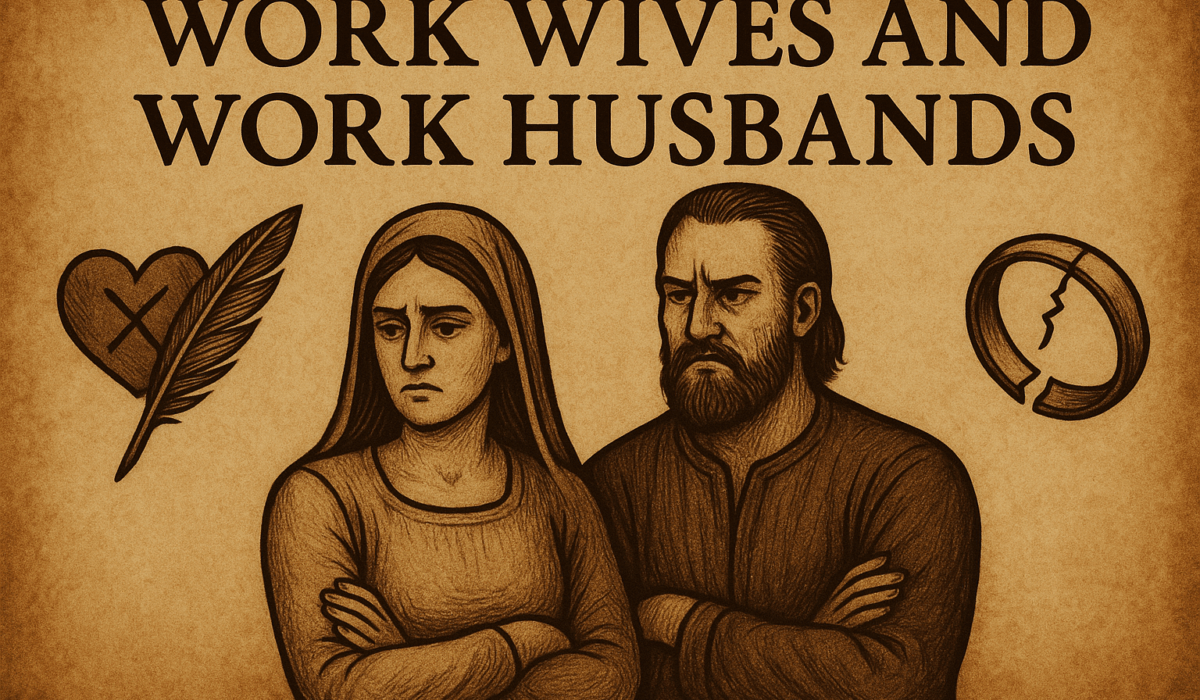
Work Wives and Work Husbands: Adultery Disguised as Friendship

A Call to Reject Emotional Infidelity, Reclaim Covenant Boundaries, and Restore the Sanctity of Marriage

> “Ye have heard that it was said by them of old time, Thou shalt not commit adultery:

But I say unto you, That whosoever looketh on a woman to lust after her hath committed adultery with her already in his heart.”

— Matthew 5:27–28

In a world that no longer knows what marriage is, it should come as no surprise that it also fails to recognize what adultery is. We live in a society where vows are recited but not kept, where boundaries are spoken but not enforced, where men and women routinely exchange intimate glances, secrets, affections, and loyalties — not with their spouses, but with their so-called “work spouses.”

“Work wife.”

“Work husband.”

What sounds playful is nothing less than a mockery of God’s sacred covenant. It is an open door to the serpent. It is emotional polygamy, relational adultery, and moral treason, cloaked in corporate language and justified by modern customs.

But in the Kingdom of God, we do not adopt the world’s language or customs — we conform our lives to His unchanging law. And His law calls this what it is: sin.

I. The Lie of Innocence: “It’s Just Platonic”

The first defense of this modern relational cancer is predictable: “We’re just friends. It’s not romantic. It’s not sexual. It’s just easier to talk to him/her than my actual spouse.”

To this the Scripture thunders: Flee youthful lusts. Avoid even the appearance of evil. Keep thy heart with all diligence.

God’s standard is not vague:

> “Make no provision for the flesh, to fulfill the lusts thereof.”

— Romans 13:14

> “Let not sin therefore reign in your mortal body, that ye should obey it in the lusts thereof.”

— Romans 6:12

The deception of the “work spouse” is that it feels safe because it hasn’t yet crossed the line. But Scripture warns that the line is not merely physical — it is emotional. Adultery begins in the heart. It grows through small compromises: casual lunches, inside jokes, personal confessions, shared frustrations about one’s real spouse.

Many husbands and wives have found themselves in full-blown affairs not because they went looking for one — but because they permitted emotional intimacy to develop where it had no business existing.

> “Can a man take fire in his bosom, and his clothes not be burned?”

— Proverbs 6:27

The answer is no. Flirtation, familiarity, loyalty, and vulnerability do not belong to a coworker — they belong to one’s husband or wife. Anything else is fire in the bosom.

II. Marriage Is Not a Shared Title — It’s an Exclusive Covenant

The biblical vision of marriage is not vague. It is not open. It is not compartmentalized.

> “For this cause shall a man leave his father and mother, and shall cleave unto his wife: and they two shall be one flesh.”

— Genesis 2:24

One flesh. One bond. One union. No third parties. No emotional surrogates. No divided loyalties.

In the sacred covenant of marriage, all forms of intimacy — sexual, emotional, spiritual, domestic — are reserved for one’s spouse alone. To cleave to another, even in heart, is to violate this unity.

The “work spouse” is a counterfeit covenant. It simulates the affection, support, camaraderie, and even flirtation of marriage, without the vow, the accountability, or the sanctity. It is adultery that hides behind HR policies and office banter.

But God sees through the veil. He sees the shared laughter. He sees the personal texts. He hears the long conversations. He knows who you vent to, who you praise more often, whose counsel you seek, whose praise you crave, and whose absence you feel.

And if the answer is someone other than your real spouse, then the order of God has been violated.

III. The Fruits of Disorder: Broken Trust, Weakened Homes, and Generational Damage

This modern concept has consequences. The work husband and work wife dynamic is not harmless. It is devastating.

It fosters discontent: When you emotionally invest in someone outside your marriage, it erodes gratitude for the one God gave you. You compare. You fantasize. You critique. You harden.

It breeds secrecy: Even if no “lines” are crossed, these relationships often operate in a hidden realm. Texts are deleted. Details are withheld. Lunches aren’t mentioned. Why? Because the heart knows it’s wrong.

It trains the next generation: Children watch. Sons observe how their fathers treat women who aren’t their mother. Daughters watch their mothers seek attention from men who aren’t their father. And thus the cycle of infidelity, divorce, and compromise repeats.

It weakens masculine authority: A married man emotionally leaning on a female coworker for affirmation or empathy undermines his authority and becomes a passive participant in the feminization of society. He is not a patriarch — he is a needy emotional adolescet child.

It multiplies temptation: Even if physical sin never occurs, the proximity and regular emotional stimulation lay a minefield of spiritual vulnerability. Satan is patient. He will wait years to detonate what you’ve casually cultivated.

IV. Emotional Affairs Are Real Affairs

The modern church has a high tolerance for emotional sin and a low view of spiritual fidelity. But God does not divide the soul from the body as cleanly as modern psychology. In Scripture, adultery is not just an act — it is a spirit.

> “But I say unto you, That whosoever looketh… hath committed adultery already in his heart.”

— Matthew 5:28

What the world calls “work wife,” God calls another woman in your heart.

What the culture calls “work husband,” God calls a man who receives your attention and emotional submission.

You do not need to lie in a bed with someone to be unfaithful to your spouse. If you give another man or woman:

The affection that belongs to your spouse,

The admiration that belongs to your spouse,

The emotional intimacy that belongs to your spouse,

The trust, vulnerability, or attention that belongs to your spouse…

Then you have committed adultery. It may not be punishable by law, but it is condemnable before heaven.

V. The Root Cause: Feminized Workplaces and Gender Mixing

At the root of this phenomenon is the deep disorder of the modern work environment — namely, the mass integration of men and women in professional settings that God never intended.

When women left the home and entered the workplace en masse, the sacred boundaries between male and female interactions eroded. Men and women began spending the majority of their waking hours with each other in private, emotionally charged, success-driven environments.

Coworkers became confidants.

Business lunches became dates in disguise.

Projects became shared battles that forged unnatural bonds.

Office flirtation became normalized and even encouraged.

Masculine hierarchy was replaced with emotional egalitarianism.

The workplace is now the most common place where affairs begin — because it is a daily proximity without accountability, duty without covenant, and familiarity without consequence.

Biblically, women were not designed to work beside unrelated men. They were designed to work for their household, under the authority of a husband or father, not under a male boss or alongside male peers. The feminized workplace is a powder keg of sexual and emotional confusion.

VI. The Gospel Solution: Repentance, Rebuilding, and Reformation

The answer to this cultural cancer is not merely to avoid certain behaviors, it is to repent of an entire framework of thinking. We must repent not only of inappropriate relationships, but of the worldly philosophies that made them seem harmless.

> “Be not conformed to this world, but be ye transformed by the renewing of your mind…”

— Romans 12:2

What must we do?

1. Repent

If you have entertained an emotionally inappropriate relationship, confess it. Before God. Before your spouse. Cut off all ties, emotional dependencies, and ongoing connections. Even if it was “just a friendship,” sever it without apology. You don’t need closure. You need immediate obedience!

2. Rebuild Trust in Your Marriage

Reinforce emotional walls around your household. Return to your spouse as your primary,and only source of emotional intimacy. Pray together. Speak openly. Study Scripture. Eat meals without distraction. Build the oneness that you were meant to enjoy, with no competitors in sight.

3. Reevaluate Your Workplace Setup

If you are in an environment that constantly places you in compromising situations,  consider what must change. This may mean seeking a new role, requesting boundary-respecting accommodations, or even radically restructuring your career. Better to suffer financially than to suffer the wrath of God.

4. Establish and Enforce Clear Boundaries

Married men and women should not spend one-on-one time with the opposite sex. No private lunches. No casual texting. No sharing personal details. No familiarity. No banter. It may look extreme to the world. But it looks holy to heaven.

5. Train Your Children in Real Loyalty

Teach your sons and daughters that marriage is an exclusive covenant, not a partial arrangement. Warn them of the emotional compromises that lead to physical ones. Show them how to preserve trust by denying access.

VII. Let the Marriage Bed Be Undefiled

> “Marriage is honourable in all, and the bed undefiled: but whoremongers and adulterers God will judge.”

— Hebrews 13:4

The world defiles everything it touches. It mocks fidelity. It rewards flirtation. It encourages men and women to find comfort in strangers and neglect the covenant of their youth.

But the people of God are not called to flirt with boundaries. We are called to build walls, high walls, sacred walls, covenant walls.

Let your marriage be a fortress.

Let no other man have your wife’s loyalty.

Give no married woman your attention.

Any outside emotional bond will undermine the oneness of your union.

Let the marriage bed be undefiled — not just sexually, but emotionally, mentally, and spiritually.

VIII. The Rise of Patriarchal Loyalty

What the world calls “work spouses” is a symptom of something deeper, the collapse of godly patriarchy. When men fail to lead at home, women seek affirmation elsewhere. When women abandon domestic order, they search for masculine covering in the marketplace and their husbands seek affection elsewhere. 

The restoration of marital fidelity begins with the restoration of Biblical order:

Husbands must lead their wives spiritually, emotionally, and practically.

No wife needs a “work husband” when she is being shepherded, cherished, and honored by the real head of her house.

Wives must submit joyfully and cultivate the home.

No husband will wander when his wife is his true helper, crown, and delight.

Fathers must protect their daughters from early emotional entanglements.

Train them not to give their hearts to coworkers, classmates, or casual connections. Teach them that loyalty belongs only to their future husband.

IX. When Women Have “Work Wives”: The Rise of Feminized Emotional Codependency

The deception of “work spouses” is not limited to cross-sex entanglements. In our gender-confused and emotionally disordered culture, even women are now adopting the language of “work wives”,  forming overly intimate emotional relationships with other women in the workplace. And though this may appear less threatening on the surface, its underlying disorder is no less real or damaging.

This phenomenon stems not from Biblical sisterhood, but from feminized codependency.

These relationships often replace the emotional intimacy that should exist between wife and husband, or even sister-wives.

They encourage gossip, emotional vulnerability, and spiritual confusion, outside of covenant.

They mimic the closeness of marriage, treating another woman as a surrogate spouse, confidant, and daily companion when those relationships should be limited to their husband or sister-wives.

The modern woman now boasts of her “work wife”, the coworker she eats lunch with, shares secrets with, travels with, and emotionally leans on. It is framed as friendship. But its essence is the same: disorder.

Scripture speaks clearly:

> “That they may teach the young women to be sober, to love their husbands, to love their children, to be discreet, chaste, keepers at home…”

— Titus 2:4–5

These so-called “work wife” dynamics do not produce sobriety, discretion, or chastity. They breed spiritual laxity, emotional discontentment, and subtle rebellion against the home. Instead of being anchored in their own households, many women have become emotionally tethered to other women in the workplace.

And increasingly, the line between codependent “friendship” and lesbian flirtation is blurred. In a world that encourages pride in perversion, emotional and physical boundaries are obliterated. We now see women flirting, touching, and even experimenting under the banner of “friendship”, another abomination in the eyes of God.

The truth is this: a married woman has no business forming emotional enmeshments with other women, these entanglements will rival or replace her bond with her husband.

Her allegiance belongs to her household.

Her loyalty belongs to her head.

Her heart belongs to the man God gave her — not a female coworker, a “bestie,” or an emotional twin.

The household of faith must train women in true sisterhood — not emotional lesbianism. Older women are to train the younger, not seduce them with dependency. Biblical womanhood is strong, fruitful, and sober — not clingy, dramatic, or relationally chaotic.

Let women be guarded. Let emotional boundaries be restored. Let the term “work wife” be cast back into the sewer from which it came.

Conclusion: Let No Man Tear Asunder

In the beginning, God made them male and female. He joined them. He called it very good. And He warned: what God hath joined together, let no man (no coworker, no friend, no casual flirtation) put asunder.

If you are married, your emotional, spiritual, and intimate focus belongs to one another. Guard it like a sword. Protect it like a treasure. Honor it like a temple.

The culture will scoff. It will say you’re insecure. It will say you’re overreacting.

Let them scoff. Let them mock. Let them wallow in their broken homes, their emotional affairs, their office romances, and their destroyed legacies.

But as for the people of God, we will re-build the Great Order.

And the Great Order begins with marriage — covenanted, loyal, undefiled, and unshakable.

Soli Deo Gloria.

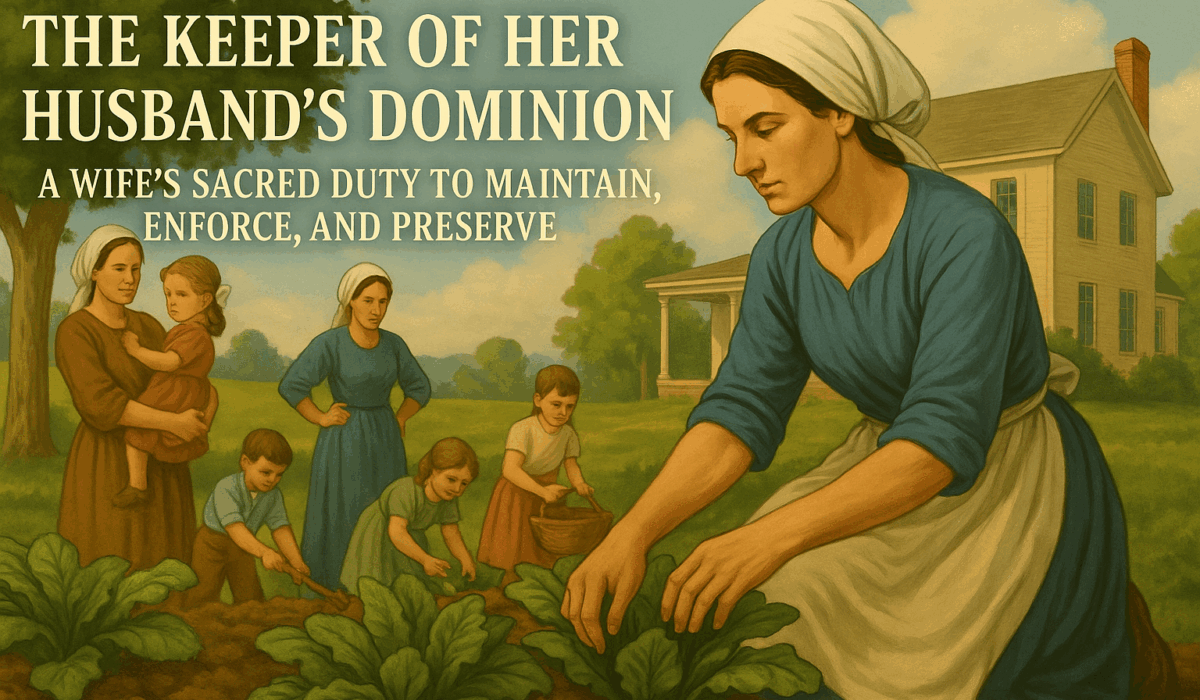
The Keeper of Her Husband’s Dominion: A Wife’s Sacred Duty to Maintain, Enforce, and Preserve

In the divine hierarchy established by God, the man is the builder, the establisher, the governor. He goes out to war, to work, to wrest dominion from the earth by the sweat of his brow. He lays foundations: spiritually, economically, and physically. The woman, by contrast, is called to maintain and enforce the order her husband builds. Her task is not to innovate her own laws or construct her own dominion, but to be a wise and faithful steward of the man’s household and headship.

This is not demeaning—it is glorifying. The wife, when she faithfully fulfills her calling, sustains and beautifies the kingdom entrusted to her. She is like the moon reflecting the light of the sun—she governs the night with the authority delegated to her. She is the queen, upholding the rule of the king.

Let us examine this sacred role through Scripture, through the wisdom of our forefathers, and through the eyes of common sense, now so rare in a society poisoned by egalitarian rebellion.

I. Biblical Foundations: Keeper of the Home

The most fundamental and oft-repeated command given to the wife in Scripture is to be a keeper at home:

“That they may teach the young women to be sober, to love their husbands, to love their children, to be discreet, chaste, keepers at home, good, obedient to their own husbands, that the word of God be not blasphemed.”
—Titus 2:4–5

The Greek word used for “keeper at home” (οἰκουργός) carries a robust meaning—“a guard or warden of the house.” Not merely a passive occupant, the wife is an active maintainer and enforcer of the household dominion. She is a steward, a governor under authority, a domestic magistrate who executes her husband’s law and vision within the sphere of their home.

The man builds; the woman maintains.

The man provides; the woman preserves.

The man establishes order; the woman enforces it.

This is her honor and her duty.

II. The Garden Pattern: From Eden to Household

The pattern of dominion and maintenance is laid down at the very beginning in the Garden of Eden. God placed Adam in the garden “to dress it and to keep it” (Genesis 2:15). After the creation of Eve, she was brought to Adam not to found her own garden, but to help him in the work God had given him. She was bone of his bones and flesh of his flesh—created for the man (1 Corinthians 11:9)—to serve, guard, beautify, and multiply what had already been given.

The fall itself occurred because Eve stepped outside her lane. She began to entertain a vision and decision-making authority apart from her husband’s rule. She failed in her duty to uphold the order given by God through Adam, and chaos ensued. Her punishment included a prophetic return to proper headship:

“Thy desire shall be to thy husband, and he shall rule over thee.”
—Genesis 3:16

Her redemption would not come through autonomy but through faithful childbearing and submission (1 Timothy 2:15).

III. Enforcing the Law of the Household

One of the gravest errors of modern women is the belief that the home is their “own domain,” independent from the oversight and rule of their husbands. This is false. The husband is head of the wife (Ephesians 5:23), and that headship extends to every sphere, including the home, rules, routines, budget, diet, and child discipline.

The wife is to enforce the laws her husband has set in place. This includes:

  • Bedtimes for children
  • Rules of modesty and dress
  • Household cleanliness and standards of presentation
  • Sabbath and feast observance
  • Media access and content restrictions
  • Chores and responsibilities
  • Hospitality and guest boundaries
  • Dietary rules/guidelines 

If the husband has declared that no television shall be watched after dinner, the wife is not free to change that. If he has ruled that certain behaviors warrant discipline, she must not turn a blind eye. She must uphold his word, not undermine it. To do otherwise is to act as a usurper within the gates of his authority.

This is seen clearly in the book of Proverbs:

“The wise woman buildeth her house: but the foolish plucketh it down with her hands.”
—Proverbs 14:1

What is it that tears down a house? Rebellion against the husband’s law. Disregard for his vision. Neglect of his provision. Laziness. Gossip. Complaining. Softness with the children when firmness is required. These are not minor infractions; they are betrayals of covenant duty.

IV. Dominion by Delegation: The Stewardship of All That Is Entrusted

The godly woman is not a ruler in her own right. She is a steward, a high-ranking servant within the covenant household, entrusted with dominion that is delegated, not innate. What she oversees is not her possession, but her husband’s estate. What she manages is not her own empire, but his dominion.

This principle must be understood deeply: everything a husband gives to his wife is a sacred trust. She is not the owner of the home, the furnishings, the land, or the provision—she is the keeper, the preserver, the multiplier of that which was delivered to her by her head.

The faithful wife recognizes that to waste what her husband has built is to dishonor and disrespect him, and in so doing, to dishonor Christ, who commands her submission. It is likened to physically slapping him in the face. Her work is not freelance. Her hands are not idle. Her authority is not self-declared. Her role is sacred.

Let us now examine the breadth of her stewardship.

1. The Home: Fortress and Sanctuary

The home is the outward expression of a man’s inward order. It is the sanctuary where his rule is made manifest, where law becomes culture, where peace dwells and truth is taught.

The wife is to guard and maintain the home with holy vigilance. Cleanliness, structure, beauty, and functionality are not luxuries, they are marks of honor. Disorder in the home reflects disorder in the woman. When a wife allows clutter, laziness, decay, or distraction to take root, she is not just being careless, she is allowing the enemy within the gates.

Every room, every corner, every closet is a reflection of the stewardship of the woman. She is called to maintain the home not as a showpiece for outsiders, but as a place of ordered dominion where her husband’s rule is made visible.

“She looketh well to the ways of her household, and eateth not the bread of idleness.”
—Proverbs 31:27

2. Furnishings and Garments: Order in the Details

The beds her husband purchased are to be made. The tables he provided are to be cleared and set. The furniture he supplied is to be cared for with dignity—not stained, destroyed, or buried beneath toys and debris. This is not about materialism—it is about respect.

Likewise, the clothing he provides for his wife and children is to be maintained with diligence. Torn seams should be mended. Laundry should not pile to the ceiling. Stains should be addressed. Shoes should be clean and placed in order.

The Proverbs 31 woman is not a passive consumer, she is a craftswoman, a caretaker, a provider of beauty. Her efforts in these things express her gratitude to God and to her husband.

“She maketh herself coverings of tapestry; her clothing is silk and purple.”
—Proverbs 31:22

3. Garden and Grounds: Dominion Over the Earth

The garden and yard, however large or small—are part of the man’s dominion. Whether a few raised beds or a broad acreage, they are under the wife’s stewardship. A weed-choked garden and a trash-littered yard dishonor the name of the man who pays for that land.

The godly woman will ensure the grass is cut, the flowers maintained, the tools cared for, the trash bins orderly, and the land not neglected. She teaches her children that even the appearance of the home’s grounds reflects the glory of their father.

“She considereth a field, and buyeth it: with the fruit of her hands she planteth a vineyard.”
—Proverbs 31:16

This is not just busy work. It is visible dominion. It is faithfulness in the little things.

4. Vehicles, Tools, and Implements: Respecting the Man’s Work

The car her husband bought for the family is not a garbage heap. The truck he uses for work is not a playground. The tools he stores in the garage are not toys. Every item her husband has earned by the sweat of his brow must be treated with reverence.

She should ensure that oil changes happen on schedule, that children do not slam car doors or mishandle equipment, that tools are returned to their place, and that vehicles remain clean and ready for use.

A faithful wife will train the children to handle these things properly and speak of them with respect. Why? Because these items are extensions of the man’s work. To lack respect for the items acquired by the husband is to dishonor.

5. Finances and Household Resources: Guarding the Treasury

Every dollar her husband earns represents time away from home, risk, sweat, and toil. The faithful wife does not squander this. She does not waste household money on trinkets, convenience foods, unneeded luxuries, or vanity. She keeps records, stretches each dollar, plans meals, compares prices, shows accountability and multiplies what is given.

“The heart of her husband doth safely trust in her, so that he shall have no need of spoil.”
—Proverbs 31:11

In the biblical order, the husband is the provider, the household king; the wife is the treasurer, the household steward. She may not generate the income, but she governs its use. She does not spend frivolously. She spends righteously.

She is the Proverbs 31 woman—not chasing careers, but making her husband’s name great in the gates by her industry and faithfulness.

V. Historical Witnesses: Women of Order and Excellence

The vision of a woman as steward, guardian, and enforcer of her husband’s dominion is not merely a biblical ideal—it is a pattern consistently affirmed in the lives of godly women throughout history. In eras of strength, women embraced this sacred charge and preserved the household economy, the moral law, and domestic order with diligence and reverence. Their names are not always remembered, but the civilizations they upheld were built upon their faithfulness.

1. The Matriarchs of Scripture

From Sarah to Ruth, from Hannah to Elizabeth, the holy women of old built nothing of their own name, but magnified the names of their husbands and sons through obedience and faithful stewardship.

Sarah, though married to the great patriarch Abraham, was not known for public exploits but for reverence and obedience:

“Even as Sara obeyed Abraham, calling him lord: whose daughters ye are, as long as ye do well…”
—1 Peter 3:6

Rebekah, Rachel, and Leah each submitted to the headship of the men appointed to them and managed the flocks, tents, and children with steadfastness, bearing the future of Israel on their backs.

Hannah’s sacrifice of Samuel was not a detachment from motherhood—it was a fulfillment of her vow to uphold the household’s devotion to God, giving her son back to the Lord in accordance with her husband’s leadership.

2. The Noble Wives of the Reformation

In the time of the Protestant Reformation, when men were risking their lives to preach the gospel and reform the Church, their wives were not idle. They built homes, taught children, cultivated gardens, welcomed persecuted believers, and enforced household law without wavering.

Katharina von Bora, the wife of Martin Luther, managed a complex estate, fed dozens daily, and kept order in a home that was often a refuge for students, refugees, and reformers. Luther affectionately called her “My Lord Kate,” not because she ruled him, but because she ruled the home well under his authority.

She did not seek to lead the Reformation in the public square. She ruled her portion of the kingdom—faithfully maintaining what Luther, her head, had built. That was her glory.

3. The Colonial and Pioneer Women of America

In early America, the homestead was the heart of civilization. Men cleared the land, raised barns, and established farms, but it was the wives who turned rough wood and stone into sanctuaries of peace and law.

These women enforced strict order in their homes: keeping meals on schedule, teaching catechisms, disciplining children, managing livestock, storing food, and maintaining cleanliness even under harsh frontier conditions. Their husbands rode for supplies, went to war, or labored in the fields—often for weeks—trusting that all would be in order upon return.

They were not seeking escape through feminism or employment in town. They had dominion to keep. A fire to tend. A people to govern in the name of their husband and unto the Lord!

4. Victorian and Edwardian Homemakers

Even in the great cities of England and America, Christian wives understood that the home was a moral and spiritual realm to be governed under the man’s headship. Victorian households were marked by schedule, virtue, modesty, and order. The lady of the house enforced the rhythm of the day—prayers, meals, instruction, cleanliness, and decorum.

She was a steward of appearances and behavior, ensuring that what her husband established—socially, financially, and religiously, was preserved, reinforced, and passed on.

The collapse of such homes in the 20th century was not accidental. It came when women left the post of keeper and began to clamor for equal rulership, collapsing the hierarchy that had upheld generations of Christian family strength.

VI. Modern Rebellion and the Decay of Stewardship

The enemy of order is rebellion, and rebellion now wears the mask of liberation. Modernity has sold women a bitter lie: that to serve under a man’s authority is slavery, and that to preserve his house is demeaning. The consequence? A generation of women who despise the very work for which they were created—and homes that lie in ruins because of it.

The home has been traded for the cubicle, the cradle for the boardroom, the garden for gossip, and the order of the husband for the doctrines of feminism. Where once women built multigenerational households under patriarchal authority, now they chase paychecks and political power, leaving the home desolate.

The average woman today cannot sew, cook from scratch, manage a budget,  discipline her children, and cannot submit to her husband’s law without complaint. She has been trained to scorn these things—to see the dominion of the household as a prison rather than a throne.

“Because that, when they knew God, they glorified him not as God… Professing themselves to be wise, they became fools.”
—Romans 1:21–22

Women who abandon their post as keepers of the home do not merely create messy houses, they dismantle civilizations. The household is the smallest unit of God’s kingdom on earth. When it is neglected, the Church is weakened, the nation is corrupted, and the next generation is lost.

The spirit of rebellion has consequences:

  • Children are undisciplined and defiant.
  • Homes are disordered, chaotic, and joyless.
  • Husbands are dishonored and treated as equals—or worse, as burdens.
  • Finances spiral into debt and dysfunction.
  • Generations forget the law of God.

This is not a theoretical problem. It is the daily, lived reality of most families in the West. And the solution is not another conference, podcast, or Instagram reel. The solution is repentance. The solution is a return to The Great Order—where men lead in righteousness and women submit in reverent stewardship.

There is no neutral ground. A woman is either upholding her husband’s dominion or undermining it. She is either honoring the law of the house or sowing confusion within it. There is no such thing as harmless rebellion.

Let the women of God renounce the rebellion of our age. Let them cast down the idols of feminism, egalitarianism, and careerism. Let them return home, not as slaves, but as stewards. Not as doormats, but as queens under the crown. And let them raise daughters who do the same.

“Let the aged women… teach the young women… to be sober, to love their husbands, to love their children, to be discreet, chaste, keepers at home… that the word of God be not blasphemed.”
—Titus 2:3–5

The world blasphemes when Christian women abandon their role. But heaven rejoices when the household is ordered according to God’s design.

VII. Let Her Reign: The Glory of the Faithful Steward

The faithful wife is not a background figure in her husband’s dominion—she is its heartbeat. She reigns not by usurping his authority, but by glorifying it. She extends his law. She enforces his order. She multiplies his provision. And in doing so, she magnifies her own glory, for “a virtuous woman is a crown to her husband” (Proverbs 12:4).

Let no woman shrink from this call. Let no wife despise her sacred role. For the one who maintains what her husband has built is not a servant in chains, but a queen entrusted with treasure.

She reigns when she:

  • Keeps the home clean, orderly, and peaceful, reflecting her husband’s wisdom.
  • Disciplines the children with consistency, upholding his authority.
  • Guards his time, his name, and his resources with watchful diligence.
  • Respects the furnishings, land, vehicles, and tools he has earned with honor.
  • Upholds the laws of the household—not with pride, but with obedience.

This is her crown. This is her dominion. This is her offering of praise—not with lips only, but with labor. Not in theory, but in the daily practice of keeping, tending, multiplying, and glorifying what her husband has entrusted to her.

“Every wise woman buildeth her house: but the foolish plucketh it down with her hands.”
—Proverbs 14:1

Let her rise in the strength of the Lord. Let her reject the slanders of a godless age. Let her take joy in her husband’s approval, in her children’s obedience, and in the fruit of her hands. Her work is not small, it is the work of empires, the labor of queens.

Let her speak to her daughters not of careers and competition, but of covenant and stewardship. Let her show them that the path of glory is found in obedience. That the house is not a trap, but a throne. That to be a keeper at home is not to hide from the world, but to reshape it through generational dominion.

And when the world mocks, let her laugh. When fools scoff, let her remember that God smiles on the woman who fears Him. Her reward is eternal, her legacy generational, and her title high: faithful steward of her husband’s house.

“Give her of the fruit of her hands; and let her own works praise her in the gates.”
—Proverbs 31:31

Let the wives arise. Let them keep what has been built. Let them enforce what has been ordered. Let them glorify their husbands by reigning in reverent submission.

This is The Great Order. And it shall not be shaken!

If Your Family (Kingdom/Domain) Is Not Growing, It Is Dying

The Biblical Call to Expand Your Household in Wives, Children, Property, Influence, and Dominion

I. Introduction: Life, Growth, and the Nature of God’s Kingdom

In the natural world, stagnation is the first sign of death. A tree that no longer puts forth branches, fruit, or roots is already dying. A river that ceases to flow becomes stagnant and poisonous. A body that ceases to regenerate its cells wastes away. The same is true for the household — the kingdom and dominion of the patriarch.

God’s design for the family is growth. Not merely survival. Not maintenance. Not compromise. But fruitfulness, multiplication, and dominion. These are not optional suggestions but commands given in the first chapter of the Bible:

> “And God blessed them, and God said unto them, Be fruitful, and multiply, and replenish the earth, and subdue it: and have dominion…”

— Genesis 1:28

This command was not revoked. It was reaffirmed to Noah after the flood (Genesis 9:1), to Abraham in the covenant (Genesis 17:6), and to the Church spiritually (Matthew 28:19–20). Growth is the nature of godly dominion. Expansion is obedience. Stagnation is disobedience. Shrinking is rebellion.

Your family is your kingdom. And if your kingdom is not growing, it is dying.

II. The Dominion Mandate: Fruitfulness as Faithfulness

God made man to rule, to build, and to expand. The household was created to be the epicenter of this dominion — a miniature kingdom under God’s greater rule.

The first command to man and woman was not about worship services or fasting rituals. It was about fertility and authority.

> “Be fruitful and multiply.”

This is God’s economy. His Kingdom grows through families, not through governments or programs. The covenantal expansion of God’s people comes through childbirth, headship, marriage, and inheritance.

A man is not faithful merely because he avoids scandal or attends church. He is faithful when he multiplies, when he fills the earth with godly seed, builds an enduring legacy, and structures his household to outlast him for generations.

This means real expansion — in:

Children

Wives

Land and property

Influence

Business and productivity

Generational faithfulness through sons and daughters-in-laws

Protection and headship over uncovered women

Political influence and dominion

Each of these are expressions of the dominion mandate.

III. The Curse of Shrinking Households

Modern households are shrinking. The average Western couple now has 1.2 children. Many Christians sterilize themselves with pride, calling it “wise family planning.” They limit the number of arrows in their quiver because they have conformed to the world’s fear and its idols of ease, entertainment, and wealth.

The result? A dying kingdom. A disobedient household. A sterile future.

> “Lo, children are an heritage of the Lord: and the fruit of the womb is his reward.”

— Psalm 127:3

The man who refuses children is despising God’s reward. The man who refuses to expand his house is refusing stewardship of more inheritance, blessing, and responsibility. The man who resists influence, property, or responsibility is shrinking his domain. Whether he knows it or not, his kingdom is dying.

There is no neutral ground. You are either growing or declining.

IV. Biblical Polygyny: The Engine of Household Growth

One of the most powerful, God-ordained means of household growth is polygyny, the marriage of one man to multiple wives. Far from being a footnote or cultural anomaly, polygyny was a primary tool of expansion among the patriarchs.

Abraham, the father of the faith, had multiple wives and concubines.

Jacob had four wives and twelve sons — the heads of the twelve tribes of Israel.

David and Solomon, kings after God’s own appointment, had multiple wives (though Solomon’s excess in foreign women brought judgment).

Gideon, a judge raised up by the Lord, had many wives and seventy sons (Judges 8:30).

Polygyny, when governed by God’s law, is a righteous vehicle for dominion and growth. Each wife brings the potential for children, productivity, nurturing of future warriors and builders, and the expansion of the household’s legacy.

If a man is able, called, and ordered in righteousness, the taking of additional wives is not indulgence, it is obedience. It is the exercising of holy headship over more ground, more territory, and more fruitfulness.

> “And in thy seed shall all the nations of the earth be blessed.”

— Genesis 22:18

Seed multiplies through fruitful women. More wives = more seed. More seed = more blessing.

V. Household Expansion Through Generations

A household should not merely expand in the immediate generation — it must be built to multiply generationally.

This happens through:

Daughters-in-law, brought under the household’s law and culture

Grandchildren, raised in the same traditions, faith, and order

Sons, trained to lead, rule, and expand the house still further

The goal is not independence but continuity. Sons do not leave to start autonomous lives; they are trained to inherit and expand the household dominion. The patriarch must think 100 years ahead. He builds systems, expectations, and laws that will remain even after he is buried with his fathers.

> “A good man leaveth an inheritance to his children’s children.”

— Proverbs 13:22

VI. Expansion in Land, Wealth, and Influence

Abraham was blessed not just in children but in flocks, herds, servants, and land. The blessing of the Lord is multi-dimensional. A growing household also acquires:

Property — to establish territorial dominion

Businesses — to create economic strength and independence

Servants, laborers, and allies — to wield greater reach

Cultural influence — to shape communities, cities, and nations

In the biblical worldview, fruitfulness is material as well as spiritual. A household that grows only in theology but not in impact is malformed. God calls for men who multiply both the gospel and goats, both the Word and their wealth.

Even Christ framed the Kingdom in terms of growth and stewardship:

> “For unto every one that hath shall be given, and he shall have abundance: but from him that hath not shall be taken away even that which he hath.”

— Matthew 25:29

The man who multiplies is rewarded. The man who maintains is cast out as lazy.

VII. Providing Headship to the Uncovered

Another vital form of household expansion is taking responsibility for the uncovered — women who are without godly headship.

Scripture is clear: women are not to be autonomous. They are to be under the authority of fathers or husbands (Numbers 30; Ephesians 5:22).

In a righteous society, widows, orphans, or divorced women are not left to drift. They are covered. Brought under headship. Given protection, law, and purpose.

In many cases, a patriarchal man may rightly expand his household by taking such a woman as an additional wife. This is a holy act — not of romance, but of rescue and governance. He provides her law. He disciplines her flesh. He integrates her into a structure she desperately needs, and which she was created for.

> “Let not a widow be taken into the number under threescore years old, having been the wife of one man… If she have brought up children, if she have lodged strangers…”

— 1 Timothy 5:9–10

Paul’s instruction assumes that the Church takes responsibility for uncovered women, but only when no man will. The highest and most fitting place for such a woman is in a righteous man’s house.

A man who is able should not leave women uncovered. He should expand, for their good and for God’s glory.

VIII. The Example of the Patriarchs

Throughout Scripture and history, the righteous men, those who shaped nations and carried God’s promise — were not maintainers. They were builders and expanders.

Noah built an ark, saved a family, and repopulated the earth.

Abraham went out not knowing where he went and became the father of many nations.

Jacob multiplied through wives and sons and became Israel.

Moses led a people and gave them law.

David conquered territory and established a throne.

Nehemiah rebuilt the wall.

Paul planted churches across the empire.

Christ conquered sin and is building His Church.

The God-fearing man is always multiplying. Always expanding. Always thinking in dynasties and dominion. Never content with neutrality or pause.

> “Of the increase of His government and peace there shall be no end.”

— Isaiah 9:7

The kingdom of God increases. So must yours!

IX. Warning Against Shrinking and Excuses

The temptation for the modern man is retreat. He is told to “be content,” to “not overextend,” to “live modestly.” These can be good in context. But often, they are masks for cowardice, laziness, or outright disobedience.

“I can’t afford more children.” — But you trust God to save your soul?

“I’m not sure I could lead more than one wife.” — Then why are you leading at all?

“Our house isn’t big enough.” — Then why aren’t you building a bigger one?

“It’s too hard to manage a big household.” — Then grow up and learn.

God never promises ease. He promises blessing. And blessing follows obedience.

The faithful man expands even in famine. He builds in the face of chaos. He governs when others retreat. He takes headship where others make excuses.

> “And the man waxed great, and went forward, and grew until he became very great.”

— Genesis 26:13

This is the pattern of the patriarch.

X. Let the Righteous Multiply

This is the hour to rise. The time for compromise has ended. Your family is either marching toward dominion or dying in retreat.

Take wives. Raise children. Train sons. Rule over daughters. Bring in daughters-in-law. Gather grandchildren. Purchase land. Build businesses. Influence local Government. Shelter the uncovered. Preach the gospel. Plant orchards. Expand your tent.

> “Enlarge the place of thy tent, and let them stretch forth the curtains of thine habitations: spare not, lengthen thy cords, and strengthen thy stakes; For thou shalt break forth on the right hand and on the left…”

— Isaiah 54:2–3

This is the way of dominion.

This is the nature of God’s Kingdom.

This is the legacy of righteous men.

Let the patriarchs rise — and let their houses grow.

If your family is not growing, it is dying. Build, expand, multiply and Reign with Authority!

This is the Great Order!

“The Last Rodeo” – A Stirring Testament to Headship, Legacy, and the Restoration of God’s Order

Movie Review by: Lord Redbeard 

The Last Rodeo is not merely a film, it is a providential parable draped in denim and dust, a cry from the heart of America’s dying masculine spirit, and a timely call to restore the righteous headship of the patriarch in a generation gone astray.

Joe Wainwright, played masterfully by Neal McDonough, embodies the kind of man our world desperately lacks: a weathered but unbroken patriarch willing to bleed for his household. After losing his beloved wife to cancer, Joe is left alone; grieving not just the loss of a woman, but the collapse of the ordered home she helped him maintain. With no additional wives to bear the burden of mothering his still-young daughter, the structure of his household was fractured. A man should never leave his family, certainly not his children with a single pillar of support. That is the painful lesson quietly tucked in the background of Joe’s story.

His daughter, now grown, bears the scars of this imbalance.

Lacking a mother’s guidance and nurture, especially in those tender years, she grows into a woman unwed, unsupported, and spiritually adrift. It is not hard to see how the absence of feminine reinforcement under male headship left her vulnerable, unequipped to discern or submit to a worthy man.

In this vacuum, Joe steps in once again as head, not just as father, but as surrogate husband in terms of protection and provision, bearing the weight his daughter’s own absent husband should have carried.

This is Biblical patriarchy in action: a father refusing to relinquish responsibility, even when the structure below him falters. Joe does not pity himself. He rises, acts, and reclaims dominion. That is the true measure of a man, not his ease, but his endurance; not his wealth, but his willingness to suffer for those under his care.

And suffer he does. The script does not sugarcoat the emotional ache of widowhood, nor the isolation a man feels when he has no one to comfort him. One wife, no matter how precious, cannot carry the burden of a lifetime alone. This is the unspoken cost of monogamy, especially in an age when men are expected to go it alone after a loss. 

Joe has no other wife to manage the house, to care for him, to counsel him, to help steward his daughter, or simply to sit with him in silence as he mourns. That loneliness haunts the film, and rightfully so. It is a quiet indictment of the one-woman-only tradition that has left many patriarchs exposed.

No patriarch walks alone, and The Last Rodeo wisely includes a figure often forgotten in today’s hyper-individualistic narratives, the faithful friend. Joe’s companion throughout the film (Charlie) is not merely comic relief or a background prop; he is a pillar in Joe’s lonely world, a living reminder that masculine headship thrives best in brotherhood.

While Joe shoulders the burdens of grief, provision, and legacy, Charlie stands beside him with quiet strength, offering counsel, encouragement, and a kind of spiritual camaraderie that every man needs. This man is not his wife, nor a replacement for her,  he is something distinct and vitally necessary: a fellow patriarch who reinforces rather than competes. He listens without emasculating Joe, advises without undermining, and supports without usurping.

In an age when most men are isolated and stripped of godly male fellowship, Charlie models the kind of masculine loyalty that mirrors the brotherhood of David and Jonathan, loyal unto death, bound not by blood but by principle. He is the friend that Proverbs 18:24 speaks of: “there is a friend that sticketh closer than a brother.”

When Joe doubts, his friend steadies him. When Joe wavers, his friend nudges him forward. When Joe prepares for his final ride, Charlie is there, not to stop him, but to see him through. His presence testifies to the reality that true masculinity is not solitary bravado, but a covenantal network of men who fear God, bear burdens, and strengthen one another’s resolve.

In a world that has all but erased male friendship rooted in virtue and purpose, Charlie’s quiet faithfulness is a blazing reminder: no patriarch should lead alone. And if we are to restore the Great Order, we must not only raise up strong men, but surround them with brothers willing to hold them up when their arms grow weary.

God honors responsibility. Joe is not rewarded because of ease or worldly privilege, he is rewarded because he acts as a man ought. He steps into the ring; literally and figuratively, to win back a future for his grandson. The surgery his grandson needs seems impossible, but Joe puts his life on the line in one last act of sacrificial headship. And through his courage and obedience, God makes a way.

Just like Abraham raised the knife in obedience before God stayed his hand, Joe takes the ride, trusting in Providence. And Providence delivers. The funds for the surgery come, not through government handouts or pity, but through the dignity of labor and the fierce loyalty of a grandfather who refuses to abandon his post.

The Last Rodeo reminds us that the household is God’s holy institution, and when a man dares to act in faith, by stepping into headship, by protecting, providing, and persevering, God honors that faith. Joe’s story is not one of perfection, but of order being restored one act at a time. He reclaims what was broken by taking hold of what he never should have let go, his role as patriarch, even when it costs him everything.

The Lasting Consequences of Disobedience — Even After Repentance

It is a beautiful truth that God redeems sinners. He washes the unclean, restores the broken, and welcomes the prodigal. But this truth must be balanced with another: while forgiveness is instant, consequences often linger for a lifetime. The grace of God removes our guilt, but it does not always remove the scars and consequences of our choices. For both men and women, especially in our modern age of rebellion against Biblical order, sin leaves deep and lasting effects.

When Christians wake up to the truth—embracing Biblical patriarchy, godly family order, and the call to dominion—they often do so after years, sometimes decades, of walking in ignorance or willful rebellion. And even after they turn to righteousness, they must live with the fruit of former sins. This is not punishment—it is God’s discipline, the natural outworking of His law.

Let us consider these consequences in greater detail.

I: Broken Foundations: The Haunting Echoes of Upbringing

Many Christians come from homes with no structure, no Biblical order, and no clear vision of God’s purpose for the family. The father was passive or absent altogether. The mother was overbearing or emotionally unstable. The children were raised on television, public schools, and godless philosophies. This chaotic upbringing forms the mental and emotional framework for life.

Even after repentance, Christians must unlearn years or even decades of disorder. Men must discover how to lead, not from instinct, but from scratch. Women must retrain their affections, shifting from independence and emotionalism to submission and nurturing strength. The habits of the flesh do not vanish in an instant. And the deeper the corruption, the longer the detox period. It is an unfortunate truth that childhood trauma, fatherlessness and feminist indoctrination do not disappear simply because one discovers the truth.

II: The Wounds of Fornication and Divorce

The sexual sins of youth or years gone by leave invisible, but often irreversible wounds.

For Women: Promiscuity hardens the heart, confuses the soul, and damages the body. Women who have shared themselves with many men often suffer from emotional numbness, broken trust,depression, loneliness, lack of true connection and deep shame. Even when they marry a godly man later, they struggle to fully bond with him. Their ability to submit is fractured by years of being used and using others. Their reproductive health can also suffer from things like STDs, hormonal imbalance, miscarriages, or infertility. These often result from prior sins, hormonal contraception, medications, vaginal trauma, rape, abuse and other activities not found in a healthy Biblical marriage. Divorce, especially if it includes fornication, adultery or sexual abuse leaves spiritual and emotional trauma that may affect their ability to love, nurture, trust or conceive again.

For Men: Lustful living reshapes the man’s understanding of women, sex, and marriage. He may bring past memories, expectations, or emotional detachment into a godly union. He may carry guilt over children conceived in sin or the pain of abandoned relationships. If he has divorced, he may have legal and financial obligations to another woman and children who no longer honor him. These are chains that rarely break completely.

III: Barren Wombs and Shattered Homes: Physical and Reproductive Consequences

Sin is not just spiritual—it is embodied. It leaves marks on the flesh.

For women, the consequences can be tragic:

Improper nutrition as a child, being overweight as a young woman, even wearing tight pants can lead to permanently lowered hormone levels resulting in thyroid problems, PCOS, Osteoporosis, ovarian cysts and a myriad of other medical related reproductive issues.

Years of contraceptive and prescription drug use damages the womb, hormone levels and reproductive processes.

Multiple sexual partners increase the risk of cervical disease and reproductive complications.

Abortion leaves not only a moral wound, but physical and psychological trauma.

A woman who waits too long to marry, due to career or feminism, may find herself past her childbearing years when she finally repents and embraces her proper place in the Biblical family.

Even those who can still bear children may find it difficult to conceive or carry them to term. This is not a failure of God, but the natural result of years spent outside His design.

For men, consequences often show in diminished strength, infertility, or sexual dysfunction—often due to pornography, masturbation, or fornication. These acts literally rewire the brain and poison the body. Even after turning from them, many men carry the shame and weakness of these actions with them for years.

IV: Divided Loyalties and Mixed Households

The man who repents later in life may be married to a wife who does not share his faith or his newfound patriarchal convictions. His children may already be raised in feminist or secular ideologies. He may try to lead, but his wife resists. He may try to teach, but his children mock him. The home becomes a battlefield, and the patriarch is outnumbered in his own house.

This is the fruit of marrying outside the faith or choosing a spouse based on worldly standards. The man cannot simply erase his past. He must now lead through resistance and live with the pain of a house that was not built on the rock.

In polygynous households, the damage can be multiplied if wives were previously divorced, wounded by sin, or carry feminist assumptions. The patriarch must shepherd them gently, but firmly, knowing that the dysfunctions of their past may take time to heal.

V: Emotional Entanglements and Soul Ties

Many Christians do not realize that sexual intimacy creates soul ties—deep, spiritual connections that linger even after the relationship ends. Women, especially, carry memories, emotions, and guilt from past relationships into their current lives. These can surface in moments of conflict, insecurity, or desire for escape.

Repentant Christians must fight against these ties through prayer, fasting, and renewing the mind. But the residue of past sin clings closely. In marriage, it may cause coldness, suspicion, or recurring temptation. These are the lasting effects of rebellion and sin.

VI: Weakened Witness and Limited Authority

A Christian who has lived much of life in rebellion, even if now walking righteously, often has a compromised witness. The world—and even the church—remembers his past. If he was a coward, a fornicator, a divorced man, or an absent father, his ability to lead and teach may be limited. He may be forgiven by God, but not by men.

Similarly, a woman who has publicly embraced feminism or rebellion, especially if she divorced a good man or defied Biblical teaching. She will struggle to be seen as a model of Biblical womanhood, no matter how sincerely she repents. She may never teach younger women or mentor wives in the way she could have if she had obeyed earlier.

VII: Limited Time and Lost Opportunities

A man who discovers Biblical order at 40, 50, 60 cannot build the same household a 20-year-old can. He has fewer childbearing years left with his wife (or wives), less strength to build an enterprise, and limited time to raise sons into maturity. He may do much, but he will always be catching up.

A woman who repents at 30, 40 may be beyond her childbearing prime. She may deeply desire children, but have no husband. Or, worse, she may have children from a previous sinful relationship, complicating her future prospects. She may desire to serve a godly man, but her history makes her an uncertain foundation for a fruitful household.

VIII: The Hope of Redemption and the Call to Build Anyway

Despite all these consequences, God is not mocked, but He is also merciful. The repentant man or woman is not cast away. They may not reclaim the years the locust has eaten, but they can still plant seeds for a future harvest.

The man with a checkered past may raise up sons who will surpass him.

The barren woman may disciple younger women or adopt and nurture the fatherless.

The broken family may, by God’s grace, become a beacon of healing and order for others.

The latecomer may have less time, but greater fire. And a short life of righteous order is better than a long life of compromise.

Our sins have consequences, but obedience still bears fruit. What we build today can and will echo into eternity!

Veiled Glory: The Case for Christian Women Wearing Head Coverings

Reclaiming a Forgotten Sign of Order, Honor, and Holy Femininity

In a world obsessed with visibility, defiance, and autonomy, the act of a woman veiling her head in reverence to God’s design is a bold declaration of countercultural obedience. It is not a relic of a bygone era; it is a signpost of heavenly order. For the faithful Christian woman, the head covering is not just fabric. It is a banner of glory, humility, and strength.

This practice, largely abandoned in the modern West, is not cultural baggage to be discarded, but a Biblical mandate to be recovered. For those with ears to hear, the head covering is a call to restore the visible markers of God’s unchanging order in the family and in the church.

I. The Biblical Foundation: 1 Corinthians 11

The clearest instruction regarding head coverings is found in 1 Corinthians 11:2–16, where the Apostle Paul lays out God’s hierarchy and how it is to be visibly displayed in worship.

“But I would have you know, that the head of every man is Christ; and the head of the woman is the man; and the head of Christ is God.”1 Corinthians 11:3

The head covering is not about fashion or ancient culture. It is a visual testimony of the divine hierarchy:

  • God
  • Christ
  • Man
  • Woman

Paul is explicit: a woman covering her head in worship honors her husband (or male head), while an uncovered head dishonors him (v. 5). The covering is a sign of submission, just as a man’s uncovered head honors Christ.

“For this cause ought the woman to have power on her head because of the angels.”1 Corinthians 11:10

This strange and often overlooked phrase points to the spiritual weight of the head covering. It is not just social. It is angelic, cosmic, and theological. The covering is a sign of authority, not of weakness. It signifies the woman’s place under God’s order, and her access to God’s power.

Paul never roots this command in culture, but in creation:

“For the man is not of the woman; but the woman of the man… For this cause ought the woman to have power on her head.”1 Corinthians 11:8–10

The argument is grounded in Genesis, not in Greco-Roman fashion. Paul appeals to the created distinction between man and woman as permanent, not transient. The covering is a symbolic affirmation of that order.

II. The Practical Purpose: Visible Submission and Reverent Femininity

Why is this necessary?

Because submission is not just a private heart posture. It is a public confession. In the gathered assembly of saints, where Christ is proclaimed, prayers are lifted, and spiritual authority is exercised—symbols matter. Just as baptism signifies union with Christ, and the Lord’s Supper proclaims His death, so the head covering visibly proclaims that the woman understands and honors her God-ordained place.

In a culture where rebellion is glamorized and androgyny is celebrated; the covered head is a form of holy protest. It testifies:

  • That woman is not autonomous.
  • That man is her head under Christ.
  • That gender distinction is beautiful and good.
  • That reverence, not assertion, is the glory of femininity.

The modern church may have abandoned the practice, but Paul’s words remain unchanged. The woman who obeys them displays her glory in submission, not in visibility.

“For the woman is the glory of the man.”1 Corinthians 11:7

Her head is not unveiled to project herself; it is veiled to proclaim God’s order.

III. The Historical Witness: 2,000 Years of Christian Practice

Until the 20th century, head coverings were universally practiced by Christian women across cultures and denominations. From the early church to the Puritans, from the Eastern Orthodox to the Anabaptists, the testimony is unanimous.

Early Church Fathers affirmed it:

  • Tertullian (3rd century) wrote that women should cover not only in worship but habitually, saying: “She ought to be veiled not only in the church but in every place.”
  • John Chrysostom (4th century) taught that the veil was not about shame, but honor.

The Reformers upheld it:

  • John Calvin argued that the veil was not optional, saying: “If women show their hair in public, they blur the line between sexes.”

Historic Protestantism taught it:

  • The Puritans considered the veil part of reverent worship.
  • Early American churches saw it as basic Christian modesty.

It was only in the mid-20th century, with the rise of feminism and the sexual revolution, that the head covering all but disappeared from most churches—especially in the West. It was not theology that changed. It was cultural compromise.

IV. The Modern Objections Answered

Many Christians today dismiss head coverings with several common objections. But these fail the test of Scripture, logic, and history.

“It was cultural, not eternal.”

Paul explicitly grounds his teaching in creation, not culture (1 Corinthians 11:8–9). He does not say, “This is Corinthian custom.” He says, “This is because of God’s design.”

Furthermore, if we say head coverings were cultural, we must also throw out:

  • Male headship (v. 3)
  • The role of angels (v. 10)
  • Gender distinctions in hair and clothing (v. 14–15)

The logic unravels. To deny the veil as a permanent sign is to open the door to denying headship itself.

“The hair is the covering.”

Paul distinguishes between two coverings in the same passage:

  • The hair is a woman’s natural covering, her glory (v. 15).
  • The veil or fabric is an additional covering during worship (v. 6).

If hair alone were sufficient, Paul would not say:

“If a woman does not cover her head, let her also have her hair cut off.” – 1 Corinthians 11:6

This makes no sense if the hair is the covering. Rather, Paul treats them separately—natural hair as a permanent covering, and a veil as a voluntary sign of submission in worship.

“We are not under law.”

Correct—we are not justified by law. But this is not about legalism. It is about order and obedience. The same Paul who wrote Romans also wrote 1 Corinthians. Grace does not negate commands—it empowers obedience.


V. The Symbolism of the Veil: Modesty, Mystery, and Beauty

The head covering is not a sign of inferiority. It is a sign of sacred distinction. Just as the Ark of the Covenant was veiled, just as the Holy of Holies was hidden behind the curtain, so the godly woman covers her glory in reverence to her God and head.

It is not to hide beauty, but to sanctify it.

It is not to suppress the woman, but to exalt her role in God’s design.

Where the world says, “Show yourself,” the veil says, “Glory withheld is glory magnified.” Where the feminist says, “I answer to no one,” the covered woman says, “I honor my husband, and in doing so, I honor Christ.”

The veil is a quiet thunderclap of defiance against the rebellion of our age.

VI. The Practical Application: When and How Should Women Cover?

Biblically, the covering is explicitly required “when praying or prophesying” (1 Corinthians 11:5). This implies:

  • During worship
  • During any time of vocal public prayer or exhortation
  • Possibly during private devotion, though this is less clear

Many women choose to wear a covering throughout the day, especially when around others, as a constant testimony of their submission and womanhood. Others wear it during church services or prayer meetings. The key is not the frequency but the faithfulness of the sign.

The type of covering is not specified, but modesty and clarity are key. It should be obvious that the woman is veiling her head, not accessorizing.

Common options include:

  • Soft veils or mantillas
  • Simple scarves or wraps
  • Bonnets or snoods in traditional styles

The goal is not fashion, but reverence.

VII. The Witness of the Veil in a Rebellious Culture

In a day when gender confusion, sexual rebellion, and feminist ideology dominate every sphere, the sight of a woman quietly covering her head in submission to God and her husband is a sermon in itself.

It testifies:

  • That gender is not fluid.
  • That headship is not abuse, it is glory.
  • That woman’s power lies not in asserting equality, but in embracing design.
  • That the created order is still good, still binding, and still beautiful.

The woman who covers her head tells the world: “I belong to God, and I honor His order.”

This witness is not loud, but it is unmistakable.

VIII. The Restoration of Order Begins in the Home and the Church

When women veil their heads in obedience to Scripture, they help restore the visible, embodied order of God’s kingdom. They remind men of their duty to lead. They encourage other women to return to submission and modesty. They bless their children with a visual testimony of God’s good design.

“Let all things be done decently and in order.”1 Corinthians 14:40

Order is not legalism. It is beauty. And the veil is a token of that order.

In an age of confusion, God is raising up women of clarity. Women who are not afraid to be seen as old-fashioned. Women who understand that a covered head is a covered heart, a heart that fears the Lord.


Conclusion: The Covered Head as a Crown of Honor

The woman who veils her head does not lose her dignity—she displays it.

She does not hide in shame; she stands in honor.

She does not follow man, she obeys God.

Let the churches return to obedience. Let the women return to reverence. Let the covered head return—not as a legalistic burden, but as a joyful sign of restored glory.

For in covering her head, the Christian woman declares with her life:

“I receive my place. I honor my head. I magnify my Lord.”

Let her be praised.

Announcing the Forthcoming Release of “The Great Order” by Lord Redbeard

Bold Foundations for Biblical Patriarchy, Masculinity, and Household Dominion

> “If the foundations be destroyed, what can the righteous do?”

— Psalm 11:3

We stand at the precipice of a collapsing world. The nations rage, the families crumble, the church is compromised, and the people groan under the weight of disorder. Men are passive, women are rebellious and children are untamed. The covenantal design of God’s order has been all but forgotten.

Yet from the ashes, a trumpet has sounded. A clarion call not of man’s wisdom but of divine truth — bold, ancient, and uncompromising.

That trumpet is The Great Order.

This book is not merely a work of writing. It is not a collection of random thoughts. It is a declaration. One forged through the fires of spiritual warfare, personal experience, obedience, and relentless pursuit of the Kingdom of God.

And now, by the providence and grace of the Most High, it is almost here.

A Work Birthed in Fire and Revelation

There are books that entertain, books that educate and books that simply pass the time. The Great Order is none of these. This is not a journalistic commentary on the state of the culture. This is not a casual opinion piece about the family.

This is a blueprint for dominion!

Every word in this book has been wrought through struggle, failure and triumph. Each sentence has been borne through prayer, sharpened through Scripture, and written through conviction. I did not merely choose to write this book, I was compelled, burdened and gripped by the Spirit of God with a vision too weighty to ignore.

> “The word of the Lord was in my heart as a burning fire shut up in my bones…”

— Jeremiah 20:9

I have lived these words, while often failing. I have been humbled by them, corrected by them, and built by them. They were not written in an ivory tower but forged in the trenches of real fatherhood, real household government, and real spiritual war. The Great Order is not theoretical, it is incarnational. It is truth that has been lived, tested, and proven by patriarchs since the beginning of written history. 

This book has not been filtered for cultural acceptance. It has not been softened for fragile ears. It is a sword, a plumbline, a trumpet blast for men to rise, women to embrace sacred roles, and families to become embassies of heaven.

 Why This Book Is a Threat to the World and a Balm for the Faithful

The world hates order, it mocks patriarchy, it despises submission and tears down hierarchy. This is no accident, Satan’s war has always been against God’s design. At the heart of that design is the household, governed by man, under Christ, filled with fruitful labor, and advancing the Kingdom through generations.

The Great Order is a threat to every demonic stronghold because it restores the very structure the enemy fears most,the Biblical family.

But this book is more than just a rebuke of the present. It is a balm for the faithful, a comfort to the remnant, a light to those wandering in the darkness of feminism, fatherlessness, and confusion. Many have felt the stirrings in their soul that things are not right, that the modern way is broken and that there must be more.

This book puts language to what the Spirit of God has already whispered in many hearts. It is a framework, a vocabulary,a standard.

In a generation that knows the truth instinctively but lacks the words to defend or articulate it, The Great Order gives voice to the righteous yearning buried in every God-fearing man and woman. It bridges the gap between conviction and communication, between the groaning of the soul and the clarity of truth.

Truths We Know But Cannot Articulate — Until Now

There are times when a man knows something is wrong, even though he cannot explain it. He sees a woman preach, and something in him recoils. He watches a child disobey his mother, and he feels disgust, he sees a home led by a career-focused wife and feels instinctively — this is disorder.

But if pressed, he cannot explain it. He cannot defend it, he cannot express it to his wife, to his children, to his church, to his peers. The conscience bears witness to God’s design. But the vocabulary has been stolen.

This is the plight of our generations, men and women raised without the theological framework or historical wisdom to articulate what they sense in their souls. We know disorder when we see it. We feel its destruction, but we have been robbed of the language to name it, and the courage to confront and profess it.

The Great Order restores that language. It articulates what you’ve always known, it puts steel in your spine and precision in your mouth. It enables fathers to teach their sons, it enables husbands to lead their wives, and enables shepherds to guard the flock. This book is not abstract,  it is accessible, practical, and potent.

It accomplishes the seemingly impossible: giving form to formless conviction, giving words to what was once only felt. It is the bridge between inner clarity and external boldness.

IV. The Structure of the Great Order: A Manual for Reconstruction

This is not a book of feelings. It is not a devotional. It is a war manual.

The Great Order is organized into chapters that walk step-by-step through the rebuilding of Christian civilization:

Biblical Patriarchy — restoring God’s government in the home.

Masculinity — dominion, not indulgence; strength through sacrifice.

Christian Polygyny — a weapon of revival and fruitfulness.

The Role of Women — sacred submission, homemaking, and generational building.

Family Government — fathers as kings, priests, and judges.

Household Economy — families as productive units, not consumers.

Education — indoctrinating children in righteousness.

Resistance — rejecting feminism, statism, and cultural apostasy.

The Church and the Household — integrating worship and dominion.

It doesn’t simply teach why we must return to Biblical order, it shows how. It is intensely practical, designed to be implemented. The principles in this book already form the foundation of households that have rejected compromise and chosen to live by the Law of God.

The Fruit of the Great Order: Revival, Peace, and Restoration

Revival will not come from stadiums, celebrity pastors, or emotional altar calls.

Revival begins at the dinner table!

It begins when a man takes his place as head of his home. When a woman repents of autonomy and embraces her role with joy. When children are trained in obedience, fear of God, and discipline. When homes become churches, the Sabbath is kept, and Scripture governs life.

The Great Order is not just about family. It is about national restoration.This book declares what few are willing to say: that peace cannot come until patriarchy is restored. That harmony cannot come until hierarchy is obeyed. That blessing cannot come until the household is ruled by God’s order.

This is not nostalgia, politics, or moralism, this is covenantal. When men obey the order of heaven, the result is peace on earth.

Children flourish.

Wives rejoice.

Men lead.

The poor are cared for.

The land is healed.

The nations tremble.

This is how we rebuild civilization — not by electing the right leaders, but by raising them in our homes.

 A Book for the Centuries to come:

The world writes books for entertainment, and the church writes books to sell but The Great Order was written to last, to stand the test of time.

This is not a trending topic, but a timeless template. It will be as relevant in five hundred years as it is today, because it is built on eternal truth. As long as the Word of God stands — and it will stand forever, this book will be a plumbline for the faithful.

When governments fall, the households guided by this book will remain!

When seminaries apostatize, the sons trained by this book will become shepherds!

When feminism collapses, the daughters raised by this book will rebuild homes!

The Great Order is not a one-generation manual. It is a multi-generational standard. It is written to be passed from father to son, from elder to disciple, from patriarch to patriarch. It is the blueprint for God’s covenant people to restore the ancient paths (Jeremiah 6:16). This book will outlast trends. It will outlast empires. Because it is built on the Rock.

Who This Book Is For

This book is not for everyone. It is not for cowards. It is not for cultural Christians. It is not for women who want to control men or men who fear responsibility.

This book is for fathers ready to rule their homes, wives ready to be crowned with honor, 

sons ready to build legacies, daughters ready to prepare for homemaking. It is for shepherds ready to reform their flocks, remnant believers ready to live counter-culturally, and seekers ready to repent and submit to God’s order.

If you are tired of the lies. If you know there’s more. If you feel the conviction but lack the clarity. If you want to plant trees under whose shade your great-grandchildren will sit — then this book is for you.

What to Expect in the Coming Release

The release of The Great Order will be more than a publication. It will be a launch. A declaration of war. A rallying point for households across the earth who are tired of compromise and ready to build.

The book will be released in softcover initially, with hardcover, audiobook, and digital formats planned for the near future. This is more than a book. It is a movement.

The website LordRedbeard.com will serve as the command center — featuring articles, updates, resources, and an ever-growing library or resources for covenant households.

Let the Patriarchs Rise

We are not waiting for revival, we are building it. We are not waiting for the world to wake up, we are establishing households that shine as light in the darkness. We are not waiting for permission, we have a mandate.

God is raising up a remnant of men — fathers, brothers, sons — who will not bow to Baal. They will not kneel to feminism, and will not compromise with the world.

They will build, marry, multiply and they will reign!

And when the Lord returns, He will find not a scattered, weak, feminized people — but an ordered people. A governed people. A glorious bride.

The Great Order is the trumpet.

The time for excuses is over.

Let the patriarchs rise.

Let the women rejoice in their submission and glory.

Let the children be trained as arrows.

Let the households become kingdoms.

Let the dominion begin.

Are you ready?

The Great Order is coming, get your house ready, train your sons, teach your daughters, insure that your name is found among the builders!

Prepare your household, clear your calendar, sharpen your mind and fortify your heart.

The time has come.

The standard has been raised.

The restoration has begun.

Let the Great Order rise and be restored!

Soli Deo Gloria.

When a Woman Marries a Biblical Husband, She Leaves All and Becomes One Flesh

In a world that prizes independence, self-expression, and perpetual connection to family and friends, the Biblical vision for marriage stands in stark, unwavering contrast. When a woman marries a man under God’s order, she is not simply signing a social contract or celebrating a romantic milestone—she is undergoing a covenantal death and resurrection. She dies to her former life and rises to walk in oneness with her husband. There is no looking back. No lingering ties. No dual loyalties. No competing authorities. She becomes his, and he becomes hers, under God.


1. The Covenant of Leaving and Cleaving

The foundation of Biblical marriage is established in Genesis 2:24:

“Therefore shall a man leave his father and his mother, and shall cleave unto his wife: and they shall be one flesh.”

This passage is often quoted, but rarely understood in its full weight. While the verse addresses the man, the principle of leaving and cleaving applies equally to the woman. The man leaves his parents to initiate a new household. The woman, by marrying him, enters that household and leaves her own behind.

Marriage is not an arrangement of two individuals pursuing parallel dreams. It is the fusion of two lives into one household under one headship, not her father’s anymore, not her mother’s, not her pastor’s—but her husband’s.

“Wives, submit yourselves unto your own husbands, as unto the Lord.”Ephesians 5:22

Her loyalty is now exclusively to her husband. She has no spiritual, emotional, or relational ties that can override or compete with her submission to him.


2. A Severance Without Regret

The Biblical wife does not maintain dual allegiances. She is not torn between her husband’s leadership and her parents’ opinions. She is not divided between her husband’s vision and her girlfriends’ expectations. She is not emotionally tethered to a past life through social media, group chats, or nostalgia. She has cut the cord with the world—and she does not look back.

“Remember Lot’s wife.”Luke 17:32

Lot’s wife serves as a haunting warning. Though delivered from destruction, she looked back with longing to the world she was leaving—and was judged for it. In marriage, looking back at the old life is not harmless sentiment. It is rebellion in the heart. A wife who glances backward—toward old authority, old affections, or old habits—risks despising the new covenant she has entered.


3. Leaving Family: The Final Transfer of Headship

“Hearken, O daughter, and consider, and incline thine ear; forget also thine own people, and thy father’s house; So shall the king greatly desire thy beauty: for he is thy Lord; and worship thou him.”Psalm 45:10–11

This prophetic wedding Psalm pictures the bride leaving behind her father’s house to belong entirely to her lord—her husband. She is told to forget her people, to incline her ear to her new lord, and to offer him the loyalty of heart, body, and soul.

Modern women are raised to be emotionally attached to their parents, particularly their mothers, well into adulthood. But marriage is a transfer of authority and allegiance. A married woman who still runs to her parents for advice, sympathy, or protection is out of order. Her father is no longer her covering. Her mother is no longer her counselor. Her husband is now both leader and protector under God.


4. Leaving Friends and the World Behind

“Be not conformed to this world: but be ye transformed by the renewing of your mind…”Romans 12:2

Friendships from a woman’s past life—particularly with ungodly, unmarried, or feminist women—must be left behind Immediately and without exception. These relationships will become channels of rebellion, sowing doubt and dissatisfaction into the marriage. A wife united to her husband must guard the gates of influence and protect her affections.

“Evil communications corrupt good manners.”1 Corinthians 15:33

She does not “go out with the girls,” entertain worldly counsel, or seek emotional support outside the household. Her affections, concerns, and loyalties are reserved for her husband, her children, and her God. That is her new world.


5. One Flesh—One Life

“So then they are no more twain, but one flesh. What therefore God hath joined together, let not man put asunder.”Mark 10:8-9

Becoming “one flesh” is not poetic—it is ontological. A new organism is created in the covenant of marriage: the household. The woman is no longer her own. Her thoughts, her time, her body, her purpose—all belong to her husband. She has become him in covenantal unity, under his rule and protection.

“The wife hath not power of her own body, but the husband…”1 Corinthians 7:4

This is not slavery—it is sacred union. The feminist world cannot comprehend it. But in God’s design, the wife’s surrender is not dehumanization—it is glorification. She becomes a living picture of the Church, submitting to Christ.

“As the church is subject unto Christ, so let the wives be to their own husbands in every thing.”Ephesians 5:24


6. No Looking Back—Only Forward Together

Once married, a wife does not second-guess her obedience. She does not weigh her husband’s leadership against the opinions of others. She does not maintain back doors, backup plans or “escape” routes . Her heart is steady, her soul is aligned, and her eyes are fixed on the household’s future.

The moment a woman clings to the past, the marriage begins to fracture. But when she embraces her calling fully, cuts every tie that competes with her husband, and commits herself to building his name, the house becomes a fortress of peace and power.

“Her husband doth safely trust in her… She will do him good and not evil all the days of her life.”Proverbs 31:11-12

This is not popular. It is not easy. But it is the path of blessing.


7. Conclusion: A Holy Severing and a Holy Union

A woman who marries a Biblical husband does not merely add a role to her life—she is transplanted. She leaves her father’s house, her friendships, her comforts, her former authorities, and becomes one flesh with her husband, under Christ. This is not bondage—it is Biblical. It is not outdated—it is divine order.

She says, like Ruth:

“Whither thou goest, I will go; and where thou lodgest, I will lodge: thy people shall be my people, and thy God my God.”Ruth 1:16

No looking back. No divided heart. She is his. And in this sacred surrender, she finds her highest glory.

A Wife’s Role in Finding Her Husband Another Wife: A Biblical Case for Shared Stewardship

In a culture steeped in romantic individualism and emotional entitlement, the idea that a wife could — or should — be involved in finding another wife for her husband seems radical, even offensive. But when we return to the Bible, we discover a vision for family that is ordered, sacrificial, and aimed not at feelings and emotion but, fruitfulness and kingdom purpose.

This post will lay out a Biblical foundation for why a wife may not only support but even initiate the pursuit of another wife for her husband — not as a betrayal of her role, but as a fulfillment of it.


1. Polygyny in the Biblical Record: Not Condemned, but Regulated

The first step is acknowledging that polygyny (one man, multiple wives) is never condemned in Scripture regardless what you may have heard to the contrary. Abraham, Jacob, David, Solomon, and many others had multiple wives. While some situations led to strife, the Lord never outlawed the practice; instead, He gave laws to regulate it (see Exodus 21:10, Deuteronomy 21:15–17).

God is not the author of confusion (1 Cor. 14:33), and the presence of such relationships in His Word — including in the lineage of Christ cannot be dismissed simply because they are not currently “in style”. The Church has long tried to sweep this under the rug, but the Bible does not share that discomfort.


2. The Wife’s Role as a Helper and Keeper of the Household

Genesis 2:18 tells us the wife was created to be a helper fit for her husband. This is not a small task, it’s a sacred one. A godly wife is a builder of her household (Proverbs 14:1), and that includes discerning what her family needs to grow and thrive.

If a man is walking in righteousness, leading with strength, and bearing fruit in his work and leadership, the question becomes: Why wouldn’t a wise and godly wife desire to multiply that influence?

A woman who fears the Lord sees the bigger picture. She knows her husband’s strength is not just for her benefit, but for God’s glory.


3. An Example in Sarah: A Wife Who Gave Another Woman to Her Husband

Genesis 16 gives us a striking example: Sarai gave her maid Hagar to Abram to bear a child. While the result was complicated, it was Sarah’s idea. She saw her barrenness and sought to provide her husband with a son, and she was not condemned for this action.

Her motives were not perfect, but her initiative aligned with a foundational truth: a godly woman desires her husband’s name and legacy to continue. This isn’t weakness, it’s vision.


4. The Spirit of Selflessness in Biblical Marriage

Biblical love is not based on insecurity, jealousy, or possessiveness. First Corinthians 13 teaches us that love “does not envy,” “is not self-seeking,” and “rejoices in the truth.” A godly wife, confident in her place, understands that adding another woman is not a threat, it’s an act of expansion.

Just as Christ’s Bride (the Church) is not made of one person, but many, so too can a man’s household expand, ideally with the current wife/wives blessing and even involvement.


5. Unity and Order: A Wife as Gatekeeper, Not Gate Crasher

If a man simply adds a second wife without unity in his home, chaos can result. But when a first wife leads or participates in that process — helping to vet, disciple, and welcome a new wife into the family, there can be a greater chance of order, peace, and shared vision.

Rather than being left out, the first wife is honored with responsibility. She becomes not only a wife, but a matriarch, a Titus 2 woman who models maturity and sacrifice.


6. The Gospel Model: Multiplication Through Submission

The Gospel is a model of submission for the sake of fruit. Christ submitted to the Father. The Church submits to Christ. Husbands lay down their lives. Wives submit to their husbands, not because they are lesser, but because their obedience multiplies life.

In the same way, a wife’s willingness to open her home and heart to another woman, chosen with wisdom and prayer, can be a powerful testimony of Gospel love: not possessive, but sacrificial and abundant.


Conclusion: A Higher Vision for Marriage

This isn’t about competition or romantic indulgence. It’s about seeing marriage as mission, family as fruitfulness, and love as selfless.

A wife who encourages or even leads in seeking another godly woman for her husband isn’t abdicating her role, she is elevating it. She is thinking generationally. She is multiplying strength. She is trusting that God’s ways are higher than ours.

And in a world of broken homes and weak men, we need more women who are brave enough to build something bigger than themselves.


“A wise woman builds her house…” — Proverbs 14:1
“He who finds a wife finds a good thing and obtains favor from the Lord.” — Proverbs 18:22

Let us be women — and men — who pursue the favor of the Lord above the approval of man.