Introduction:
For modern Christians, the death of a beloved pet is met with a familiar assurance: “Don’t worry, you’ll see him again in Heaven.” It is spoken sincerely, usually through tears, often accompanied by stories about dogs waiting at pearly gates and cats lounging somewhere beyond the clouds. The sentiment is understandable in a fallen society because pets occupy a unique place in human life. They offer companionship, loyalty, comfort, and, in some cases, more affection than relatives. However sincerity does not create truth, a comforting lie remains a lie, no matter how warmly it is delivered by your so-called “pastor”
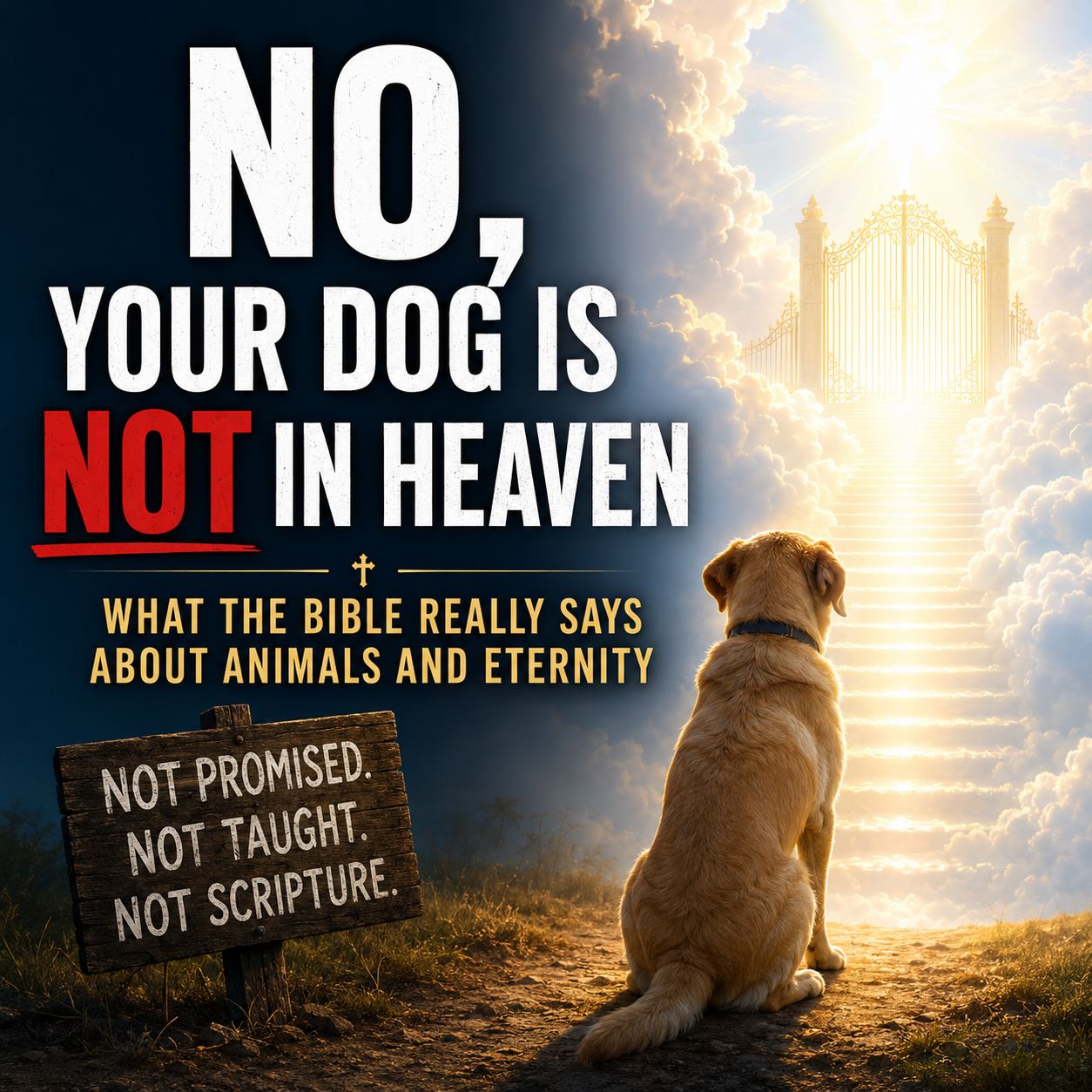
The problem is that modern Christianity increasingly substitutes emotional feelings for biblical doctrine. Rather than asking what God has revealed, many ask what would make them feel better. The result is a theology shaped by greeting cards, children’s movies, and sentimental Facebook memes featuring golden retrievers with angel wings. The question before us is: does the Bible teach that your individual dog, cat, hamster, goldfish, or emotionally fragile rescue llama will spend eternity with you in Heaven? The answer, despite popular opinion, is no.
I. The Bible Never Promises Eternal Life to Animals
The strongest argument against the popular belief that pets go to Heaven is also the simplest: Scripture never says they do. Throughout the entirety of the biblical record (from Genesis to Revelation) God speaks of eternal life, resurrection, salvation, judgment, redemption, glorification, and the destiny of mankind. Animals are discussed frequently, but never in the context of receiving eternal life as individuals.
The Bible consistently distinguishes man from beast. Genesis 1:26-27 declares that humanity was created in the image of God. No animal shares this distinction. No dog, regardless of loyalty, reflects the divine image in the way a human being does. No horse, however noble, bears moral responsibility before God. No cat, despite its obvious belief in its own divinity, was created as God’s covenant representative on earth.
Ecclesiastes 3:19-21 appears in many discussions about animal souls. Solomon writes that man and beast both die and return to dust. He then asks who knows whether the spirit of man goes upward and the spirit of the beast goes down into the earth. This passage is not teaching animal immortality. Rather, Solomon is emphasizing the limitations of human observation under the sun. Externally, both men and animals die. Elsewhere Scripture clarifies the distinction. Hebrews 9:27 declares that man is appointed once to die and then face judgment. Animals never face judgment because animals are not moral agents.
The New Testament consistently connects eternal life to redemption through Christ. John 3:16 speaks of believing humans receiving everlasting life. Romans 8 discusses the redemption of God’s children. First Corinthians 15 details the resurrection of believers. The subjects are always people, not once are animals included among the “redeemed.”
Historically, this understanding was universal among Christian theologians. Augustine, Thomas Aquinas, John Calvin, Martin Luther, Charles Hodge, and countless others rejected the notion that animals possess immortal souls equivalent to humans. While they differed on many theological matters, they all agreed here.
Modern assumptions about pets in Heaven owe far more to sentimentality than Scripture. The doctrine emerged from emotional attachment (More on that in section IV). Unfortunately, many Christians have become so accustomed to hearing something repeated that they mistake repetition for revelation. The Bible never promises eternal life to your Labrador, your Persian cat, or your emotional-support iguana.
II. Animals Are Living Creatures, But They Are Not Human Souls
A common source of confusion seems to stem from the biblical word translated as “soul.” Many assume that because animals are called living creatures, they therefore possess immortal souls identical to human beings. But this misunderstanding does not hold up under even basic examination of Scripture.
The Hebrew word nephesh is often translated as soul, living being, or creature. Genesis 1 uses the term repeatedly to describe animals. Genesis 2 uses it for mankind as well. The word does not automatically imply immortality, it simply refers to a living creature. A fish can be a nephesh, a bird can be a nephesh, and a man can be a nephesh. Context determines the meaning.
Human beings possess qualities animals do not. Humanity bears God’s image. Humanity exercises moral reasoning. Humanity enters covenant relationship with God. Humanity is accountable for sin. Humanity stands before divine judgment. Animals do none of these things. You may think your dog feels guilty after destroying the couch, but that is not conviction of sin. It is recognition that consequences are approaching.
The distinction becomes even clearer throughout Scripture. God makes covenants with people. Christ dies for people. Angels minister to people. The Gospel is preached to people. Resurrection is promised to people. The final judgment concerns people. The entire redemptive narrative revolves around humanity’s relationship with God.
Philosophically, this distinction was recognized throughout history. Aristotle distinguished rational souls from animal life. Aquinas argued that animals possess life and sensation but lack the rational, immortal soul unique to man. Jewish scholars likewise recognized humanity’s unique status as image bearers.
Scientific observations reinforce rather than undermine this distinction. Animals demonstrate remarkable instincts, emotions, and even minimal forms of intelligence. Dogs can recognize hundreds of words. Crows solve puzzles. Dolphins exhibit sophisticated social behaviors. But none display moral accountability, religious worship, abstract theological reasoning, or covenant consciousness. Intelligence is not the same thing as personhood.
The modern tendency to anthropomorphize pets has only deepened the confusion. Many owners increasingly treat animals as surrogate children, assigning them human motives, emotions, and even spiritual capacities. Pet expenditures in the United States now exceed hundreds of billions of dollars annually, reflecting a cultural shift that often elevates animals to near-human status, but this affection does not erase ontological distinctions.
The Bible celebrates animals as part of God’s creation. It commands kindness toward them. It recognizes their value and purpose. But Scripture never blurs the line between beast and man. God created both, loves both within their proper place, and assigns each a different role within creation. Confusing those roles produces bad theology, no matter how adorable the puppy pictures may be.
III. What About the Animals Mentioned in the New Creation?
At this point someone usually raises an objection: “But there are animals in Heaven!” The statement is partially true and entirely irrelevant to the claim that individual pets receive eternal life. Scripture does indeed indicate the presence of animals within God’s restored creation. The issue is whether those animals are resurrected household pets. That is an entirely different question.
Isaiah’s prophecies concerning the Messianic kingdom describe wolves dwelling with lambs, lions eating straw like oxen, and harmony among creatures previously marked by predation. Isaiah 11 and Isaiah 65 present a restored order in which creation experiences peace. These passages demonstrate that animals have a place within God’s renewed world.
Romans 8:19-22 expands this concept. Paul teaches that creation groans under the curse and awaits liberation. The fall affected the entire created order. Disease, decay, predation, and death entered the world through sin’s consequences. Paul’s language suggests a future restoration that extends beyond mankind.
Revelation also includes imagery involving horses and creatures participating within heavenly scenes. Christ returns mounted upon a white horse in Revelation 19. Clearly, animals exist within biblical visions of the future.
However, none of these passages identify individual pets receiving resurrection.God restoring animal life does not mean He is restoring every specific animal that ever lived. One does not automatically lead to the other.
Consider an analogy. Scripture teaches that trees exist in the New Creation. Yet no one assumes the oak tree removed from their backyard in 1848 will be resurrected and waiting beside the River of Life. The existence of a category does not imply the restoration of every individual thing of that category.
Most theologians acknowledge the possibility that God may create animals in the New Earth. Some even suggest He may choose to recreate particular animals according to His pleasure. God can certainly do whatever He wishes. But Scripture reveals no promise concerning the resurrection of specific pets.
The distinction between possibility and doctrine matters enormously. Christians should never build theology upon speculation or emotion. We build theology upon revelation. God has revealed the resurrection of believers. He has revealed the restoration of creation. He has revealed the return of Christ. He has NOT revealed the eternal destiny of your childhood beagle named Sparky.
Many people desperately want certainty where God has provided none. Unfortunately, wishful thinking is not a recognized hermeneutical method. Biblical doctrine requires more than hopeful imagination and a framed photograph of Mr. Whiskers.
IV. The Fur-Baby Religion: When Pets Replace the Children We Refused to Have
To understand why so many modern people are emotionally invested in the idea that pets must be waiting in Heaven, one must first understand a much larger cultural transformation. The question is demographic, sociological, and psychological. The modern West has experienced one of the most dramatic collapses in fertility ever recorded. Nearly every developed nation now faces birth rates significantly below replacement level. Marriage rates have fallen. The average age of first marriage has risen. Millions delay or reject parenthood altogether. Yet pet ownership exploded.
For most of human history, people loved animals without confusing them with children. Farmers named horses, shepherds cared for sheep, hunters valued their dogs, and families mourned beloved animals when they died. But nobody threw birthday parties for goats, pushed terriers in strollers through shopping malls, purchased matching pajamas for cats, or referred to a pug as their “fur son.” Society understood the distinction between an animal and a child. One was a companion. The other was an heir.
Today that distinction is increasingly blurred. Terms such as “dog mom,” “cat mom,” “pet parent,” and “fur baby” have become commonplace. Entire industries now exist around the humanization of animals. Pet birthday cakes, pet daycare centers, pet insurance policies, pet psychiatrists, pet inheritance trusts, luxury pet hotels, and even pet custody battles have become normalized. Americans now spend hundreds of billions of dollars annually on pets, often treating them as substitute family members.
What changed? The answer is painfully obvious. Human beings were designed for family. Men were designed to build households. Women were designed with powerful nurturing instincts directed toward husbands, children, grandchildren, and community. Those instincts do not simply disappear because modern culture declares motherhood optional. They remain, and they seek an outlet. And when a society systematically discourages marriage, delays childbearing, celebrates childlessness, and treats fertility as an inconvenience, those instincts are redirected elsewhere. Increasingly, they are redirected toward pets.
This reality explains why discussions about pets in Heaven generate such intense emotional reactions. A person who views a dog as a dog may grieve its death. A person who views a dog as a child experiences the loss a parent feels because the relationship has become parental. Once that emotional substitution occurs, the desire for eternal reunion becomes overwhelming. Suddenly, the question is no longer, “What does Scripture teach?” but, “How could God possibly separate me from my baby?”
A golden retriever is a wonderful animal. He may be loyal, affectionate, protective, and deeply loved. But he cannot inherit your family legacy. He cannot carry your name into the next generation. He cannot produce grandchildren. He cannot fulfill God’s command to be fruitful and multiply. He cannot become the future of your household. He is a dog!
Likewise, a cat may provide companionship, comfort, and affection. But she cannot replace a husband, a family, or a house full of children. She was never designed to do so. The growing tendency to treat animals as substitutes for human relationships reflects deep confusion about God’s created order.
The irony is difficult to ignore. Previous generations pushed strollers containing babies. Modern society increasingly pushes strollers containing French bulldogs wearing sweaters. Only one of those choices builds civilizations.
This cultural substitution also helps explain why pet-heaven theology has become so popular. People are not searching the Scriptures and discovering hidden doctrines about canine immortality. They are beginning with emotional attachment and then searching for theological justification. The conclusion is reached before the investigation begins.
For many, the doctrine serves a psychological purpose. It protects a surrogate parent-child bond from the finality of death and offers comfort in a culture increasingly disconnected from the very institutions God created to provide meaning, legacy, and continuity. In other words, the obsession with pets in Heaven reveals less about the afterlife and more about the loneliness, childlessness, and family degradation of modern society.
The Bible never condemns caring about animals. Scripture commands kindness toward them. What it does condemn is idolatry, taking something good and elevating it into a place it was never intended to occupy. When pets become replacements for children, substitutes for families, and foundations for theology, they have ceased being companions and have been elevated to Idols.
And once a dog becomes a child in the mind of its owner, it becomes impossible to convince that owner that the Bible does not promise its resurrection. Because the emotional investment is enormous. The doctrine survives not through exegesis, but through attachment, and is driven by replacement.
V. What Christians Should Actually Hope For
If Christians should not place their hope in seeing their pets again, where should their hope rest? Scripture provides the answer.
The central promise of Christianity is reconciliation with God. The great hope of the believer is not that Fluffy waits beyond the gates of Heaven, but that Christ has conquered sin and death. The Gospel centers on the resurrection of Jesus, the forgiveness of sins, the redemption of God’s people, and the establishment of His eternal kingdom.
First Corinthians 2:9 declares that no eye has seen, nor ear heard, nor heart imagined what God has prepared for those who love Him. Revelation describes a future without death, mourning, crying, or pain. God’s people will dwell in His presence forever. Every legitimate longing will be fulfilled in ways beyond present comprehension.
This truth also addresses the fear underlying much pet-related grief. Many people assume Heaven would somehow be incomplete without their favorite animal. This assumption unintentionally reveals a diminished view of God. If the fullness of joy exists in God’s presence, then nothing essential will be lacking. Psalm 16:11 says that in His presence is fullness of joy and pleasures forevermore.
That does not mean short-term grief over a pet is wrong. Scripture acknowledges sorrow. Animals are gifts from God, their loss should hurt because they brought genuine blessing. Mourning that loss is natural and appropriate.
What Christians should avoid is elevating personal wishes to the level of doctrine. If God chooses to populate the New Creation with animals, wonderful. If He chooses to recreate specific animals according to His sovereign pleasure, wonderful. If He does neither, His goodness remains unchanged.
The irony is that believers who obsess over finding their dog in eternity often overlook the infinitely greater reality awaiting them. The Creator of galaxies, the Savior who conquered death, the King of Kings who purchased redemption with His own blood, that is the One Christians are promised they will see. Compared to that glory, even the best golden retriever ever wagged its tail in the shadow of something far greater.
Conclusion
The Bible presents animals as valuable, purposeful, and worthy of proper care. They are part of God’s good creation, beneficiaries of His providence, and participants in the broader restoration of the created order. Scripture never grants them the status of image bearers, never promises them individual resurrection, and never teaches that beloved household pets await believers in Heaven. The doctrine simply is not there and only survives because people want it to be true.
Christians must resist the temptation to build theology upon sentiment. God’s Word alone determines truth. Your dog may have been loyal, your cat may have been lovable, and your horse may have been magnificent. But none of those realities create biblical promises God never made. The good news is that believers are offered eternal life with Christ. And if standing face to face with the risen King somehow leaves a person disappointed because their schnauzer is missing, the problem is not with Heaven. The problem is that they never properly understood its glory in the first place.
where do you get off condemning other peoples dogs to hell!
oh this is a lead balloon