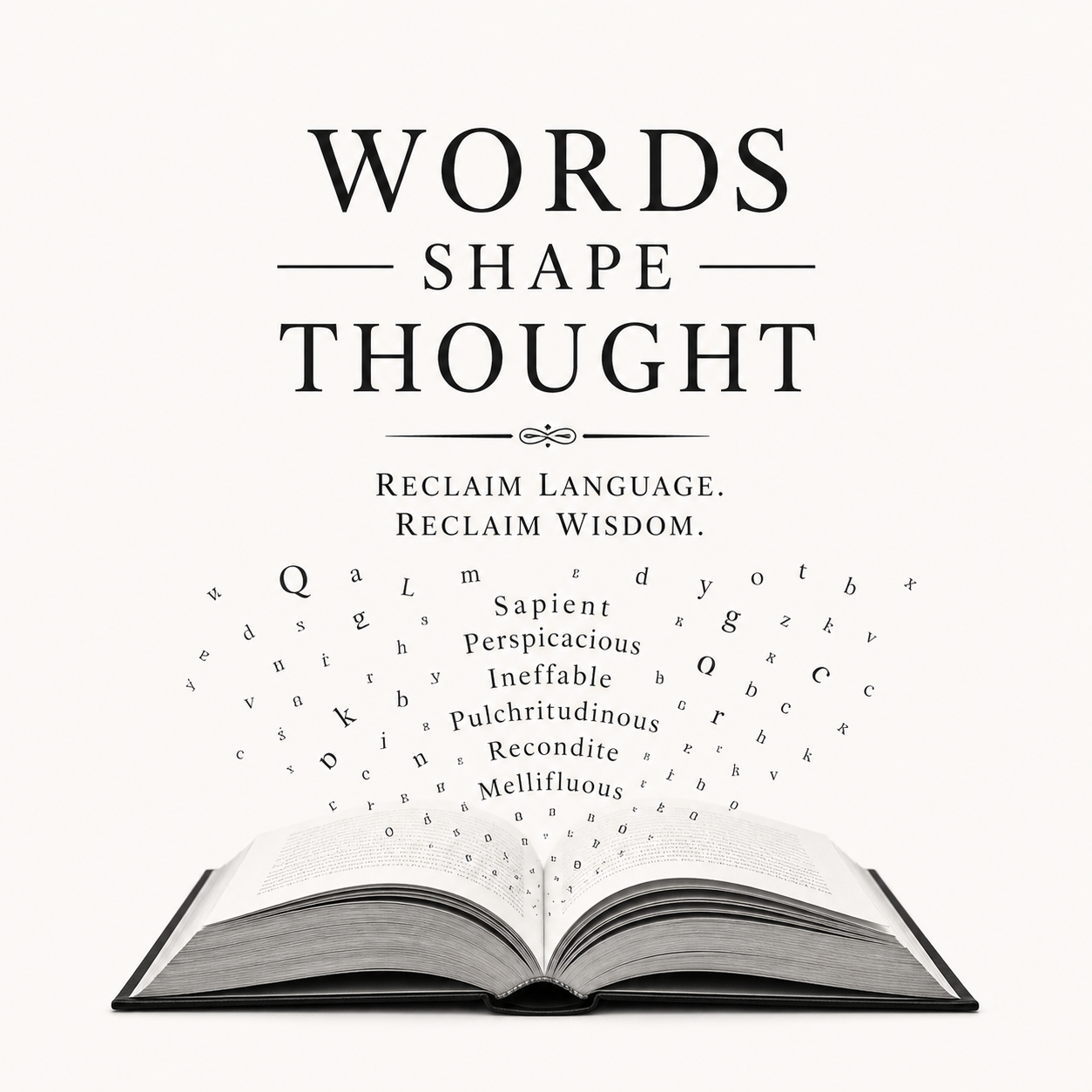
Prologue: The Diminishing Vocabulary of Man
In a previous essay, The Death of Conversation, I lamented the gradual extinction of meaningful discourse in the modern age. The thesis was simple: a civilization that loses its capacity for sustained conversation will lose the principal mechanisms by which wisdom, culture, and truth are transmitted from one generation to the next. Upon further reflection, I have come to suspect that the death of conversation is not the disease, but merely one of its more conspicuous symptoms. After all, before men cease speaking well, they cease thinking well; and before they cease thinking well, they cease possessing the linguistic apparatus necessary for sophisticated thought. One cannot communicate profundity with a vocabulary composed chiefly of grunts, abbreviations, emojis, and cultural slang.
This brings us to a related, though perhaps even more alarming phenomenon: the Great Lexical Impoverishment. The English language (once a vast and magnificent treasury of Anglo-Saxon vigor, Norman refinement, Latin precision, and Greek intellectuality) is undergoing a slow but undeniable contraction in common usage. Words once employed by ordinary educated men and women are now regarded as ostentatious curiosities, relics fit only for academics, antiquarians, and insufferable know-it-alls. The modern speaker is increasingly encouraged to exchange eloquence for simplicity, precision for accessibility, and intellectual aspiration for linguistic minimalism. Indeed, we have arrived at the peculiar historical moment in which a man may spend twelve years in public education, possess unlimited access to the accumulated knowledge of civilization through a device in his pocket, and yet regard a four-syllable word as an act of aggression.
The irony is almost too delicious to ignore. Never before has mankind possessed greater access to books, dictionaries, libraries, universities, lectures, and educational resources. The average peasant of the fourteenth century would have regarded the modern smartphone as a repository of near-omniscience. Despite these unprecedented advantages, studies consistently show that reading habits are declining, attention spans are shrinking, and vocabulary acquisition is stagnating nearly all of the population. The National Endowment for the Arts has documented decades of decline in literary reading among adults, while numerous educational assessments have noted troubling deficiencies in reading comprehension and advanced literacy. We inhabit an age of informational abundance and intellectual malnutrition simultaneously, a feat so paradoxical that future historians may struggle to determine whether it was tragic, comedic, or both.
This lexical diminution is not just an aesthetic concern for grammarians and word enthusiasts who derive unreasonable pleasure from terms such as perspicacious, ineffable, recondite, or sesquipedalian. Words are not ornamental baubles affixed to thought after the fact. They are the primary instruments through which thought is formed, organized, refined, and communicated. As the philosopher Ludwig Wittgenstein observed, “The limits of my language mean the limits of my world.” A man equipped with a rich vocabulary possesses a greater capacity for distinction, nuance, and conceptual precision than one confined to a meager lexicon. To lose words is not merely to lose sounds, but to lose categories, distinctions, and ways of perceiving reality.
Nor should Christians regard this matter as trivial. Scripture places extraordinary emphasis upon language. God creates through speech. Adam exercises dominion by naming creation. Wisdom and folly are repeatedly distinguished by their words throughout Proverbs. Most strikingly, the Gospel of John opens not with language: “In the beginning was the Word, and the Word was with God, and the Word was God” (John 1:1). Language is foundational to civilization. Consequently, a civilization that habitually abandons precision, depth, and eloquence in favor of verbal simplicity should not be surprised when its reasoning becomes equally simplistic.
Thus, this essay is not simply a defense of large words, nor an exercise in sesquipedalian exhibitionism for its own sake. Rather, it is an examination of what is lost when a people gradually abandon linguistic ambition. For beneath the cumbersome yet delightfully appropriate title lies a serious contention: that the floccinaucinihilipilification (the estimation of something as worthless) of English vocabulary has contributed to a broader cultural tendency to regard intellectual rigor as unnecessary. And when a society treats precision of language as pretension, it will discover too late that precision of thought will follow it into oblivion.
I. The Cathedral of Words and the Barbarians at the Gate
The English language did not emerge fully formed from the brow of some literary deity. The greatest, most expressive and complex system of communication ever developed was forged across centuries through conquest, commerce, theology, philosophy, scholarship, and no small measure of civilizational tumult. Old English contributed its sturdy and practical foundation; Norman French supplied refinement and sophistication; Latin bestowed precision and technicality; Greek furnished the language of philosophy, science, and theology. The result was a linguistic cathedral, a sprawling edifice of astonishing depth and complexity wherein a man might find a word for nearly every conceivable shade of thought, emotion, object, virtue, vice, or circumstance.
Consider the lexical inheritance bequeathed to us by previous generations. The translators of the King James Bible, working in the early seventeenth century, employed a vocabulary that modern publishing houses would likely deem too difficult for contemporary audiences. Shakespeare casually utilized thousands of unique words, many of which remain recognizable centuries later. Statesmen, theologians, merchants, and craftsmen alike possessed vocabularies that would surprise most contemporary university graduates. One need only peruse personal correspondence from the eighteenth or nineteenth centuries to discover ordinary citizens employing terms such as vicissitude, amelioration, magnanimity, obduracy, and circumspection without apology or explanation.
The evidence of this linguistic richness is not anecdotal. Historical analyses of literature reveal that earlier generations routinely encountered a broader range of vocabulary through sermons, newspapers, books, public lectures, and formal education. Even elementary readers from the nineteenth century exposed children to words that today might provoke demands for simplification. Noah Webster, whose name became synonymous with American lexicography, believed that education should elevate the student to the language rather than degrade the language to the student. Such an assumption now appears almost quaint, if not outright revolutionary.
What distinguished these generations was not intelligence, but aspiration. They expected language to stretch the mind. A difficult word was viewed as an invitation to learn rather than an affront to one’s dignity. The encounter with an unfamiliar term often prompted inquiry, reflection, and growth. Today, however, many regard lexical complexity with suspicion. Words that once conveyed learning now risk accusations of elitism. A man may be praised for ignorance so long as it is confidently expressed, while the individual who employs a precise or uncommon term is often treated as though he has committed an act of social aggression.
This represents a profound inversion of historical norms. For centuries, vocabulary functioned as a ladder by which individuals ascended toward greater knowledge. Increasingly, however, modern culture is determined to shorten the ladder lest someone be inconvenienced by the climb. The result is diminished aspiration. We have inherited a linguistic cathedral and, through a peculiar mixture of indolence and egalitarian sentimentality, have begun converting it into a storage shed. The stones remain. The architecture still stands. But fewer and fewer people venture inside, and fewer still appreciate the grandeur that surrounds them.
II. The Cult of Simplification and The Tyranny of Accessibility
One curious development of the modern age is the widespread assumption that every form of simplification constitutes progress. We are told that language must be streamlined, shortened, condensed, optimized, modernized, and rendered perpetually accessible to the broadest (and dumbest) possible audience. The stated intention is usually noble enough. Communication ought not be needlessly obfuscatory. A writer should strive for clarity over verbosity. Yet somewhere along the path from clarity to accessibility, civilization took a wrong turn and wandered headlong into the swamp of intellectual mediocrity on an inevitable path to idiocracy.
While clarity seeks to illuminate truth, simplification often seeks to eliminate difficulty. These are not identical pursuits. A competent teacher explains a complex concept in a manner that can be understood. A poor teacher simply removes the complexity. The former produces wisdom; the latter produces ignorance adorned with confidence. Modern communication has embraced the latter approach. Newspapers that once assumed a literate readership now target progressively lower reading skill levels. Educational materials are frequently rewritten to accommodate shrinking vocabularies. Public discourse increasingly favors slogans, feelings and assertions over evidence and eloquence.
The consequences are visible everywhere. Political rhetoric has become increasingly reductive. Corporate communication has been distilled into vacuous platitudes. Advertising agencies, social media consultants, and marketing professionals labor tirelessly to transform every conceivable message into a sequence of digestible fragments capable of being consumed by individuals whose attention span rivals that of an over-caffeinated squirrel. We are surrounded by language engineered to accommodate its lowest common denominator. The result is a peculiar cultural feedback loop: as vocabulary declines, communicators simplify their language; as language is simplified, vocabulary declines further and the cycle continues ad nauseam.
This phenomenon might appropriately be called the democratization of ignorance. Previous generations sought to democratize education by expanding access to knowledge. Modern society appears content to democratize ignorance by lowering intellectual expectations. The distinction is subtle but significant. The goal is to bring the summit for everyone down to the lowest denominator student. Unfortunately, mountains cease being mountains when enough of their elevation is removed.
One need not search far for examples. Universities increasingly report students arriving with diminished reading endurance and reduced familiarity in advanced vocabulary. Professors routinely assign shorter readings, simpler texts, and less demanding material than their predecessors. Even among educated adults, there exists a growing reluctance to engage with language that requires effort. Encountering an unfamiliar word no longer inspires curiosity but irritation. The immediate response is not, “What does this mean?” but rather, “Why didn’t you use an easier word?” Such a reaction would have perplexed our forebears to the point of exasperation. To them, the discovery of a new word represented an expansion of one’s intellectual armory. To modern readers, it is perceived as an inconvenience too burdensome to bear.
The irony, of course, is delicious. We live in an age where every dictionary in human history can be accessed within seconds. Never has it been easier to learn a word. Never has the cost of ignorance been lower. Yet never have so many people insisted upon remaining comfortably uninformed. The problem, therefore, is a lack of aspiration. The modern war against big words is not truly a war against vocabulary, but effort. And like most wars against effort, it is being won with alarming efficiency.
III. The Necessity of Sesquipedalianism
A persistent absurdity of modern discourse is the belief that large words exist to make simple ideas sound complicated. According to this popular fiction, the individual who employs terms such as perspicacious, ineluctable, circumlocution, or magniloquent is engaged in some form of linguistic peacocking, strutting about the verbal barnyard in search of admiration. Certainly, there are occasions when a man may indulge in needless verbosity. Every profession possesses its charlatans, and every dictionary has its show-offs. But to dismiss uncommon words as ornamental affectations is to fundamentally misunderstand why language develops in the first place. Words exist because distinctions exist.
A civilization does not create additional vocabulary out of boredom. Vocabulary is created because reality proves more intricate than the existing lexicon can adequately describe. Consider the emotional spectrum. A child may know only the word angry. While a mature speaker, however, recognizes substantial differences between irritation, annoyance, vexation, indignation, resentment, exasperation, wrath, and apoplexy. Each describes a distinct state of mind. To condense them all into the word angry is rather like insisting that every shade of color be called blue. Communication remains possible, but precision greatly suffers.
Likewise, there is a meaningful distinction between a person who is intelligent, one who is knowledgeable, one who is wise, one who is shrewd, one who is astute, one who is sagacious, and one who is perspicacious. These terms overlap, yet they are not interchangeable. A knowledgeable fool remains a fool. A shrewd villain may lack wisdom. A perspicacious observer may discern truths that escape a merely intelligent man. The existence of these distinctions allows thought, and thereby expression to become more refined. Vocabulary is the principal mechanism by which ideas are formed.
This principle is easily observed by linguists, psychologists, and educators. Research consistently demonstrates correlations between vocabulary breadth, reading comprehension, academic achievement, and critical thinking ability. Individuals possessing larger vocabularies process complex information more effectively because they possess a greater number of conceptual categories through which information can be organized and understood. Language functions as a cognitive infrastructure. A man who possesses only a handful of conceptual tools can perform only a limited range of intellectual tasks.
The philosopher and statesman Francis Bacon observed that “reading maketh a full man; conference a ready man; and writing an exact man.” Implicit within this observation is the understanding that words are instruments of precision. A craftsman does not carry twenty different tools because he wishes to impress passersby. He carries them because different tasks require different instruments. No sane carpenter attempts to build a house using only a hammer and screwdriver. However our modern society increasingly expects language to accomplish every intellectual task with a remarkably limited verbal toolkit.
The matter is even clearer when one examines the language of theology, philosophy, and law. Terms such as propitiation, sanctification, jurisprudence, teleology, ontology, and epistemology emerged because entire realms of thought required vocabulary capable of expressing subtle distinctions. If you remove or condense this expressive terminology the distinctions become difficult (or impossible) to articulate.
Scripture reflects this reality. The Book of Proverbs contrasts wisdom with folly, prudence with simplicity, and understanding with ignorance. “The heart of the prudent getteth knowledge; and the ear of the wise seeketh knowledge” (Proverbs 18:15). Knowledge requires categories, categories require language, and language requires vocabulary. Consequently, the man who voluntarily limits his vocabulary limits his capacity for understanding.
Big words, then, are not the enemy of communication. More often, they are the servants of precision. They exist because reality is complicated, because truth possesses nuances, and because the human mind requires linguistic tools capable of navigating the realm in which we exist and hope to understand. To reject them wholesale is an act of intellectual self-impoverishment. One might as well discard half the instruments from a surgeon’s tray and then boast of one’s commitment to simplicity.
IV. The Digital Babel and the Triumph of Verbal Gruel
Previous generations gradually diminished their vocabularies through educational neglect and cultural simplification, the digital age has accelerated the process with all the subtlety of a battering ram. Never before in human history have so many people communicated so frequently while saying so little. We inhabit a civilization perpetually engaged in conversation, yet increasingly incapable of sustained expression. Millions of messages are transmitted every minute, billions every day, and an alarming percentage of them could be adequately summarized by a medieval monk as, “The villagers continue making noises.”
The architecture of modern communication bears much of the blame. Social media platforms reward brevity, speed and emotional impact over depth, reflection, and intellectual rigor. The algorithms governing digital discourse do not ask whether a statement is thoughtful, nuanced, or accurate. They simply ask whether it is engaging. Consequently, the modern communicator is incentivized to be provocative, reactionary, and concise rather than comprehensive. The result is a linguistic environment in which vocabulary is treated as an obstacle rather than an asset.
We need only observe the evolution of online communication. Entire phrases have been reduced to acronyms. Complete thoughts have been condensed into hashtags. Complex emotions are increasingly represented by tiny yellow pictographs whose expressive range would be the envy of ancient cave painters. A civilization capable of producing Shakespeare, Milton, and the translators of the King James Bible now frequently communicates through combinations of abbreviations, animated images, and symbols depicting laughing faces, crying faces, and vegetables. Forgive me if I hesitate to call this progress.
The irony is particularly striking because the internet possesses the potential to be the greatest educational instrument ever devised. For the first time in human history, any individual can access ancient manuscripts, scholarly journals, dictionaries, lectures, and entire libraries from virtually anywhere on earth. A word that once required a trip to a university library can now be defined in seconds. A curious mind has never enjoyed greater opportunities for intellectual expansion. However, the same technology that grants access to the accumulated wisdom of civilization also inundates the user with an endless torrent of distractions specifically engineered to prevent sustained concentration and production.
Recent studies on digital media consumption have shown constant exposure to fragmented information encourages skimming rather than deep reading. Individuals increasingly consume information in short bursts rather than extended periods of contemplation. Long-form reading has declined below single digit percentages. Attention spans have contracted more than 3700% in the last five generations. Vocabulary acquisition has slowed to a trickle. Our brains have adapted to the environment in which we operate, and an environment dominated by snippets, headlines, captions, and notifications will naturally cultivate habits of superficial engagement. It is impossible to acquire a sophisticated vocabulary when one’s reading consists primarily of comments sections and arguments conducted entirely through memes, emoji’s and slang.
Perhaps more troubling is the emergence of what might be termed linguistic minimalism as a cultural virtue. Brevity has always possessed value when employed judiciously. The problem arises when brevity becomes the highest good. Not every idea can be compressed into a slogan, not every truth fits in a caption, and not every argument survives reduction to a soundbite. Our modern communication increasingly demands precisely these reductions. Complexity is viewed with suspicion, nuance is treated as weakness, and qualification is mistaken for uncertainty. The result has created a public discourse nourished upon verbal gruel – easily consumed, rapidly digested, and almost entirely devoid of intellectual nutrition.
A society that communicates through fragments will think in fragments. A society that abandons difficult reading will abandon difficult thinking. And a society that ceases striving for linguistic excellence will be a society where intellectual intelligence becomes increasingly rare. For language is not merely the vessel that carries thought; it is the forge in which thought is shaped.
V.The Logos, the Lexicon, and the Loss of Civilization
At this juncture, the reader may be tempted to dismiss the foregoing discussion as little more than the lamentations of grammarians, bibliophiles, and incurable word enthusiasts mourning the disappearance of their favorite sesquipedalian curiosities. Surely civilization faces graver concerns than the decline of words such as perspicacity, munificence, concupiscence, or circumspection. Yet such a conclusion mistakes the symptom for the disease. Vocabulary is the principal mechanism through which knowledge, wisdom, law, theology, history, and civilization are preserved and transmitted. When language deteriorates, the consequences will extend far beyond the dictionary.
The biblical witness repeatedly affirms the profound significance of language. The opening chapter of Genesis depicts a God who creates the world and everything on it through speech. The universe literally emerges from divine utterance. Shortly thereafter, Adam is entrusted with the task of naming the creatures, an act that signifies both understanding and stewardship. Throughout Scripture, words are treated with an unparalleled level of importance. Proverbs contains hundreds of admonitions regarding speech, wisdom, understanding, instruction, and knowledge. “Death and life are in the power of the tongue” (Proverbs 18:21). Such language presupposes that words possess consequence, substance, and authority.
More strikingly, the Apostle John opens his Gospel with a declaration of staggering theological profundity: “In the beginning was the Word, and the Word was with God, and the Word was God” (John 1:1). The Greek term employed is Logos, a word carrying layers of meaning that encompass reason, order, discourse, wisdom, and divine self-expression. Entire libraries have been written exploring the implications of that single term. If a society gradually loses the vocabulary necessary to understand complex concepts, it also loses the ability to engage deeply with theological truths. The impoverishment of language will inevitably contribute to the impoverishment of doctrine.
This reality extends far beyond theology. Law depends upon precise definitions. Philosophy depends upon conceptual distinctions. Science depends upon technical terminology. History depends upon accurate description. Commerce depends upon carefully negotiated language. Every sophisticated human endeavor and behaviour rests upon the assumption that words possess stable meanings capable of conveying nuanced ideas. If you remove enough vocabulary those distinctions will collapse. Ambiguity will replace precision, emotion will supplant reason, and slogans will replace arguments. In such an environment, manipulation thrives.
Indeed, there exists a deeply political dimension to lexical decline. A populace incapable of understanding complex language is far easier to govern through simplistic narratives. The individual who lacks vocabulary also lacks the conceptual categories necessary to identify deception, contradiction, equivocation, or sophistry. He may sense that something is wrong but he will struggle to articulate precisely why. By contrast, the person possessing a rich and disciplined vocabulary will enjoy a greater capacity for analysis, discernment, and resistance to rhetorical manipulation. Tyrants have seldom feared an illiterate mob, but they have always feared educated readers.
The civilizational consequences are therefore profound. A culture that ceases reading demanding books will lose the ability to produce demanding books. A people that abandons eloquence will cease to recognize eloquence when they encounter it. A generation raised upon verbal minimalism will find the writings of previous centuries increasingly inaccessible. The result is a form of cultural amnesia. The wisdom of ancestors remains physically available and becomes practically unreachable because the linguistic bridge connecting past and present has been purposefully demolished.
For this reason, the decline of vocabulary should concern anyone interested in preserving civilization, faith, and culture. Words are repositories of accumulated human understanding. They are vessels carrying ideas across centuries and generations. They are instruments by which truth is discerned, wisdom is communicated, and reality is apprehended. To treat them as expendable is an act of astonishing shortsightedness.
Civilizations rarely collapse in a single cataclysmic moment. More often they deteriorate through countless small abdications of responsibility. The abandonment of difficult words may appear inconsequential when viewed in isolation, but when a people consistently choose convenience over precision, simplification over understanding, and intellectual ease over intellectual growth, the cumulative effect will be substantial. Lexical impoverishment is a civilizational issue of paramount importance. For when a culture loses its words, it will lose far more than its vocabulary.
Conclusion: The Last Custodians of the Lexicon
The decline of sophisticated vocabulary is not, in itself, the greatest crisis confronting modern civilization. Nations have endured wars, plagues, famines, invasions, and revolutions without losing their identity. However, language occupies a unique position among the pillars of culture, for it serves as the medium through which every other pillar is maintained. Laws are written in words, Scripture is preserved in words, philosophy, science, history, commerce, and education are all transmitted through words. Consequently, when a society neglects its language it is quietly undermining the foundation upon which civilization rests.
The tragedy is not that fewer people know the meaning of floccinaucinihilipilification, delightful though that word may be. The tragedy is that many no longer see any value in knowing it, or in learning any unfamiliar word at all. Curiosity and aspiration have been replaced by convenience and accommodation. We have reached the peculiar point in history where a man may spend decades mastering the intricacies of video games, memorizing sports statistics, or debating the minutiae of popular entertainment, yet regard the acquisition of new vocabulary as an unreasonable burden. Such priorities reveal a fundamental cultural failure and profound spiritual inadequacy.
The remedy, fortunately, is neither complicated nor inaccessible. Read old books. Read difficult books. Read books that force you to keep a dictionary nearby. Read the King James Bible. Read Shakespeare. Read Milton, Burke, Chesterton, Webster, and the countless forgotten authors whose works once formed the backbone of an educated society. When an unfamiliar word appears, wrestle with it, learn it, and use it. Language grows through exercise just as muscles grow through labor. A vocabulary, like a garden, flourishes only when cultivated.
Parents should challenge their children with language rather than perpetually simplifying it. Teachers should elevate students toward knowledge rather than dragging knowledge downward toward ignorance. Writers should strive for clarity without surrendering precision. Readers should recover the habit of intellectual exertion. Most importantly, we must reject the pernicious notion that complexity is inherently elitist or that understanding difficult words is somehow pretentious. There is nothing arrogant about learning, there is nothing oppressive about precision, and there is certainly nothing noble about remaining intellectually stagnant.
The English language remains the most magnificent linguistic achievement in human history. Its vaults are filled with treasures accumulated over centuries, words of astonishing beauty, precision, utility, and power. If we continue treating our lexical inheritance as an inconvenience, future generations will inherit only fragments of what once existed. The cathedral will still stand, but its halls will be empty, its libraries neglected, and its grandeur forgotten to time.
A civilization will not become wiser by shortening its vocabulary any more than a carpenter will become more skilled by discarding half his tools. The man who knows ten thousand words can perceive distinctions unavailable to the man who knows one thousand. He can articulate truths with greater precision, identify errors with greater clarity, and engage reality with greater depth. Words are the instruments of thought, tools of dominion, and repositories of culture.
And so the question before us is whether we shall be faithful stewards of the extraordinary linguistic inheritance entrusted to us, or sheep continuing down the path of simplification, abbreviation, and intellectual indolence until our discourse consists chiefly of slogans, emojis, and verbal grunts. THe time is now to recover the lost virtues of curiosity, eloquence, precision, and learning.
For the death of conversation is merely the beginning. The floccinaucinihilipilification of English threatens something far greater: the gradual abandonment of the very language by which civilization remembers, reasons, and endures.
nobody can read this, it aint even english
This is an exquisitely perspicacious exposition of the accelerating lexical atrophy afflicting contemporary discourse. The ubiquitous predilection for linguistic minimalism has precipitated an epistemological impoverishment wherein semantic precision is unceremoniously sacrificed upon the altar of convenience and anti-intellectualism. When one’s vocabulary is circumscribed, one’s capacity for nuanced cognition becomes concomitantly circumscribed, rendering sophisticated contemplation increasingly anachronistic.
The article’s repudiation of this inexorable trend is both commendable and indispensable. Those who deride words like floccinaucinihilipilification, sesquipedalian, or antidisestablishmentarianism as ostentatious merely advertise their own philological incuriosity. A robust lexicon is an instrument of conceptual exactitude. To relinquish linguistic richness is to embrace intellectual mediocrity with unwarranted enthusiasm. Magnificent article, may it catalyze a renaissance of eloquence amidst this regrettably monosyllabic age.
While I had to look up a lot of these words even though I’m 2 classes away from a bachelor’s degree 🤦♀️🤷♀️.