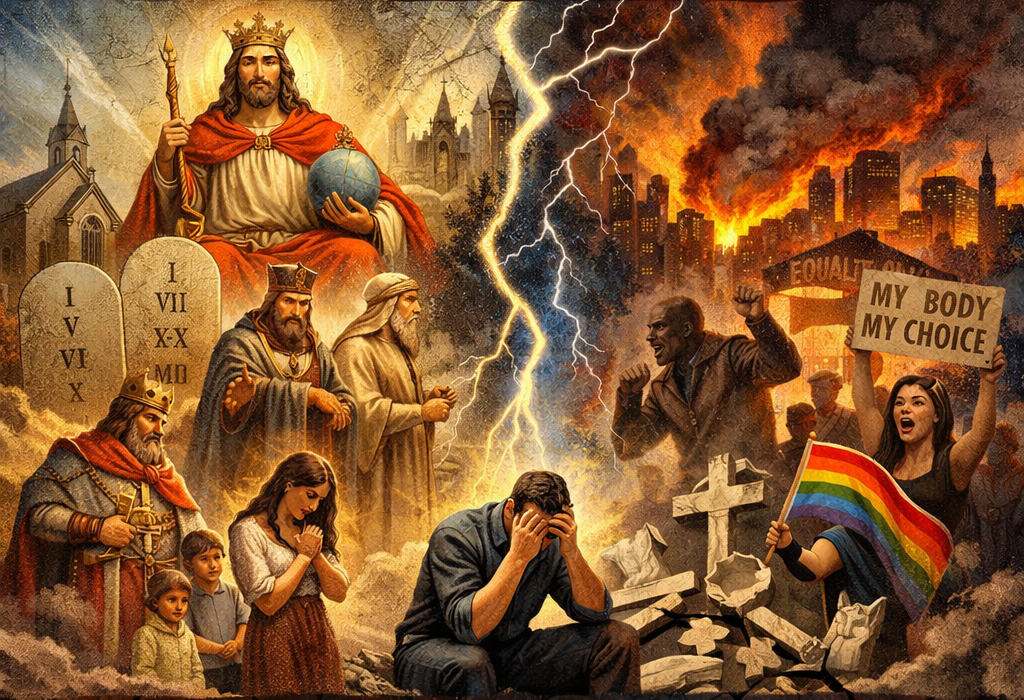
There is a lie so deeply embedded in the modern mind that we no longer recognize it as a lie. Rather, it is assumed, repeated, enforced, and weaponized without examination. That lie is this: that the current age (this 1% sliver of human history) is the most enlightened, the most just, the most morally advanced era that has ever existed. And from that poisoned root flows every modern distortion of truth, every inversion of order, and every rejection of what came before. We have simply declared war on the past and crowned ourselves victors without ever asking if we understood the battle.
For nearly all of human history (across nations, languages, empires, and covenants) there existed a shared understanding of reality that had never, until recently, been debated. God’s created order was simply accepted. Authority was not questioned at every turn, the family was not redefined, and we never found it necessary to defy the created order. Yet in the span of roughly a century (a blink in the timeline of mankind) those foundations have been dismantled, mocked, and replaced with unstable substitutes. And now, in breathtaking arrogance, modern man dares to judge the other 99% of history by the warped standards of the 1% that abandoned it.
I. The Ancient Consensus: Order Was Inherent
For the overwhelming majority of human history, the fundamental structures of life were not open for debate. God’s created order was obvious to anyone with an IQ above room temperature. Across civilizations as distant as ancient Israel, imperial Rome, dynastic China, and medieval Europe, there existed a striking and undeniable consistency in how societies were ordered. Authority flowed downward, households were governed, fathers ruled their homes, kings ruled their nations, priests mediated the sacred, and above all of it stood God (or the gods) whose authority has never been subject to human revision and interpretation. When radically different peoples, separated by geography, language, and culture, arrive at the same structural conclusions, you are no longer looking at culture preference, but reality pressing itself onto human civilization.
Scripture presents God’s order as the design we must structure our lives and societies by. In Genesis, dominion is given, man is commanded to subdue, to rule, and to exercise authority over creation. This pattern cascades through every layer of biblical structure. The patriarchs did not hold family meetings to determine direction; they led. Abraham did not ask for consensus before moving his household, he obeyed God and the household followed. The law given through Moses issued commands backed by consequence. And in the New Testament, the same structure persists. Wives are commanded to submit, children to obey, and men to lead as reflections of divine order. “For God is not the author of confusion, but of peace” (1 Corinthians 14:33). Peace, in Scripture is the presence of rightly ordered authority.
What modern man calls “oppression,” the ancient world rightly understood as necessity. Not because they were cruel, but because they were not delusional about human nature. They understood something we have chosen to forget: that without structure, authority, and hierarchy there is no stability, there is no accountability, and there is no freedom. This is why even pagan societies (those without the fullness of biblical revelation) still built rigid systems of authority. They recognized, however imperfectly, that order is not a social construct. Structured order is a basic requirement of long-term societal survival.
Our modern world recoils at this in horror because they have been trained to equate authority with abuse and submission with weakness. But that is not how history understood it, and it is not how Scripture defines it. Authority is protection, submission is alignment, and obedience is wisdom. These were not arbitrary burdens placed on humanity, but were guardrails that made civilization possible. The fact that nearly every society in human history independently affirmed these truths cannot be dismissed. When you reject something that universal, you are not making progress. You are stepping outside the boundaries that God established to keep humanity intact, and then calling the fall “freedom.”
II. The Modern Revolt: When Man Rejected What God Established
What God established, as we followed for thousands of years, was not gradually refined over millennia as we have been led to believe, instead it was aggressively attacked and viciously dismantled over a very short time. The last century did not produce a careful evolution of thought. While often presented as a revolt against injustice, it was in truth, a revolt against structure itself. Authority was no longer to be respected, it was to be questioned, then resisted, then destroyed. The household was no longer to be governed, and religion was no longer to be obeyed, but reinterpreted, softened, and eventually subordinated to our desires. What we are witnessing is rebellion, clean, deliberate, and theological in nature, whether modern man admits it or not.
Scripture describes this pattern with unsettling clarity. “Every man did that which was right in his own eyes” (Judges 21:25). That verse is an indictment of modern culture. It is the definition of disorder. And yet, that exact condition is now held up as the highest good in modern society. Personal autonomy has replaced obedience, self-expression has replaced submission, and individual desire has replaced the divine commands. What God established as fixed, man now treats as fluid. Our world is in open defiance of divine order.
The rejection of authority has not stopped at the throne or the church, the home has also been invaded. The father, once the unquestioned head of the household, has been reduced to a partner, participant, or worse, an unnecessary figure altogether. The mother, once honored within a defined structure, has been pushed into a role that often demands she abandon that structure entirely. Children, once trained in obedience, are now raised to challenge, question, and assert themselves as equals to those tasked with leading them. This is no accident, when you remove hierarchy, you do so for the purpose of eliminating harmony and replacing it with competition. And when every member of the household is competing for authority, the household ceases to function as a unit, much like with see in the broader society today.
Even the church, which should have stood as the final line of resistance, has largely capitulated, being absorbed with modern culture. Instead of proclaiming truth and calling for repentance, it has softened, offered affirmations, and rebranded as “contextual,” “cultural,” or “misunderstood,” anything that conflicts with modern sensibilities. But truth that must be softened to survive is no longer truth, and that reality will become more costly the longer it persists.
This is the modern revolt, the rejection of authority itself. Not the correction of abuse, but the elimination of God’s established structure. And in doing so, modern man has untethered himself from the very framework that defined, restrained, and preserved human civilization for millennia. He now drifts (confident, expressive, and utterly unmoored) calling it freedom, while the foundations beneath him continue to collapse.
III. The Rewriting of History: Judging the Past by a Corrupt Standard
Once the revolt was well underway, it was not enough to simply abandon the old order, modern man had to justify his rebellion. And the most effective way to do that was not by proving himself right, but by declaring the past wrong. Entire civilizations, spanning thousands of years, were suddenly placed on trial, not in their own context, not according to the standards they lived by, but under the artificial lens of modern ideology. What could not be erased was reinterpreted, what could not be reinterpreted was condemned, and what could not be condemned outright was simply ignored. This is deeply dishonest, intentional revision on a grand scale.
Ancient societies are labeled “primitive” not because they lacked intelligence, but because they refused to conform to our modern values. Biblical structures are dismissed as “cultural artifacts” rather than acknowledged as divine prescriptions. The patriarchal framework that dominated nearly every civilization is caricatured. Authority is recast as oppression, hierarchy is reframed as injustice, and submission is rebranded as degradation. But these are accusations rooted in a pre-decided conclusion: that modern man is morally superior to all who came before him.
Scripture warns us against this kind of arrogance. “Say not thou, What is the cause that the former days were better than these? for thou dost not enquire wisely concerning this” (Ecclesiastes 7:10). This article is not a call to blind nostalgia, but a warning against shallow judgment. The modern world does not “inquire wisely” about the past. It does not seek to understand why structures existed, what purpose they served, or what stability they provided. It simply assumes they were wrong because they are not in-line with the current “understanding.” This is chronological arrogance, the belief that being later in time automatically makes one more correct.
Consider the audacity of the modern position. For thousands of years, societies across the globe (many of which had no contact with one another) arrived at similar conclusions about authority, family structure, gender roles, and social order. Then, within a narrow slice of recent history, those conclusions were abruptly rejected. And instead of questioning the anomaly, we question the entirety of what came before it. We do not ask, “Why did they all agree?” We ask, “Why were they all wrong?” This is revisionist indoctrination.
Even the Scriptures are not spared, passages that were once understood clearly are now subjected to endless reinterpretation, not because the text has changed, but because the reader has. Commands regarding submission, obedience, and order are softened, contextualized, or dismissed entirely in an attempt to align eternal truth with temporary culture. But when the standard shifts from God’s Word to man’s comfort, the result is inevitable: truth becomes fluid, authority is no longer respected, and history becomes something to be rewritten.
This is the true cost of the modern lens. It corrupts the past. And when a society loses the ability to accurately understand where it came from, it also loses the ability to correctly determine where it is going. What remains is a people untethered from both origin and direction, confidently condemning their ancestors while unknowingly repeating their own errors, only this time without the benefit of inherited wisdom to correct them.
IV. The Collapse of Function: When Order Is Removed, Consequences Follow
These ideas produce outcomes. And when you dismantle the structures that governed human life for all of human history, you trigger consequences. The modern world loves to speak in abstractions (freedom, equality, autonomy, equity) but reality responds to structure. And when structure is removed, what follows is not liberation, but breakdown. You do not get a better-functioning society when you strip away authority, hierarchy, and defined roles. You get confusion, instability, and eventual collapse, no matter how appealing the language used to justify it.
This principle is demonstrated in Scripture: “Where there is no vision, the people perish” (Proverbs 29:18). Vision, in this context, is not ambition, but order, direction, and revealed authority. Remove it, and the result is decay. You can see it in every layer of modern life. The family, once the most stable and durable institution in human history, is now in tatters. Households are divided, roles are blurred, and leadership is either absent or constantly challenged. What was once a unit designed for continuity and strength has become a revolving door of instability, with each generation less anchored than the last.
Masculinity, once defined by responsibility, leadership, and restraint, has been either neutered or caricatured. Men are told to abandon authority but are given no viable replacement for it. The predictable result is passivity, confusion, and in many cases, complete withdrawal. And where men refuse to lead, others will fill the vacuum, and without the structure or accountability that leadership requires. Then they have the gall to call this “progress.”
Women, likewise, have not been burdened under the guise of “liberation.” Stripped of defined roles and clear expectations, they are now expected to function in every capacity at once, without the structural support that once made those roles sustainable. The promise was freedom; the result has often been exhaustion, instability, and dissatisfaction. Because when you remove the framework that orders responsibility, you multiply it, then scatter it across every aspect of life.
Even the broader society reflects this collapse. Institutions that once commanded respect now struggle to maintain legitimacy. Authority figures are questioned at every turn, not based on their actions, but on the mere fact that they hold authority at all. Discipline is viewed with automatic suspicion. Any standard is seen as oppressive. And without standards, there is no consistent measure for behavior, only shifting expectations driven by emotion and opinion.
The unavoidable reality is this: when you remove order you get disorder. When you reject hierarchy you get chaos. And when you abandon the structures that governed human life for millennia, you create something fragile, volatile, and unsustainable. The modern world is not evidence that the old ways were wrong, but evidence of what happens when they are ignored.
V. The Judgment of God: When a Civilization Refuses Order
There is a point at which disorder becomes judicial. Scripture not only describes what happens when man rejects God’s order; it explains why it happens. At a certain threshold, God no longer observes rebellion, but responds to it by giving man over to the very chaos he demands. The most chilling passages in Scripture are not those where God strikes immediately, but those where He withdraws restraint and allows a people to descend into the full expression of their own desires. This is judgment.
Romans 1 lays this out. “Professing themselves to be wise, they became fools… Wherefore God also gave them up…” That phrase repeats like a drumbeat of consequence. Given up to uncleanness, to vile affections, and given over to a reprobate mind. When a society rejects truth, redefines righteousness, and inverts what God has established, the result is degradation under divine allowance. God does not need to destroy such a society immediately. He allows it to unravel itself.
This is precisely where our world finds itself. The rejection of authority, the dissolution of the family, the confusion of roles, the redefinition of morality are symptoms of a deeper reality: a civilization that has rejected the order of God and is now experiencing the consequences of that rejection. What was once unthinkable is now normalized. What was once condemned is now celebrated. And what was once honored is now ridiculed. This is inversion, and inversion is a hallmark of judgment.
Even more sobering is the fact that this condition often comes with a sense of confidence. Those under judgment do not typically recognize it. They believe themselves to be advancing, improving, evolving. They create new language to justify old sins. They construct moral frameworks that affirm what God has already condemned. And they surround themselves with voices that reinforce the illusion. “Woe unto them that call evil good, and good evil; that put darkness for light, and light for darkness” (Isaiah 5:20). That is a diagnosis.
History confirms that civilizations do not collapse simply because of external threats. They collapse when the internal order decays. When discipline erodes, when authority is mocked, when moral clarity is replaced with relativism, the structure cannot hold. And when that collapse comes, it is often sudden, but never without warning. The warning is the disorder itself.
This is the final stage of the 1% rebellion, not merely rejecting the past, not merely rewriting truth, but standing under the consequences of that rejection while insisting it is virtue. And that is the most dangerous position a society can occupy. Because when judgment is mistaken for progress, repentance is not considered, and without repentance, the outcome is inevitable.
Conclusion
The issue before us is foundational. It is not about preferences, trends, or generational differences. We must decide whether reality is something we were appointed by the creator or something we invent. For 99% of human history, that question did not have to be asked. Order was not created by man, authority was not negotiated, and the family was not an experiment. Above all, God was not subject to reinterpretation, He was the standard by which all things were measured. That world was not perfect, but it was anchored. It understood that stability does not come from reinvention, but from alignment with what is fixed and true.
But in the last 100 years, man has attempted something unprecedented. He has stepped outside of that inherited order and declared himself the architect of a new one. He has taken what was clear and made it muddy. What was commanded, he has made optional. And in doing so, he has made himself god. The modern world is not standing on the shoulders of history; it is severed from it, drifting, unstable, and increasingly unable to explain the very disorder it continues to produce.
The question, then, is whether the past was closer to reality than what we have now. Whether the structures that endured for thousands of years did so because they were oppressive, or because they were ordained by God. Whether the commands of God were burdens, or guardrails. And whether the collapse we are witnessing is the result of rebellion.
Because in the end, the choice is not between old and new. It is between order and disorder. Between submission to what God has established, or rebellion against it. And history (nearly all of it) has already shown us which one sustains civilization, and which one destroys it.
May God’s Great Order be Restored!