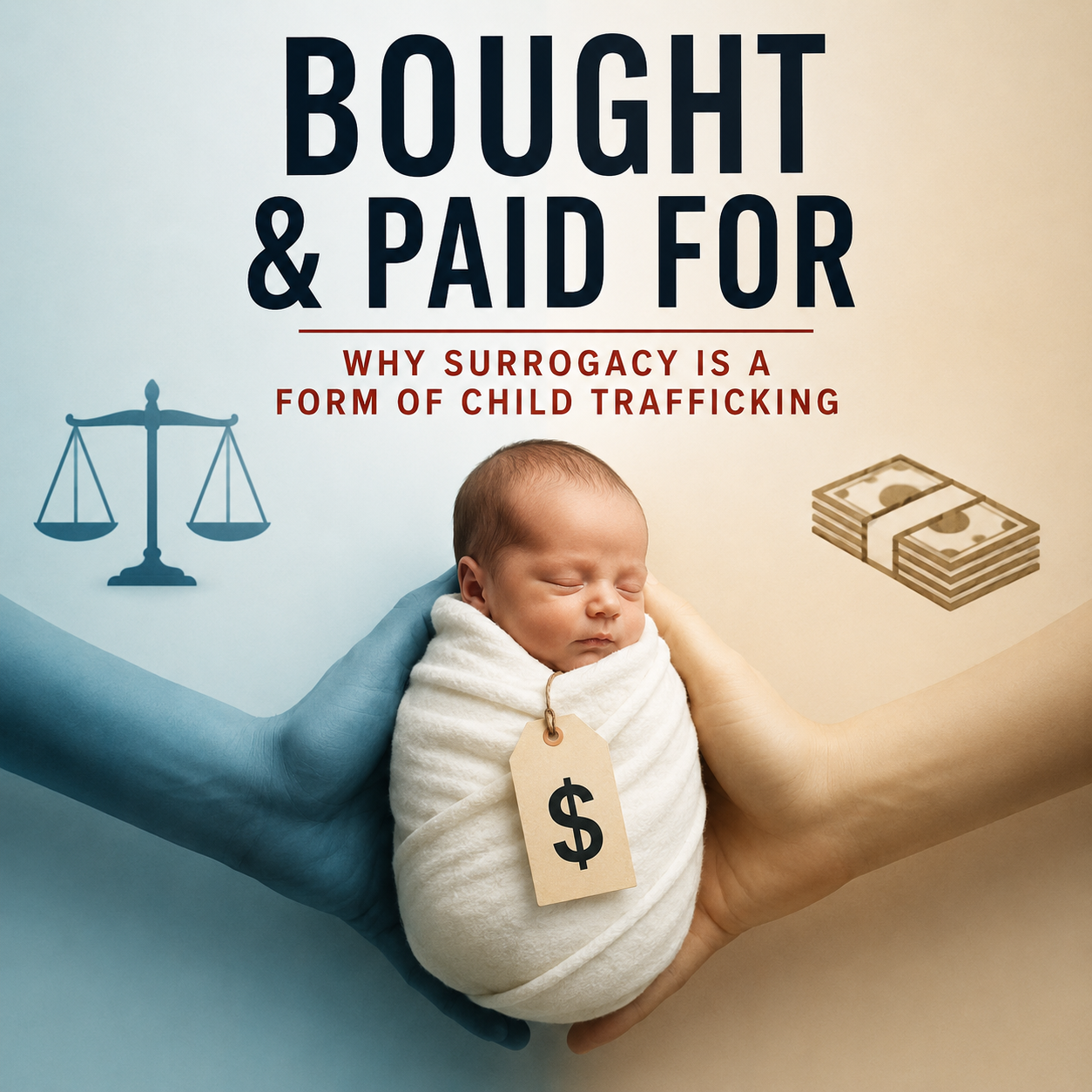
Modern surrogacy is marketed as a beautiful act of generosity: hopeful parents finally holding a long-awaited baby, smiling doctors standing beside expensive fertility clinics, and emotionally charged slogans about “creating families.” The public relations machine surrounding the modern child trafficking industry is powerful, polished, and deeply emotional. Yet beneath the sentimental language lies the reality. Surrogacy is a commercial system in which human beings are contractually commissioned, manufactured through reproductive technology, and transferred in exchange for money. Strip away all the polite euphemisms, and the structure resembles something disturbingly close to child trafficking.
That comparison shocks people because modern society has learned to separate immoral acts from acceptable ones through language rather than substance. If a child is exchanged through illegal networks, society calls it trafficking. If a child is produced through lawyers, clinics, contracts, and six-figure payments, society calls it “family building.” But legality has never determine morality. History is filled with legal systems that institutionalized deeply evil practices. The central question is not whether surrogacy is legal in certain jurisdictions, but whether paying to obtain a child through contractual transfer fundamentally commodifies human life. Once that question is honestly answered, the parallels become impossible to ignore. Even setting aside the serious moral, psychological, medical, and theological problems associated with surrogacy (of which there are many), the transaction increasingly mirrors the logic, mechanics, and incentives of trafficking.
I: When Children Become Products
The defining feature of commerce is simple: a product is commissioned, produced, and transferred in exchange for compensation. Commercial surrogacy follows that framework. Intended parents pay agencies, lawyers, fertility clinics, and surrogate mothers in order to obtain a child. In the United States, commercial surrogacy arrangements commonly range from $100,000 to over $500,000 once medical procedures, legal fees, agency fees, insurance, embryo transfers, and “surrogate compensation” are included. The child is the object of the transaction.
The surrogacy industry often insists that parents are merely paying for “services,” not for the child. But this is simply not true. If the surrogate miscarries, intended parents frequently demand refunds, repeat procedures, or contractual remedies. Contracts routinely specify selective abortion clauses, embryo quantity requirements, health expectations, and behavioral restrictions. In many agreements, intended parents exercise extraordinary control over the pregnancy (and even the mother) because they view the outcome as something purchased and expected. That is not the language of gift, sacrifice, or adoption, but the language of consumer entitlement.
One of the clearest demonstrations that surrogacy operates as a commercial ownership arrangement rather than a purely compassionate act is found in the abortion and “selective reduction” clauses embedded in surrogacy contracts. Intended parents frequently demand contractual authority over whether the surrogate must terminate the pregnancy in cases involving disability, genetic abnormality, multiple embryos, or medical complications. In these agreements, the surrogate can face financial penalties, breach-of-contract lawsuits, criminal charges, and/or the withholding of compensation if she refuses. Courts have repeatedly wrestled with disputes involving intended parents demanding abortion and surrogates resisting those demands. The existence of such clauses exposes the underlying logic of the industry: the child is not treated as a sovereign human life but a commissioned product subject to quality control standards. A mother carrying her own child would never be viewed as contractually obligated to murder that child at another person’s request. Yet within commercial surrogacy, this requirement is normalized because the financial structure encourages the paying parties to view themselves as entitled decision-makers over both the pregnancy and the unborn child.
Bioethicist Dr. Renate Klein, editor of Surrogacy: A Human Rights Violation, argued that surrogacy “turns women into breeders and children into commodities.” Meanwhile, philosopher Michael Sandel warned in What Money Can’t Buy that market logic increasingly invades areas of life where it does not belong, including human reproduction. Once human life becomes subject to contract and commercial expectation, moral boundaries no longer exist.
Even secular legal scholars have acknowledged the resemblance between commercial surrogacy and human trafficking systems. The European Parliament condemned surrogacy in 2015, stating that the practice “undermines the human dignity of the woman” and that the “human body and its reproductive functions should not be treated as commodities.” Critics across political and religious lines increasingly recognize that the industry monetizes both women and children simultaneously.
Scripture states in Psalm 127:3, “Children are a heritage from the Lord, the fruit of the womb a reward.” A reward is received from God, not commissioned through contractual acquisition.
The uncomfortable reality is: when money changes hands specifically so a child can be conceived, carried, and transferred to paying adults, society has already crossed into morally dangerous territory. The existence of legal paperwork does not eliminate commodification.
II: The Exploitation of Women and Economic Coercion
Commercial surrogacy depends heavily upon greed. Why don’t we see wealthy couples becoming surrogates for poorer women. The flow only moves in one direction: affluent individuals purchase reproductive labor from women in financially vulnerable positions, or women that value money more than human life. That imbalance is foundational to the industry itself.
In countries where commercial surrogacy expanded rapidly, exploitation scandals quickly followed. India became one of the world’s largest surrogacy hubs before tightening restrictions in response to widespread ethical concerns. Women living in poverty were recruited to carry babies for wealthy foreigners while agencies profited enormously from the arrangement. A 2013 report by the Centre for Social Research in India documented cases in which surrogates were isolated from their families, pressured into medical decisions, and inadequately informed about health risks. Similar concerns emerged in Thailand, Ukraine, Georgia, and other international surrogacy markets.
The industry often presents surrogate mothers as empowered entrepreneurs making free choices. If a woman agrees to rent her womb because she cannot pay medical bills, avoid eviction, or feed her children, how voluntary is the arrangement? Economic coercion does not disappear because contracts are signed.
Feminist scholar Andrea Dworkin once warned that systems which commercialize the female body inevitably become systems of exploitation. Even many degenerates who support abortion rights have expressed discomfort with surrogacy because it transforms pregnancy into paid labor subject to customer expectations. The surrogate’s body becomes a managed production environment overseen by clinics, agencies, and intended parents.
Medical risks are also significant. Surrogates face heightened risks of gestational diabetes, preeclampsia, postpartum depression, cesarean delivery, hemorrhage, and emotional trauma. A 2018 study published in Human Reproduction found 140% increased obstetric complications among surrogate pregnancies compared to traditional pregnancies. Yet despite these risks, surrogacy agencies frequently emphasize financial compensation over any long-term consequences.
The biblical vision of motherhood bears no resemblance to commercial surrogacy. Pregnancy is portrayed in Scripture as deeply relational, covenantal, and familial. In Genesis, the womb is consistently treated as sacred territory under God’s authority, not an economic asset for temporary lease.
Surrogacy advocates frequently speak about compassion for infertile couples, and infertility is undeniably painful. But compassion cannot justify exploitation. A society that solves one person’s suffering by financially incentivizing another person’s bodily risk and emotional sacrifice is redistributing suffering downward through economic power.
III: The Deliberate Separation of Mother and Child
One of the most unnatural elements of surrogacy is that it intentionally creates maternal separation. The child is conceived with the expectation that the woman carrying him or her will surrender the baby immediately after birth. What adoption addresses after tragedy or crisis, surrogacy deliberately engineers in advance.
For decades, attachment research has demonstrated that bonds between mother and child begin in the womb. Studies published in journals such as Infant Behavior and Development show that unborn babies recognize maternal voices, rhythms, hormones, and stress patterns long before birth. Pregnancy is not simply biological incubation; it is relational formation. The surrogate mother and unborn child are connected physically, hormonally, neurologically, and emotionally throughout gestation.
Surrogacy contracts, however, require everyone involved to suppress or deny the significance of that bond. Surrogates are often instructed to emotionally distance themselves from the baby. Intended parents are encouraged to view the surrogate primarily as a carrier rather than a mother. The language has been engineered to weaken natural human attachment. Terms like “gestational carrier” replace “mother” because the industry understands the emotional power of motherhood.
Yet reality consistently intrudes. Nearly all surrogate mothers report grief, depression, and/or emotional distress after relinquishment. Children born through surrogacy increasingly describe identity confusion and emotional struggles related to their origins. Some feel fragmented by the knowledge that conception, gestation, genetics, and parenting were divided among multiple parties connected through financial arrangements.
Psychologist Nancy Verrier, author of The Primal Wound, argued that early maternal separation leaves profound psychological effects even when infants cannot consciously articulate the experience. While debate continues over the extent of those effects, it is increasingly difficult to maintain the fiction that maternal detachment is emotionally neutral.
The comparison to trafficking becomes especially troubling here because trafficking systems often involve the severing of natural family bonds for the desires or demands of others. Again, defenders object that intended parents love the child deeply. But traffickers may also claim benevolent intentions. Intent alone cannot sanctify morally distorted systems.
The Bible consistently emphasizes the unity between mother and child. Psalm 22:10 declares, “Upon you I was cast from my birth, and from my mother’s womb you have been my God.” The womb is not treated as a rental environment disconnected from maternal identity. Likewise, Isaiah 49:15 asks, “Can a woman forget her nursing child?” Scripture assumes maternal attachment is powerful, natural, and good.
Surrogacy requires society to deny this reality because acknowledging it would destabilize the industry, costing them billions of dollars. If pregnancy creates genuine maternal bonds, then commercial contracts demanding relinquishment are pre-negotiated separation agreements involving the ownership of human children.
IV: The Global Industry and the Machinery of Trafficking
Trafficking is not only about illegal abduction. Modern trafficking systems often involve legal paperwork, intermediaries, transportation networks, financial transactions, and often vulnerable “3rd world” populations. By that broader definition, international surrogacy increasingly mirrors every other human trafficking infrastructure.
The global surrogacy market is projected to exceed tens of billions of dollars in coming years as demand rises among wealthy clients. Agencies recruit surrogate mothers, fertility clinics manufacture embryos, lawyers navigate parentage laws, brokers coordinate international arrangements, and children are transferred across borders after birth. Entire industries now exist to facilitate the movement of human children from reproductive suppliers to paying consumers.
Numerous scandals have exposed the dark underbelly of this machine. During the war in Ukraine, international media outlets reported chaotic scenes involving dozens of surrogate-born infants stranded in clinics awaiting pickup by foreign parents. The images were jarring: rows of babies produced through international reproductive contracts, delayed in transfer because geopolitical circumstances interrupted delivery logistics.
In another infamous case, the “Baby Gammy” scandal in Thailand involved the intended parents abandoning one twin born with Down syndrome while taking the healthy sibling, because if children are just goods, then why pay for damaged ones? The case highlighted how easily children conceived through contractual arrangements can become subject to consumer preference and rejection.
Commercial surrogacy also creates complicated citizenship, legal parentage, and custody disputes. Some children born through international surrogacy arrangements have effectively become stateless due to conflicting national laws regarding parenthood. Others become trapped in prolonged legal conflicts between genetic contributors, surrogates, and intended parents.
The language of trafficking is difficult to avoid because the mechanics are the same. A woman is recruited, money changes hands, a child is produced under contract, legal intermediaries facilitate transfer, and wealthy clients acquire custody rights. International transportation (or occasionally domestic) then follows. The only substantial difference is paperwork.
From a biblical perspective, Babel-like technological ambition frequently leads humanity into moral confusion when capability outruns wisdom. Ecclesiastes 8:11 warns that when judgment against wrongdoing is delayed, “the heart of the children of man is fully set to do evil.” Modern reproductive technology has enabled humanity to separate conception, pregnancy, genetics, parenthood, sexuality, and family into modular commercial services. But the ability to do something does not establish a moral right to do it.
Industrialized surrogacy has never resembled compassionate caregiving, it is nothing more than supply-chain management for human reproduction.
V: The Loss of Human Dignity in the Age of Reproductive Commerce
At its core, the surrogacy debate is about whether human beings possess intrinsic dignity or market value. Once reproduction enters the marketplace children inevitably become products evaluated according to preference, specification, and consumer expectations.
Modern fertility clinics already allow embryo screening for sex selection and genetic abnormalities. In most cases, embryos are discarded because they fail to meet desired criteria. Surrogacy intensifies this logic because the child is not conceived naturally but intentionally commissioned through expensive technological processes. The emotional and financial investment encourages consumers to view themselves as entitled purchasers rather than grateful recipients of sacred life.
This mentality has reshaped parenthood. Historically, children were understood as gifts from God, entrusted to families. Modern reproductive commerce increasingly treats children as lifestyle acquisitions obtained through sufficient resources and technological advances. Desire has become entitlement, and pregnancy has become outsourced labor.
Underneath much of the modern fertility industry lies a deeper spiritual problem: the refusal to accept limits, timing, order, or authority outside the self. Scripture presents children as blessings given by God within covenantal structure. Yet modern surrogacy culture increasingly encourages people to circumvent natural, moral, relational, and even biological boundaries through money and technology rather than first examining whether their lives are aligned with God’s design.
In many cases, little attention is given to spiritual order, repentance, health restoration, or disciplined living. A culture drowning in processed food, hormonal disruption, obesity, pharmaceutical dependence, pornography, sexual disorder, delayed marriage, and rejection of biblical family structure now turns to laboratories and commercial wombs to solve problems that are often downstream of rebellion against natural and divine order. Instead of asking, “How do we honor God and restore healthy households?” society increasingly asks, “How do we obtain the outcome we desire regardless of cost?” The issue is not infertility, but humanity’s growing insistence on sovereignty over creation.
Scripture does not mock the pain of barrenness. Sarah, Rachel, Hannah, and Elizabeth (and others) all wept over infertility. But in each case, the answer was ultimately found in God’s providence rather than commercialized markets. Their stories point toward dependence upon God, prayer, covenant faithfulness, and trust.
The language used by the industry reveals the shift. Intended parents are called “clients.” Agencies advertise “guaranteed programs.” Clinics discuss “success rates” and “deliverables.” Some agencies even market “premium surrogate packages” resembling luxury service tiers. Human reproduction is no longer described in relational or familial terms, but increasingly in commercial terminology.
Pope Francis condemned surrogacy in 2024 as a practice that “violates the dignity” of both women and children because it turns the child into “an object of trafficking.” While many theological traditions differ on various reproductive questions, there is growing consensus among religious ethicists that surrogacy fundamentally risks reducing human life to a transaction.
Even secular critics increasingly warn that the marketization of reproduction destroys social morality. Political philosopher Michael Walzer argued that certain human goods become corrupted when bought and sold, and parenthood belongs among those goods. Love, family, and children cease to function properly once subordinated to consumer logic.
Surrogacy supporters frequently ask emotionally compelling questions: “Should infertile couples never have children?” The answer: Painful desires do not automatically justify every possible solution. Not every longing can be fulfilled morally. Human dignity imposes boundaries even on deeply emotional aspirations.
The fundamental issue remains unchanged no matter how sophisticated the technology becomes: if a child is intentionally produced through paid contractual arrangements for transfer to purchasing adults, then society has already entered territory dangerously adjacent to trafficking. The presence of compassion does not change the commodification.
Conclusion:
Modern society often mistakes technological advancement for moral progress. Surrogacy is celebrated because it has been advertised as compassionate, sophisticated, and empowering. But civilizations are not judged by what they can accomplish technologically. They are judged by whether they preserve the dignity of the weak, the integrity of the family, and the sanctity of human life. Commercial surrogacy completely fails all three tests.
The deepest danger of surrogacy is not simply that it exploits women, confuses children, or enriches fertility corporations. The deepest danger is that it trains society to think of human beings as products obtainable through sufficient money, legal engineering, and technological power. Since that mentality has taken hold, the moral foundation beneath human dignity has eroded rapidly. Our civilization now sells children, and convinces everyone they are doing something good.