Introduction:
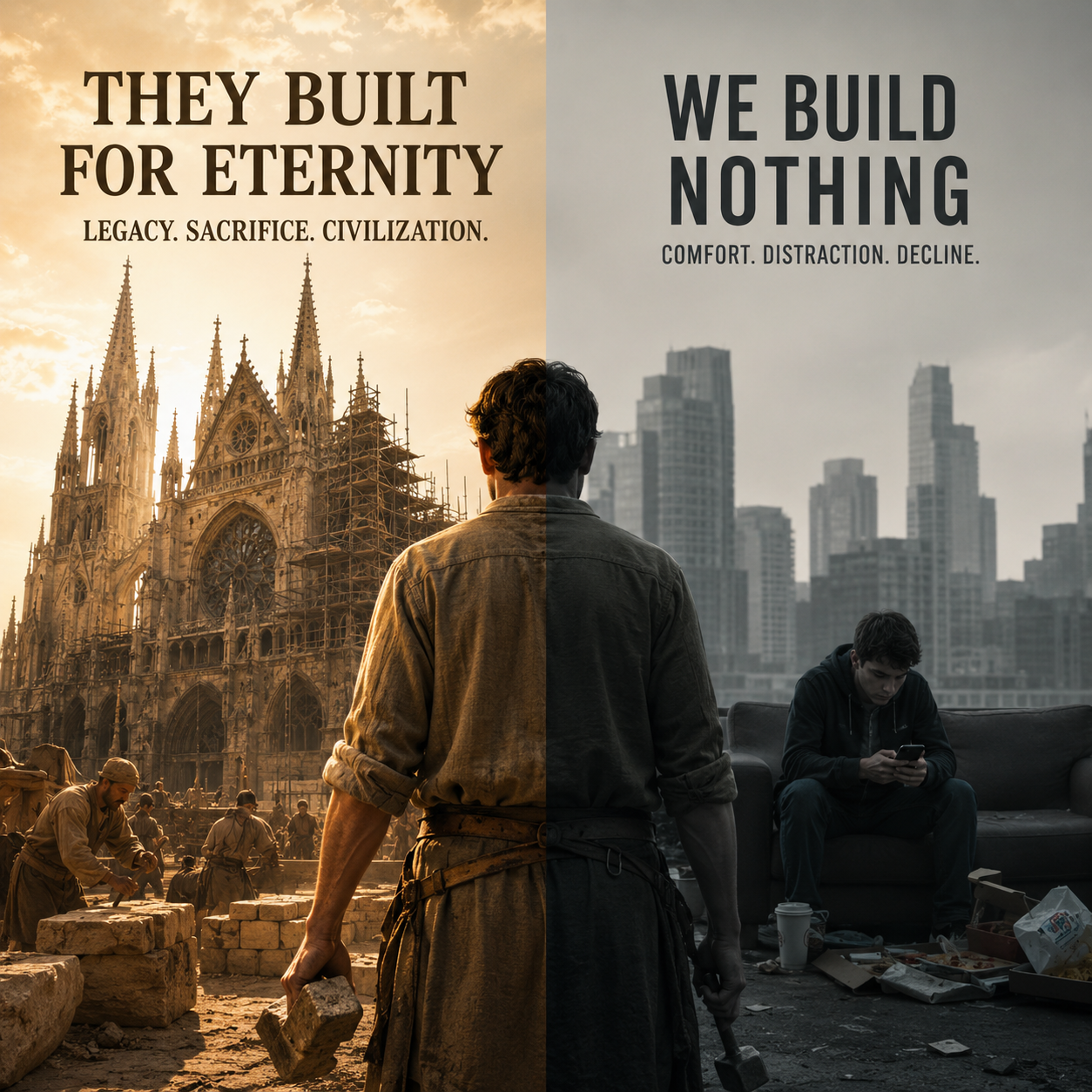
There was a time when men planted oak trees they would never sit beneath. They carved stones for buildings they would never see completed. They hauled granite, raised arches, cut timber, and stained glass (not for quarterly profits, social media engagement, or government grants) but because they believed they were part of something bigger than themselves. Medieval cathedrals often took generations to complete. The builders knew this. Many of the laborers who laid the foundations would die long before the bells rang from the towers. Yet they built anyway. Imagine explaining that to our society where people become emotionally exhausted because their two-day shipping took four days.
The modern world suffers from the disease of immediacy. We are surrounded by men who think in election cycles, subscription plans, dopamine hits, and weekend entertainment schedules. They consume constantly and construct almost nothing of lasting value. We live in an age of disposable architecture, disposable relationships, disposable morality, and increasingly disposable people. Ancient men built civilizations because they knew the future mattered. Modern men often struggle to assemble a bookshelf without watching a twenty-minute tutorial while arguing online about “toxic productivity.” The issue is spiritual. A civilization incapable of sacrifice will be incapable of permanence.
I. Cathedrals Were Built by Men Who Expected Their Civilization to Continue
The great cathedrals of Europe were not merely religious buildings, they were declarations of confidence in the future. Structures like Notre-Dame de Paris, Chartres Cathedral, and Cologne Cathedral were engineering marvels requiring enormous coordination, funding, logistics, mathematics, craftsmanship, and long-term social stability. Construction on Cologne Cathedral began in 1248 and was not completed until 1880. That is over six centuries of continuity. Think about that for a moment. Modern corporations collapse after six bad quarters, and medieval men built projects that outlived dynasties.
Historian Georges Duby noted that the cathedral represented “the collective soul of a civilization.” Entire towns participated in construction efforts. Blacksmiths, masons, carpenters, glassmakers, theologians, and laborers all contributed. These buildings unified economics, religion, art, science, and civic identity into one transcendent goal. Contrast that with modern architecture, where most urban skylines resemble sterile filing cabinets designed by depressed accountants.
The medieval world possessed many things we have lost, one of those is intergenerational thinking. Psalm 78 commands fathers to teach future generations so that “they should set their hope in God.” Proverbs 13:22 declares that “a good man leaveth an inheritance to his children’s children.” Ancient men understood themselves as stewards, their work existed within a chain extending backward to ancestors and forward to descendants.
Today we increasingly reject permanence because permanence implies responsibility. If you intend your civilization to endure, you must build institutions capable of surviving hardship. You must produce stable families, disciplined men, functioning churches, moral laws, and infrastructure that can outlive yourself and your children’s children. And that requires great sacrifice. Unfortunately, modern culture teaches men to maximize comfort rather than legacy. We have replaced the cathedral with the entertainment complex, the shopping center, and the social media feed.
Ironically, many modern men still crave greatness. You see it everywhere in their obsession with fantasy epics, empire-building video games, survivalism, and ancient history documentaries. Buried beneath layers of consumer conditioning is the lingering instinct that men were designed to build civilizations. The problem is that masculine ambition has been redirected into digital trivialities because modern society no longer offers worthy civilizational missions.
II. Ancient Men Understood Sacrifice; Modern Men Worship Convenience
“Every cathedral is a living sacrifice permanently frozen in stone”–Lord Redbead
Thousands of laborers worked in dangerous conditions for decades with little (if any) personal recognition. Medieval quarry workers died cutting stone, craftsmen spent entire lifetimes perfecting skills most modern schools no longer even teach, and entire communities tithed resources toward projects that offered no immediate material return. Why? Because they believed some things were worth suffering for.
Modern man, by contrast, has been conditioned to view any inconvenience as oppression. We inhabit a civilization where people demand therapy because somebody used the wrong pronoun but cannot change a tire, sharpen a blade, repair a fence, or endure thirty seconds of silence without checking their phone. The average American spends over seven hours per day consuming digital media. Meanwhile, rates of loneliness, anxiety, purposelessness, and depression continue climbing despite unprecedented technological conveniences.
Convenience is not inherently evil. The issue arises when that convenience and comfort becomes the highest societal value. Civilizations collapse when citizens prioritize ease over endurance. Rome did not fall because barbarians arrived, Rome decayed internally long before the gates were breached. Historian Edward Gibbon famously argued that civic virtue eroded into decadence and dependency ultimately causing the societal condition that allowed the barbarian invasion. Men stopped seeing themselves as guardians of civilization and increasingly viewed the state as a mechanism for personal gratification, much like today.
Scripture warns against this mindset. In Judges 2, generations arose “which knew not the Lord, nor yet the works which he had done for Israel.” Comfort produced forgetfulness, and prosperity produced softness. Deuteronomy warns Israel not to forget God once they inherit houses they did not build and vineyards they did not plant because comfort without discipline eventually creates entitlement.
Cathedral builders accepted delayed gratification because they possessed transcendent purpose. We now largely reject transcendence altogether. Without God, eternity, legacy, or inherited duty, sacrifice is irrational. Why deny yourself if pleasure is the highest good? Why build for descendants if civilization is viewed as oppressive? Why preserve heritage if every generation is taught to despise its ancestors?
This is partly why modern architecture is spiritually empty. Ancient builders sought beauty because beauty reflected the divine order. Gothic cathedrals intentionally lifted the eyes upward. Modern architecture often resembles giant air-conditioning units with windows. Efficiency has replaced glory, and sterility has replaced transcendence. Apparently humanity spent two thousand years developing architecture only to culminate in luxury apartments that look like corporate microwaves.
A civilization unwilling to sacrifice will not produce greatness because greatness always costs greatly.
III. Men Once Built for Their Great-Grandchildren
Another defining characteristic of healthy civilizations is long-term planning. Ancient societies routinely planted orchards whose fruit they would never eat. They established institutions expected to endure centuries. Roman roads lasted millennia, medieval universities such as University of Bologna and University of Oxford survived wars, plagues, monarchies, revolutions, and technological upheavals because they were founded with permanence in mind.
Today, we increasingly struggle to think beyond our immediate consumption. Public infrastructure decays while governments borrow against future generations. Families disintegrate because adults prioritize self-fulfillment over covenantal responsibility. Corporations maximize quarterly profits while outsourcing long-term societal costs to everyone else. Even churches increasingly market themselves like entertainment brands rather than institutions stewarding truth across centuries and generations.
The economist Thomas Sowell observed that most social policies fail because they ignore “the next stage.” Modern thinking is obsessed with immediate emotional outcomes while neglecting downstream consequences. Ancient builders understood continuity. They recognized that every generation inherits both blessings and debts from its predecessors.
This principle is profoundly biblical. Psalm 145 speaks of one generation declaring God’s works to another. The covenantal structure of Scripture consistently emphasizes inheritance, continuity, lineage, and stewardship. The fifth commandment assumes multi-generational order. Christianity was never intended to function as isolated spiritual individualism detached from family, heritage, inheritance, or civilization.
When men cease thinking generationally, societies always become predatory. Debt skyrockets, birthrates collapse, infrastructure deteriorates, education becomes ideological, and art degenerates into narcissism. Eventually the culture consumes its inheritance faster than it can replenish it.
Consider modern birthrate trends. Every western nation now sits below replacement fertility levels. Sociologists increasingly warn of demographic collapse across Europe, Japan, and North America. Yet at the same time, modern culture celebrates perpetual adolescence. Men are encouraged to avoid responsibility, delay marriage indefinitely, consume entertainment freely, and fear commitment like medieval peasants feared plague ships.
Ancient men became adults by accepting burdens. Meanwhile modern men are told adulthood is oppressive. The predictable result is declining ambition, declining competence, and declining civilization.
A cathedral is impossible without generational continuity because no single man completes it. Likewise, civilization cannot survive without men willing to build beyond their own lifespan. Legacy requires humility, it demands that a man accept he is part of a chain rather than the center of the universe.
Oddly enough, this actually produces meaning. Men deteriorate psychologically when they lack responsibility. Numerous studies associate purpose, family stability, religious participation, and meaningful labor with higher life satisfaction and psychological resilience. Human beings were designed for stewardship, not perpetual consumption.
IV. The Loss of Masculine Ambition Has Crippled Civilization
Ancient civilizations expected men to build, defend, govern, cultivate, invent, and endure hardship. Modern culture increasingly treats masculinity as a disease in need of eradication. Strength is labeled “toxic.” Authority is treated as inherently oppressive. Competitiveness is pathologized unless it benefits corporate revenue or political activism.
The irony is painful. The same civilization that condemns traditional masculinity still desperately depends upon masculine labor for survival. Bridges are maintained by men. Electrical grids are repaired by men. Sewage systems, freight logistics, construction, mining, steel production, military defense, and infrastructure remain overwhelmingly male-dominated fields. Civilization still runs on masculine sacrifice even while fashionable culture mocks the men performing it.
Historically, ambitious civilizations produced extraordinary works because they believed their culture deserved preservation. The Egyptians built pyramids. The Romans built aqueducts. Medieval Christians built cathedrals. Renaissance Europe produced universities, art, and scientific advancement. These societies were far from perfect, but they possessed a level of confidence in their own continuity that we have lost.
Instead of building monuments, we often build temporary experiences. Instead of cultivating rooted communities, we cultivate transient lifestyles. Instead of teaching boys responsibility, we medicate them for failing to sit still eight hours daily under fluorescent lighting while being told masculinity is dangerous and “toxic.”
Research increasingly shows boys falling behind academically across much of the Western world. Male college enrollment has declined significantly relative to women. Rates of depression, addiction, suicide, social isolation, and aimlessness among men continue rising. A society that systematically strips men of mission should not be surprised when many become directionless.
Historian Arnold Toynbee argued civilizations collapse not primarily from external conquest but from internal failure of creative minorities, the leaders, builders, thinkers, and organizers who once sustained cultural momentum. This helps explain the modern obsession with nostalgia. Men instinctively long for eras that demanded courage, competence, and contribution. They watch documentaries about medieval Europe, Rome, frontier life, and ancient warfare because these periods reflected existential seriousness absent from modern life. Human beings desire meaning more than comfort.
Ecclesiastes reminds us that “where there is no vision, the people perish.” Men require missions worthy of sacrifice. Remove transcendent purpose, and society will balkenize into hedonism, tribalism, and nihilism.
Cathedral builders endured because they believed eternity mattered. We behave as though nothing matters beyond personal entertainment and political outrage.. Unsurprisingly, one worldview produced monuments still standing after centuries, while the other produces viral videos forgotten by Thursday afternoon.
V. Civilization Is Built by Men Willing to Become Ancestors
Perhaps one of the greatest differences between ancient men and modern men is this: ancient men consciously sought to become worthy ancestors.
They desired honor beyond their own lifespan. Their names, families, cities, and institutions mattered because they viewed themselves as custodians of inherited civilization. This mindset shaped everything from architecture to warfare to craftsmanship to fatherhood.
Our society increasingly rejects ancestry. Tradition is mocked, heritage is viewed suspiciously, and historical continuity is treated as oppressive rather than stabilizing. Yet human beings cannot survive without rooted identity. Every civilization depends upon inherited moral frameworks, accumulated wisdom, social trust, and cultural memory for survival.
The cathedral represented this continuity physically. Its stones embodied theological conviction, artistic mastery, communal cooperation, inherited knowledge, and future hope simultaneously. It was both practical and symbolic. It declared that the builders believed truth transcended their own mortality. Hebrews 11 praises men and women who acted by faith toward promises they would not fully see fulfilled in their lifetime. Abraham wandered toward a future inheritance. Moses led people toward a land he would never enter. David gathered resources for a temple Solomon would build. Biblical civilization consistently requires long-term obedience beyond immediate gratification.
Our world struggles with this because it worships self-expression over stewardship. Men are encouraged to “find themselves” rather than discipline themselves. Historically identity was forged through responsibility. A man becomes meaningful by carrying burdens, building institutions, protecting others, and sacrificing for future generations.
Ironically, the rejection of legacy produces profound emptiness. Consumer culture offers distraction but never significance. Unlimited entertainment numbs existential anxiety temporarily but cannot replace the missing purpose, and men instinctively know they were designed to leave something behind.
This does not mean everyone must literally build cathedrals. But men should build families, businesses, churches, communities, farms, schools, institutions, traditions, and legacies capable of surviving them. They should produce children who surpass them. They should cultivate land, wisdom, craftsmanship, discipline, and faithfulness. The tragedy of modern civilization is the collapse of civilizational ambition. Too many men no longer believe anything is worth building permanently. And when a civilization loses the will to build, they will lose the ability to survive.
Even termites build mounds that outlast individual termites. Modern man, however, often leases an apartment, accumulates streaming subscriptions, argues online about politics he cannot influence, and calls that a meaningful life.
Conclusion:
The cathedral builders understood something we have forgotten: a meaningful life is not measured by personal comfort but by what remains standing after you are gone. Great civilizations emerge when men willingly sacrifice present ease for future strength. They decline when comfort replaces duty, consumption replaces stewardship, and immediacy replaces legacy.
The question facing modern men is therefore simple: what are you building that deserves to outlive you? Your descendants will inherit either your discipline or your negligence. They will inherit either foundations or rubble. Every generation lays stones future generations must stand upon, or dig themselves out from under.
Ancient men built cathedrals because they believed God, truth, family, and civilization were worth enduring hardship for. Our civilization desperately needs men capable of recovering that vision. Because civilizations do not survive on convenience, entertainment, and self-centeredness, they survive when men once again decide to become builders instead of consumers.
May God’s Great Order be Restored!