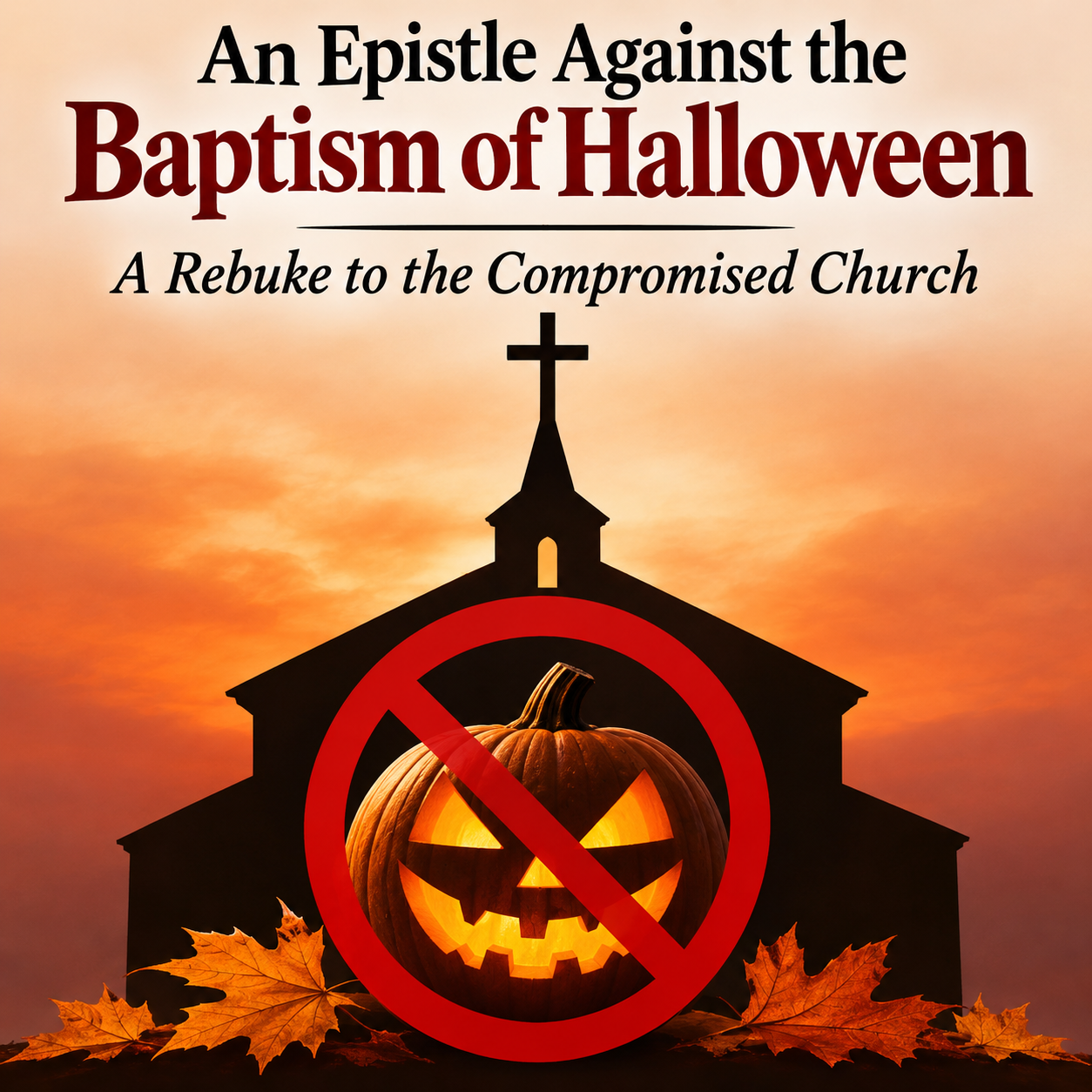
To the pastors who have traded Biblical conviction for attendance, to the elders who have compromised their integrity, and to the Christians are comfortable celebrating what they profess to reject.
To the Churches of This Present Age:
I write not to congratulate you upon your ingenuity, nor to commend the astonishing creativity with which you have learned to accommodate the customs of the world, but to rebuke an ecclesiastical hypocrisy so thoroughly normalized that many among you no longer recognize it. You profess allegiance to Jesus Christ, proclaim the authority of Holy Scripture, and declare yourselves a people called out of darkness into His marvelous light. Yet when the appointed season of Halloween approaches, your congregations begin preparing celebrations of their own, carefully designed to preserve the festivities while concealing their association hidden by a vocabulary of religious respectability. You have renamed the occasion. You have not separated yourselves from the prevailing culture, but constructed a Christian imitation of its celebration. And having exchanged witches for scarecrows, skeletons for hay bales, and haunted houses for decorated automobiles, you congratulate yourselves upon a victory over darkness that is indistinguishable from complete surrender.
What shall we say to such things? Shall we praise the ingenuity of a Church that has manufactured a theological justification for virtually anything its members desire? Shall we admire pastors who possess sufficient creativity to transform Halloween into a Harvest Festival, Trunk-or-Treat, Light Party, Family Fun Night, or Community Outreach Celebration, while lacking the conviction to tell their congregations not every worldly observance requires a Christian equivalent? You who proclaim that Christ has called His followers to be separate, why are you so terrified of separation? You who preach that obedience is greater than sacrifice, why do you labor so diligently to devise alternatives to obedience? You who insist that Scripture is sufficient, why must the cultural calendar continually furnish occasions for celebrations that are in obvious opposition to Holy Scripture. The institutional Church has appointed itself the architect of Halloween’s rehabilitation, falsely claiming religious permission where it was required to exercise spiritual discernment.
I. You Have Not Rejected Halloween; You Have Baptized It
Let us dispense with the insulting pretense that changing the designation of an observance changes the essential character thereof. If a congregation assembles on October 31 knowing Halloween is approaching, advertises an event specifically as an alternative to Halloween, organizes activities modeled upon Halloween customs, and/or distributes candy to children whose anticipation has been cultivated by Halloween, by what extraordinary exercise of theological reasoning does that congregation conclude that Halloween has ceased to determine its conduct? The matter is not settled by the removal of objectionable decorations. Neither is it settled by the substitution of biblical costumes, cheerful music, or evangelical literature. These alterations may change the appearance of the occasion, but they do not erase the causal dependence upon the celebration supposedly being rejected.
Consider the absurdity of Trunk-or-Treat. Children who would otherwise proceed from residence to residence collecting candy are instead directed from automobile to automobile collecting candy. The fundamental activity, annual anticipation, and cultural occasion remain intact. The Church has accomplished nothing more than relocating Halloween onto ecclesiastical property. Are we seriously expected to regard this geographical adjustment as a triumph of holiness? Does an activity become sanctified because the asphalt belongs to a congregation? Does a costume acquire righteousness when worn beneath the supervision of an elder? Does the distribution of candy become an act of Christian distinction because the person distributing it attends Sunday worship? The absurdity of such thought is cause for vomit.
And what of the Harvest Festival, that particularly convenient invention by which churches claim to celebrate agricultural abundance whilst the surrounding culture celebrates Halloween? If the harvest is genuinely the object of thanksgiving, why is the celebration so dependent upon October 31? Why does it reproduce the seasonal excitement of Halloween rather than arise independently from the agricultural calendar or the biblical feasts? If Halloween never existed, would your congregation have organized the same elaborate festivities on the same date? If not, then cease insulting the intelligence of your congregation by pretending that the harvest is the principal cause of your assembly. Your observance is governed by the very occasion you claim to have renounced. You are knowingly participating in the highest holy day of Satanism.
The same criticism without exception applies to Light Parties, costume carnivals, specially organized service nights, and annual family celebrations deliberately established as Halloween substitutes. Their individual activities are anything but innocent because of the context. Fellowship is good. Hospitality is good. Evangelism is good. Service to one’s neighbor is good. The moral legitimacy of an individual activity does not establish the wisdom or legitimacy of the religious observance constructed around it. We must examine not only what is being done, but why it is being done, what occasion governs it, and what spiritual instruction its repetition communicates.
The Apostle Paul certainly did not instruct the Church to imitate the cultural festivities of unbelievers with carefully modified decorations, but to examine their conduct and refuse fellowship with the unfruitful works of darkness (Ephesians 5:11). His admonition was not an invitation to creatively find substitutes for every worldly celebration. Nor did he imagine that the Church’s mission depended upon its ability to provide a religious counterpart to whatever entertained the surrounding pagans.
You may call your celebration whatever you please. You may decorate it with Scripture, surround it with prayer, and advertise it beneath the false banner of Christian fellowship. But if Halloween remains the reason your celebration exists, then Halloween remains the occasion to which your institution has subordinated its authority. If you are celebrating halloween in any form, you are not a follower of Jesus Christ.
II. You Have Forgotten the Difference Between Worshiping God and Pleasing God
The profound fundamental theological error underlying this accommodation is the presumption that religious intention possesses the authority to sanctify whatever practice Christians choose to adopt. Such reasoning is not only careless; it stands in direct opposition with Scripture and there are severe warnings concerning such worship.
In Exodus 32. Aaron did not simply announce the abandonment of Israel’s religious identity. Having fashioned the golden calf image, he constructed an altar and proclaimed a feast to the LORD. The people offered sacrifices, participated in festivities, and attached the name of Israel’s God to their celebration. The invocation of His name did not transform their disobedience into worship. The fact that they claimed to honor God did not establish that God was honored.
A modern harvest festival is the equivalent to Israel’s idolatrous worship before the golden calf. The comparison concerns the underlying principle: human beings possess an astonishing capacity to confuse religious intention with divine authorization. They imagine that because they have incorporated sacred language into an observance, the observance has thereby acquired sacred legitimacy. But Scripture exposes the danger of approaching God according to our own invention while disregarding His revealed will.
Deuteronomy 12:30–31 warns Israel against investigating the religious practices of surrounding pagan nations and attempting to worship the LORD according to those patterns. The immediate context is idolatrous worship and its abominations. The warning establishes that the practices of surrounding societies must not become the unquestioned model for the worship of God’s people.
Jeremiah 10:2 likewise warns against learning the ways of the nations. Christ later rebuked religious authorities for elevating similar traditions above divine commandment, declaring that they had made the commandment of God ineffective through their traditions (Matthew 15:3–9). The issue in these passages is the substitution of earthly religious invention for fidelity to divine revelation.
To the contemporary Church: By what authority have you made Halloween alternatives a recurring feature of Christian life? Why is a celebration constructed in deliberate correspondence with Halloween? Why should it become a cherished ecclesiastical tradition, defended with greater enthusiasm you exhibit for biblical instructions.
You speak of redeeming the culture. Yet where has Christ commissioned you to redeem pagan cultural celebrations by reproducing their attractions under the Christian banner? Redemption in Scripture concerns deliverance from bondage, reconciliation to God, and transformation through Christ. To describe every religiously modified cultural practice as “redeemed” is to employ a profound theological concept with astonishing carelessness.
Martin Luther’s polemics against ecclesiastical presumption were directed specifically at the elevation of human inventions to obligations of religion. He distinguished between useful arrangements and traditions imposed upon conscience as though they possessed divine authority. That distinction should trouble modern pastors who never claim that God commanded a Halloween festival, yet defend its existence as though questioning it were an assault upon Christian fellowship.
The Church is not commissioned to institute whatever celebrations its members desire and then demand that Scripture be interpreted generously enough to accommodate them, quite the opposite.
III. You Neglect the Appointed Feasts of God While Inventing Festivals of Your Own
Hypocrisy is particularly conspicuous and evident when you have sufficient time to organize Trunk-or-Treat, but insufficient interest to study the Feast of Tabernacles. You can assemble committees to decorate automobiles, coordinate costumes, purchase candy, and advertise a Harvest Festival, yet the appointed times described in Leviticus 23 remain unfamiliar to substantial portions of your congregation. Your children know exactly when Halloween is, what costumes they intend to wear, and what festivities their church has prepared. Ask those same children to explain the Feast of Weeks, the Day of Atonement, or the significance of the Feast of Trumpets, and how many will be able to give answer?
Leviticus 23 identifies its observances as the appointed feasts of the LORD. The chapter establishes sacred assemblies and commemorations connected to God’s creation, deliverance, provision, judgment, and covenantal relationship with His people. Passover recalls deliverance through sacrifice. Unleavened Bread commemorates separation and redemption. The Feast of Weeks celebrates divine provision. The Day of Atonement focuses our attention toward repentance and reconciliation. Tabernacles commemorates Israel’s wilderness dependence upon God and His sustaining faithfulness.These feasts form the scriptural world in which Jesus and His apostles lived, worshiped, taught, and understood the unfolding purposes of God.
Jesus observed Passover (Luke 22:7–15). John records being at the Feast of Tabernacles (John 7:2–14). Acts 2 locates the outpouring of the Holy Spirit at Pentecost, the Feast of Weeks. Paul references the Feast of Unleavened Bread in his moral exhortation to the Corinthians, invoking its imagery to demand sincerity and truth rather than malice and wickedness (1 Corinthians 5:7–8).
Even granting the broadest possible Christian liberty concerning their formal observance of these feasts, the present contradiction remains disgraceful at best. How has the Church acquired such boundless enthusiasm for a festival it invented as a sanitized version of the highest Satanic holy day while displaying such remarkable indifference toward the festivals God established in Scripture?
How can a congregation plead that biblical feast observance is unnecessary while treating its annual Halloween alternative as indispensable? Why are pastors prepared to defend the legitimacy of a Light Party with elaborate arguments concerning Christian freedom, yet unwilling to devote comparable effort to explaining the theological significance of the Day of Atonement? Why do children receive weeks of excitement surrounding an autumn celebration while remaining ignorant of the biblical calendar through which God instructed Israel concerning holiness, remembrance, repentance, and thanksgiving?
Do not misunderstand my accusation. The mere existence of a voluntary church gathering surrounding the Oct 31date is Satanic worship. Every Christian participating in these events bears the consequences of idol worship.
You possess a treasury of biblical history and sacred instruction and you repeatedly turn toward the surrounding culture for Satanic and Pagan inspiration. You have inherited the Scriptures, but the entertainment calendar has become your supreme liturgical adviser. And then you wonder why your congregations possess so little understanding of biblical worship.
IV. Would Christ Have Led His Disciples Through the Streets Collecting Candy?
Let us now confront a question that easily exposes the absurdity of the entire enterprise. If Jesus Christ walked among us today, would He gather Peter, James, John, and the other disciples, dress them in costumes, distribute bags, and lead them through the neighborhood collecting candy on Halloween?
Would Paul interrupt his missionary labors to organize a costume competition in the Corinthian assembly? Would he advise the Galatians that their children need not feel excluded from the festivities of their neighbors, provided that the congregation constructed a suitably Christian substitute? Would he instruct Timothy to ensure that the Ephesian church offered an annual celebration corresponding to the popular religious and cultural observances of the surrounding Pagan city?
These questions are obviously rhetorical, no professing Christian could be so profoundly stupid as to think any legitimacy exists for such foolishness. Nevertheless, the questions expose the extraordinary distance between the priorities of apostolic Christianity and the priorities of the contemporary religious entertainment complex we know as “churchianity”
Christ rebuked religious hypocrisy, confronted traditions that displaced God’s commandments, demanded repentance, and warned discipleship required the rejection of familial and social expectations. He did not promise His followers that obedience would always be entertaining, culturally convenient, or socially acceptable.
Consider Paul, who admonished the Corinthians for their disorder, rebuked the Galatians for their departure from the truth of the Gospel, and warned believers against conformity to the present age. His pastoral concern that believers might abandon holiness, compromise truth, tolerate corruption, and confuse worldly wisdom with spiritual maturity.
And consider Luther, whose ferocious denunciations of religious corruption were fueled by his conviction that ecclesiastical authorities had obscured the Word of God twisted by traditions, pretensions, and institutional interests. Would he commend such priorities? Or would he demand that the Church cease confusing popularity with piety?
Has the modern Church has become so preoccupied with keeping its members entertained that it can scarcely imagine a form of discipleship requiring them to abstain from a popular celebration?
V. You Have Made Your Children Comfortable With Compromise
And now I must turn to parents, for the consequences of this ecclesiastical foolishness are not confined to church programming. You are teaching your children a theology of accommodation.
You tell them that Halloween is objectionable, but immediately assure them that they need not surrender its pleasures. You warn them against the celebration, then provide a carefully modified imitation. You insist that Christians must be different from the world, but construct an alternative so similar that the distinction is difficult to articulate beyond the identity of the organizers. What principle do you imagine your children are learning?
That obedience sometimes requires sacrifice? That conviction must remain steadfast even when the surrounding culture offers something attractive? That the people of God need not participate in every popular custom?
Or are they learning that whenever Christian conviction threatens to deprive them of some anticipated pleasure, the Church will invent a theological accommodation that preserves the pleasure while removing the discomfort? You have confused protecting children from disappointment with preparing children for discipleship.
Christ explicitly warned that following Him will provoke opposition and require sacrifice (Luke 14:25–33). Paul instructed believers not to conform to this age (Romans 12:2). Peter described Christians as sojourners and pilgrims whose conduct should reflect their distinctive allegiance to God (1 Peter 2:11–12). And Modern Christian parenting is determined to eliminate precisely the experiences through which such distinctions would become meaningful.
A child who learns that his family does not celebrate Halloween has not suffered some intolerable deprivation. He has encountered an opportunity to understand conviction. A child who learns that the Satanic, Pagan community celebrates something his household declines has encountered an elementary lesson in principled independence. Such instruction must be accompanied by patience, explanation, and love, not fearmongering or contempt for neighbors. But it certainly should not be abandoned because obedience may disappoint a child.
And pastors, your responsibility is greater still. James 3:1 warns that teachers will receive harsher judgment. Acts 20:28 charges elders to shepherd the flock entrusted to their care. Those who teach possess an obligation to cultivate discernment. When a congregation organizes its annual Halloween substitute, its leadership communicates the Church’s priorities, whether intentionally or otherwise. The children observe what the institution celebrates. They notice what receives money, publicity, preparation, and excitement. They also notice what does not.
If the appointed feasts of Scripture receive little attention while Halloween alternatives receive elaborate celebration, do not be astonished when the next generation concludes that the latter are more significant to Christian life than the former. You cannot teach separation while institutionalizing pagan substitutions and you cannot cultivate conviction by ensuring that conviction never costs us anything. Do not expect children to honor distinctions that their spiritual authorities have labored so diligently to erase.
VI. An Indictment of the Shepherds Who Prefer Popularity to Obedience
The most severe rebuke belongs not to children collecting candy, nor to parents who have uncritically accepted familiar customs, but to those entrusted with the teaching and governance of the Church. Pastors, what precisely are you attempting to accomplish?
If your objective is evangelism, why must evangelism assume the form of a Halloween alternative? If your objective is fellowship, why must fellowship imitate the calendar of the Pagan culture? If your objective is thanksgiving, why must thanksgiving be concentrated upon the evening of Halloween? If your objective is service, why must your annual service event derive its identity from the occasion you claim to oppose?
Do you lack sufficient biblical reasons to gather the people of God? Do you lack the intestinal fortitude to stand for Biblical truth? Must Satan first announce a celebration before the Church discovers an occasion for communal activity?
The Church was commissioned to make disciples, baptize believers, teach obedience to Christ, proclaim the Gospel, care for the needy, and persevere in holiness. There is a profound difference between engaging the surrounding culture for the sake of the Gospel and allowing that culture to determine the Church’s priorities.
Paul became all things to all people in order that he might save some (1 Corinthians 9:19–23). But his missionary adaptability was not unlimited, he remained subordinate to the law of Christ and the integrity of the Gospel. His willingness to engage people where they lived cannot reasonably be used as authorization for pagan religious imitation.
We must examine whether a practice is beneficial, edifying, or consistent with a congregation’s witness. Paul declared that although certain things might be lawful, not all things are expedient or edifying (1 Corinthians 10:23).
We must ask if the institution has exercised wisdom, maintained consistency, honored biblical priorities, and taught its members to distinguish cultural accommodation from Christian faithfulness. You may insist that your event attracts visitors. So might countless other forms of entertainment, but attendance is not proof of spiritual legitimacy. You may insist that families enjoy it. Enjoyment is not a theological argument.
If your defense ultimately amounts to the assertion that people enjoy the event and would resent its cancellation, then at least possess the integrity to acknowledge that congregational preference has become the idol you worship.
The Church does not exist to preserve any pleasure its members have inherited from the surrounding culture, but to bear witness to Christ. A shepherd who cannot distinguish between feeding the flock and entertaining the flock is NOT a man of the one true everlasting God.
VII. Repent of the Imitation and Recover the Courage to Be Separate
What, then, must be done?
First, abandon the pretense. If your congregation has constructed any annual celebration surrounding Halloween, acknowledge the connection and do not conceal it beneath euphemisms. Examine whether the gathering would exist in the same form without Halloween’s cultural influence.
Second, cease treating Christian separation as an inconvenience. The Church does not require a substitute for every celebration it declines to observe. There is no spiritual deficiency in allowing October 31 to pass without so much as a passing thought. There is no commandment requiring children to receive candy, wear costumes, or attend a festival because their neighbors do so.
Third, recover the biblical calendar as an object of serious theological instruction. Teach the appointed feasts of Leviticus 23. Explain their historical meaning, covenantal context, prophetic significance, and relationship to the ministry of Christ.
Fourth, restore intellectual honesty to the Church. Romans 14 is not an all-purpose instrument for dismissing every concern about accommodation, just as Deuteronomy 12 is not to be stretched beyond its context to prohibit every cultural practice not expressly commanded in Scripture. Sound theology demands careful interpretation The objective is to expose traditions that Christians have defended without adequate discernment.
Finally, remember that the Church’s calling is to proclaim Christ faithfully, demonstrate holiness, practice charity, and remain obedient even when obedience is unpopular.
I do not condemn the child who receives a piece of candy, the family that gathers for a meal, or the believer who performs an act of mercy on October 31. The date is not cursed, and Christians must not surrender any specific day to superstition. My indictment concerns the deliberate ecclesiastical construction of Halloween substitutes and the theological evasions by which those substitutes are defended.
If your church would not have organized the celebration but for Halloween, then have the courage to ask why your church is participating in Pagan worship. And if the answer troubles you, seek repentance, reform, and a better ordering of your priorities.
A Final Admonition to the Church
To the modern Church, I leave this charge: cease congratulating yourselves for the religious ingenuity with which you have accommodated what you profess to reject. Your Fall Festivals, Trunk-or-Treat celebrations, Light Parties, and carefully invented Halloween alternatives are not evidence of spiritual maturity. They instead reveal a profound unwillingness to endure the smallest inconvenience of being different. You possess the Scriptures, the testimony of the prophets, the teaching of the apostles, and the example of Christ. You possess a biblical inheritance rich with appointed times, sacred history, covenantal instruction, and occasions for thanksgiving. And yet, much like Israel, you repeatedly permit pagan idol worship to dictate the timing, structure, and character of your festivities. You have become extraordinarily proficient at providing Christian substitutes for Satanic customs while remaining astonishingly reluctant to examine those substitutes by the standard of Scripture.
Let this be the end of the excuses. Let pastors recover the courage to instruct rather than entertain, let parents recover the conviction to distinguish obedience from indulgence, and let congregations cease mistaking Pagan worship for evangelistic achievement. The Church need not fear October 31, nor must it regard every activity performed upon that date as defilement. But neither must it bow before the expectation that Halloween deserves an annual Christian counterpart or participation. Let the world celebrate according to its customs, and let the people of God order their lives according to Scripture, conscience, wisdom, and fidelity to Christ. For a Church that cannot bear to abstain from a pagan celebration has not demonstrated the triumph of Christian liberty.
May God’s Great Order be Restored!