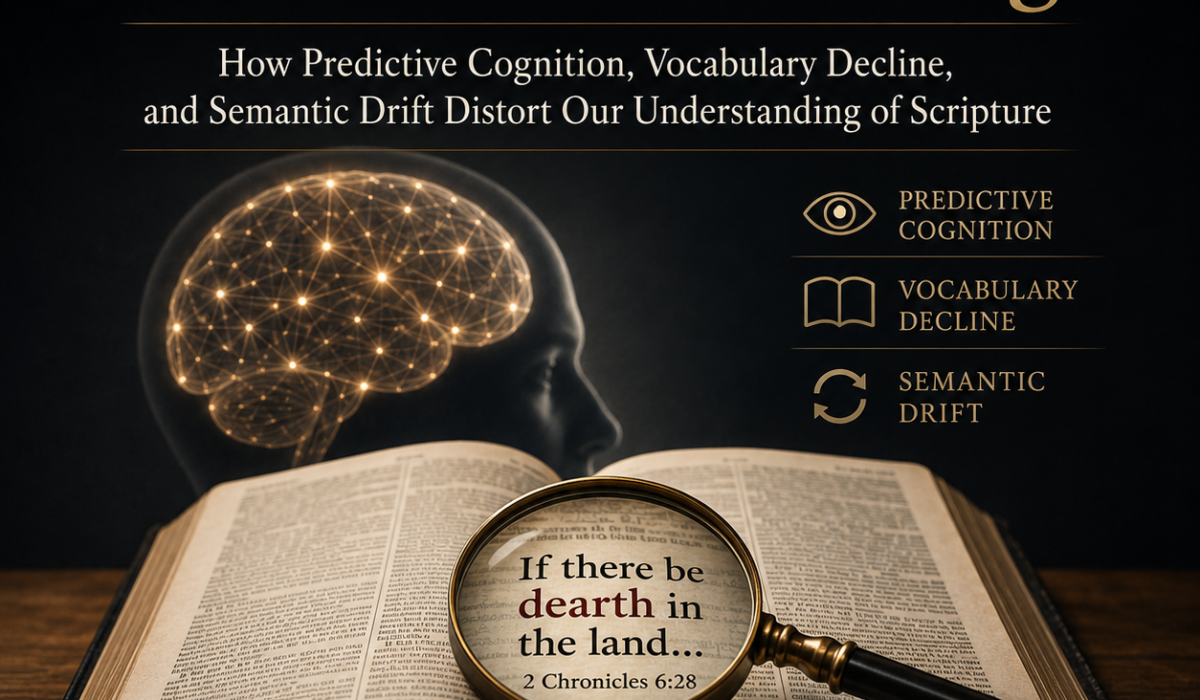
How Predictive Cognition, Lexical Attrition, and Semantic Drift Distort Our Understanding of Scripture
The average Christian believes he is literate. In the most basic sense, he is correct. He can identify letters, pronounce words, and follow sentences well enough to navigate daily life with the proficiency of a 17th century 10 year old. Yet this false confidence conceals a profound weakness. Reading is far more profound than the ability to pronounce words on a page; it is the ability to accurately extract the meaning intended by the author. Cognitive science has demonstrated that the human brain is an active prediction engine. It constantly anticipates what it expects to see, fills in gaps, substitutes familiar patterns for unfamiliar ones, and unconsciously “corrects” perceived anomalies. This remarkable efficiency allows fluent readers to process text rapidly. It also makes them exceptionally vulnerable to misunderstanding literature.
Nowhere is this vulnerability more evident than in the reading of the King James Bible and other pre-1900 texts. Unlike contemporary English, the Authorized Version (and other peak English literature) preserves a vocabulary shaped by the linguistic conventions of the early seventeenth century. Many of its words remain English, but their meanings have shifted dramatically over the past four centuries. Others have disappeared from daily vocabulary altogether. Consequently, millions of readers unknowingly import modern definitions into ancient words or unconsciously substitute unfamiliar vocabulary with more familiar alternatives. The result is often a complete alteration of the intended meaning in Scripture. The danger is that most readers never realize they have misunderstood it.
The present study builds upon themes explored in my earlier essays, The Death of Conversation , The Great Lexical Impoverishment and the Floccinaucinihilipilification of English. and The Shrinking Tongue: On the Withering of English Expression in an Age of Infinite Words Those articles examined the cultural consequences of shrinking vocabulary and deteriorating discourse. This essay advances the discussion one additional step by demonstrating how those same linguistic deficiencies directly affect the modern Christian’s ability to read and accurately understand the Scriptures.
I. The Brain Does Not Read Every Letter
Contrary to popular intuition, the human brain does not read by examining every individual letter in sequence. More than a century of psychological research has shown that fluent reading relies heavily upon pattern recognition, contextual prediction, and lexical familiarity. The brain constructs expectations without conscious awareness, allowing experienced readers to process thousands of words per minute with remarkable efficiency. This phenomenon has been documented extensively within the fields of cognitive psychology and psycholinguistics. Researchers such as Keith Rayner, whose pioneering work on eye movements transformed the scientific study of reading, demonstrated that readers frequently identify words from only partial visual information while relying heavily upon surrounding context to complete recognition.
This predictive process is ordinarily beneficial by allowing the reader to move effortlessly through familiar material. Unfortunately the same mechanism introduces systematic errors whenever unfamiliar vocabulary is encountered. Rather than pausing to investigate an unknown word, the brain often substitutes the nearest familiar equivalent without conscious awareness. The reader experiences a complete false confidence while simultaneously misunderstanding the text. This is an observable feature of human cognition.
Consider the simple example found in 2 Chronicles 6:28. The King James Bible reads, “If there be dearth in the land…” Most readers who have never encountered the word dearth frequently report reading it as death. The substitution is understandable. Both words possess nearly identical visual structures, share overlapping contextual associations, and differ by only a single internal letter. The mind unconsciously replaces the unfamiliar with the familiar, fundamentally changing Solomon’s meaning from famine to mortality.
The same principle explains why readers regularly misunderstand words such as conversation, prevent, quick, charity, meat, peculiar, and let. The eyes faithfully encounter one word while the mind silently supplies another. Daniel Kahneman observed in Thinking, Fast and Slow that the human mind continually constructs coherent narratives from incomplete information, favoring cognitive ease over analytical precision. Correspondingly, reading functions in a parallel way. The brain prefers what is probable over what is actually present.
Scripture emphasizes careful attention to words. Christ declared, “Man shall not live by bread alone, but by every word that proceedeth out of the mouth of God” (Matthew 4:4). If every word matters, then every misunderstood word matters equally. The scientific evidence and the biblical testimony converge upon the same conclusion: careful reading requires deliberate resistance against the brain’s natural tendency toward prediction.
II. Vocabulary is Key in Determining Comprehension
Reading comprehension rises and falls with vocabulary. Educational research has identified vocabulary knowledge as the strongest predictor of comprehension across virtually every discipline. Isabel Beck, Margaret McKeown, and Linda Kucan have argued that vocabulary is the central foundation of reading. A reader cannot accurately understand words whose meanings he does not possess, and whose comprehension alludes him.
English encompasses an extraordinarily large lexicon. The exact number varies depending upon whether obsolete, technical, scientific, and derivative forms are counted, but comprehensive dictionaries document hundreds of thousands of distinct entries (600,000+). Meanwhile numerous educational studies estimate that the average adult actively recognizes only a fraction of that total. Even highly educated readers command only a small fraction of the available vocabulary. This reality is simply the consequence of finite experience within an extraordinarily expansive language.
The difficulty is especially pronounced when approaching historical texts. Words preserved in seventeenth-century English frequently retain meanings no longer dominant within contemporary speech. Consequently, readers unconsciously assign modern definitions to older vocabulary. Conversation becomes spoken dialogue rather than one’s conduct. Prevent becomes hinder rather than precede. Quick becomes fast instead of living. Study becomes academic research rather than diligent effort. Every substitution quietly distorts the original conveyed meaning and interpretation.
This problem extends well beyond isolated vocabulary. It affects theological understanding. A single misunderstood word often redirects the interpretation of an entire passage. Because readers do not recognize the substitution, confidence increases alongside misunderstanding. This phenomenon resembles what psychologists describe as the “illusion of explanatory depth,” in which individuals believe they understand concepts far more thoroughly than objective testing reveals.
The Scriptures encourage the pursuit of wisdom through understanding. Proverbs 4:7 states, “Wisdom is the principal thing; therefore get wisdom: and with all thy getting get understanding.” Understanding presupposes correct definitions. Words possess objective meanings established by authorial intent.
The solution is neither intimidation nor abandonment of older translations. Rather, it is disciplined humility. Christians must cultivate the habit of pausing whenever a word appears unfamiliar or surprisingly ordinary. Consulting historical dictionaries, cross-references, and lexical resources transforms apparent obstacles into opportunities for deeper comprehension. Every newly understood word expands not only one’s vocabulary but one’s ability to hear Scripture as intended.
III. Vocabulary Size Is Not Enough: Why Thousands of Unknown Words Can Change the Meaning of Scripture
The ability to recognize written words is not synonymous with the ability to understand them. Modern linguistic research distinguishes between active vocabulary (the words an individual regularly uses in speech and writing) and receptive vocabulary (the considerably larger body of words that one can recognize and comprehend) when encountered in print. Even among highly educated native English speakers, these vocabularies differ substantially, and both represent only a fraction of the total breadth of the English language. Estimates vary depending upon the methodology employed, but researchers generally agree that English possesses hundreds of thousands of words (600,000+), while the vocabulary commanded by the average speaker is dramatically smaller. Furthermore, studies demonstrate that vocabulary breadth remains the strongest predictor of reading comprehension, particularly when readers encounter historical, technical, or literary texts not commonplace in modern conversational English.
Before examining the relationship between vocabulary size and biblical comprehension, it is important to recognize that vocabulary is not simply a repository of definitions but the fundamental instrument of human cognition. As I wrote in The Great Lexical Impoverishment and the Floccinaucinihilipilification of English, “Before men cease speaking well, they cease thinking well; and before they cease thinking well, they cease possessing the linguistic apparatus necessary for sophisticated thought.” That observation forms the foundation of the present discussion. If vocabulary constitutes the apparatus of thought, then biblical interpretation necessarily depends upon the quality of that apparatus. The mind cannot accurately distinguish meanings for which it possesses neither the vocabulary nor the historical framework. Consequently, the issue is not simply how many words a person knows, but whether he possesses the particular historical vocabulary required to recognize the distinctions preserved within the biblical text.
This is particularly significant when approaching the King James Bible. Depending upon the method of counting, the Authorized Version contains approximately 13,000+/- unique English word forms distributed across nearly 800,000 words of text. At first glance, this appears to present a daunting linguistic challenge. In reality, however, the difficulty does not arise because readers fail to recognize thousands of words. The overwhelming majority of the Bible consists of vocabulary that remains familiar to even the lay English speaker. The challenge lies elsewhere. It lies within a comparatively small body of historical vocabulary whose meanings have either disappeared from common usage or undergone substantial semantic change during the past four centuries.
This observation reveals an important principle of reading comprehension. The important question is: Which words does the reader not know? A legal contract may contain hundreds of ordinary words and a single technical term upon which the entire agreement depends. A medical diagnosis may hinge upon one unfamiliar anatomical expression. Likewise, biblical interpretation is frequently governed by a relatively small collection of historically significant words whose meanings shape entire passages. If those words are misunderstood, the reader may correctly understand ninety-eight percent of the sentence while entirely missing its intended message.
Consider once more Solomon’s prayer in 2 Chronicles 6:28. “If there be dearth in the land…” A reader unfamiliar with the word dearth is likely to unconsciously substitute the far more familiar death. Only one letter changes, and the entire context shifts from agricultural famine to mortality. The error occurs without conscious awareness because predictive reading instinctively favors familiar vocabulary over unfamiliar forms. Similar substitutions occur repeatedly throughout Scripture. Conversation becomes spoken dialogue rather than manner of life. Prevent becomes hinder instead of precede. Quick becomes fast instead of living. Let becomes permit instead of restrain. Charity is reduced to charitable donations rather than self-sacrificial love. These mistakes arise not from intellectual deficiency but from a combination of lexical impoverishment and importing contemporary English into a four-hundred-year-old text.
Cognitive psychology offers a compelling explanation for this phenomenon. The human brain does not process every letter independently; it predicts what it expects to encounter based upon context, familiarity, and previous experience. When an unfamiliar word appears, the mind frequently supplies the closest familiar equivalent, producing the illusion of accurate reading while quietly altering the author’s intended meaning. Researchers studying eye movements and lexical processing have demonstrated that fluent readers rely heavily upon contextual prediction rather than exhaustive letter-by-letter decoding. Under ordinary circumstances this mechanism dramatically increases reading speed and efficiency. When reading historical literature, however, the same mechanism becomes a source of systematic error.
The practical implication is profound. A Christian need not misunderstand thousands of words in order to misunderstand Scripture. He need only misunderstand the relatively small collection of historically significant words upon which interpretation depends. Those few hundred words appear repeatedly throughout the biblical text, quietly influencing doctrine, application, historical context, and theological precision. Consequently, the path toward deeper biblical understanding does not require mastering the entire English language. It requires the deliberate recovery of those historical words whose meanings have faded from modern speech. Every such word restored is another barrier removed between the reader and the inspired text, allowing Scripture to resound in its own voice.
IV. The Decline of Classical Literacy and the Modern Reader’s Disadvantage
If vocabulary determines comprehension, an obvious question then follows: Why do contemporary readers struggle with vocabulary that earlier generations handled with ease? The answer lies not primarily in the Bible, but in the history of English education. While it is true that English has evolved considerably since 1611, this explanation is only partially correct. The greater change has occurred within the reader. The vocabulary, literary exposure, and historical language training once considered ordinary components of a child’s education have steadily diminished over the past century. Consequently, many readers now approach the Scriptures with a linguistic disadvantage that previous generations simply did not possess, and could not imagine.
For approximately three centuries, the King James Bible occupied a singular position within the English-speaking world. It served as the principal instrument of literacy and education. Children in Britain and America routinely learned to read from biblical passages, memorized extensive portions of Scripture, and encountered the language of the Authorized Version in homes, churches, and schools on a daily basis. Educational texts such as the New England Primer and the widely influential McGuffey Readers drew heavily from biblical language and moral instruction, reinforcing vocabulary that current readers regard as foreign. The language of the King James Bible was therefore the dialect for theologians and school children alike, as it formed the ordinary linguistic environment of English-speaking society.
As argued more extensively in The Great Lexical Impoverishment and the Floccinaucinihilipilification of English and The Shrinking Tongue: On the Withering of English Expression in an Age of Infinite Words, vocabulary is the architecture of thought. Every lost word narrows the range of distinctions the mind is capable of making. Consequently, a shrinking vocabulary diminishes perception. We therefore approach Scripture with fewer conceptual tools than many of our predecessors possessed.
Moreover, classical education demanded far more than simple literacy. A well-educated student of the eighteenth or nineteenth century studied Latin, often Greek, and regularly read Shakespeare, Milton, Bunyan, and other foundational works of English literature. Public recitation, memorization, rhetorical exercises, and careful grammatical analysis were standard features of instruction rather than specialized academic pursuits. Such training cultivated the ability to pronounce words and the capacity to recognize historical vocabulary, identify semantic nuance, and interpret language according to intended context. Modern educational research consistently identifies vocabulary breadth as the strongest predictor of reading comprehension, and many studies have demonstrated that extensive exposure to complex literature substantially expands lexical knowledge and long-term comprehension. The educational practices of earlier generations naturally reinforced these abilities.
By contrast, contemporary education emphasizes functional literacy over classical mastery. Students graduate possessing sufficient reading skills for everyday communication while having encountered comparatively little historical English. The average reader today is therefore far more likely to confront words such as dearth, conversation, prevent, quick, peculiar, charity, or let without ever having learned their historical meanings. Predictive reading then fills the gap, replacing unfamiliar vocabulary with familiar modern equivalents and silently altering the Scripture’s intended meaning. The King James Bible has not become unintelligible. Rather, the linguistic formation of the average reader has degraded.
This is an objective observation and should not be interpreted as an argument for intellectual elitism, nor does it suggest that Scripture has become inaccessible. On the contrary, it demonstrates that careful study remains both necessary and reasonably attainable. Every unfamiliar word presents an unparalleled opportunity to expand one’s understanding and and depth of comprehension. The solution is to raise the standard of biblical literacy. Christians must aspire to become students of language as well as students of theology, recognizing that every newly understood word equips them to hear the voice of Scripture with greater clarity and greater fidelity. The challenge before us is therefore to recover the disciplined habits of reading that earlier generations rightly regarded as indispensable.
V. Predictive Reading Produces Theological Error
Not every doctrinal misunderstanding originates from philosophical bias. Some begin with the misreading of considerably ordinary words. Human beings naturally assume they understand the things they read. Rarely (if ever) do they suspect that a misunderstanding has occurred. Yet predictive reading introduces precisely this danger. By altering vocabulary, it quietly alters theology.
Consider Christ’s instruction, “Suffer little children to come unto me” (Mark 10:14). We likely associate suffer exclusively with pain or hardship. The original meaning, however, is “permit” or “allow.” The verse is not commanding children to endure suffering but commanding adults not to prevent them from approaching Christ. Likewise, Paul’s statement that “we which are alive… shall not prevent them which are asleep” (1 Thessalonians 4:15) appears confusing until you recognize that prevent historically meant “precede.” Suddenly the passage becomes entirely coherent.
Historical linguistics demonstrates that semantic change is a normal (albeit destructive) feature of every living language. Meanings broaden, narrow, shift, or disappear over centuries. The Authorized Version has remained stable while English has continued evolving/devolving. Consequently, readers must cross a historical bridge if they wish to understand Scripture accurately.
Theologians have long recognized the importance of lexical precision. Gordon Fee and Douglas Stuart observed that “a text cannot mean what it never meant.” Authorial intent remains the governing principle of sound interpretation. Readers therefore possess an obligation to understand the words according to their historical usage.
This responsibility extends beyond ministers and scholars. The Bereans were commended because they “searched the scriptures daily” (Acts 17:11). Their diligence consisted not of passive reading but active investigation. They verified, questioned, compared, and examined.
Predictive reading discourages precisely this discipline because it creates the illusion of effortless understanding. The danger is subtle. A reader who knows he is ignorant may seek instruction. A reader who mistakenly believes he already understands will not. Confidence has become the enemy of correction in this way.
Scientific research confirms that metacognition (the ability to evaluate one’s own understanding accurately) is imperfect. People routinely overestimate their comprehension. Scripture warns similarly: “There is a way which seemeth right unto a man, but the end thereof are the ways of death” (Proverbs 14:12). Intellectual humility, therefore, is a biblical command.
VI. Recovering Precision Through Deliberate Focus
The remedy for predictive reading is intentional, focused reading. Precision requires discipline. Every unfamiliar word should become an invitation to investigation rather than an excuse for assumption. The great students of Scripture revered throughout history consistently displayed this habit. They treated every word as significant because they accurately believed every word was inspired.
Historical dictionaries remain valuable tools available to Bible students. Noah Webster’s 1828 American Dictionary of the English Language preserves many definitions far closer to seventeenth-century usage than our modern dictionaries. The Oxford English Dictionary documents semantic development across centuries, allowing readers to identify historical meanings with acceptable accuracy. Lexicons, concordances, and parallel passages further illuminate vocabulary through biblical context.
Reading aloud also proves quite beneficial. Eye-tracking studies have shown that vocalization slows predictive processing sufficiently to increase conscious attention to individual words. Likewise, comparing multiple occurrences of the same term throughout Scripture allows meaning to emerge naturally from repetitive biblical usage.
Equally important is the cultivation of intellectual humility. Every reader, regardless of education, remains vulnerable to cognitive shortcuts. Degrees do not eliminate predictive reading, and familiarity does not prevent semantic substitution. The more confident one becomes, the more necessary deliberate verification becomes.
Psalm 119 celebrates careful meditation upon God’s law. The psalmist delights in Scripture, ponders it, remembers it, and studies it without ceasing. Such language reflects sustained contemplation.
Our modern culture prizes speed and laziness. The digital age rewards immediate answers and abbreviated attention spans. Scripture rewards patience. Truth yields itself gradually to the diligent rather than instantly to the hurried. Proverbs contrasts wisdom with haste, observation with presumption, and understanding with superficial knowledge.
Scientific evidence and biblical wisdom therefore point toward the same practical conclusion. Accurate reading requires conscious resistance against unconscious habits. Every unfamiliar word deserves examination. Every surprising phrase deserves reflection. Every assumption deserves testing. Such habits will transform Bible reading from passive consumption into disciplined study, allowing the inspired text (not the reader’s expectations) to determine meaning.
VII. Every Word Matters Because God Chose Every Word
The doctrine of verbal inspiration carries tremendous unavoidable implications. If God inspired the words of Scripture, then words cannot be treated as interchangeable. Every noun, verb, adjective, and conjunction contributes to the intended meaning. Christ built theological arguments upon individual words and even grammatical forms. His defense of the resurrection in Matthew 22 rests upon the present tense of God’s declaration to Moses: “I am the God of Abraham…” Such reasoning demonstrates profound confidence in verbal precision.
We are taught that broad ideas matter while individual words are less important, or even negotiable. Scripture teaches the opposite. Psalm 12:6 tells us, “The words of the LORD are pure words.” Christ further affirmed that “one jot or one tittle shall in no wise pass from the law” (Matthew 5:18). Such statements elevate careful reading from simple academic exercise to a moral and spiritual responsibility.
Every unnoticed substitution therefore possesses consequences. If dearth becomes death, famine becomes mortality. If conversation becomes dialogue, conduct becomes speech. If quick becomes fast, life becomes speed. Each alteration may appear insignificant in isolation, yet collectively they reshape entire passages and, in some cases, influence doctrinal understanding.
This reality should encourage renewed diligence. The Bible remains wonderfully understandable. Its central message of redemption shines clearly throughout its pages. But faithful stewardship demands continual growth in understanding. Peter commands believers to “grow in grace, and in the knowledge of our Lord and Saviour Jesus Christ” (2 Peter 3:18). Growth presupposes that our present understanding will forever remain incomplete.
Scientific investigation into reading cognition has (unexpectedly to the world) reinforced this biblical principle. Human perception is imperfect. Memory is imperfect. Prediction is imperfect. God’s Word alone remains perfect. Therefore the faithful student will continually submit his assumptions to the text rather than forcing the text into his assumptions.
The highest compliment a Christian can pay Scripture is careful attention. To slow down, verify meanings, examine historical usage, and compare passage with passage is not pedantry. It is reverence. It acknowledges that divine revelation deserves more than casual familiarity, it deserves disciplined precision.
The Christian who learns this habit will soon deepen his understanding of the word, and the word being God, thereby deepening his understanding and relationship with God.
Conclusion
The greatest obstacle to understanding Scripture is often the confidence of the reader. Predictive reading, semantic drift, and limited historical vocabulary combine to create an illusion of comprehension that is difficult to detect precisely because it feels effortless. Science demonstrates that the human mind is fully capable of seeing words that are not there, assigning meanings that were never intended, and overlooking distinctions that fundamentally alter interpretation. Such findings should undermine confidence in ourselves and encourage diligence while reading.
If The Death of Conversation examined the erosion of meaningful discourse, and The Great Lexical Impoverishment and The Shrinking Tongue: On the Withering of English Expression in an Age of Infinite Words explored the shrinking vocabulary that made such discourse inevitable, then this essay demonstrates the theological consequence of both. A civilization that no longer speaks with precision will cease reading precisely. When vocabulary contracts, comprehension contracts with it. When comprehension contracts, Scripture will begin to say what the reader expects rather than what God inspired.
The solution is both scholarly and biblical: read carefully, define precisely, question assumptions, and allow the text to speak in its own historical voice. Every unfamiliar word is an opportunity rather than an obstacle. Every careful definition is an act of reverence. The student who refuses to substitute his assumptions for historical meanings will become a more faithful interpreter of the Word of God. As Solomon wrote, “Incline thine ear unto wisdom, and apply thine heart to understanding” (Proverbs 2:2). In an age of hurried reading, careful reading is an act of obedience.