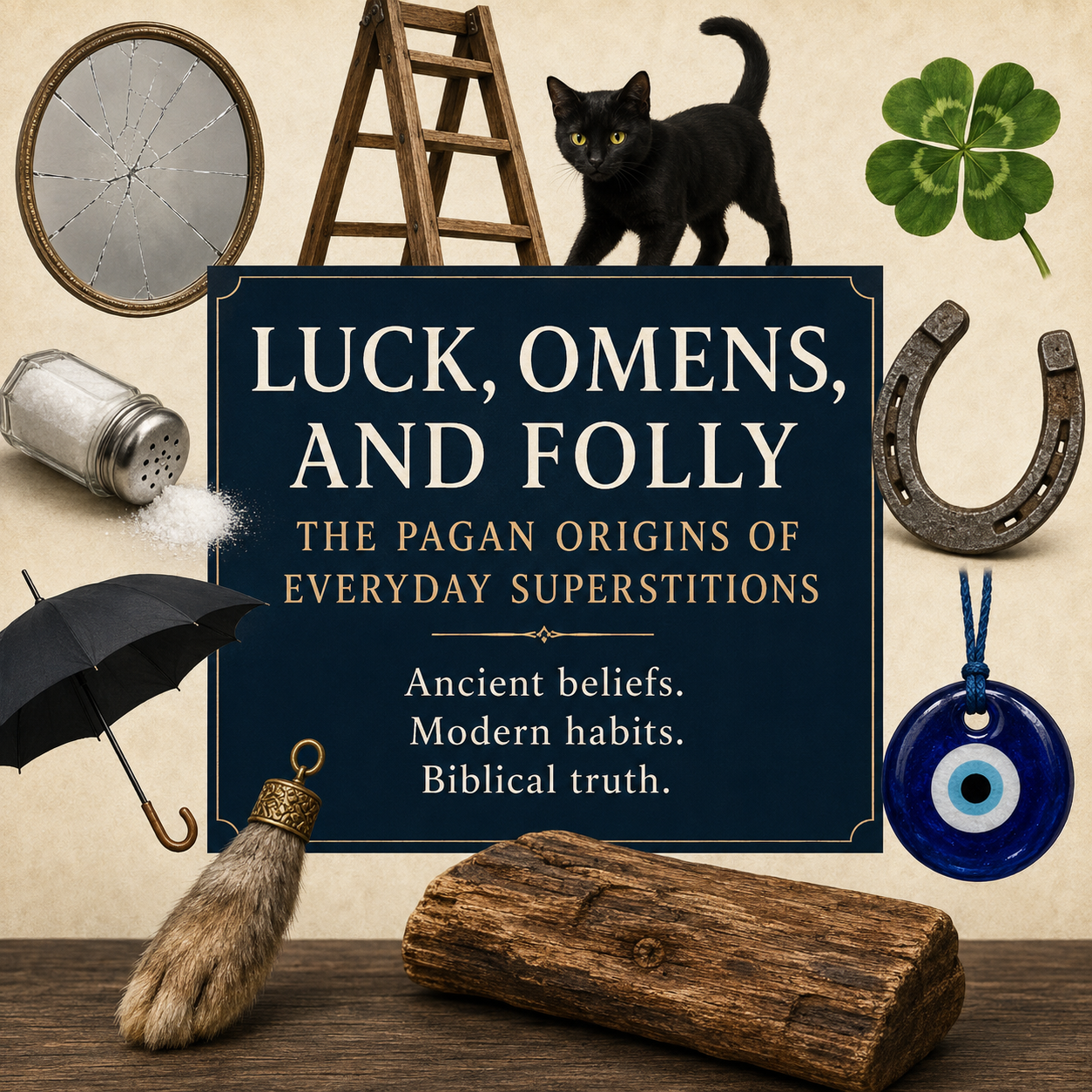
How Ancient Idolatry Still Hides in Modern Habits
Most Christians consider themselves far too intelligent to believe in magic. They scoff at fortune tellers, roll their eyes at crystal healers, and laugh at stories of witches stirring cauldrons beneath a full moon. But most of these same people will hesitate before walking under a ladder, feel a moment of concern when a black cat crosses their path, or instinctively knock on wood after mentioning a favorable outcome. They reject the label of superstition while faithfully practicing its rituals. Such contradictions reveal that ancient paganism has a remarkable ability to survive long after its temples have crumbled.
The Bible condemns attempts to manipulate fate, interpret omens, or seek protection through charms and rituals. Scripture teaches that the future belongs to God and providence governs events. Countless customs from pagan civilizations have been passed from generation to generation until their origins have been forgotten. What remains are cultural habits divorced from their original religious context but still carrying the same underlying assumptions. This series will examine some of the most enduring superstitions in human history, tracing their origins, meanings, and survival into modern society. We will begin with ten of the most familiar examples, beliefs so common that many practice them without ever asking where they came from or whether they have any place in a biblical worldview.
I. Seven Years of Bad Luck: The Broken Mirror
Few superstitions are more recognizable than the belief that breaking a mirror brings seven years of bad luck. The origin of this idea can be traced to the ancient Romans, who believed a person’s reflection in the mirror was connected directly to the soul. Damaging a mirror was thought to damage the spiritual essence of the individual reflected within it.
The Romans also held that human life renewed itself in seven-year cycles. If a person’s soul was harmed or damaged through the destruction of a mirror, recovery would supposedly require an entire cycle of renewal. Thus emerged the notion of seven years of misfortune. The assumption beneath the belief is that physical objects possess spiritual power, and fate can be altered through accidental contact with those objects. This is not only bad science, but dangerous theology.
Over the centuries, the pagan origins slowly faded while the superstition remained. Today, many people who would never consult an oracle still feel a twinge of concern when they break a mirror. Some even perform rituals to counteract the supposed curse. The irony is amusing, a society capable of placing a rover on Mars still fears the supposed spiritual consequences of a cracked mirror..
Scripture uses a mirror as a tool. James uses a mirror as an illustration of self-examination (James 1:23–25). The future is not determined by broken household items but by God’s sovereign providence. The broken mirror superstition survives because people continue to crave control and place power in physical things. Ancient Rome supplied the myth, our culture simply repackaged it.
II. The Ladder and the Triangle of the Gods
The fear of walking under a ladder is another superstition whose roots stretch deep into pagan antiquity. Ancient Egyptians viewed the triangular shape formed by a ladder leaning against a wall as sacred. Triangles were associated with divine power and the realm of the gods. Passing through that sacred shape was considered an act of disrespect that would invite supernatural punishment. Later the Druids continued this myth and used ladders leaning against homes where someone had died to help their spirit rise, interrupting this process by walking under the ladder was thought to doom the soul to wandering the earth for eternity.
As centuries passed, the symbolism evolved. Medieval Europeans connected the ladder to Christian imagery, particularly depictions of the crucifixion. Ladders frequently appeared in artwork portraying Christ’s execution and ascension. Walking beneath one came to be associated with misfortune, sacrilege, and even death. The superstition absorbed new imagery while retaining the same underlying principle: certain physical arrangements possessed mystical significance capable of affecting human destiny.
Practical considerations undoubtedly reinforced the belief. Anyone who has ever seen a hammer fall from a ladder can appreciate the wisdom of avoiding the area beneath it. But common sense has become intertwined with superstition. Rather than avoiding danger, we began avoiding imagined spiritual consequences.
Biblical wisdom encourages prudence. Proverbs repeatedly praises foresight and caution. Avoiding a ladder because tools may fall is wisdom. Avoiding it because invisible forces might alter your fortune is ridiculous superstition. Only one of those is grounded in reality.
The persistence of this belief demonstrates how easily practical advice can become spiritual folklore. Somewhere along the way, sensible caution acquired mystical baggage. Today almost no one cannot explain why walking under a ladder is supposedly unlucky, but the superstition endures. The ritual survives like an abandoned shrine standing long after the worshippers have disappeared.
III. The Black Cat’s Ancient Reputation
Few animals have suffered more damage to their public relations department than the black cat. For centuries, these creatures have been regarded as omens of misfortune throughout the Western world.
In ancient Egypt, cats were highly esteemed and associated with the goddess Bastet. They were protected, honored, and in many cases mummified. Far from being feared, cats were considered symbols of blessing and protection. As Christianity spread throughout Europe and pagan religions declined, many former pagan symbols acquired negative associations. The black cat became one of them.
During the Middle Ages, widespread fears concerning witchcraft transformed the cat’s image. Folklore claimed witches could transform into black cats or use them as supernatural companions known as familiars. Stories spread of cats appearing before disasters, attending secret gatherings, or serving dark spiritual powers. Evidence was never required, as we know, once fear gains momentum, facts become optional.
The result has been centuries of suspicion toward an entirely innocent animal. In some regions, a black cat crossing one’s path became a warning of impending disaster. Curiously, other cultures developed the exact opposite belief and considered black cats symbols of good fortune. Such contradictions reveal the arbitrary nature of superstition. Apparently the same cat can deliver blessings in one country and curses in another without changing anything.
The Bible never assigns spiritual significance to the color of a cat’s fur. Animals are part of God’s creation. The black cat superstition illustrates how quickly cultural fears can become accepted traditions. A creature once associated with pagan blessing later became associated with pagan fear. Human imaginations did all the work.
IV. Knock on Wood: Consulting the Spirits in the Trees
Of all the superstitions examined in this article, “knocking on wood” may be the one most commonly practiced by people who insist they are not superstitious. Mention a favorable circumstance, express hope for a future outcome, and watch how quickly hands begin searching for the nearest wooden surface. The ritual is so deeply embedded in modern culture that many perform it without a moment’s reflection, and its origins are unmistakably pagan.
Ancient animistic religions taught that spirits inhabited natural objects, particularly trees. Celtic tribes, Germanic pagans, and numerous other cultures believed certain trees were dwelling places of divine beings and protective spirits. Touching or knocking upon wood was thought to invoke their favor, protection, or assistance. In some traditions, the act also concealed one’s good fortune from malevolent spirits who might otherwise become jealous and interfere.
The progression of the practice is remarkable. This Pagan ritual has remained quite popular. Modern people who would never pray to a tree spirit still perform a gesture intended to do just that. The theological foundation has been removed, but the habit survives.
Scripture directs believers away from such practices. The prophets repeatedly condemned the worship of sacred trees and groves. Isaiah mocked those who cut down a tree, burned part of it for warmth, and then worshiped the remainder (Isaiah 44:14–19). The biblical answer to uncertainty is trusting God’s providence. The Christian does not need to knock on wood because he already knows Who governs tomorrow.
V. Salt, Demons, and the Left Shoulder
Spilling salt is annoying. Throwing it over your left shoulder afterward is superstitious. Yet millions continue the practice without any understanding of its origins or purpose.
In the ancient world, salt was an extraordinarily valuable commodity. It preserved food, prevented spoilage, and served economic functions that made it highly prized. Because of its importance, many cultures attached spiritual significance to it. Salt became associated with purity, protection, and the warding off of evil influences.
The specific act of throwing salt over the left shoulder appears to have developed from the belief that evil spirits lurked behind a person’s left side. The right side was traditionally associated with favor and blessing, while the left was linked with misfortune. Tossing salt behind oneself supposedly blinded, repelled, or distracted lurking demons before they could cause trouble.
Like many superstitions, the practice survived long after belief in its underlying cosmology faded. Most people today can not explain why the salt must go over the left shoulder. They simply know that “that’s how it’s done.” Tradition has replaced understanding.
The biblical worldview offers no support for such rituals. While salt carries symbolic significance in Scripture (believers are called the “salt of the earth” (Matthew 5:13)) its power is symbolic. Demons are not thwarted by seasoning, evil spirits do not retreat from table condiments, and God’s protection is not obtained through ritual gestures.
The enduring popularity of this superstition reveals humanity’s persistent desire for simple rituals that promise security, instead of having faith and trusting in God.
VI. The Umbrella Curse
Among the younger superstitions on this list is the belief that opening an umbrella indoors brings bad luck. Unlike many ancient customs, this one developed from a combination of pagan symbolism and sun god worship.
Historians trace its roots to ancient Egypt, where umbrellas and sunshades were associated with divine protection. Because they shielded individuals from the sun (the celestial object linked with Ra) opening one indoors was viewed as an insult to the protective powers it represented. Whether this explanation fully accounts for the superstition remains debated, but symbolic concerns certainly played a role.
The belief gained broader popularity during the Victorian era. Early umbrellas were cumbersome devices with stiff metal ribs and powerful spring mechanisms. Opening one inside a crowded room could easily damage property, break objects, or injure bystanders. Practical caution gradually merged with superstition. Rather than saying, “Don’t open that indoors because you’ll knock over grandmother’s lamp,” people began saying, “Don’t open that indoors because it’s bad luck.”
Such transformations are common in folklore. Practical wisdom acquires mystical explanations, which often prove more memorable than the original reasons. Scripture encourages wisdom rooted in reality. If opening an umbrella indoors risks damaging your chandelier, refrain from doing so. But assigning supernatural consequences to the act moves into the realm of superstition.
The umbrella possesses no mystical power. The future of your family, finances, and health will not be altered by where it happens to be opened. Even so, many people feel an uneasy hesitation when confronted with the situation.
VII. The Four-Leaf Clover and Celtic Magic
Finding a four-leaf clover is greeted with excitement, celebration, and declarations of good fortune. Entire industries have been built around reproducing its image on jewelry, clothing, greeting cards, and decorations. but beneath the cheerful symbolism lies a distinctly pagan heritage.
The association between four-leaf clovers and luck is traced to ancient Celtic traditions. Druids believed certain plants possessed supernatural properties, and rare natural occurrences were viewed as signs of spiritual favor. Because four-leaf clovers occur infrequently, they were regarded as special gifts that granted protection, insight, or access to unseen realms.
Various legends developed over time. Some claimed the clover allowed the holder to see fairies. Others taught it protected against evil spirits and brought success in future endeavors. Whatever the variation, the underlying assumption remained consistent: an unusual plant could alter a person’s fortunes.
As Christianity spread through Europe, belief in fairies and nature spirits gradually declined, but the lucky clover endured. Today, most people who carry a four-leaf clover do not expect to encounter woodland spirits. They simply regard it as a harmless token of luck. The theology has been abandoned while the symbolism has survived.
Scripture attributes blessing to the providence of God. A rare plant may be an interesting feature of creation, but it possesses no power to influence your destiny. Jesus taught that God’s care extends even to the lilies of the field (Matthew 6:28–30), but nowhere does Scripture suggest that carrying one grants supernatural favor.
The four-leaf clover remains popular because people enjoy tangible symbols of hope. Unfortunately, that hope is sorely misplaced.
VIII. Horseshoes, Iron, and Protection from Evil
The horseshoe hanging above a doorway is another readily recognizable symbol of good luck in Western culture. Restaurants display them, homes mount them, and gift shops sell them by the thousands, and nobody understands why.
The superstition originated in ancient beliefs regarding iron. Most pagan cultures viewed iron as possessing supernatural protective qualities. Because it was strong, durable, and difficult to produce, it was thought capable of repelling evil spirits, witches, fairies, and malevolent beings.
The horseshoe combined this belief with folklore surrounding blacksmiths, who were often regarded as possessing mysterious powers because of their mastery over fire and metal. One medieval legend involved a saintly blacksmith who tricked the devil and compelled him to avoid homes displaying horseshoes. Stories such as these reinforced the object’s reputation as a protective talisman.
Over time, debates even emerged regarding proper placement. Some insisted the horseshoe should point upward to hold luck. Others argued it should point downward to pour blessings upon the household. Whenever a superstition develops competing theories about the direction in which luck flows from a piece of farm equipment, one should probably pause and reconsider the entire enterprise.
The biblical worldview rejects talismanic thinking in all forms. Protection comes from God, Psalm 127:1 reminds us that unless the Lord guards the city, the watchman remains awake in vain. A horseshoe cannot guard a home, it cannot repel demons, and it certainly cannot alter providence.
It remains, however, a fascinating reminder of humanity’s enduring desire to transform ordinary objects into spiritual safeguards.
IX. The Evil Eye: Humanity’s Oldest Curse
Among all superstitions still practiced today, the oldest and most widespread is the evil eye. Versions of this superstition appear throughout ancient Mesopotamia, Egypt, Greece, Rome, the Middle East, India, and countless other cultures. It is believed to be humanity’s oldest surviving superstition.
The belief holds that certain individuals can cause harm through envy, jealousy, or malicious intent expressed through a glance. Crops might fail, children might become ill, livestock might perish, or fortunes might change because someone looked upon them with envy. To counter this threat, people developed amulets, charms, symbols, and rituals intended to deflect the curse.
The familiar blue-eye amulet still sold throughout the Mediterranean world represents one of the most enduring examples. Tourists purchase them as souvenirs without realizing they are participating in a pagan tradition thousands of years old.
At its core, the evil eye reflects fear of unseen spiritual forces operating outside God’s providence. It assumes that human envy possesses supernatural power and that protection can be purchased through charms and symbols.
Scripture certainly acknowledges the destructive nature of envy, and Proverbs warns repeatedly against jealousy. But the danger lies in the sinful heart. The irony is striking. Most who reject belief in demons, angels, miracles, and divine judgment will nonetheless wear protective amulets against a curse they cannot explain. Ancient pagan fears have proven remarkably resilient.
The biblical response remains unchanged: trust in God’s sovereignty.
X. The Rabbit’s Foot and Sympathetic Magic
If there is a stranger superstition on this list than carrying the foot of a dead rabbit for good fortune, it does not immediately come to mind. The rabbit’s foot remains one of the most recognizable lucky charms in modern culture.
Its origins lie in a form of pagan belief known as sympathetic magic, the idea that qualities possessed by one object can be transferred to another. Rabbits were associated with fertility, abundance, speed, and survival. Because they reproduced rapidly and seemed remarkably adept at avoiding predators, people concluded that carrying part of a rabbit would transfer those desirable traits to themselves.
Various cultures expanded upon the concept with increasingly elaborate requirements. Some traditions specified that the rabbit had to be captured in a particular place, during a specific lunar phase, by a certain method. The more complicated the ritual became, the more obvious it should have been that human imagination was driving the process.
Nevertheless, the charm endured. By the nineteenth and twentieth centuries, rabbit’s feet were sold commercially in Europe and America. The supernatural assumptions were forgotten, but the object remains a symbol of luck.
Scripture leaves no room for such magical thinking. Blessing is not transferable through animal body parts, and fortune cannot be carried in your pocket. The future is governed by God alone.
The rabbit’s foot ultimately serves as a fitting conclusion to this collection of superstitions. It demonstrates humanity’s remarkable capacity to assign mystical significance to virtually anything. If ancient people could convince themselves that prosperity might be found in the detached foot of a rabbit, perhaps our ancestors were not quite as enlightened as modern textbooks suggest.
Conclusion
A common thread runs through every superstition examined in this article. Whether mirrors, ladders, cats, trees, salt, umbrellas, clovers, horseshoes, amulets, or rabbit’s feet, each originated from the same fundamental impulse: the desire to gain knowledge, protection, or control apart from God. Different cultures supplied different symbols, but the underlying motivation has remained unchanged. Humanity has always chosen visible rituals and idols to invisible faith. Trusting God’s providence requires something far more difficult – Faith!
Scripture warns against omens, divination, charms, and pagan practices because they direct the heart away from dependence upon the Lord. As Moses reminded Israel, “The secret things belong to the LORD our God” (Deuteronomy 29:29). Christians need not fear broken mirrors, black cats, or spilled salt because our confidence rests elsewhere. The God who numbers the hairs on our heads is not thwarted by a ladder, an umbrella, or an unlucky leaf. These superstitions endure because ancient pagan ideas die hard. While truth remains what it has always been: providence belongs to God alone.
Complete Series
Part I: Luck,Omens and Folly
Part II: Pregnancy, Babies, and Generations of Guesswork
Part III: Weather, Wildlife, and Wisdom from the Front Porch
This was a delightful read and abundantly informational. Thank you, Sir.