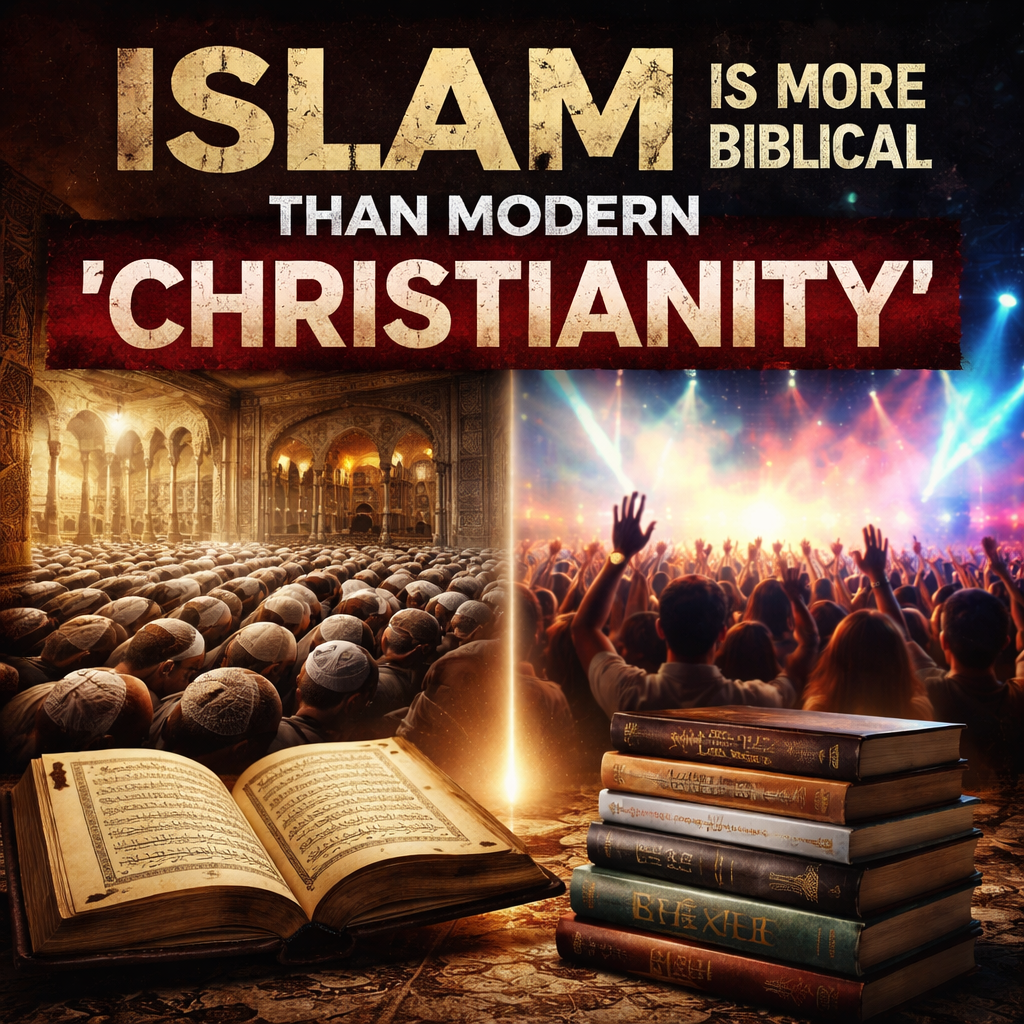
Modern Christianity, at least in its dominant Western expression, has become almost unrecognizable when held up against the standard of Biblical Scripture. What once demanded sacrifice and devotion now offers comfort to the cowardly practitioners thereof. What once required obedience now celebrates personal interpretation. Churches have transformed from houses of doctrine and sanctuaries of truth into businesses and social clubs, where the primary goal is not obedience to God, but attendance, revenue, and cultural approval. The result is a diluted, fragmented, and often contradictory version of Christianity that bears little (if any) resemblance to the faith it claims to represent.
This is a wholesale departure from the foundations of our faith. When the average “Christian” openly ignores commands, redefines sin, reshapes doctrine to fit modern sensibilities, and selects only the palatable portions of Scripture, the question must be asked: by what standard are they still Christian? If beliefs no longer produce obedience, if doctrine is negotiable, and if truth bends to personal preference, then what remains is not Christianity, but a man-made heretical religion.
I: The Religion of Convenience vs. The Religion of Command
At its core, biblical faith is a religion of command rather than convenience. From Genesis to Revelation, Scripture presents a consistent pattern: God speaks, and man is expected to obey (ideally, without question). There is no negotiation, no revision process, and no cultural adaptation clause inserted for the sake of comfort. Whether it was Abraham leaving his homeland, Moses confronting Pharaoh, or Jesus Christ commanding His followers to deny themselves, take up their cross, and follow Him: obedience was required. It was the most obvious and overt defining mark of faith.
Contrast that with modern “Christianity”, where obedience has been quietly replaced with personal preference. The language remains the same (“faith,” “grace,” “love”) but the substance has been hollowed out. Today’s churches often function as environments where individuals curate their beliefs like a playlist. If a command is uncomfortable, it is labeled “contextual.” If a teaching conflicts with modern culture, it is “reinterpreted.” If a passage demands too much, it is simply ignored. The result is a faith that demands nothing and produces even less.
When we compare purely on the basis of visible structure and discipline, Islam often appears (and is) more aligned with the biblical pattern and devotion than modern Christianity. The Qur’an is not treated as a suggestion, but as absolute authority. Practices like modesty, Salah (daily prayer), fasting during Ramadan, patriarchy, submission, and adherence to prescribed conduct are not optional expressions of personal spirituality; they are expected acts of submission. A Muslim does not wake up and decide whether obedience fits their mood that day. The structure exists, the expectation is clear, and the consequences are real to them.
Meanwhile, the average modern Christian often cannot articulate basic doctrine, let alone demonstrate any level of consistent obedience to it. Churches bend over backward to remove offense, soften language, and accommodate lifestyles that Scripture explicitly condemns. Entire denominations split and multiply over disagreements, producing endless variations of belief, each claiming legitimacy while contradicting the others. The authority of Scripture has become secondary to the authority of personal interpretation.
This is by no means an endorsement of Islam’s theology, but an indictment of Christian inconsistency. The issue is not who is “right” in doctrine, but who actually lives according to what they claim to believe. One system, however flawed in truth, demands submission and consistently produces it. The other claims ultimate truth yet tolerates (and even welcomes) open rebellion within its own ranks.
Biblically, this is a fatal problem not to be taken lightly.. Scripture does not recognize any belief that does not result in obedience, “Faith without works is dead” And by that standard, much of what passes for Christianity today is not alive, it is but a hollow shell, maintained by habit, culture, and convenience rather than conviction of the soul.
When obedience becomes optional (as it has) your faith becomes meaningless. And that is precisely where modern Christianity finds itself today, rich in language, poor in substance, and increasingly indistinguishable from the world it was commanded to stand apart from.
II: A Book That Commands vs. A Book That Is Edited
A defining mark of any true religion is how it treats the sacred text responsible for governing it. Not what it claims about that text, but what it actually does with it. Scripture, by its very nature, is not subject to be adjusted to man; man is meant to be adjusted to Scripture. From Deuteronomy comes the clear warning not to add or take away from what God has commanded, and Revelation closes with that same warning. The message is consistent: God’s Word is not clay in the hands of men. The Scripture is divinely inspired, inerrant, fixed, authoritative, and binding for all time.
Modern Christianity has treated the Bible as anything but fixed. Over time, it has produced an ever-growing list of translations, paraphrases, and “updated” versions, most of which are not attempts at “clarity”, but attempts at comfort, often commenting grave heresies. The language is softened, commands are reframed, words like “sin,” “repentance,” and “judgment” are diluted or reinterpreted to avoid offending the cowards, and entire passages are debated, footnoted into irrelevance, or simply ignored in practice. The problem is not translation itself (faithful translation was necessary) but the motivation behind many modern revisions: to reshape Scripture into something more acceptable to the modern world.
The Qur’an, regardless of one’s agreement with its theology, is treated by Muslims with a level of consistency and reverence that modern Christianity fails to show the Bible. It is preserved in a single language, recited, memorized, and guarded with fervor. A Muslim does not approach the text asking, “What parts can I adjust to fit my life?” but rather, “How must my life conform to this sacred text?” The authority ONLY flows one direction – downward.
Meanwhile, most Christians approach Scripture in the reverse. The text is filtered through personal preference, cultural norms, and emotional comfort. If a passage affirms their lifestyle, it is embraced. If it challenges them, it is simply explained away (or ignored). This selective submission creates a dangerous illusion: people believe they are following Scripture, when in reality they are following a bastardized, heretical, pagan version of it.
Even more concerning is the casual attitude toward Scripture in many churches. Bibles are replaced with screens, and deep study is replaced with motivational speaking. Sermons have become entertainment-driven, and carefully crafted not to convict, but to encourage. The Word of God (once feared, studied, and obeyed) is now reduced to a supporting role behind personality-driven “preaching”.
Again, this is not a theological endorsement of Islam, I am simply holding a mirror up to Christianity. One group, though doctrinally in grave error, treats its book as the ultimate untouchable authority. The other claims to possess the true Word of God, yet desacrates it, reshapes it , and obeys it selectively (at best).
If the Word of God is truly His Word, then it cannot be negotiated, edited, modernized into irrelevance, or molded to suit the preferences of the reader. It stands over man, and never under him. And until Christianity returns to that posture (where Scripture commands and man obeys) it will continue drifting further from the very foundation it claims to stand on.
III: Devotion That Costs vs. Devotion That Is Comfortable
Real faith always costs something. This is the expectation of Scripture from the beginning, those who followed God were marked not by convenience, but by sacrifice. Abraham was called to leave everything. Moses gave up his privilege to suffer with his people. The early followers of Jesus Christ lost their status in society. Many lost their homes, their livelihoods, and ultimately their lives. Faith was not something added to life; it became the very thing that reordered it entirely.
Jesus made this unmistakably clear: to follow Him meant to deny oneself, take up the cross, and walk a narrow path. This was not symbolic language about mild inconveniences, but a declaration of total surrender to His will. Biblical faith demands allegiance that overrides our comfort, reputation, safety, and even survival. It is costly by design, because it separates those who truly believe from those who merely claim to.
Now look at what modern Christianity has become in today’s world. The Christian faith has been sold as an accessory to an already comfortable life. Church attendance is optional, obedience is selective, and devotion is often measured by how little it disrupts one’s routine. If following Christ begins to cost too much (socially, financially, or personally) you can simply adjust your beliefs to reduce the tension. The cross, once a symbol of death to self, has now been reduced to a decoration.
In contrast, the visible devotion within Islam often reflects a level of discipline that modern Christianity has been lacking for generations. Practices such as Salah require structured, daily interruption of life, multiple times a day, regardless of how “convenient”. Fasting during Ramadan is a physically demanding act of obedience carried out across an entire community. Public identity as a Muslim often comes with real social, political, or even physical consequences depending on the region. Yet the followers adhere to these practices without apologizing or compromising their beliefs regardless of the consequences.
Again, this is not about affirming the truth of Islam’s doctrine. One group structures life around its faith. The other structures “faith” around its life. One embraces cost as part of devotion. The other avoids cost anytime possible.
A faith that costs nothing is worth nothing. Scripture consistently ties genuine belief to endurance, sacrifice, and perseverance under pressure. The early church did not grow because it was comfortable, it grew because it was committed. It attracted followers by proclaiming and standing for truth regardless of consequence.
Modern Christianity has reversed that model. It seeks to attract by lowering the bar, by removing offense, by offering a version of faith that integrates seamlessly into a self-centered lifestyle. But a faith that asks nothing transforms nothing. If devotion does not cost, it is not devotion. And until Christianity rediscovers the cost of following Christ, it will continue producing adherents who are committed in word, but absent in action.
IV: Unity of Practice vs. Fragmentation of Belief
One of the clearest external markers of a belief system is whether it produces unity or fragmentation. Not uniformity in personality or culture, but unity in doctrine, practice, application and direction. Biblically, unity has always been expected of the brethren. The early church, as seen throughout Acts, operated with shared belief, shared purpose, and shared obedience. They were described as being “of one accord,” not because they were identical individuals, but because they were aligned under a single authority, and with a shared mission.
That authority was the Word of God. There were standards, there was structure, and there was accountability. When disputes arose, they were resolved through appeal to doctrine, not man’s preference. Unity was the byproduct of submission to something higher than the individual. Now compare that to the landscape of modern Christianity. Not unified, but fractured, thousands of denominations, sub-denominations, and independent churches all claim to represent the same truth, yet often contradict one another on fundamental issues. Baptism, salvation, gender roles, morality, authority, core doctrines are debated endlessly, redefined, and reinterpreted. Entire churches are built not on shared conviction, but on shared preferences.
If someone does not like a teaching, they do not submit to correction, they simply leave and find a church that agrees with them. If none exists, they start one. This is not unity, the individual has become the final authority, and doctrine has become so fluid it is no longer recognizable. The result is a religious marketplace where “truth” is whatever the local congregation decides it to be at any given time.
This fragmentation has exposed a deeper issue: when there is no submission to a fixed standard, there can be no lasting unity. What remains is a collection of loosely connected groups, each operating under its own interpretation, each convinced of its own correctness, and none able to claim true alignment with the others.
In contrast, Islam presents a far more unified external structure. Regardless of geography, language, or culture, the core practices remain quite consistent. The Qur’an is the same. The direction of prayer is the same. The daily rhythms of Salah are the same. While there are internal differences within Islam, the visible structure of practice remains strikingly unified across the globe. A Muslim in one country can step into a mosque in another and immediately recognize the pattern, the posture, and know the expectations. Again, this is not a validation of theological correctness. One system produces cohesion in practice. The other produces endless variations.
Biblically, unity is not achieved by tolerance of contradiction, but achieved through shared submission to truth. The more Christianity drifts from that foundation, the more it fragments. And the more it fragments, the less credible it will become, not only to the outside world, but within its own ranks. A divided faith cannot speak with authority, a fractured body cannot move with strength, and a religion that allows every man to define truth for himself will inevitably collapse.
Until Christianity returns to a standard that is above the individual (fixed, binding, based on truth and non-negotiable) it will continue to splinter, dilute, and lose the very thing that once made it powerful: unified conviction under the authority of God.
V: Bold Conviction vs. Apologetic Cowardice
There is a final dividing line that exposes the difference between a faith that is lived and a faith that is claimed: conviction. Public, immovable conviction, the kind that does not bend when pressured, does not retreat when challenged, and does not apologize for existing. Biblically, this was the standard for millenia. The prophets did not negotiate truth, the apostles did not soften their message to avoid backlash, and the followers of Jesus Christ did not hide their allegiance when it became dangerous. Historically Christians PROCLAIMED the gospel, publicly and proudly.
The early church did not grow because it was agreeable, but because it was unwavering. Men stood before rulers, knowing full well the cost, and still refused to compromise. They were imprisoned, beaten, and executed, yet remained steadfast. Why? Because conviction rooted in truth produces real courage. When a man believes something is true, truly true, he will stand on that truth to the death.
Now compare that to much of modern Christianity. What once stood boldly now often speaks in muddled disclaimers, and what once declared truth now couches everything in apology. Christians today frequently feel the need to soften, qualify, or distance themselves from their own beliefs to avoid offending anyone. “That’s not what it really means.” “That was for a different time.” “We don’t want to judge.” The language of conviction has been replaced with the language of cowardly hesitation.
Modern Christians are far more concerned with being liked than being right, more focused on social acceptance than biblical accuracy. When cultural pressure rises, they trample each other in retreat, they backpedal, and they reinterpret. The result is a faith that cannot defend itself because it no longer firmly believes what it claims.
In contrast, Muslims are widely recognized (even by their critics) for their unapologetic conviction. The Qur’an is not treated as something to be explained away, but fiercely defended. Their practices are boldly displayed, not hidden and not diluted for acceptance. They are maintained, even in the face of substantial opposition. Whether one agrees with their theology or not, the consistency of their conviction is undeniable and admirable.
And that consistency commands a certain level of respect. Not because it is correct, but because it is real. Meanwhile, Christianity (claiming to hold ultimate truth) presents itself as uncertain, divided, and hesitant. That contradiction is glaring and revolting, a faith that claims eternal authority should not sound like it is asking permission to exist.
Biblically, cowardice is condemned. Truth is meant to be proclaimed, not whispered. If the message of Scripture is true, then it requires boldness, not apology. The tragedy of modern Christianity is that it has resources, influence, or numbers and lacks conviction. And without conviction, everything else is meaningless.
When belief no longer produces boldness, it has already died.
Conclusion
This issue may be uncomfortable, but it is not complicated. Modern Christianity claims to possess the ultimate truth, the final revelation, the living Word of God. And yet, when examined in practice, it utterly fails to reflect even the most basic biblical expectations of obedience, submission, discipline, unity, and conviction. What remains is no longer a faith defined by Scripture.
Meanwhile, Islam (though doctrinally flawed and ultimately incorrect in its rejection of Jesus Christ as Lord) often demonstrates something modern Christianity has largely abandoned: consistency. It believes, and it acts accordingly. It commands, and its followers submit. It structures life, and its adherents conform to it. One system, though wrong in truth, produces visible obedience. The other claims truth, yet produces indifference.
Because Scripture does not leave room for a faith that is merely claimed but not lived. It does not recognize beliefs without obedience, conviction and action. If Christianity is true (and it is) then it demands our everything, and it will produce in return, transformation.
Until modern Christianity returns to that standard (where Scripture is final, obedience is expected, and conviction is unshakable) it will continue to lose credibility, not only in the eyes of the world, but under the very judgment of the God it claims to serve.
The solution is not to return to the Bible – and actually live it!
this idea is not working for me, Islam cannot be Christian
This article is both depressing and true.
I have always admired their devotion. Just image in the Christian people were that devoted…
Well this was an interesting read