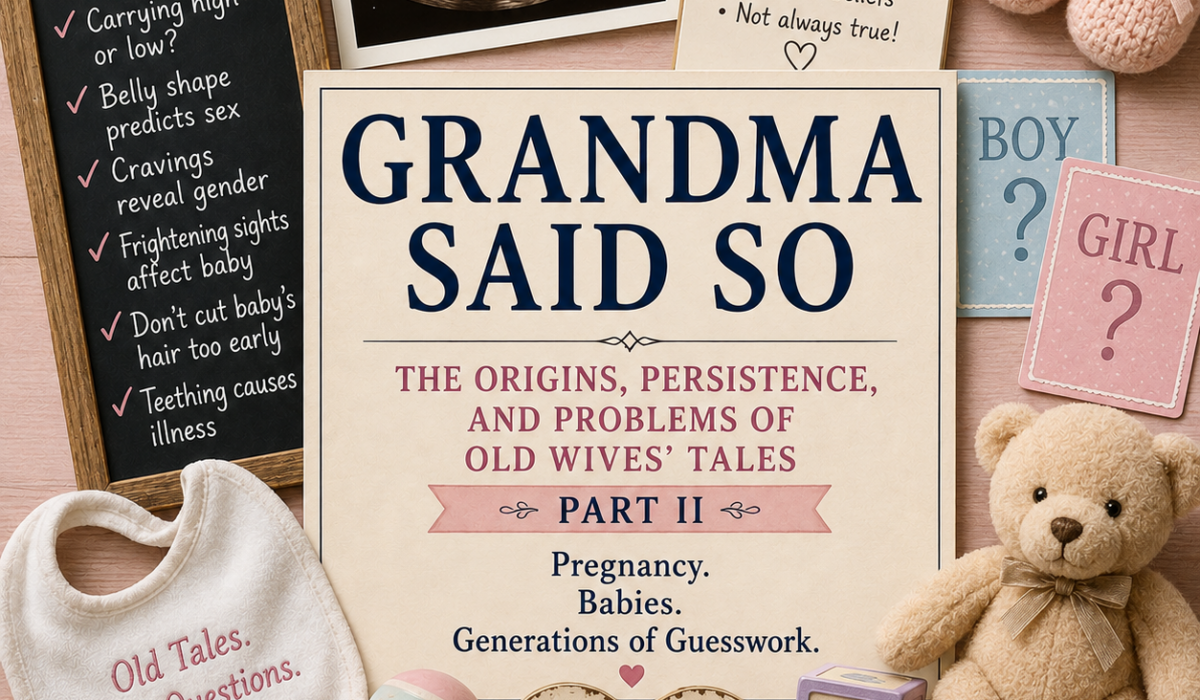
Babies, Bellies, and Generations of Guesswork
Few subjects generate more folk “wisdom” than pregnancy, childbirth, and raising children. Long before ultrasounds, genetic testing, pediatric medicine, and modern obstetrics, families relied on observation, tradition, and a considerable amount of educated guesswork. Some of these traditions emerged from genuine attempts to understand the mysteries of pregnancy. Others arose because human beings are naturally adverse to uncertainty and would rather invent explanations than admit ignorance.
The result is an enormous collection of old wives’ tales concerning unborn children, expectant mothers, and infant development. Some are harmless diversions. Some reflect cultural values and fears. Others attempted to answer questions that science would not solve for centuries. Like the superstitions examined in previous articles, most survived because they occasionally appeared to work. A correct prediction was remembered; the countless failures ignored and quietly forgotten. In this article, we examine seven enduring beliefs surrounding pregnancy, babies, and family life, tracing their origins, meanings, progression, and what Scripture and common sense have to say about them.
I. Heartburn During Pregnancy Means the Baby Will Have Lots of Hair
Among pregnancy-related folk beliefs, few are as widespread as the claim that severe heartburn means the baby will be born with a full head of hair.
The tale developed from observation. Pregnant women experiencing significant heartburn occasionally gave birth to unusually hairy babies. Over time, repeated anecdotes evolved into accepted wisdom.
Unlike many old wives’ tales, however, this one contains a surprising twist. Modern medical research has identified a possible connection. Hormonal changes during pregnancy can influence both fetal hair growth and relaxation of the esophageal sphincter, which contributes to heartburn. Three studies have found a modest correlation between increased heartburn and babies born with more hair.
This does not mean the old wives’ tale is entirely correct. Plenty of women suffer heartburn and deliver relatively bald infants, while others experience little heartburn and produce children who appear ready for a shampoo commercial.
The progression of the tale illustrates an important principle. Occasionally folk wisdom stumbles upon a partial truth through observation before science explains it.
Scripture reminds us that children are blessings from God (Psalm 127:3), regardless of their follicular abundance. The amount of hair present at birth may be interesting, but it says little about the child’s future character or destiny.
For once, Grandma may have been partially right, though she completely lacked an explanation involving pregnancy hormones.
II. Carrying High Means It’s a Girl; Carrying Low Means It’s a Boy
Long before ultrasound technology transformed pregnancy, families searched for clues about a baby’s gender. A commonly enduring method involved examining how the mother carried the pregnancy.
According to the traditional belief, carrying the baby high indicated a girl, while carrying low indicated a boy. Variations exist across cultures, but the basic principle remains consistent.
The origin lies in folk attempts to identify patterns where none truly existed. Because half of all pregnancies result in boys and half in girls, occasional successful predictions were inevitable. Each apparent success reinforced confidence in the method.
As the tradition spread, communities developed elaborate systems of interpretation. Belly position, walking style, facial appearance, food preferences, and even mood were recruited into an increasingly complicated framework of prediction.
Modern obstetrics offers a far less mystical explanation. The position of a pregnancy is influenced by maternal anatomy, muscle tone, fetal position, body type, and countless other factors unrelated to gender. The tale survives because people enjoy speculating. Pregnancy naturally invites anticipation and curiosity.
Before modern medicine, parents did not know a child’s sex until birth. They survived the experience just fine. The old wives’ tale continues because people enjoy making predictions. The fact that the accuracy does not exceed random chance has done little to diminish enthusiasm.
III. The Shape of a Pregnant Belly Predicts the Baby’s Sex
Closely related to carrying high or low is the belief that the overall shape of a pregnant woman’s belly predicts whether she is carrying a boy or a girl.
The usual claim suggests that a pointed or narrow belly indicates a boy, while a wider or rounder appearance suggests a girl. Variations differ by region, but the premise remains.
This belief emerged from the same historical environment that produced countless pregnancy predictors. Before modern diagnostic tools, communities sought observable indicators that might reveal hidden information. Human beings are pattern-seeking creatures, and pregnancy offered abundant opportunities for speculation.
The progression was inevitable. Some predictions happened to be correct. As stories spread confidence grew. Soon entire generations treated the method as “reliable.”
Modern medicine, however, attributes belly shape to factors such as fetal position, maternal body composition, muscle structure, previous pregnancies, and genetics. Gender plays no role in determining whether a pregnancy appears pointed, broad, high, or low.
The tale remains popular because it allows family members to participate in the mystery of pregnancy. It provides conversation, anticipation, and debate.
Scripture places surprisingly little emphasis on predicting the future. Instead, it consistently emphasizes faithfulness in the present. Whether a child is male or female, the biblical responsibility remains unchanged: raise that child in the nurture and instruction of the Lord (Ephesians 6:4).
The shape of a belly may reveal many things. The baby’s gender certianly is not one of them.
IV. Cravings Reveal the Baby’s Gender
Pregnancy certainly does cause abnormal food cravings. When unusual food preferences appear, someone inevitably claims they reveal the baby’s sex.
The traditional version states that sweet cravings indicate a girl while salty, savory, or protein-heavy cravings indicate a boy. Other cultures reverse the categories or create additional rules.
The origins stem from attempts to explain observable differences between pregnancies. Since hormonal changes can affect appetite, taste, and food preferences, people naturally searched for patterns that might predict outcomes.
Human beings remember successful predictions and forget failures. If a woman craves chocolate and later gives birth to a girl, the story is retold for years. The numerous contradictory later examples quietly disappear.
Scientific research has found no reliable connection between specific cravings and fetal gender. Cravings appear more closely related to hormonal shifts, nutritional needs, personal preferences, and psychological factors.
Nevertheless, the tale persists because it provides entertainment during a season filled with anticipation. Few people genuinely stake their retirement accounts on pickle-based gender prediction.
Cravings may reveal what a pregnant woman wants for dinner. Beyond that, their predictive abilities are vastly overrated.
V. Looking at Frightening Things During Pregnancy Affects the Baby
For centuries, many cultures believed that a pregnant woman’s experiences directly influenced the physical appearance of her unborn child. Frightening sights, disturbing events, unusual animals, or shocking experiences were all thought capable of leaving visible marks upon the baby.
This belief, often called “maternal impression,” dates back to ancient Greece and Rome and remained influential well into the nineteenth century. A mother startled by a rabbit might supposedly produce a child with a harelip. Exposure to frightening situations was believed capable of creating birth defects or unusual characteristics.
The theory developed because birth abnormalities had unknown causes. Without genetics, embryology, or modern medicine, societies constructed narratives linking maternal experiences to infant outcomes.
The progression of the belief demonstrates humanity’s tendency to seek causes even when evidence is lacking. Every unusual birth invited speculation and coincidences became proof.
Modern science has thoroughly dismantled the concept. While maternal health, nutrition, stress, and environmental exposures can influence fetal development, simply seeing something frightening does not imprint physical characteristics onto a child.
Scripture rejects magical causation while emphasizing God’s sovereignty over life. Human beings are fearfully and wonderfully made (Psalm 139:14), not mysteriously altered by accidental encounters with unpleasant scenery.
The tale survives largely because pregnancy heightens concern for a child’s well-being. Fear and uncertainty create fertile ground for folklore.
VI. Cutting a Baby’s Hair Before Age One Brings Bad Luck or Affects Growth
Across numerous cultures, parents have been warned not to cut a baby’s hair before a certain age. Some traditions claim it causes bad luck. Others suggest it affects intelligence, growth, speech development, or future health.
The origins vary considerably. In many Pagan societies, hair was viewed as containing spiritual significance or life force. Cutting it prematurely was thought to interfere with proper development. Other later traditions linked early haircuts to vulnerability during infancy, a period when childhood mortality rates were historically high.
As these beliefs spread through families and communities, practical concerns gradually merged with superstition. What began as a Pagan spiritual ritual became folklore.
Modern biology offers no support for the idea. Hair growth occurs independently of intellectual development, physical growth, or future success. Whether a child receives a haircut at six months or eighteen months has zero bearing on adulthood.
The tradition persists because first haircuts carry emotional significance for the mother. Parents naturally associate milestones with deeper meaning.
The Bible never attributes spiritual power to hairstyles. While Scripture occasionally references hair symbolically, it never suggests that haircut timing determines a child’s destiny.
VII. Teething Causes Fever, Illness, and Major Health Problems
Perhaps no childhood old wives’ tale has endured longer than the belief that teething causes significant illness.
For centuries, parents blamed teething for fevers, diarrhea, infections, seizures, behavioral problems, and countless other symptoms. During periods when infant mortality was common, teething frequently received responsibility for a myriad of unrelated conditions.
The reasoning was understandable. Teething occurs during the same developmental stage when children begin encountering numerous illnesses. Symptoms often appeared simultaneously, creating the illusion of causation.
Historical medical records reveal how seriously this belief was taken. Entire treatments were developed to combat the supposed dangers of teething, some of them considerably more dangerous than the teeth.
Modern pediatric research indicates that teething may cause mild discomfort, irritability, drooling, gum tenderness, and the occasional mild fever.
The progression of the tale serves as a cautionary lesson. Misattributing symptoms can delay proper treatment by convincing parents that a genuine illness is merely a normal developmental process. The appearance of tiny teeth is a normal milestone. It is not the source of every childhood ailment that happens to occur at the same time.
VIII. Morning Sickness Means You’re Having a Girl
Among the countless methods developed to predict a baby’s sex, one of the more enduring claims is that severe morning sickness indicates the mother is carrying a girl.
The belief appears to have emerged from centuries of observation. Families noticed that some pregnancies involved far more nausea than others and naturally searched for explanations. Since the baby’s gender remained unknown until birth, every symptom became a potential clue.
As generations compared stories, a pattern seemed to emerge. Women who experienced significant nausea sometimes gave birth to daughters. From this observation grew the familiar prediction that girls make mothers sicker than boys.
Unlike many old wives’ tales, this one contains a small grain of scientific support. Some studies have found that pregnancies involving female babies may be associated with slightly higher levels of certain hormones, which can contribute to increased nausea in some women. However, the relationship is far from reliable. Many mothers carrying boys experience severe morning sickness, while many carrying girls do not.
The progression of the tale illustrates how partial truths evolve into exaggerated certainties. What may have been a modest statistical trend became a supposedly foolproof prediction method.
Scripture never encourages believers to seek hidden knowledge through symptoms and signs. Pregnancy itself is a gift from God, regardless of whether the child is a son or daughter. Morning sickness may reveal something about hormone levels. It is considerably less reliable when scheduling a gender-reveal party.
IX. A Wedding Ring on a String Can Predict the Baby’s Gender
For generations, expectant mothers have suspended a wedding ring from a string above their abdomen and carefully watched its movement. According to the tale, a circular motion predicts a girl while a back-and-forth swing predicts a boy. Other versions reverse the results, which should immediately inspire confidence.
The practice has roots in European folk divination traditions. Throughout history, pendulums, suspended objects, and dangling charms were used to obtain hidden information. The wedding ring version simply adapted these older practices to pregnancy.
The progression was predictable. The ritual required no special equipment, cost nothing, and provided entertainment for family gatherings. Every correct prediction reinforced belief. Every incorrect prediction was quietly forgotten or blamed on improper technique.
Tiny movements of the hand, air currents, muscle tension, and unconscious motions all influence the ring’s movement. This phenomenon, known as the ideomotor effect, explains why pendulums appear to move on their own.
Scripture consistently warns against divination and attempts to obtain hidden knowledge through signs and rituals. The future belongs to God, not to jewelry suspended from sewing supplies.
X. Looking at the Moon During Pregnancy Causes Birthmarks
Among the more imaginative pregnancy-related old wives’ tales is the belief that looking at the moon (particularly a full moon) can cause birthmarks, deformities, or unusual features in an unborn child. Variations of this belief appear throughout Europe, Latin America, Asia, and the Middle East, where expectant mothers were warned against gazing at the moon for too long or during certain phases.
The origins of this tale can be traced to ancient ideas concerning “maternal impression,” the belief that a mother’s experiences, emotions, or observations could physically imprint themselves upon her unborn child. Long before genetics and embryology were understood, people sought explanations for birthmarks, birth defects, and unusual physical characteristics. If a child was born with a distinctive mark, communities searched for something the mother had seen, feared, or experienced during pregnancy. The moon, already associated with mystery, fertility, and feminine cycles in many pagan religions, became a convenient suspect.
As centuries passed, the superstition spread through folklore and family tradition. In some regions, women were warned not to look directly at a full moon. In others, they were told to avoid lunar eclipses or cover their stomachs when outdoors at night. The details differed, but the assumption remained the same: celestial objects could somehow alter fetal development through visual contact or exposure.
Modern medicine has thoroughly rejected the idea. Birthmarks arise from genetic, vascular, or developmental factors. A pregnant woman may admire the night sky as often as she wishes without worrying that the moon is secretly marking her child.
Scripture consistently portrays the moon as part of God’s created order, serving as a marker for seasons and times (Genesis 1:14–18). The tale survives because people naturally seek explanations for life’s mysteries. Unfortunately, folklore and Pagan traditions often supplied answers. The moon may illuminate the night, but it has never been in the birthmark business.
Conclusion
The old wives’ tales surrounding pregnancy and childhood reveal both the strengths and weaknesses of folk wisdom. Human beings observed patterns, recorded experiences, and attempted to understand mysteries long before modern science supplied better answers. Occasionally those observations uncovered genuine truths. More often they produced entertaining theories that survived because they offered certainty in situations filled with uncertainty.
Scripture consistently directs believers toward wisdom grounded in truth rather than speculation. Children are blessings from God, not puzzles to be solved through cravings, belly shapes, or haircut schedules. While family traditions can be enjoyable, they should never replace sound judgment or reliable knowledge. As Proverbs reminds us, “The simple believes every word, but the prudent considers well his steps” (Proverbs 14:15). Grandma’s advice deserves a hearing, but never unquestioning acceptance!
Complete Series
Part I: Health, Sickness, and Folk Medicine
Part II: Pregnancy, Babies, and Generations of Guesswork
Part III: Weather, Wildlife, and Wisdom from the Front Porch