Category Archives: Health

The Red Pill and the Empty Throne: Why Men Are Looking for Answers and Why They Still Need Christ


Introduction:

For nearly a century, Western society has conducted a grand social experiment. The premise was simple enough: remove traditional authority, redefine masculinity, weaken the family, sever society from its religious foundations, and convince men and women that they are equal, acting on their personal preference rather than natural law or divine order. We were assured that the results would be freedom, equality, fulfillment, and peace. Instead, the experiment has produced confusion, isolation, extinction level birth rates, broken homes, fatherlessness, and a generation of men who have been told simultaneously that they are unnecessary and yet responsible for everything that is wrong in the world.

It should surprise no one, then, that millions of men have begun searching for answers. Human beings possess an innate desire for order, purpose, hierarchy, and truth. Men in particular are designed to seek responsibility, mission, and authority. When churches refuse to address these realities, when schools actively undermine them, and when popular culture mocks them, men will inevitably look elsewhere. This is the soil from which the modern “Red Pill” movement emerged. Men didn’t suddenly become misogynists, angry, or reactionary. It arose because men recognized that they had been lied to. The problem is that while the Red Pill movement correctly identifies many symptoms of the disease, it then prescribes treatments that are ultimately incapable of restoring true health because they reject the very source of order they claim to seek.


I. Nature Abhors a Vacuum

A very predictable principle in history is that when legitimate authority disappears, illegitimate authority rushes in to replace it. Human beings do not cease believing in hierarchy simply because someone writes an academic paper declaring hierarchy oppressive. They merely replace one hierarchy with another.

The twentieth century provides abundant examples. As traditional Christianity declined throughout Europe and North America, alternative belief systems emerged to fill the void. Political ideologies became religions. Consumerism, identity politics, even entertainment became religions. The human desire for meaning never disappeared; it simply sought new objects of worship.

The same phenomenon occurred with masculinity. For generations, churches taught men that they were called to lead, provide, protect, govern their households, and exercise self-sacrificial authority. Scripture consistently examples this pattern. Adam was held accountable for the fall before Eve. Abraham commanded his household after him. Joshua declared, “As for me and my house, we will serve the Lord” (Joshua 24:15). The Apostle Paul instructed husbands to lead their families as Christ leads the church (Ephesians 5:23).

Then came the modern era. Universities informed men that leadership was oppressive. Popular media portrayed fathers as incompetent buffoons. Marriage was redefined from covenantal duty into a vehicle for personal happiness. The concept of masculinity was cast as evil. Boys grew up hearing that every traditional male trait (strength, competitiveness, ambition, authority, assertiveness) was either toxic or dangerous. Yet men remained men.

A 2023 survey by the Pew Research Center found significant numbers of young men reporting feelings of purposelessness, loneliness, and social isolation. Similar findings have emerged from research by the American Institute for Boys and Men and numerous studies documenting declining marriage rates, educational achievement, and social engagement among males. Men are not rejecting purpose; they simply can no longer find it in the institutions that once provided it.

The Red Pill movement entered this vacuum and said something many men had not heard in years: “You are not crazy. What you have been told is a lie.” That message resonated because it contained a measure of truth.

The problem is that identifying a lie is not the same thing as finding the truth. A man can correctly diagnose that his house is on fire and still choose to extinguish it with gasoline. Many Red Pill voices recognize the collapse of family structure, the consequences of feminism, and the failures of modern culture. But without submission to God, the pursuit of truth often devolves into bitterness, cynicism, pride, and self-interest. The throne may be vacant, but replacing Christ with self-improvement gurus does not solve the problem. It merely changes the idol to self.

The Red Pill movement gained influence because it acknowledged realities that many institutions refused to discuss. Its popularity is evidence not of male rebellion but of male hunger. The deeper question is whether that hunger is being fed with truth or with a more sophisticated form of rebellion.


II. The Red Pill Is Often Right About the Problem

One of the reasons so many critics fail to understand the Red Pill movement is because they refuse to acknowledge the realities that gave birth to it. It is difficult to persuade a starving man that he is not hungry while his stomach is growling. Likewise, it is difficult to convince men that modern society is functioning properly when they can observe its failures with their own eyes.

According to the United States Census Bureau, approximately 58 percent of children are now born outside of marriage. Fatherlessness has become so common that it is often treated as normal rather than catastrophic. Researchers have repeatedly linked father absence to increased rates of crime, substance abuse, depression, academic failure, and poverty. Sociologist David Popenoe concluded that “fathers provide unique contributions that are difficult or impossible to replace.”

Marriage has undergone a dramatic transformation as well. Marriage rates throughout the Western world have steadily declined while divorce rates remain historically elevated. Birth rates have fallen well below replacement levels across all of Europe and North America. Nations that once worried about overpopulation are now struggling to maintain population. The family, which for thousands of years served as the fundamental building block of civilization, has become increasingly fragile, bordering extinction.

Meanwhile, many men have experienced firsthand the consequences of modern sexual culture. Dating applications have transformed courtship into a joke. Social media has amplified unrealistic expectations and fostered constant comparison. Men frequently report confusion regarding their role, purpose, and responsibilities. They are told to lead and not lead, provide and not provide, be masculine but not too masculine, confident but not authoritative. It is the social equivalent of being instructed to drive north and south simultaneously.

The Red Pill movement deserves credit for recognizing many of these realities. It correctly observes that men and women are different. It correctly notes that incentives shape behavior. It correctly identifies the destructive consequences of fatherlessness, promiscuity, and cultural hostility toward masculinity. It correctly points out that many modern institutions have failed young men.

Unfortunately, being correct about a diagnosis does not automatically make one qualified to perform surgery. Satan correctly identified truths while tempting Christ in the wilderness. But truth detached from righteousness becomes a weapon rather than a remedy.

Many Red Pill voices begin with legitimate observations but end with profoundly flawed conclusions. They often encourage men to become stronger, wealthier, more disciplined, and more attractive, but primarily for selfish purposes. The message frequently becomes, “Improve yourself so you can win the game,” rather than, “Improve yourself so you can serve God.”

A man who pursues strength for his own glory will remain enslaved, while a man who pursues strength in service to God will become free.


III. The Fatal Flaw: Self-Worship in Masculine Clothing

The greatest weakness of the Red Pill movement is that it often attempts to restore masculinity while simultaneously rejecting the God who created it. This is where many men encounter a subtle but dangerous trap.

A typical Red Pill message sounds appealing. Build your body. Increase your income. Develop confidence. Learn leadership skills. Gain social competence. Become disciplined. In isolation, none of these goals are inherently wrong. In fact, many are quite commendable. The problem emerges when the ultimate purpose becomes self-exaltation.

The modern Red Pill movement presents a version of masculinity centered upon personal optimization. The man becomes the focus, his success becomes the objective., his desires become the standard, and his advancement becomes the mission. What begins as a rejection of feminism frequently ends as another form of individualism wearing a beard and carrying a barbell. This is not the model presented in Scripture.

Christ was unquestionably masculine. No serious reading of the Gospels can avoid that conclusion. He confronted corruption, exercised authority, endured hardship, spoke truth without compromise, and inspired fierce loyalty. Yet every action flowed from obedience to the Father rather than HIs self-interest.

Philippians 2 describes Christ as one who humbled Himself, taking the form of a servant, while our culture teaches men to serve themselves. The Red Pill movement teaches men to serve themselves more effectively. Christianity teaches men to serve God.

The Red Pill frequently recognizes female hypergamy, relationship dynamics, and social realities. What it rarely recognizes is the depravity of the male heart. It correctly points out that women are sinners but often behaves as though men would create paradise if simply left in charge. History disagrees.

The same men capable of building cathedrals are capable of great depravity. The same masculine traits that create civilizations can create tyrannies. Human beings are not victims of social programming; they are fallen creatures in need of redemption.

Jeremiah 17:9 declares that “the heart is deceitful above all things, and desperately wicked.” That verse applies equally to men discussing masculine self-improvement. A movement that teaches discipline without holiness will produce pride. A movement that teaches authority without accountability will produce abuse. A movement that teaches strength without submission will eventually produce tyranny.

This explains why some corners of the Red Pill world descend into bitterness, promiscuity, manipulation, and cynicism. They recognize the failures of modern culture but refuse the solution God provides. They have discovered that the ship is sinking, they simply refuse to board the lifeboat.


IV. What Men Are Actually Searching For

Beneath the countless podcasts, social media clips, motivational speeches, and debates lies a far deeper reality. Men are searching for purpose.

Young men increasingly consume content focused on discipline, responsibility, fitness, leadership, entrepreneurship, survival skills, and personal development. Critics often interpret this as vanity or insecurity. More often, it represents something far more fundamental. Men are searching for mission, because God designed men for mission.

From the beginning, Adam received a task before he received a wife. He was placed in the garden to work it and keep it. Throughout Scripture, men are consistently called toward responsibility. Noah built an ark. Abraham established a nation. Moses delivered Israel. David defended a kingdom. Nehemiah rebuilt walls. The Apostles carried the Gospel throughout the known world.

None of these men spent their lives asking whether they were living their” best life.” Modern culture treats happiness as life’s highest objective, while Scripture consistently treats obedience as life’s highest objective. 

Many young men today instinctively recognize that unlimited entertainment, casual relationships, and consumerism cannot satisfy the soul. They may lack the theological language, but they sense the emptiness. The rising popularity of fitness culture, martial arts, homesteading, traditional craftsmanship, and even preparedness communities reflects a growing desire for competence and responsibility.

The Red Pill movement taps into this longing because it offers structure. It provides explanations. It establishes rules. It identifies problems and proposes solutions. Men naturally gravitate toward systems that impose order. The church should have been leading this conversation long ago.

Instead, many churches have spent decades attempting to become indistinguishable from the culture surrounding them. Sermons focus on comfort rather than duty. Masculine virtues are  ignored or treated with suspicion. Men are told to be nice when Scripture calls them to be courageous. As a result, many men have gone elsewhere.

Yet even when the Red Pill movement identifies purpose, it often stops short of the ultimate purpose. It teaches men to build kingdoms but rarely asks whose kingdom they are building. Christ answered that question “Seek first the kingdom of God and His righteousness” (Matthew 6:33).

The deepest hunger driving men is not ultimately for women, wealth, status, or influence. It is for meaning. Every human heart was created to worship something greater than itself. Men are searching for a cause worthy of that sacrifice. The tragedy is that most are settling for self-improvement when they were created for discipleship.


V. The Biblical Alternative: Not Red Pill, But Truth Pill

The answer to confusion is not the Red Pill movement. The answer is the restoration of biblical order. This statement will probably frustrate extremists on both sides.

Biblical masculinity rejects the modern narrative that men are inherently oppressive. It also rejects the Red Pill tendency toward selfishness, resentment, and manipulation. Scripture demands far more from men than either side is willing to admit.

The biblical husband is not a tyrant. He is also not a servant of his wife’s emotions. He is a leader under authority. In Ephesians 5 Husbands are called to lead their wives as Christ leads the church. Critics immediately focus on authority, they often ignore the next part.

Christ died for the church. Biblical leadership requires great sacrifice. The Red Pill frequently teaches men how to gain leverage. Scripture teaches men how to bear responsibility. The Red Pill often asks, “What do I deserve?” Christianity asks, “What has God commanded?” The Red Pill teaches men to maximize outcomes. Christianity teaches men to maximize obedience. One produces successful narcissists, the other produces patriarchs.

Historically, the civilizations that flourished most consistently were those built upon strong families, clear moral standards, responsible fathers, and religious foundations. Historians from Will Durant to Arnold Toynbee have observed that civilizations decay when family structures collapse and moral restraints disappear.

The biblical model addresses the root causes rather than merely the symptoms. It restores marriage as covenant rather than contract. It restores fatherhood as duty rather than optional participation. It restores masculinity as service rather than domination. It restores authority as stewardship rather than entitlement. Most importantly, it restores man’s relationship with God.

A man may become wealthy, muscular, disciplined, influential, and respected. Yet if he gains the whole world and loses his soul, he remains bankrupt by eternity’s standards. The Red Pill movement correctly recognizes that something is terribly wrong. Scripture explains why it is wrong.

Christ offers the whole truth.


Conclusion

The rise of the Red Pill movement should not be viewed as a cultural anomaly, but a symptom. It reveals a generation of men who have grown weary of lies, tired of confusion, and hungry for purpose. They are looking for answers because the institutions that once provided them have largely abandoned their responsibilities. When churches refuse to teach biblical manhood, fathers fail to train their sons, and society wages war against natural order, men will inevitably search elsewhere. The Red Pill movement gained traction because it was willing to acknowledge realities that most others refused to discuss.

Yet a half-truth remains a dangerous thing. The Red Pill can expose deception, teach discipline, and explain female nature, but it cannot reconcile man to God. Ultimately, the movement succeeds because it identifies a genuine void.

Men need Christ. They need submission to God. They need a kingdom worth serving. The answer to the crisis facing modern men is not found in swallowing the Red Pill. It is found in bowing the knee to the King.

May God’s Great Order be Restored!

The Sacred Bean: Coffee and the Preservation of Civilization 


Introduction:

There are certain truths so obvious that modern scholarship refuses to acknowledge them. Gravity pulls downward, fire is hot, taxes increase whenever government discovers a new way to spend money, and perhaps most importantly, coffee has played an integral role in every worthwhile achievement in human history. While secular historians continue to waste valuable grant money debating obscure economic trends and political theories, the evidence has been hiding in plain sight for centuries: whenever men gather to build civilizations, establish nations, advance science, preserve knowledge, or accomplish anything of lasting significance, coffee is always in hand.

Now, before the reader accuses me of exaggeration, allow me to clarify. This article is not suggesting that coffee should be elevated to the status of a sacrament (although it’s been considered). It is not the fourth member of the Trinity, nor is it explicitly mentioned in Scripture, though neither are diesel engines, antibiotics, chain saws, indoor plumbing, or air conditioning, and few rational people would volunteer to live without them. What this article does propose (through a combination of historical evidence, theological observation, economic analysis, and a healthy dose of common sense) is that coffee has contributed more to the advancement of civilization than any of the figures who receive monuments, holidays, and chapters in history books. Indeed, one could make a compelling case that without coffee, Western civilization as we know it would not exist. Repeatedly, throughout history, humanity has stood at the crossroads of progress and collapse. And remarkably often (if not always), someone standing nearby was holding a cup of coffee, ready to save it.


I. Eden, Babel, and the Missing Bean

The Bible opens with God creating a world of order, beauty, purpose, and abundance. Genesis 1:29 records the Lord providing mankind with seed-bearing plants and fruit-bearing trees for food. While Scripture does not specifically identify coffee among these gifts, it is worth noting that Scripture also does not specifically deny its existence. Modern scholars may object to such reasoning, but modern scholars also spent several decades insisting that boys and girls were interchangeable “social constructs”, so perhaps we should not place excessive confidence in their judgment.

Consider the pattern of early human history. Adam and Eve are placed into a perfect garden with direct access to God. Yet shortly thereafter they make a catastrophic decision with consequences affecting every generation since. Cain murders Abel, and humanity descends into violence before the Flood. Following the Flood, mankind attempts to build a tower to heaven at Babel in direct rebellion against God’s command. Throughout these accounts, one striking detail remains very consistent: there is absolutely no evidence that any of these people had access to coffee.

Coincidence? Perhaps. Yet the evidence is difficult to ignore.

Imagine Adam standing in the Garden at sunrise with a properly roasted Ethiopian blend. Does he impulsively accept advice from a talking serpent? It seems unlikely. Picture Cain taking a few moments to relax with a warm cup of coffee before confronting his brother in the field. Consider the engineers at Babel gathering around a coffee pot to discuss the practical limitations of constructing a tower into the heavens. Human history might have unfolded very differently.

Obviously, this is satire. Well, ….Partly.

The deeper point remains worth considering. Civilization requires long-term thinking, it requires planning, discipline, attention, and productive labor. These are the traits repeatedly absent during humanity’s earliest failures. Scripture associates wisdom with diligence and foolishness with impulsiveness. Proverbs praises the man who plans ahead, works faithfully, and exercises self-control. Whether by providence or simple chemistry, coffee is one of history’s most effective tools for supporting those very behaviors.

Ecclesiastes 1:9 famously declares, “There is no new thing under the sun.” If that is true, then coffee’s role in civilization may be older than we realize. Perhaps somewhere beyond the pages of Scripture, while Cain was babbling excuses and Nimrod was inventing bureaucratic headaches, some forgotten shepherd was quietly discovering that life becomes significantly more manageable after the second cup.

Regardless, the conclusion seems unavoidable. The first chapters of human history are filled with poor decisions, failed judgment, rebellion, and chaos. Historians have yet to uncover evidence of a functioning coffeehouse in any of those locations. This might actually be the strongest argument in favor of coffee ever recorded.


II. Monks, Muslims, and the Discovery of Liquid Productivity

While the biblical evidence remains frustratingly inconclusive, the historical evidence is considerably stronger once we enter the documented world of coffee’s origins. Historians trace coffee’s discovery to Ethiopia, where the famous legend of Kaldi tells of a goat herder who noticed his animals becoming unusually energetic after consuming the berries of a certain shrub. Upon observing goats behaving as though they had collectively discovered electricity, Kaldi reportedly shared the discovery with local monks. Thus began one of the most consequential relationships in human history: exhausted religious men and caffeine.

Whether the Kaldi story is entirely factual remains debated. What is not debated is that coffee cultivation spread from Ethiopia into Yemen by the fifteenth century, where it became deeply integrated into Islamic religious life. Sufi Muslims, known for lengthy periods of prayer and worship, found coffee particularly useful for remaining awake during nighttime devotions. This should not surprise anyone who has ever attempted to stay alert during a three-hour church meeting after a large lunch.

From Yemen, coffee rapidly spread throughout the Islamic world. Coffeehouses appeared in Mecca, Cairo, Damascus, and Constantinople. These establishments inevitably became centers of discussion, education, commerce, and intellectual exchange. Travelers reported rooms filled with merchants, scholars, poets, politicians, and religious thinkers engaged in lively debate. Some historians referred to these coffeehouses as “Schools of the Wise,” a title that modern social media platforms have thus far failed to earn.

Remarkably, coffee immediately attracted suspicion from the political authorities. Various rulers attempted to ban it religious authorities occasionally condemned it, a governments worried that large groups of educated people gathering together might begin discussing ideas, questioning authority, or developing independent thoughts. History repeatedly demonstrates that tyrants are uncomfortable whenever citizens start reading books, asking questions, and staying awake.

One ruler after another attempted to suppress coffee consumption, and one ruler after another failed.This should tell us something important. Nobody has ever attempted to outlaw broccoli because citizens were becoming dangerously productive. Nobody has ever convened an emergency council to address the threat posed by asparagus. Governments were concerned about coffee because coffeehouses became hubs of information, commerce, and communication. Men gathered there to exchange news, negotiate business arrangements, discuss philosophy, and build relationships. In short, civilization was happening.

Coffee did not create intelligence, it did not create wisdom, and it did not create virtue. It simply provided a gathering point where those things could flourish. History often credits kings, generals, and political leaders for shaping nations. Less attention is given to the countless conversations that preceded those achievements, conversations that increasingly took place over steaming cups of coffee.

Western civilization had not yet arrived. But the fuel that would power it had already entered the stage, and with that foundation we were bound to flourish.


III. Coffeehouses and the Accidental Invention of the Modern World

If coffee’s early history established it as a useful beverage, its arrival in Europe then  transformed it into something more dangerous: a catalyst for civilization. By the seventeenth century, coffeehouses had spread throughout England, and what followed was one of the most productive outbreaks of human competence ever recorded.

Prior to coffee’s rise, much of Europe routinely consumed alcohol during the day. Water quality was questionable, and even breakfast frequently involved beer or ale. Our ancestors built cathedrals, crossed oceans, and survived winters without central heating. Nevertheless, one cannot help but observe that the Scientific Revolution accelerated dramatically after large numbers of people replaced morning alcohol with coffee.

English coffeehouses became famous as “Penny Universities.” For the cost of a single penny and a cup of coffee, a man could sit among merchants, scholars, scientists, businessmen, politicians, and philosophers. As information flowed freely, ideas collided, debates flourished,  networks formed, and entire industries emerged from conversations that began over a simple drink.

Some of the most important institutions in Western civilization trace their origins to coffeehouses. Lloyd’s Coffee House became the birthplace of modern insurance markets. Jonathan’s Coffee House evolved into what would eventually become the London Stock Exchange. Newspapers circulated through coffeehouses. Business ventures were launched there. Political movements were discussed there. Scientific discoveries were debated there.

The Royal Society, founded in 1660 and dedicated to scientific inquiry, flourished in the same intellectual culture that coffeehouses created. Figures such as Sir Isaac Newton, Robert Hooke, Edmund Halley, and countless others operated within a society fueled by discussion, observation, experimentation, and coffee.

One famous historian observed that coffeehouses provided an environment where “men could meet on equal terms.” The wealthy merchant and the ambitious apprentice might find themselves discussing the same ideas. As knowledge became more accessible and conversation became more productive, society became more dynamic.

To summarize the situation, before coffee, many men drank ale at breakfast, after coffee, they invented calculus. That statement is admittedly a slight oversimplification. Yet it remains surprisingly difficult to argue against the broader pattern. Coffeehouses became incubators of commerce, science, finance, journalism, and political thought. The modern world emerged exclusively from coffeehouses, and it is remarkable how often one finds coffee waiting quietly in the background every time something historically significant occurred.

Civilization, it seems, runs remarkably well when intelligent men are awake, gathered in the same room, and drinking coffee.


IV. Coffee, Capitalism, and the Rise of Western Civilization

As coffee created the environment for intellectual advancement, it also helped fuel the economic systems that transformed the modern world. Historians have long noted the relationship between coffee consumption and the rise of commercial society. While coffee may not have single handedly invented capitalism, it certainly arrived at a suspiciously convenient moment.

Economic historian William H. Ukers famously described coffee as a beverage that “promotes sobriety and industry.” Unlike alcohol, which tends to encourage poor decisions shortly after the third serving, coffee encourages people to continue working, planning, building, calculating, organizing, and solving problems. Entire civilizations have been built on far less reliable foundations.

As Europe entered the Industrial Revolution, productivity became increasingly important. Factories required schedules. Merchants required accurate records. Banks required precision. International trade required coordination across enormous distances. These activities demanded alertness, discipline, and sustained concentration. Coffee just so happened to provide those things.

Modern research continues to support what generations of workers already knew. Numerous studies published through institutions such as the National Institutes of Health have demonstrated that caffeine can improve vigilance, reaction time, alertness, concentration, and certain aspects of cognitive performance. Researchers have observed benefits for tasks requiring sustained attention and mental endurance. In other words, science has spent millions of dollars confirming what every farmer, truck driver, accountant, pastor, and small-business owner discovered decades ago (shocking).

This is not to suggest that caffeine transforms lazy men into industrious men. Scripture remains clear that diligence is ultimately a matter of moral character. Proverbs praises the ant, not because the ant drinks coffee, but because the ant works. Nevertheless, there is no theological contradiction in acknowledging that a hardworking man will appreciate assistance from God’s creation while carrying out his responsibilities.

Indeed, one begins to notice a pattern throughout history. Great commercial centers consume coffee, financial districts consume coffee, universities consume coffee, and military headquarters consume coffee. Many other institutions such as Churches, missionaries,  entrepreneurs, and new parents consume coffee by the gallon. The cumulative evidence is impossible to ignore.

Western civilization was built upon faith, family, property rights, personal responsibility, free enterprise, biblical moral foundations, and coffee. Somewhere beneath those towering pillars sits an overworked merchant, a sleep-deprived pastor, and an exhausted father staring into a steaming mug and deciding that perhaps he can solve one more problem before lunch.

History rarely records the role of coffee, but civilization simply wouldn’t exist without it.


V. The Theological Case for Coffee

At this point, some readers may be wondering whether coffee deserves a place within a biblical worldview. While caution is always warranted whenever humans become attached to created things, the broader theological case for coffee remains surprisingly strong.

Scripture presents productive labor as a blessing rather than a curse. Adam was given work before the Fall. Proverbs celebrates diligence, planning, wisdom, and discipline. The Apostle Paul instructed believers that if a man would not work, neither should he eat. Throughout the Bible, faithful stewardship requires energy, effort, perseverance, and responsibility. Coffee only enhances those virtues by assisting the practitioner.

Psalm 104:15 states that God gives wine “that maketh glad the heart of man.” Fair enough. Wine may gladden the heart, but coffee gets the tractor started. Wine may improve conversation at the end of the day, but coffee helps a man survive the beginning of it. Both have their place, but only one is commonly consumed while repairing fences at sunrise.

Coffee can also be viewed through the doctrine of common grace. God, in His kindness, provides countless blessings that benefit humanity. Agriculture, medicine, engineering, music, mathematics, and useful plants all fall within this category. Coffee appears remarkably qualified for inclusion on that list.

Consider the practical reality of church life. Volunteers arrive early to set up classrooms, musicians rehearse before services, teachers prepare lessons, deacons organize events, pastors counsel struggling families, missionaries travel across continents, and entire congregations routinely gather around tables equipped with coffee pots large enough to support a small military operation.

The logical conclusion is unavoidable.Churches run on volunteers, volunteers run on coffee. Therefore churches run on coffee. Even Aristotle would struggle to find fault with such elegant reasoning.

Of course, coffee is not a sacrament. It does not confer salvation. No man enters heaven by faith, grace, and a dark roast. Nevertheless, history demonstrates that coffee has consistently served those who build, teach, govern, invent, protect, provide, and disciple. Perhaps that is its greatest contribution.


Conclusion

So where does all of this leave us?

The historical record is remarkably clear on several points. Coffee spread from Ethiopia into the Islamic world, where it became associated with scholarship, commerce, and religious devotion. It then migrated into Europe and quickly established itself at the center of intellectual life. Coffeehouses became gathering places for scientists, businessmen, inventors, merchants, journalists, and political thinkers. The institutions that shaped the modern world (from insurance markets to stock exchanges) emerged from conversations held over coffee. Modern research continues to demonstrate measurable benefits to alertness, concentration, and productivity. None of this is controversial. These are simply historical facts. What may be controversial is the increasingly unavoidable observation that whenever civilization advances, coffee is somewhere in the vicinity.

Did Adam drink coffee in the Garden of Eden? We cannot prove it. Did Noah carry roasted beans aboard the Ark to help endure months trapped on a floating zoo with thousands of animals and their associated odors? Scripture remains frustratingly silent. Did Joseph keep a small reserve hidden somewhere in Egypt while administering one of the greatest logistical operations in human history? We do not know. Did Nehemiah rebuild Jerusalem’s walls fueled entirely by determination, faith, and an alarming amount of caffeine? The biblical text declines to elaborate. Yet as we survey history, a pattern emerges that is impossible to ignore. Great builders, reformers, explorers, merchants, missionaries, inventors, pastors, fathers, and statesmen repeatedly appear with coffee in hand. Correlation does not necessarily prove causation, but after several centuries one begins to suspect the relationship deserves further investigation.

Indeed, perhaps the greatest irony is that coffee receives none of the recognition it rightly deserves. History books celebrate kings, presidents, generals, and industrialists. Monuments are erected to conquerors and politicians. Universities are named after wealthy benefactors. Yet somewhere behind nearly every major achievement stands a tired man staring into a steaming mug, calculating how much work remains before sunset. The inventor refining his design. The pastor preparing tomorrow’s sermon. The merchant balancing ledgers by candlelight. The father working overtime to provide for his household. The missionary translating Scripture into a new language. Civilization is not sustained by celebrities, influencers, or bureaucrats, but by ordinary men and women faithfully fulfilling their responsibilities day after day. And most of them are doing so with coffee in hand.

Western civilization was built upon biblical truth, strong families, private property, free enterprise, personal responsibility, hard work, sacrifice, and faith in God. To be clear, coffee did not create morality, or Christianity, but it may have created civilization. If history teaches us anything, it is that civilization appears to function considerably better when the people responsible for maintaining it are partaking of the sacred bean. The rise and fall of nations may ultimately rest in the hands of God, but the daily work of stewardship still falls to men. And more often than not, those men begin their day with coffee.

Therefore, after careful review of the evidence, this article reaches the following scholarly conclusion: Western civilization would not exist as we know it without the sacred bean!

Nobody Wants to Grow Old Gracefully Anymore


Introduction

There was a time (not even that long ago) when old age was considered an achievement rather than a medical emergency. Wrinkles were not viewed as defects to be “corrected,” gray hair was not treated like a contagious disease, and a seventy-year-old woman was not expected to resemble a digitally filtered Instagram influencer with frozen eyebrows and lips inflated like a pool toy. Across every civilization in human history, aging carried dignity, wisdom, and authority. The elderly were respected because they had survived hardship, raised families, buried loved ones, endured suffering, and accumulated experience that younger generations lacked. Today, however, Western culture has decided that maturity is offensive. The modern world fears looking mortal. So instead of preparing souls for eternity, society injects Botox into foreheads and pretends collagen powder can stop time.

The irony really is theatrical. Humanity now possesses more wealth, more medicine, more technology, more comfort, and more leisure than any civilization in history, yet we are more terrified of aging than peasants living in mud huts during the Middle Ages. Entire industries exist solely to delay, disguise, chemically alter, surgically remove, or digitally filter the natural process God designed into creation. Americans spent over $20 billion on cosmetic procedures last year, according to the American Society of Plastic Surgeons, while anti-aging products globally have become a market worth hundreds of billions. Meanwhile depression, anxiety, loneliness, and identity disorders continue skyrocketing. Apparently eternal youth was supposed to make everyone happier. Strange how that worked out. Scripture warns us against vanity and obsession with our outward appearance, but modern culture has turned narcissism into both an economic engine and a moral virtue. The result is a civilization aging physically while remaining emotionally adolescent.


I. The Historical Understanding of Aging: Honor Instead of Horror

For most of human history, aging was viewed as evidence of blessing, survival, wisdom, and divine providence. Ancient societies understood something we have almost completely forgotten: youth is energetic, but age is valuable. In biblical culture, elders held authority not because they were fashionable, attractive, or socially entertaining, but because they had lived long enough to understand reality. Leviticus 19:32 commands, “Thou shalt rise up before the hoary head, and honour the face of the old man.” Scripture does not say, “Offer him a discount on cosmetic fillers so he can look thirty-two again.” Gray hair was considered honorable because it represented endurance. Proverbs 16:31 states: “The hoary head is a crown of glory, if it be found in the way of righteousness.”

Virtually every civilization echoed this intrinsic understanding. The Greeks associated elders with philosophical wisdom. The Romans tied age to statesmanship and authority. Traditional Asian cultures emphasized reverence toward ancestors and the elderly. Even poor agrarian societies understood that old age was accumulated knowledge. Grandparents preserved family history, practical skills, religious traditions, and cultural memory. An elderly woman with wrinkles and weathered hands was viewed as someone who had raised children, survived childbirth, buried relatives, managed hardship, and carried responsibilities modern adults can barely tolerate without therapy and an emotional support cat.

Modern culture has reversed this entirely. Today wisdom matters less than aesthetics. A seventy-year-old grandmother is expected to compete with twenty-year-olds in appearance rather than embrace the dignity of maturity. Cosmetic surgery advertisements openly market aging as though it were a disease requiring immediate intervention. One could almost imagine future historians concluding that 21st-century Westerners believed crow’s feet were a terminal illness. Dermatology clinics promise “age reversal,” magazines praise celebrities for “not aging,” and social media rewards those most capable of digitally erasing reality. The phrase “aging gracefully” has become almost insulting because modern society no longer believes aging can be graceful.

This cultural shift is commercial. Entire industries profit from convincing people that normal human aging is unacceptable. Fear sells extraordinarily well. A woman content with growing older naturally is economically useless to the anti-aging market. But convince her every wrinkle or grey hair represents failure, and she becomes a lifelong consumer. A study published in Body Image found that media exposure significantly increases dissatisfaction with aging appearance, particularly among women. Meanwhile the American Psychological Association has noted links between appearance anxiety and depression. In other words, society creates insecurity, monetizes insecurity, and then sells insecurity management systems as empowerment.

Ironically, the endless pursuit of youth produces the exact opposite effect. Cosmetic excess never actually makes people look younger; it simply makes them look like wealthy aliens attempting to impersonate humans. Faces become stiff, expressions disappear, lips inflate unnaturally, and everyone eventually begins resembling variations of the same vaguely startled wax figure. Humanity has somehow spent billions of dollars attempting to eliminate visible aging only to create an epidemic of people who look permanently surprised by invisible bees.


II. Cosmetic Culture and the Commercialization of Insecurity

Modern cosmetic culture thrives on a simple premise: if people are content with themselves, they cannot be bilked for profits. The beauty industry therefore requires perpetual dissatisfaction to survive. It cannot merely sell products; it must first create emotional instability. Every wrinkle must become a crisis, every gray hair must become evidence of decline, and every sign of maturity must be framed as a personal failure. Once society accepted the idea that aging was undesirable, corporations discovered an almost infinite revenue stream. According to Grand View Research, the global anti-aging market is projected to exceed $120 billion, encompassing skincare, injectables, surgeries, supplements, hormone therapies, and cosmetic procedures. Entire economies now revolve around convincing human beings to wage war against mirrors.

The messaging is relentless. Advertisements promise “timeless beauty,” “age-defying skin,” and “youth restoration,” as though mortality were simply an inconvenience easily remedied. Hollywood actresses are celebrated for “looking amazing for their age,” which sounds complimentary until you realize the phrase assumes aging normally would somehow be shameful. Meanwhile actors and celebrities quietly spend fortunes on surgeries, hormone treatments, hair restoration, fillers, and personal trainers while magazines pretend their appearance is the result of drinking water and “positive energy.” Apparently kale smoothies now possess supernatural resurrection properties we were heretofore unaware of.

Social media intensifies this crisis exponentially. Filters, editing apps, lighting manipulation, and artificial enhancement have created a civilization increasingly unable to recognize normal human appearance. Studies published by the Journal of Cosmetic Dermatology found growing numbers of patients seeking surgery specifically to resemble filtered versions of themselves, a phenomenon researchers have now labeled “Snapchat dysmorphia.” This is what happens when people stare at digitally altered illusions all day long. Eventually reality begins to feel defective. A woman comparing herself to filtered influencers experiences the same psychological effect previous generations might have experienced comparing themselves to literal fantasy artwork.

The tragedy is spiritual. Scripture warns against vanity and obsession with outward beauty detached from character. First Peter 3:3–4 instructs women not to focus primarily on “outward adorning,” but on “the hidden man of the heart.” But modern society does precisely the opposite. Character, wisdom, motherhood, faithfulness, humility, discipline, and virtue increasingly matter less than maintaining visual youthfulness. A fifty-year-old woman may possess extraordinary wisdom, strength, and dignity, but culture pressures her to remain trapped in perpetual aesthetic competition with women half her age. The result is emotional exhaustion, sold as empowerment.

Even more ironically, cosmetic culture never produces genuine confidence. Studies from the University of Basel and many other institutions have found cosmetic interventions almost always fail to produce lasting improvements in psychological well-being. Why? Because insecurity rooted in identity cannot be solved externally. Someone terrified of aging does not become peaceful after one procedure; they simply become temporarily distracted before searching for the next “correction.” The pursuit never ends because the underlying fear never ends.

And beneath all the sarcasm lies a truth society desperately avoids: people obsessed with appearing young are often terrified of becoming old because they have built identities entirely around their appearance. Remove youth, and they no longer know who they are. They are terrified that they will no longer get the attention they so badly crave.


III. The Fear of Aging Is Really the Fear of Mortality

Modern society claims its obsession with youth is about “health,” “confidence,” and “self-care.” Occasionally it may be. Much of the time, however, it is something deeper and darker: terror. Humanity is increasingly terrified of what wrinkles represent. Aging reminds people they are mortal. Every gray hair, every ache, every line on the face quietly announces a truth people desperately want to suppress: life is temporary, beauty fades, strength declines, and death eventually comes for everyone. Cosmetic culture is therefore theological. It is an attempt to deny the created order and nothing else.

Historically, societies prepared people for this. Religion, family structures, rituals, and intergenerational communities all reinforced the understanding that human beings move through seasons of life. Childhood, adulthood, parenthood, old age, and death were viewed as natural transitions under God’s authority. Ecclesiastes 3 reminds readers there is “a time to be born, and a time to die.” Our culture, by contrast, behaves as though death is an unacceptable design flaw. The elderly are hidden away, funerals become increasingly sterilized, and aging is treated almost offensively. The culture endlessly screams, “Stay young forever!” while biology calmly replies, “No.”

This fear is manifested everywhere. Americans spend billions annually on hormone therapies, cosmetic dentistry, injectables, skin tightening procedures, and anti-aging supplements, most with limited scientific support or well known destructive side effects. According to the American Academy of Facial Plastic and Reconstructive Surgery, cosmetic procedures among younger demographics have risen dramatically, partly driven by social media and “preventative” anti-aging culture. Imagine explaining to a medieval farmer that healthy twenty-five-year-olds are now receiving injections of toxic botulism in their faces to prevent hypothetical future wrinkles. He would probably assume civilization had suffered collective mass brain damage.

The obsession also reveals profound spiritual emptiness. A civilization grounded in eternity does not panic over temporary physical decline. Christianity never teaches believers to despise the body, but it does place physical appearance within proper perspective. Isaiah 40:6–8 declares, “All flesh is grass… the grass withereth, the flower fadeth: but the word of our God shall stand for ever.” Scripture repeatedly directs attention away from vanity and toward eternal matters. Modern culture reverses this order by encouraging people to sacrifice peace, finances, dignity, and sometimes health in pursuit of artificial youthfulness.

Psychologically, the fear of aging correlates strongly with anxiety and depression. Research published in Clinical Interventions in Aging found that fear of aging is associated with poorer mental health outcomes, increased stress, and diminished life satisfaction. Ironically, the more a society worships youth, the more terrified people become of losing it. A woman who believes her value rests in appearance will naturally experience aging as destruction or her identity. A man whose worth is tied entirely to vitality and physical dominance will panic as strength declines. When identity rests on temporary traits, time becomes the enemy.

Perhaps this explains why our society increasingly resembles a civilization in denial. Adults dress younger, behave younger, speak younger, and refuse responsibilities traditionally associated with maturity. Forty-year-olds speak about “adulting” as though functioning adulthood were a shocking inconvenience. Elderly celebrities undergo repeated surgeries attempting to resemble younger versions of themselves until they eventually look less human and more like expensive candle sculptures left near a fireplace. Everyone is pretending age does not exist while simultaneously becoming older by the minute.

The problem is a culture that has forgotten how to die, and therefore forgotten how to live.


IV. Vanity, Identity, and the Loss of Inner Character

Another clear sign of civilizational decline is when external appearance begins outweighing internal character. Modern Western culture increasingly treats virtue as optional but attractiveness as mandatory. Entire generations have been conditioned to believe self-worth originates primarily from appearance, desirability, attention, and public validation. Consequently, aging feels catastrophic because identity was built on unstable foundations. If youth is your god, wrinkles will become blasphemy.

This is not solely a female issue, though women unquestionably bear the heaviest pressure. Men increasingly face parallel expectations involving hair restoration, testosterone optimization, cosmetic procedures, hyper-muscular physiques, and youth performance. Aging men once sought dignity, wisdom, and legacy. Modern men buy expensive supplements while watching internet advertisements promising to restore them to the hormonal vitality of a caffeinated gorilla. 

Social media has dramatically accelerated identity instability. Platforms built around visual performance encourage constant self-comparison and external validation. Studies from the Pew Research Center and the Royal Society for Public Health have repeatedly linked heavy social media use with increased anxiety, body dissatisfaction, and depressive symptoms, particularly among younger users. Constant exposure to curated beauty standards creates impossible expectations because people compare ordinary reality to artificially edited fantasy. Human beings were never psychologically designed to evaluate themselves against thousands of digitally altered faces.

The consequences extend beyond insecurity into outright narcissism. In his book The Culture of Narcissism, historian Christopher Lasch warned decades ago that modern societies increasingly produce individuals obsessed with image, attention, youthfulness, and self-display. His observations now appear prophetic. Modern culture encourages people to treat themselves as personal brands requiring perpetual aesthetic management. Appearance has become an ongoing project.Even ordinary moments increasingly exist not to be experienced, but photographed, filtered, edited, and displayed for strangers.

Scripture opposes this worldview. Proverbs 31:30 declares, “Favour is deceitful, and beauty is vain: but a woman that feareth the Lord, she shall be praised.” Modern culture effectively rewrites the verse to say, “Beauty is everything, and fear of the Lord is optional if your skincare routine is expensive enough.” The biblical perspective condemns vanity detached from righteousness and perspective. There is nothing sinful about caring for one’s appearance. The problem arises when appearance becomes the identity.

Ironically, many older individuals who age naturally possess far greater beauty than those desperately attempting to resist time. There is something profoundly dignified about a face marked by life experience, laughter, grief, sacrifice, and perseverance. Genuine maturity carries a depth artificial youth cannot imitate. Cosmetic culture attempts to preserve surface appearance while often erasing humanity. Wrinkles disappear, but so does expression, faces become smoother while personalities become emptier.

Meanwhile, the obsession with youth frequently prevents the cultivation of deeper virtues. A culture consumed with preserving appearance does not invest equally in wisdom, discipline, faithfulness, humility, or spiritual maturity. Why prepare souls when there are serums to sell? Why develop character when filters exist? Why pursue holiness when cosmetic clinics offer installment payment plans?

The result is a civilization increasingly terrified of looking old because it never learned how to become honorable.


V. Recovering the Grace and Wisdom of Growing Older

Recovering a healthy understanding of aging requires more than simply rejecting cosmetic excess, it requires restoring an entire worldview. Human beings must once again understand themselves as creatures rather than self-designed products. Aging is evidence of a life lived. The body changes because human beings are finite, temporal, and created by God with seasons and limitations. Pretending otherwise produces neurosis.

Ironically, societies most obsessed with youth become profoundly immature. True maturity involves accepting reality, embracing responsibility, preparing for death, and finding meaning beyond your physical appearance. We encourage perpetual adolescence instead. Adults obsess over trends, aesthetics, online validation,attention, and self-image while neglecting wisdom, family, faith, and legacy. A civilization terrified of aging inevitably becomes shallow because depth requires time, suffering, sacrifice, and experience.

There are encouraging signs of resistance, however. Some movements increasingly emphasize natural aging, holistic health, and rejection of excessive cosmetic intervention. Certain psychologists and sociologists have noted growing fatigue with artificial beauty standards, particularly among younger demographics exhausted by the constant unrealistic demands of culture. Many people instinctively recognize something deeply unsettling about a society where ordinary human faces are increasingly replaced by surgically standardized expressions. Humanity was not designed to resemble customizable smartphone avatars.

Scripture offers a profoundly liberating alternative. The biblical worldview allows people to value physical stewardship without worshipping appearance. It permits beauty without vanity, health without narcissism, and maturity without despair. Psalm 92:14 describes the righteous in old age as still “bringing forth fruit.” In Christianity, the elderly are meant to be sources of wisdom, stability, and instruction. Titus 2 specifically commands older men and women to teach younger generations. Modern culture, by contrast, often sidelines the elderly unless they remain visually youthful enough to market products on television.

Aging gracefully does not mean neglecting oneself. Caring for health, hygiene, nutrition, and presentation is good stewardship. The issue is whether these things serve wisdom or replace it. There is a vast difference between exercising for health and injecting poison into one’s forehead because smiling created lines. One approach accepts reality responsibly. The other wages psychological warfare against mirrors.

Perhaps the greatest irony is this: people often become most beautiful when they stop obsessing over beauty. Peace, confidence, wisdom, gratitude, faithfulness, and emotional stability create a form of attractiveness cosmetic procedures cannot replicate. An elderly couple married for fifty years possesses more genuine beauty than any influencer culture could ever comprehend. Their faces reflect covenant, sacrifice, forgiveness, and endurance rather than algorithmic optimization.

Modern culture desperately needs older men and women willing to age with dignity. It needs grandmothers who value wisdom more than fillers, fathers who pursue legacy more than vanity, and communities that honor maturity rather than mock it. Otherwise society will continue producing generations physically preserved yet spiritually devoid of substance. People endlessly striving to remain young while never actually learning how to grow old.


Conclusion

The modern obsession with youth reveals far more than vanity. It exposes a civilization spiritually disoriented, psychologically insecure, and increasingly incapable of accepting basic reality. Aging has become terrifying because society has detached identity from virtue, family, wisdom, and eternity, attaching it instead to appearance, desirability, attention, and performance. The result is a culture frantically attempting to preserve the illusion of youth while simultaneously failing emotionally under the weight of insecurity. Billions are spent trying to erase wrinkles while anxiety, loneliness, depression, and meaninglessness continue rising. Apparently eternal adolescence was not the solution after all.

For most of human history, people understood there is dignity in growing old. There is beauty in gray hair earned honestly, in weathered hands shaped by labor and sacrifice, and in faces marked by decades of life. Scripture points humanity away from vanity and toward eternal things because outward appearance will fade. The goal was never to remain twenty-five forever, but to become wise, faithful, fruitful, and honorable before God. A civilization that rediscovers this truth will finally stop fearing age, and start respecting it again.

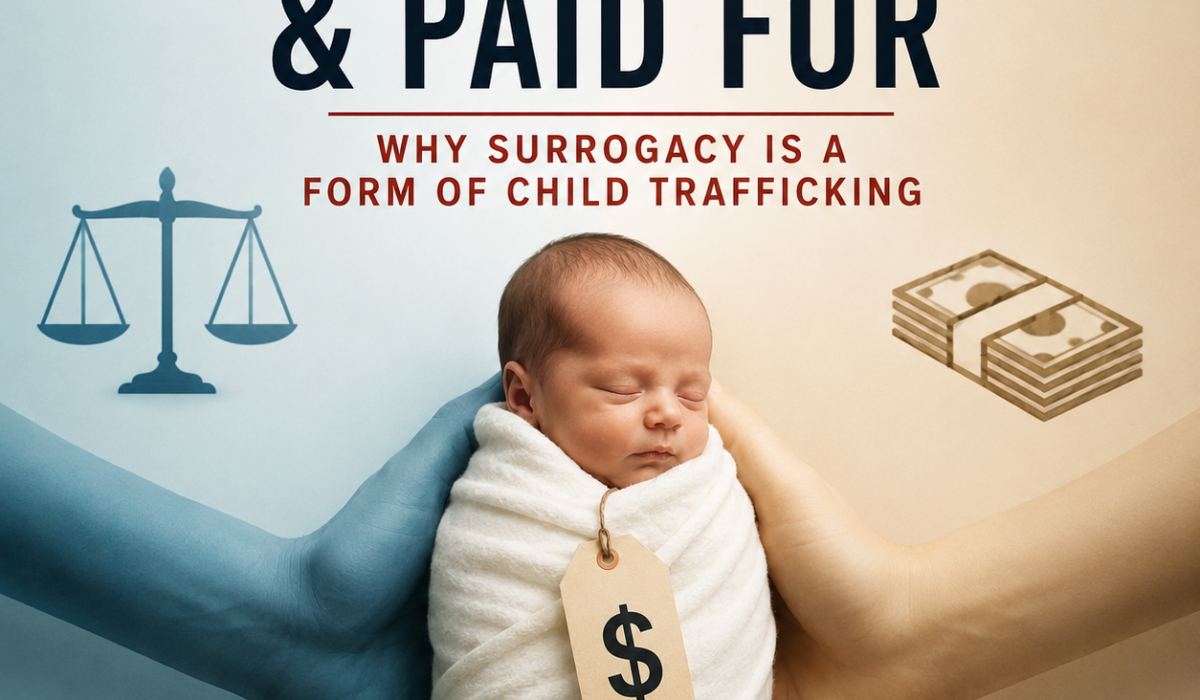
Bought and Paid For: Why Surrogacy is Modern Child Trafficking


Modern surrogacy is marketed as a beautiful act of generosity: hopeful parents finally holding a long-awaited baby, smiling doctors standing beside expensive fertility clinics, and emotionally charged slogans about “creating families.” The public relations machine surrounding the modern child trafficking industry is powerful, polished, and deeply emotional. Yet beneath the sentimental language lies the reality. Surrogacy is a commercial system in which human beings are contractually commissioned, manufactured through reproductive technology, and transferred in exchange for money. Strip away all the polite euphemisms, and the structure resembles something disturbingly close to child trafficking.

That comparison shocks people because modern society has learned to separate immoral acts from acceptable ones through language rather than substance. If a child is exchanged through illegal networks, society calls it trafficking. If a child is produced through lawyers, clinics, contracts, and six-figure payments, society calls it “family building.” But legality has never determine morality. History is filled with legal systems that institutionalized deeply evil practices. The central question is not whether surrogacy is legal in certain jurisdictions, but whether paying to obtain a child through contractual transfer fundamentally commodifies human life. Once that question is honestly answered, the parallels become impossible to ignore. Even setting aside the serious moral, psychological, medical, and theological problems associated with surrogacy (of which there are many), the transaction increasingly mirrors the logic, mechanics, and incentives of trafficking.


I: When Children Become Products

The defining feature of commerce is simple: a product is commissioned, produced, and transferred in exchange for compensation. Commercial surrogacy follows that framework. Intended parents pay agencies, lawyers, fertility clinics, and surrogate mothers in order to obtain a child. In the United States, commercial surrogacy arrangements commonly range from $100,000 to over $500,000 once medical procedures, legal fees, agency fees, insurance, embryo transfers, and “surrogate compensation” are included. The child is the object of the transaction.

The surrogacy industry often insists that parents are merely paying for “services,” not for the child. But this is simply not true. If the surrogate miscarries, intended parents frequently demand refunds, repeat procedures, or contractual remedies. Contracts routinely specify selective abortion clauses, embryo quantity requirements, health expectations, and behavioral restrictions. In many agreements, intended parents exercise extraordinary control over the pregnancy (and even the mother) because they view the outcome as something purchased and expected. That is not the language of gift, sacrifice, or adoption, but the language of consumer entitlement.

One of the clearest demonstrations that surrogacy operates as a commercial ownership arrangement rather than a purely compassionate act is found in the abortion and “selective reduction” clauses embedded in surrogacy contracts. Intended parents frequently demand contractual authority over whether the surrogate must terminate the pregnancy in cases involving disability, genetic abnormality, multiple embryos, or medical complications. In these agreements, the surrogate can face financial penalties, breach-of-contract lawsuits, criminal charges, and/or the withholding of compensation if she refuses. Courts have repeatedly wrestled with disputes involving intended parents demanding abortion and surrogates resisting those demands. The existence of such clauses exposes the underlying logic of the industry: the child is not treated as a sovereign human life but a commissioned product subject to quality control standards. A mother carrying her own child would never be viewed as contractually obligated to murder that child at another person’s request. Yet within commercial surrogacy, this requirement is normalized because the financial structure encourages the paying parties to view themselves as entitled decision-makers over both the pregnancy and the unborn child. 

Bioethicist Dr. Renate Klein, editor of Surrogacy: A Human Rights Violation, argued that surrogacy “turns women into breeders and children into commodities.” Meanwhile, philosopher Michael Sandel warned in What Money Can’t Buy that market logic increasingly invades areas of life where it does not belong, including human reproduction. Once human life becomes subject to contract and commercial expectation, moral boundaries no longer exist.

Even secular legal scholars have acknowledged the resemblance between commercial surrogacy and human trafficking systems. The European Parliament condemned surrogacy in 2015, stating that the practice “undermines the human dignity of the woman” and that the “human body and its reproductive functions should not be treated as commodities.” Critics across political and religious lines increasingly recognize that the industry monetizes both women and children simultaneously.

Scripture states in Psalm 127:3, “Children are a heritage from the Lord, the fruit of the womb a reward.” A reward is received from God, not commissioned through contractual acquisition.

The uncomfortable reality is: when money changes hands specifically so a child can be conceived, carried, and transferred to paying adults, society has already crossed into morally dangerous territory. The existence of legal paperwork does not eliminate commodification.


II: The Exploitation of Women and Economic Coercion

Commercial surrogacy depends heavily upon greed. Why don’t we see wealthy couples becoming surrogates for poorer women. The flow only moves in one direction: affluent individuals purchase reproductive labor from women in financially vulnerable positions, or women that value money more than human life. That imbalance is foundational to the industry itself.

In countries where commercial surrogacy expanded rapidly, exploitation scandals quickly followed. India became one of the world’s largest surrogacy hubs before tightening restrictions in response to widespread ethical concerns. Women living in poverty were recruited to carry babies for wealthy foreigners while agencies profited enormously from the arrangement. A 2013 report by the Centre for Social Research in India documented cases in which surrogates were isolated from their families, pressured into medical decisions, and inadequately informed about health risks. Similar concerns emerged in Thailand, Ukraine, Georgia, and other international surrogacy markets.

The industry often presents surrogate mothers as empowered entrepreneurs making free choices. If a woman agrees to rent her womb because she cannot pay medical bills, avoid eviction, or feed her children, how voluntary is the arrangement? Economic coercion does not disappear because contracts are signed.

Feminist scholar Andrea Dworkin once warned that systems which commercialize the female body inevitably become systems of exploitation. Even many degenerates who support abortion rights have expressed discomfort with surrogacy because it transforms pregnancy into paid labor subject to customer expectations. The surrogate’s body becomes a managed production environment overseen by clinics, agencies, and intended parents.

Medical risks are also significant. Surrogates face heightened risks of gestational diabetes, preeclampsia, postpartum depression, cesarean delivery, hemorrhage, and emotional trauma. A 2018 study published in Human Reproduction found 140% increased obstetric complications among surrogate pregnancies compared to traditional pregnancies. Yet despite these risks, surrogacy agencies frequently emphasize financial compensation over any long-term consequences.

The biblical vision of motherhood bears no resemblance to commercial surrogacy. Pregnancy is portrayed in Scripture as deeply relational, covenantal, and familial. In Genesis, the womb is consistently treated as sacred territory under God’s authority, not an economic asset for temporary lease. 

Surrogacy advocates frequently speak about compassion for infertile couples, and infertility is undeniably painful. But compassion cannot justify exploitation. A society that solves one person’s suffering by financially incentivizing another person’s bodily risk and emotional sacrifice is redistributing suffering downward through economic power.


III: The Deliberate Separation of Mother and Child

One of the most unnatural elements of surrogacy is that it intentionally creates maternal separation. The child is conceived with the expectation that the woman carrying him or her will surrender the baby immediately after birth. What adoption addresses after tragedy or crisis, surrogacy deliberately engineers in advance.

For decades, attachment research has demonstrated that bonds between mother and child begin in the womb. Studies published in journals such as Infant Behavior and Development show that unborn babies recognize maternal voices, rhythms, hormones, and stress patterns long before birth. Pregnancy is not simply biological incubation; it is relational formation. The surrogate mother and unborn child are connected physically, hormonally, neurologically, and emotionally throughout gestation.

Surrogacy contracts, however, require everyone involved to suppress or deny the significance of that bond. Surrogates are often instructed to emotionally distance themselves from the baby. Intended parents are encouraged to view the surrogate primarily as a carrier rather than a mother. The language has been engineered to weaken natural human attachment. Terms like “gestational carrier” replace “mother” because the industry understands the emotional power of motherhood.

Yet reality consistently intrudes. Nearly all surrogate mothers report grief, depression, and/or emotional distress after relinquishment. Children born through surrogacy increasingly describe identity confusion and emotional struggles related to their origins. Some feel fragmented by the knowledge that conception, gestation, genetics, and parenting were divided among multiple parties connected through financial arrangements.

Psychologist Nancy Verrier, author of The Primal Wound, argued that early maternal separation leaves profound psychological effects even when infants cannot consciously articulate the experience. While debate continues over the extent of those effects, it is increasingly difficult to maintain the fiction that maternal detachment is emotionally neutral.

The comparison to trafficking becomes especially troubling here because trafficking systems often involve the severing of natural family bonds for the desires or demands of others. Again, defenders object that intended parents love the child deeply. But traffickers may also claim benevolent intentions. Intent alone cannot sanctify morally distorted systems.

The Bible consistently emphasizes the unity between mother and child. Psalm 22:10 declares, “Upon you I was cast from my birth, and from my mother’s womb you have been my God.” The womb is not treated as a rental environment disconnected from maternal identity. Likewise, Isaiah 49:15 asks, “Can a woman forget her nursing child?” Scripture assumes maternal attachment is powerful, natural, and good.

Surrogacy requires society to deny this reality because acknowledging it would destabilize the industry, costing them billions of dollars. If pregnancy creates genuine maternal bonds, then commercial contracts demanding relinquishment are pre-negotiated separation agreements involving the ownership of human children.


IV: The Global Industry and the Machinery of Trafficking

Trafficking is not only about illegal abduction. Modern trafficking systems often involve legal paperwork, intermediaries, transportation networks, financial transactions, and often vulnerable  “3rd world” populations. By that broader definition, international surrogacy increasingly mirrors every other human trafficking infrastructure.

The global surrogacy market is projected to exceed tens of billions of dollars in coming years as demand rises among wealthy clients. Agencies recruit surrogate mothers, fertility clinics manufacture embryos, lawyers navigate parentage laws, brokers coordinate international arrangements, and children are transferred across borders after birth. Entire industries now exist to facilitate the movement of human children from reproductive suppliers to paying consumers.

Numerous scandals have exposed the dark underbelly of this machine. During the war in Ukraine, international media outlets reported chaotic scenes involving dozens of surrogate-born infants stranded in clinics awaiting pickup by foreign parents. The images were jarring: rows of babies produced through international reproductive contracts, delayed in transfer because geopolitical circumstances interrupted delivery logistics.

In another infamous case, the “Baby Gammy” scandal in Thailand involved the intended parents  abandoning one twin born with Down syndrome while taking the healthy sibling, because if children are just goods, then why pay for damaged ones? The case highlighted how easily children conceived through contractual arrangements can become subject to consumer preference and rejection.

Commercial surrogacy also creates complicated citizenship, legal parentage, and custody disputes. Some children born through international surrogacy arrangements have effectively become stateless due to conflicting national laws regarding parenthood. Others become trapped in prolonged legal conflicts between genetic contributors, surrogates, and intended parents.

The language of trafficking is difficult to avoid because the mechanics are the same. A woman is recruited, money changes hands, a child is produced under contract, legal intermediaries facilitate transfer, and wealthy clients acquire custody rights. International transportation (or occasionally domestic) then follows. The only substantial difference is paperwork.

From a biblical perspective, Babel-like technological ambition frequently leads humanity into moral confusion when capability outruns wisdom. Ecclesiastes 8:11 warns that when judgment against wrongdoing is delayed, “the heart of the children of man is fully set to do evil.” Modern reproductive technology has enabled humanity to separate conception, pregnancy, genetics, parenthood, sexuality, and family into modular commercial services. But the ability to do something does not establish a moral right to do it.

Industrialized surrogacy has never resembled compassionate caregiving, it is nothing more than supply-chain management for human reproduction.


V: The Loss of Human Dignity in the Age of Reproductive Commerce

At its core, the surrogacy debate is about whether human beings possess intrinsic dignity or market value. Once reproduction enters the marketplace children inevitably become products evaluated according to preference, specification, and consumer expectations.

Modern fertility clinics already allow embryo screening for sex selection and genetic abnormalities. In most cases, embryos are discarded because they fail to meet desired criteria. Surrogacy intensifies this logic because the child is not conceived naturally but intentionally commissioned through expensive technological processes. The emotional and financial investment encourages consumers to view themselves as entitled purchasers rather than grateful recipients of sacred life.

This mentality has reshaped parenthood. Historically, children were understood as gifts from God, entrusted to families. Modern reproductive commerce increasingly treats children as lifestyle acquisitions obtained through sufficient resources and technological advances. Desire has become entitlement, and pregnancy has become outsourced labor.

Underneath much of the modern fertility industry lies a deeper spiritual problem: the refusal to accept limits, timing, order, or authority outside the self. Scripture presents children as blessings given by God within covenantal structure. Yet modern surrogacy culture increasingly encourages people to circumvent natural, moral, relational, and even biological boundaries through money and technology rather than first examining whether their lives are aligned with God’s design.

In many cases, little attention is given to spiritual order, repentance, health restoration, or disciplined living. A culture drowning in processed food, hormonal disruption, obesity, pharmaceutical dependence, pornography, sexual disorder, delayed marriage, and rejection of biblical family structure now turns to laboratories and commercial wombs to solve problems that are often downstream of rebellion against natural and divine order. Instead of asking, “How do we honor God and restore healthy households?” society increasingly asks, “How do we obtain the outcome we desire regardless of cost?” The issue is not infertility, but humanity’s growing insistence on sovereignty over creation.

Scripture does not mock the pain of barrenness. Sarah, Rachel, Hannah, and Elizabeth (and others) all wept over infertility. But in each case, the answer was ultimately found in God’s providence rather than commercialized markets. Their stories point toward dependence upon God, prayer, covenant faithfulness, and trust.

The language used by the industry reveals the shift. Intended parents are called “clients.” Agencies advertise “guaranteed programs.” Clinics discuss “success rates” and “deliverables.” Some agencies even market “premium surrogate packages” resembling luxury service tiers. Human reproduction is no longer described in relational or familial terms, but increasingly in commercial terminology.

Pope Francis condemned surrogacy in 2024 as a practice that “violates the dignity” of both women and children because it turns the child into “an object of trafficking.” While many theological traditions differ on various reproductive questions, there is growing consensus among religious ethicists that surrogacy fundamentally risks reducing human life to a transaction.

Even secular critics increasingly warn that the marketization of reproduction destroys social morality. Political philosopher Michael Walzer argued that certain human goods become corrupted when bought and sold, and parenthood belongs among those goods. Love, family, and children cease to function properly once subordinated to consumer logic.

Surrogacy supporters frequently ask emotionally compelling questions: “Should infertile couples never have children?” The answer: Painful desires do not automatically justify every possible solution. Not every longing can be fulfilled morally. Human dignity imposes boundaries even on deeply emotional aspirations.

The fundamental issue remains unchanged no matter how sophisticated the technology becomes: if a child is intentionally produced through paid contractual arrangements for transfer to purchasing adults, then society has already entered territory dangerously adjacent to trafficking. The presence of compassion does not change the commodification. 


Conclusion:

Modern society often mistakes technological advancement for moral progress. Surrogacy is celebrated because it has been advertised as compassionate, sophisticated, and empowering. But civilizations are not judged by what they can accomplish technologically. They are judged by whether they preserve the dignity of the weak, the integrity of the family, and the sanctity of human life. Commercial surrogacy completely fails all three tests.

The deepest danger of surrogacy is not simply that it exploits women, confuses children, or enriches fertility corporations. The deepest danger is that it trains society to think of human beings as products obtainable through sufficient money, legal engineering, and technological power. Since that mentality has taken hold, the moral foundation beneath human dignity has eroded rapidly. Our civilization now sells children, and convinces everyone they are doing something good.

Fat, Tired, and Drugged: The New American Normal


Introduction:

America is the richest nation in human history, and yet millions of Americans wake up exhausted, overweight, anxious, inflamed, medicated, and dependent on stimulants to survive the day. The modern American lifestyle has normalized conditions that would have been considered signs of severe societal decline only a few generations ago. Obesity rates continue climbing well past 50%. Testosterone levels continue falling. Antidepressant prescriptions are handed out like candy. Birth control is consumed for years or decades at a time, starting as young as 12. Energy drinks have become breakfast for teenagers and adults alike. Meanwhile, processed food dominates grocery shelves while chronic disease consumes families physically, mentally, spiritually, and financially.

This is no accident. A culture built around convenience, comfort, pharmaceutical dependency, entertainment, sedentary living, and industrialized food production was always going to produce weak, exhausted, unhealthy people. Scripture warns repeatedly that gluttony, sloth, indulgence, and lack of self-control bring destruction. “Whether therefore ye eat, or drink, or whatsoever ye do, do all to the glory of God” (1 Corinthians 10:31). The body is not a disposable shell, but a physical vessel through which men and women fulfill their responsibilities before God, family, and society. A civilization full of weak, sick, distracted, chemically dependent people cannot sustain strength, order, productivity, or freedom for long.


I. The Obesity Crisis Is Not “Normal”

The United States is now one of the most overweight nations on earth. According to the Centers for Disease Control and Prevention, more than 50% of American adults are obese, and obesity rates among children continue to rise dramatically. Severe obesity has become increasingly common, particularly among younger adults. Conditions once associated primarily with advanced age (type 2 diabetes, hypertension, fatty liver disease, joint degeneration, and cardiovascular disease) are now commonplace in teenagers and young adults. Yet despite this national emergency, obesity has become culturally normalized. Entire industries now exist to convince people that being dangerously overweight is merely another harmless body type rather than a serious medical condition with devastating consequences to themselves and their families.

The average American diet today barely resembles food. Grocery stores are filled with ultra-processed products loaded with refined sugar, industrial seed oils, preservatives, artificial dyes, chemical stabilizers, and empty calories. Researchers at the National Institutes of Health have found that ultra-processed foods dramatically increase calorie consumption and weight gain compared to minimally processed diets. Modern food engineering is intentionally designed to override satiety signals, maximize cravings, and encourage overconsumption. The result is a population constantly eating yet chronically malnourished. Many Americans consume thousands of calories daily while remaining deficient in essential nutrients, vitamins, minerals, and protein quality.

Physical inactivity compounds the problem. Previous generations worked physically demanding jobs, walked more frequently, spent time outdoors, and engaged in regular manual labor. Today millions sit for ten or more hours daily staring at screens, commuting in vehicles, and vegetating on couches at night. The body was designed for movement, resistance, labor, sunlight, and exertion. Instead, modern life encourages passivity, and convenience has replaced discipline. Escalators replace stairs, delivery apps replace walking, and entertainment replaces activity. Even children increasingly spend their lives indoors staring at phones and tablets rather than running, climbing, building, or exploring.

Scripture condemns gluttony and excess because they destroy both the body and the character. Proverbs 23:20-21 warns, “Be not among winebibbers; among riotous eaters of flesh: For the drunkard and the glutton shall come to poverty.” Gluttony is not only about appearance; it reflects disordered appetites and lack of control over the flesh. A society that cannot govern its eating habits will struggle to govern anything else. The obesity epidemic is evidence of cultural collapse, broken discipline, industrial exploitation, and spiritual disorder.


II. Exhausted by Design: Energy Drinks, Sleep Deprivation, and Burnout

Americans are exhausted. Not merely tired after hard work, but chronically fatigued, mentally foggy, overstimulated, sleep deprived, and emotionally drained. Instead of addressing the underlying causes, millions attempt to chemically force themselves through the day with caffeine, sugar, stimulants, and energy drinks. The global energy drink industry is now worth tens of billions of dollars annually, targeting teenagers, young adults, blue-collar workers, athletes, gamers, and office employees alike. What was once an occasional stimulant has become a daily survival mechanism for many people.

Energy drinks are often loaded with massive doses of sugar, synthetic stimulants, and chemical additives. Studies published in journals such as the Journal of the American Heart Association have linked energy drink consumption to elevated blood pressure, heart rhythm abnormalities, anxiety, insomnia, and cardiovascular complications. Consumption continues rising because many Americans are trying to compensate for lifestyles fundamentally at odds with human biology. Poor diets, lack of exercise, excessive screen exposure, artificial lighting, stress, and constant digital stimulation destroy natural energy systems. Rather than restoring healthy rhythms, people simply pour drugs into their system to cover up the problem..

Sleep deprivation has become a public health epidemic. The CDC estimates that roughly two-thirds of American adults fail to get sufficient sleep due to stimulant and cell phone use. Chronic sleep deprivation affects testosterone production, insulin sensitivity, mood regulation, cognitive performance, immune function, and weight management. Sleep is biological maintenance, God designed the human body around cycles of work and rest. Psalm 127:2 warns, “It is vain for you to rise up early, to sit up late, to eat the bread of sorrows.” Modern culture glorifies burnout, hustle, endless productivity, and constant availability, even as people physically and mentally deteriorate.

Technology intensifies the problem further. Notifications, social media scrolling, binge streaming, late-night gaming, and constant smartphone exposure keep millions overstimulated well into the night. Blue light exposure suppresses melatonin production and disrupts circadian rhythms. Meanwhile, modern workers are mentally overloaded while physically inactive, a combination uniquely damaging to the human body. The result is a population simultaneously exhausted and unable to rest properly.

Most people today are not energetic at all; they are chemically stimulated zombies oscillating between drug highs and emotional crashes. They wake exhausted, medicate with stimulants, survive on sugar and processed food, stare at screens for twelve hours, then lie awake at night unable to sleep. This is managed dysfunction. A nation running on stimulants instead of strength will collapse under the weight of its own exhaustion. True vitality requires discipline, movement, sunlight, proper food, meaningful work, physical fitness, and ordered living, not another oversized can of synthetic chemical energy.


III. The Pharmaceutical Nation: Antidepressants, Anxiety Medication, and Dependency

America is heavily medicated. According to data from the National Center for Health Statistics, antidepressant use has risen dramatically over the past several decades, particularly among women. Millions of Americans now take selective serotonin reuptake inhibitors (SSRIs), anti-anxiety medications, sleep aids, mood stabilizers, and other psychiatric drugs long-term. Many people suffer from severe psychological conditions requiring medical intervention. But the sheer scale of pharmaceutical dependency raises questions about the deeper causes of America’s mental health crisis.

Modern life systematically produces anxiety, isolation, purposelessness, and emotional instability. Families are fractured, communities are weak, and Churches are hollow or compromised, while social media fosters comparison, envy, outrage, and loneliness. Men lack direction. Women place themselves in situations with impossible expectations. Children grow up immersed in digital addiction and confusion. Most Americans spend very little time outdoors, rarely exercise, eat nutrient-poor diets, sleep poorly, and remain disconnected from meaningful relationships and physical labor. Unsurprisingly, depression and anxiety flourish in such an environment.

Instead of addressing foundational issues, society turns more and more to medication. Pharmaceutical intervention can temporarily reduce symptoms, but drugs cannot replace purpose, discipline, healthy relationships, sunlight, exercise, spiritual grounding, or meaningful responsibility. Numerous studies show strong links between exercise and improved mental health outcomes. Research published in JAMA Psychiatry found that regular physical activity significantly reduces depression risk. Nutritional deficiencies, hormonal imbalances, inflammation, poor sleep, and sedentary lifestyles all contribute heavily to emotional instability, and these factors are frequently ignored in favor of quick pharmaceutical solutions.

There are also legitimate concerns regarding side effects and long-term dependency. Antidepressants produce emotional blunting, sexual dysfunction, weight gain, withdrawal symptoms, and many other serious complications. Most patients report feeling emotionally numb rather than healed. The issue is not that all psychiatric medication is evil or unnecessary, but that America increasingly treats symptoms while refusing to confront the root causes. It is easier to medicate dysfunction than rebuild healthy lives and communities.

Scripture recognizes the reality of despair, sorrow, and suffering, but consistently points people toward endurance, wisdom, discipline, community, and trust in God rather than chemical escape. Elijah experienced profound despair. David wrote about grief and anguish throughout the Psalms. Yet biblical healing involved restoration, purpose, obedience, fellowship, and renewed strength, not perpetual dependency upon substances to emotionally survive daily life.

A society drowning in antidepressants while simultaneously abandoning family structure, physical health, spiritual order, and meaningful labor should not be shocked when mental illness becomes an epidemic. Human beings were not designed to live isolated, overstimulated, sedentary, purposeless lives disconnected from God, nature, work, and community. Medication may sometimes be necessary, but no civilization can medicate itself into wholeness while continuing to poison the foundations of human flourishing.


IV. Declining Testosterone and the Collapse of Masculine Vitality

Testosterone levels among men have declined significantly over recent decades. Multiple studies, including research published in the Journal of Clinical Endocrinology & Metabolism, have documented measurable declines in male testosterone levels even after controlling for age. Simultaneously, sperm counts have fallen dramatically in many Western nations. Researchers continue debating the exact causes, but agree contributors include obesity, sedentary living, endocrine-disrupting chemicals, poor sleep, chronic stress, processed food consumption, environmental toxins, excessive pornography consumption, and declining physical activity.

The consequences extend far beyond the gym. Testosterone affects energy, motivation, muscle mass, bone density, confidence, mood stability, sexual function, competitiveness, fertility, and overall vitality. Low testosterone is associated with fatigue, depression, reduced ambition, increased body fat, diminished strength, and decreased resilience. A civilization full of physically weak, passive, exhausted men will inevitably experience broader social decline. Strong families, stable communities, economic productivity, national defense, and leadership all depend heavily upon healthy, capable men.

Modern culture treats masculinity as suspicious or dangerous. Boys are increasingly medicated, over-screened, under-disciplined, physically inactive, and deprived of meaningful male mentorship. Physical risk-taking and rough play are discouraged while unlimited digital entertainment is encouraged. Men consume pornography at unprecedented levels, weakening discipline, distorting sexuality, and training the brain toward artificial stimulation rather than real responsibility and connection. Meanwhile, processed foods and endocrine disruptors saturate daily life through plastics, pesticides, cosmetics, and industrial chemicals.

Exercise, especially resistance training, remains one of the most powerful natural methods for improving male hormonal health. Sleep quality, proper nutrition, body fat reduction, sunlight exposure, stress reduction, and meaningful purpose also play critical roles. However, instead of rebuilding healthy masculine habits, society encourages escapism, passivity, and comfort. Many men now spend more time consuming entertainment than building skills, leading families, improving health, and pursuing purpose combined.

Scripture consistently portrays masculine strength, endurance, leadership, and discipline as virtues. 1 Corinthians 16:13 states: “Watch ye, stand fast in the faith, quit you like men, be strong.” Biblical masculinity is responsible strength under godly order. Men are called to work, protect, lead, build, sacrifice, and endure hardship. Weakness, laziness, addiction, and passivity undermine not only the individual man but everyone depending upon him.

The collapse of masculine vitality is not a private issue confined to doctors’ offices or gym memberships. It affects marriage rates, fertility rates, child stability, workforce productivity, military readiness, and societal confidence. A nation cannot remain healthy while systematically producing exhausted, infertile, physically weak, distracted men addicted to comfort, porn and entertainment. Rebuilding masculine health requires restoring discipline, physical labor, exercise, nutritional sanity, spiritual order, and responsibility, not merely handing out another drug.


V. Birth Control, Hormonal Manipulation, and the War Against Natural Order

Hormonal birth control fundamentally altered our society. Since its widespread adoption in the 1960s, millions of women have spent decades suppressing natural reproductive functions through synthetic hormones. While birth control is often promoted as liberation and convenience, growing numbers of researchers and physicians have raised concerns regarding the physical, emotional, relational, and societal consequences of long-term hormonal manipulation.

Hormonal contraceptives increase risks for blood clots, stroke, hypertension, mood changes, depression, reduced libido, and other complications in women. Research published in journals such as JAMA Psychiatry has explored the links between hormonal contraception and increased depression risk, particularly among adolescents. Most women also report emotional blunting, weight gain, anxiety changes, altered attraction patterns, and diminished overall well-being. Yet public discussion surrounding these issues is still politically charged and heavily simplified.

The broader cultural implications are equally significant. Birth control contributed heavily to the normalization of consequence-free sexuality, delayed marriage, declining fertility rates, broken families, and the separation of sex from covenant, responsibility, and childbearing. The United States now faces declining birth rates alongside widespread relational instability. Millions pursue careers, consumption, entertainment, and unlimited self-fulfillment while postponing or rejecting marriage and family formation completely. Meanwhile, fertility struggles continue rising even among younger couples.

Modern culture simultaneously tells women that motherhood is burdensome while insisting  pharmaceutical intervention is empowering. Rather than encouraging women toward holistic health, stable families, proper nutrition, reduced stress, and natural fertility support, society increasingly pushes hormonal suppression as a normal lifestyle. In many cases, birth control is prescribed to also mask deeper health issues such as poor metabolic health, obesity, insulin resistance, inflammation, and/or hormonal dysfunction without addressing root causes.

This broader pattern reflects a civilization increasingly hostile toward the natural biological order. Processed foods damage metabolism, endocrine disruptors interfere with hormones, chronic stress destabilizes the body, and pharmaceutical dependency becomes normalized. This causes fertility to decline, and family structures to weaken. Then society attempts to medically engineer solutions for the problems it created through disorder and indulgence.

Scripture treats children as blessings rather than burdens. Psalm 127:3 declares, “Lo, children are an heritage of the Lord: and the fruit of the womb is his reward.” This does not mean every medical circumstance is simple or identical, nor does it eliminate the complexity surrounding reproductive health. But it does expose how radically modern attitudes have changed. A civilization that increasingly fears children, suppresses fertility, and chemically manipulates natural biological functions while simultaneously destroying its own physical health should not be surprised when emotional instability, relational dysfunction, and demographic collapse follow closely behind.


Conclusion

The modern American condition is increasingly defined by contradiction: overfed yet malnourished, stimulated yet exhausted, medicated yet miserable, entertained yet purposeless. Obesity, declining testosterone, antidepressant dependency, energy drink addiction, processed food consumption, and hormonal disruption are interconnected symptoms of a civilization disconnected from discipline, natural order, meaningful labor, healthy families, physical fitness, and spiritual truth. America did not become fat, tired, and drugged overnight. These conditions emerged gradually through decades of comfort worship, industrialized food systems, pharmaceutical dependence, technological overstimulation, and cultural decay.The solution will not come through another fad diet, another prescription, another stimulant, or another motivational slogan. Restoration will require repentance, discipline, responsibility, movement, sunlight, proper food, meaningful work, strong families, and spiritual order. It will require rejecting the lie that weakness is normal and dysfunction is inevitable. Romans 12:2 commands believers, “Be not conformed to this world: but be ye transformed by the renewing of your mind.” A healthier nation begins with healthier individuals willing to reject passive consumption and reclaim mastery over their appetite, habits, body, and mind. The path back will not be easy, but neither is living as a chronically exhausted, chemically dependent shell of what human beings were designed to become.

The Forgotten Trinity: Why Physical, Mental, and Spiritual Health Cannot Be Separated


Introduction:

Modern society has mastered the art of compartmentalization. We isolate the body from the mind, the mind from the soul, and the soul from the body, as though man were three separate creatures stitched together by accident. We treat obesity with pills while ignoring despair. We medicate anxiety while feeding people processed poison. We preach spiritual peace to exhausted, inflamed, sleep-deprived bodies running on sugar, caffeine, and fast food. Then we wonder why so many people are miserable, weak, distracted, depressed, addicted, exhausted, and spiritually numb. The truth is simple (and far more uncomfortable): human beings were designed as integrated creatures. Physical health, mental health, and spiritual health are inseparably linked, and damage to one inevitably affects the others.

A man who abuses his body will eventually cloud his mind and weaken his spirit. A man consumed by bitterness, anxiety, laziness, lust, or despair will eventually destroy his physical health. Likewise, spiritual decay often manifests itself physically through gluttony, sloth, addiction, and lack of discipline. Scripture repeatedly reflects this reality. Proverbs 14:30 states, “A tranquil heart gives life to the flesh, but envy makes the bones rot.” Romans 12:1 commands believers to present their bodies as “a living sacrifice.” Even Elijah, in 1 Kings 19, was first given sleep, food, and rest before God addressed him spiritually. The body matters because man is not a floating consciousness trapped in flesh; he is body, mind, and spirit functioning together. Most people would live radically different lives if they restored their physical health, and many would discover that the path to mental clarity and spiritual strength begins with basic obedience, self control and discipline in how they treat their own bodies.


I: The Body Is Not Separate from the Mind

For decades, modern culture treated has physical health and mental health as unrelated categories. One doctor handled the body while another handled the brain, as though the two had no meaningful interaction. Yet mounting scientific evidence continues to obliterate that theory. Researchers at the Harvard T.H. Chan School of Public Health found that regular exercise significantly reduces symptoms of depression and anxiety while improving mood, memory, and cognitive function. One major study published in JAMA Psychiatry concluded that even modest exercise reduced depression risk by up to 56%. The implications here are staggering: millions of people are trying to medicate problems that movement itself will alleviate (even if it is partially at first)..

The human body was designed for labor, motion, sunlight, challenge, and exertion. Instead, we sit in climate-controlled rooms staring at glowing rectangles for ten hours a day while consuming ultra-processed food engineered for addiction. Then we are shocked when we feel mentally foggy, emotionally unstable, and spiritually drained. Poor nutrition directly impacts neurotransmitter production, hormonal regulation, sleep quality, inflammation, and cognitive performance. Diets high in sugar and processed oils are associated with increased rates of depression and anxiety (as high as 300%), while nutrient-dense diets rich in protein, vegetables, healthy fats, and micronutrients consistently correlate with improved mental well-being.

Obesity often creates a vicious cycle. Excess body fat contributes to chronic inflammation, insulin resistance, hormonal imbalance, fatigue, sleep apnea, low testosterone, and poor self-image. Those physical consequences then fuel emotional instability, insecurity, social withdrawal, and hopelessness. The mind suffers because the body is suffering. Proverbs 23:2 warns, “Put a knife to your throat if you are given to appetite.” Scripture consistently portrays lack of self-control as destructive, not just physically but morally and spiritually.

Many people spend years trying to “find themselves” psychologically while ignoring the obvious reality that their body is collapsing underneath them. They seek therapy while sleeping four hours a night, eating fast food daily, consuming excessive alcohol, and rarely (if ever) exercising. That is like trying to tune a violin while it is being thrown down a staircase. The mind cannot function optimally in a diseased body.

This does not mean every mental illness can be solved by exercise or diet. Serious psychological conditions exist and deserve compassion and treatment. But modern culture has drastically underestimated how profoundly physical neglect damages emotional and mental stability. Often the first step toward clearer thinking, emotional resilience, confidence, peace, and motivation is brutally simple: sleep properly, walk daily, lift heavy things, eat real food, lose excess weight, and stop poisoning yourself. The body and mind are not enemies, they are allies created to function together as a whole.


II: Gluttony, Sloth, and the Spiritual Consequences of Physical Neglect

Modern culture treats gluttony exclusively as a cosmetic problem. People speak of obesity in terms of attractiveness, confidence, or social acceptance while rarely addressing the deeper spiritual implications. Yet Scripture repeatedly frames overindulgence and laziness as moral and spiritual failures connected to self-control, discipline, stewardship, and obedience. Philippians 3:19 describes this with the devastating phrase: “their god is their belly.” That is a warning about appetites ruling the human soul.

The issue is not simply weight. There are overweight people fighting valiantly toward health and thin people living in absolute physical rebellion. The deeper issue is dominion. Who is in control? The spirit governing the flesh, or the flesh governing the man? Modern consumer culture relentlessly trains people toward impulsiveness: eat immediately, indulge constantly, avoid discomfort, escape stress, seek pleasure, and eliminate effort wherever possible. Entire industries profit from addiction, convenience, sedation, and distraction. Processed food companies engineer products specifically to override satiety signals and maximize consumption. Meanwhile, endless entertainment conditions people to remain passive, distracted, lazy, and undisciplined.

This matters spiritually because discipline in one area strengthens discipline in others. A man incapable of controlling his appetite will often struggle to control his anger, lust, spending, speech, laziness, or emotions. Conversely, learning self-control physically produces spiritual clarity and confidence. Paul wrote in 1 Corinthians 9:27, “I discipline my body and keep it under control.” The apostle understood that bodily discipline was preparation for spiritual endurance.

Physical neglect also affects spiritual perception. Chronic exhaustion, poor sleep, nutritional deficiencies, hormonal imbalance, and inactivity frequently produce apathy and emotional numbness. Many people feel spiritually dead while living physically destructive lives. They stay awake until 2 a.m., demand endless stimulation, neglect exercise, eat garbage, and then wonder why prayer feels difficult and concentration is impossible. The body they inhabit is in constant physiological distress.

Even ancient Christian traditions recognized the connection between physical discipline and spiritual clarity through fasting, labor, moderation, and self-denial. The purpose was never punishment for the body but mastery over appetites. Modern society has largely reversed this principle. Today the highest virtue is often comfort, while discomfort is treated as cruelty. Yet nearly every meaningful human achievement (physically, mentally, financially, or spiritually) requires voluntary discomfort.

The tragedy is that many people have accepted weakness as normal. They assume constant fatigue, brain fog, inflammation, emotional instability, and dependency are simply part of modern life. They are not. In most cases, people are spiritually struggling in part because they are physically collapsing. Restoring order to the body often restores order elsewhere. Discipline builds momentum, strength creates confidence, and movement sharpens the mind. Physical stewardship is not and has never been separate from spiritual stewardship.


III: Exercise, Strength, and the Restoration of Human Purpose

Human beings were built to move. The body is not simply transportation for the brain, but a living system designed for action, labor, challenge, and endurance. Our modern life has engineered movement almost entirely out of existence. Food arrives at the door, work happens in chairs, entertainment streams endlessly, and entire days pass without any meaningful physical exertion. The result is catastrophic. According to the World Health Organization, physical inactivity contributes to 50% of deaths globally every year and significantly increases the risk of heart disease, diabetes, obesity, stroke, depression, and certain cancers.

But the consequences extend far beyond disease statistics. Physical weakness changes how people think, feel, behave, and live. Exercise is not about aesthetics, it profoundly affects confidence, discipline, emotional resilience, hormonal balance, stress tolerance, productivity, and mental clarity. Studies consistently show that resistance training and cardiovascular exercise improve mood, cognitive performance, sleep quality, energy levels, and self-esteem. Exercise also reduces chronic inflammation, which researchers increasingly associate with depression and neurological decline.

Strength carries psychological and spiritual significance. Weakness breeds fear and dependency. Strength creates capability, stability, and confidence. Scripture repeatedly uses physical imagery to describe spiritual readiness: running races, fighting battles, enduring hardship, standing firm, wearing armor. Even Jesus spent much of His earthly life as a laborer before beginning His ministry. The Bible never romanticizes laziness or passivity. Proverbs consistently praises diligence and warns against sloth.

There is also something deeply transformative about voluntary hardship. Modern people are drowning in comfort yet starving for purpose. Exercise introduces controlled adversity back into life. It teaches endurance, delayed gratification, consistency, pain tolerance, and discipline. A man who learns to push through physical discomfort becomes more resilient emotionally and spiritually. He begins to realize he is capable of more than he believed.

Many people underestimate how radically physical restoration can alter the trajectory of life. Weight loss will improve testosterone levels, fertility, blood pressure, sleep, mobility, mood, confidence, and longevity. Exercise will reverse insulin resistance, reduce anxiety, improve posture, sharpen concentration, and increase productivity. A healthier body will improve your  marriage, parenting, work performance, and spiritual engagement simultaneously.

The modern world frequently frames health as vanity or obsession, but stewardship is not vanity. Caring for the body is not narcissism when done properly. The body affects every conversation, every thought, every relationship, every emotion, and every spiritual practice. A physically broken man often struggles to fulfill his responsibilities because exhaustion and disease consume his energy.

People often pray for motivation while continuing lifestyles that physiologically destroy motivation. They ask for peace while living in perpetual overstimulation. They seek clarity while poisoning their bodies. Transformation begins with simple obedience: move your body, eat real food, rest properly, and embrace discipline instead of comfort. The body was designed for more than survival. It was designed for strength, service, and purpose.


IV: Food, Addiction, and the Decline of Modern Health

Modern food culture is the greatest public health disaster in human history. Most of what fills grocery store shelves today barely resembles food in any historical sense. Highly processed products packed with refined sugar, industrial seed oils, preservatives, artificial additives, and engineered flavor combinations dominate the modern diet. These substances are specifically designed to maximize cravings and override natural satiety mechanisms. The average person is not simply “overeating”; they are consuming products scientifically formulated to make moderation as difficult as possible..

The consequences are visible everywhere. According to the CDC, obesity rates in the United States exceed 48% among adults, while rates of Type 2 diabetes, PCOS,  fatty liver disease, hypertension, sleep apnea, metabolic syndrome, and cardiovascular disease are at record highs and continue to rise. Even children increasingly suffer from diseases once associated almost exclusively with old age. And many people still view nutrition through the lens of appearance rather than survival, function, and mental clarity.

What people eat profoundly affects how they think and feel. Blood sugar instability contributes to mood swings, fatigue, irritability, and mental fog. Nutritional deficiencies impact neurotransmitter production and hormonal balance. Chronic inflammation caused by poor diet affects the brain. Researchers have increasingly linked ultra-processed food consumption with depression, anxiety, cognitive decline, and addictive eating behaviors. In many ways, modern people are trying to build stable lives on unstable foundations.

Food addiction also reveals deeper spiritual realities. Consumption has become emotional coping. People eat not because they are hungry but because they are lonely, anxious, bored, angry, exhausted, or spiritually empty. Entire industries encourage this behavior with slogans built around indulgence, escape, and reward. Instead of confronting pain, many medicate themselves with comfort food, sugar, alcohol, caffeine, or constant snacking.

Scripture repeatedly warns about enslaving appetites. Titus 2 emphasizes self-control as a foundational virtue. Proverbs 25:28 states, “A man without self-control is like a city broken into and left without walls.” When appetites dominate a person, every other area of life becomes vulnerable as well. Addiction never remains isolated. The same lack of restraint that governs food spills into spending, entertainment, lust, laziness, and emotional instability.

The encouraging reality, however, is that the body responds remarkably well to restoration. Many people experience dramatic improvements within months of changing their habits. Weight loss, improved nutrition, exercise, hydration, sunlight exposure, and proper sleep always  produce enormous changes in energy, mood, confidence, inflammation, productivity, and mental clarity. Some people spend years believing they are broken psychologically when in reality they are severely unhealthy physically.

This does not mean nutrition alone solves every problem. But modern culture dramatically underestimates how many emotional, relational, and spiritual struggles are intensified by chronic physical dysfunction. The body cannot be neglected indefinitely without consequences. When we restore physical order through discipline and stewardship, we discover that many other areas of life begin healing as well.


V: Restoration Begins with Stewardship, Not Perfection

One of the greatest lies preventing people from pursuing health is the belief that transformation requires perfection. Many individuals become overwhelmed because they imagine they must instantly become elite athletes, nutrition experts, or fitness influencers. When they inevitably fail to maintain impossible standards, they quit. But restoration does not have to be dramatic. It begins with stewardship, small acts of consistent obedience repeated over a long time.

The human body is astonishingly resilient. Even years of neglect and abuse can be mostly  reversed through disciplined habits. Walking daily, reducing processed foods, increasing protein intake, sleeping consistently, strength training, drinking water, getting sunlight, and losing excess weight will radically change a person’s life trajectory. Studies consistently show that even modest weight loss dramatically improves cardiovascular health, blood sugar control, hormone balance, mobility, and quality of life. Small improvements compound very quickly when they are consistent..

The psychological effects are equally significant. Physical discipline creates momentum. Every healthy choice reinforces the belief that change is possible. Confidence grows because action replaces helplessness. Energy increases, mood stabilizes, and self-respect begins returning. Many people trapped in cycles of anxiety, shame, or hopelessness are lacking self control, and that has led to them being physically exhausted, inflamed, undernourished, overstimulated, and chronically sedentary.

Spiritual restoration often follows similar patterns. Scripture repeatedly emphasizes faithfulness in ordinary things. Discipline matters because habits shape our character. Galatians 6:7 reminds readers that “whatever one sows, that will he also reap.” This principle applies physically as much as spiritually. Bodies respond to patterns, minds respond to patterns, and souls respond to patterns.

Most importantly, stewardship is not vanity. Modern culture swings between two extremes: obsessive narcissism on one side and complete neglect on the other. But caring for one’s health is about maintaining the tool through which every responsibility in life is carried out. Parents need energy, workers need endurance, husbands and wives need strength and vitality. Ministries require stamina, service requires capability, and none of these are possible if we do not take care of our bodies.

People often wait for emotional inspiration before changing their lives. But action precedes motivation, not the other way around. A person may not feel motivated to exercise, but consistent movement eventually improves mood and energy enough to create momentum. Likewise, someone may not feel spiritually strong at first, but discipline will create conditions where clarity and stability can grow.

The modern world constantly promises quick fixes, shortcuts, pills, and effortless transformation. Real restoration is much slower, but it is also more durable. Health is built through ordinary decisions repeated daily over years and decades. The encouraging reality is that most people do not need extreme measures to radically improve their lives. They need consistency, discipline, stewardship, and the humility to admit that body, mind, and spirit were never meant to be separated.


Conclusion

The modern world has attempted to fragment human beings into disconnected categories (physical, mental, emotional, and spiritual) as though each could thrive independently from the others. But reality continually proves otherwise. The body influences the mind, the mind influences the spirit, and the spirit influences the body. A man drowning in gluttony, exhaustion, addiction, inactivity, and physical neglect will struggle mentally and spiritually as well. Likewise, a disciplined, nourished, active body frequently creates the foundation for clearer thinking, emotional resilience, confidence, and deeper spiritual stability. This is how human beings were designed by God.

Most people would live radically different lives if they restored their physical health alone. Marriages would improve. Energy would increase. Depression and anxiety would lessen for many. Confidence would return. Productivity would rise. Spiritual focus would sharpen. Children would have healthier parents. Communities would become stronger. The path toward transformation is often less mysterious than people imagine. Eat real food. Move your body. Sleep properly. Embrace discipline. Reject endless comfort and indulgence. Steward the body that God gave you. Physical health will not solve every problem in life, but without it, many people are fighting uphill battles they were never meant to fight. True wellness requires the restoration of body, mind, and spirit together, because they were never designed to function apart.

Silence Is Civilization: Why Great Men Once Had Peace, and Why Modern Man No Longer Can Think


Introduction

There was a time when silence was normal. A man could walk for hours without hearing another human voice. He could work without notifications. He could read without vibration in his pocket. He could think without being hunted every fifteen seconds by advertisements, updates, messages, alerts, calls, opinions, gossip, headlines, and demands for his attention. The modern world has become hostile to thought itself. Stillness has been replaced with constant, incessant stimulation. Reflection has been replaced with reaction. And the result is complete civilizational decline.

Every great civilization was built by men who possessed long stretches of uninterrupted thought. The cathedrals of Europe, the philosophical foundations of Greece, the scientific revolutions of the Enlightenment, the great works of literature, theology, architecture, engineering, music, and governance, none of them were (or could have been) produced in an environment of constant interruption. A civilization capable of greatness requires men capable of concentration, contemplation, and solitude. Yet modernity has constructed a world in which silence feels uncomfortable, men now panic in empty rooms, they reach for phones in elevators. They scroll while eating, while driving, while speaking to their children, and even while lying in bed beside their wives. We have created a society terrified of stillness because stillness forces a man (or woman) to confront himself.


I. Great Works Were Born in Silence

The greatest achievements in human history have always been forged in isolation, quiet, and long periods of uninterrupted labor. Isaac Newton developed many of the foundations of modern physics while isolated during the plague years. Nikola Tesla was notorious for requiring extended periods of solitude to think and design. Ludwig van Beethoven took long solitary walks through forests carrying notebooks filled with musical ideas. Blaise Pascal wrote, “All of humanity’s problems stem from man’s inability to sit quietly in a room alone.” That statement may be more true now than when he wrote it nearly four hundred years ago.

The human mind is not designed for distraction, or “multitasking”. Deep work requires uninterrupted cognitive immersion. Modern neuroscience increasingly confirms what great thinkers always understood: concentration is biologically expensive. A study from the University of California, Irvine found that after interruptions, workers can take over twenty minutes to fully regain focus. Multiply that across the dozens or hundreds of interruptions per day and it becomes obvious why modern men feel mentally exhausted while accomplishing very little of permanence.

The problem is not just phones. Phones are only the delivery mechanism for a deeper disease: perpetual accessibility. Modern man is expected to be reachable at all times by spouses, employers, strangers, family members, customers, social media platforms, advertisers, and increasingly even algorithms. Historically, access to a man was limited by geography, travel, distance, social hierarchy, and basic courtesy. Today anyone can intrude into a man’s consciousness instantly. The psychological consequence has been catastrophic.

Scripture repeatedly associates wisdom with stillness and withdrawal. Psalm 46:10 declares, “Be still, and know that I am God.” Jesus Christ repeatedly withdrew from crowds to solitary places to pray and think. In Mark 1:35, “rising very early in the morning, while it was still dark, he departed and went out to a desolate place.” Solitude was preparation for clarity and power.

One must ask a painful question: if the men who built Western civilization had possessed smartphones, social media accounts, endless entertainment, and wives demanding constant attention and emotional engagement, would they have accomplished anything at all? Would the libraries have been written? Would the symphonies have been composed? Would the discoveries have been made? Or would civilization have drowned beneath distraction before it ever rose?


II. Human History Was Far Quieter Than Modern Life

For most of human history, silence was ordinary, nightfall imposed stillness. There were no televisions screaming in every room, no engines roaring down highways, no endless playlists filling every moment with artificial sound. Even cities were dramatically quieter than modern suburban life. A medieval peasant, a frontier farmer, or a monastic scholar experienced more uninterrupted quiet in a single week than most modern men experience in an entire year.

This matters because the human nervous system was designed for those conditions. The brain was not designed to process perpetual sensory bombardment. Modern environments assault the senses: fluorescent lights, traffic noise, screens, advertisements, notifications, music in stores, conversations, alarms, and digital chatter. The result is chronic cognitive fatigue. Many people now literally cannot tolerate silence because their minds have become so addicted to mental stimulation. The silence reveals anxiety they have spent years trying to suppress.

Henry David Thoreau retreated to Walden Pond not because he hated humanity, but because he recognized that constant interruption destroys perception. “I went to the woods because I wished to live deliberately,” he wrote. Deliberate living requires enough stillness to observe reality. Constant distraction keeps a man permanently reactive instead of intentional.

Even family structure historically protected male concentration in ways modern culture no longer respects. There once existed a widespread understanding that a man engaged in study, craftsmanship, writing, or labor would not be disturbed frivolously. The workshop, the study, the library, the field, and even the walk functioned as protected spaces of thought. Today interruption is treated as a right. A buzzing phone, a trivial text, a meaningless social media notification, or casual emotional demands now interrupt and override his concentration.

The average modern person consumes more information in a single day than many historical individuals encountered in months. And despite this endless flood of information, wisdom appears to be declining. Why? Because wisdom is not information accumulation, wisdom requires digestion, contemplation, silence, and synthesis. The modern world produces data without reflection.

Ecclesiastes 3 reminds us that there is “a time to keep silence, and a time to speak.” Modern society has abolished the first half of that verse. Everything must be commented on immediately, every opinion must be shared instantly, and every emotional impulse must be broadcast publicly. Men no longer think before speaking because they no longer possess the stillness required for thinking.

Western civilization was built by men who could endure (even embrace) silence. Modern civilization increasingly produces men who cannot survive five minutes without checking a glowing rectangle.


III. Constant Interruption Is Destroying Masculinity

A man incapable of sustained focus is weak, not merely intellectually, but spiritually and morally. Masculinity has always required the ability to direct attention voluntarily toward difficult, long-term objectives. A distracted man becomes emotionally reactive, impulsive, shallow, and easily manipulated. That is precisely the kind of man the modern system prefers.

The endless interruption of modern life fragments the masculine authority. Historically, a patriarch exercised dominion over his household partly because his mind was not perpetually occupied by trivialities. He had time to think, plan, build, and establish vision. Today many men spend their lives trapped in cycles of distraction. Their minds belong not to themselves, but to those constantly demanding his engagement and attention.

Modern technology companies openly engineer addiction. Former executives from Facebook, Google, and other platforms have publicly admitted that these systems are designed to hijack dopamine pathways and maximize compulsive use. Infinite scrolling, notifications, likes, autoplay, algorithmic feeds, and constant novelty are engineered behavioral traps. These traps affect all humans but there is a greater effect of the female brain.

The consequences extend directly into marriage and family life. Men once returned home from labor with mental space intact, now many men never mentally leave the world, in fact most were never able to concentrate on their work due to the constant interruptions from home, family, and social media. Likewise, many wives no longer understand boundaries regarding attention and interruption. Emotional immediacy has become normalized. Every feeling must be processed instantly, every thought must be communicated immediately, and every discomfort demands immediate validation. The result is perpetual mental fragmentation. This produces exhaustion.

Arthur Schopenhauer observed, “Talent hits a target no one else can hit; genius hits a target no one else can see.” But seeing what others cannot see requires uninterrupted depth of perception. A distracted civilization may still produce consumers, entertainers, and bureaucrats, but it cannot consistently produce great men.

Scripture regularly portrays godly men withdrawing for periods of isolation and focus. Moses ascended mountains alone, in silence. Elijah fled into the wilderness. Christ retreated into deserts. Paul spent years in preparation before his public ministry. Solitude was the preparation for greater responsibility.

Modernity, however, treats isolation almost as pathology. A man sitting quietly reading is considered antisocial. A man unavailable for constant communication is viewed as rude. A man who disconnects from social media appears suspicious. Society now punishes the very conditions required for greatness.

One cannot build cathedrals while being harassed by calls, text, emails and notifications every three minutes.


IV. The Death of Boredom Has Killed Creativity

Boredom once (and for most of human history) served an essential human function. It created the mental space necessary for imagination, reflection, and creativity. When the mind is not constantly occupied, it begins generating connections, ideas, memories, questions, and solutions. Many of humanity’s greatest insights emerged during silence.

Today boredom has been virtually exterminated. Every idle moment is immediately filled with content. Waiting rooms, grocery lines, elevators, restaurants, sidewalks, and even bathrooms have become opportunities for digital consumption. The human brain is never allowed to wander freely anymore. This is profoundly dangerous.

Research from the University of Central Lancashire found that boredom significantly enhances creative thinking by encouraging internal reflection and imaginative problem-solving. Yet modern systems monetize attention so aggressively that uninterrupted internal thought has become economically undesirable. A man who sits quietly cannot be advertised to effectively.

C.S. Lewis warned that noise and busyness could become tools of spiritual destruction. In The Screwtape Letters, distraction functions as a demonic strategy. A man constantly entertained rarely examines his soul.

The consequences are visible everywhere. People consume enormous amounts of media yet produce almost nothing enduring. They mistake consumption for participation. Listening to podcasts about discipline becomes a substitute for discipline itself. Watching videos about philosophy replaces philosophical thinking. Endless commentary replaces original organic thought and revolutionary ideas.

The modern obsession with productivity also misunderstands the conditions necessary for meaningful work. Many of the greatest thinkers spent enormous amounts of time walking, sitting, reflecting, staring out windows, praying, journaling, or simply remaining alone with their thoughts. These were the incubation periods for ideas powerful enough to shape civilizations.

Even artistic achievement depended upon silence. Could Johann Sebastian Bach have composed while responding to text messages every few minutes? Could Dante Alighieri have written The Divine Comedy while checking social media notifications? Could Michelangelo have painted the Sistine Chapel ceiling while being harassed with modern digital overstimulation?

The question sounds humorous until you realize this will determine the future of civilization. A culture incapable of silence eventually becomes incapable of greatness because greatness requires sustained contemplation. The modern world is drowning in stimulation while starving for wisdom.


V. Reclaiming Silence Is an Act of Rebellion

To pursue silence today is almost revolutionary. Modern society trains people to fear solitude because solitude breaks the system’s control over attention. A man alone with his thoughts becomes harder to manipulate. He begins asking questions. He begins observing reality instead of reacting to narratives.

Reclaiming silence requires intentional discipline. It means turning devices off. It means walking without headphones. It means reading long books instead of consuming fragmented clips. It means building households where constant interruption is not normalized. It means restoring boundaries around thought. The modern man must relearn how to be unreachable, and remind those around him this is normal.

This does not mean abandoning responsibility. It means recognizing that uninterrupted thought is a responsibility. A father incapable of concentration cannot lead effectively, a husband incapable of reflection cannot govern wisely, and a civilization incapable of stillness cannot sustain itself.

Blaise Pascal understood that silence reveals truths many people desperately avoid. This is why modern culture fills every second with noise. Music in stores, screens in restaurants, podcasts during workouts, videos during meals, and endless scrolling before sleep. Silence confronts man with eternity, mortality, guilt, purpose, and God. While noise allows escape.

Scripture repeatedly ties wisdom to quietness. Isaiah 30:15 declares, “In quietness and in trust shall be your strength.” Quietness. The irony is striking: modern technology promised liberation, yet many people now live psychologically enslaved to devices they cannot set down for even a few minutes. The tools designed to serve humanity increasingly dominate it.

A civilization does not collapse because of military defeat or economic hardship. Civilizations collapse when their people lose the ability to think deeply, govern themselves, and pursue transcendent goals. Constant interruption erodes all three of these. Silence, therefore, is not laziness, stillness is not weakness, and solitude is not escapism.

They are, in fact, the preconditions for wisdom.


Conclusion

The modern world has created unprecedented levels of intrusion, interruption, stimulation, and accessibility, yet simultaneously produced astonishing levels of anxiety, exhaustion, confusion, and shallow thinking. Human beings were never designed to live under perpetual cognitive assault. The great works of history emerged from cultures that still permitted silence, reflection, contemplation, and deep uninterrupted labor. Without those conditions, civilization will collapse.

If Western civilization is to produce great men again (builders, thinkers, inventors, theologians, statesmen, artists, fathers, and visionaries) then silence must be reclaimed deliberately. Men must once again learn to sit quietly, think deeply, pray earnestly, read slowly, work carefully, and disconnect unapologetically from the machinery of endless distraction. The future may depend less upon acquiring more information and more upon recovering the ancient human ability to be still long enough to hear wisdom speak.

What Is a “High-Value” Man or Woman?

Why Modern Culture Is Lying to You – and Why Most People Overestimate Their Worth


I. The Lie Of “High Value” In The Modern World

The modern world loves the phrase “high value” because it sounds objective while being completely untethered from function and reality. According to contemporary culture a woman is “high value” if she is independent, successful, sexually expressive, admired, confident, and visible.

A man is “high value” if he is wealthy, charismatic, desired by women, socially approved, and impressive. None of this has anything to do with marriage, family, continuity, or order. Modern definitions of value are market-based, narcissistic, and short-term. They reward self-promotion – not service, visibility – not usefulness and desire – not responsibility.

But value (real value) has never been determined by public applause. Value is determined by function. A tool is valuable if it performs its task reliably over time. A structure is valuable if it bears weight without collapse. A person is valuable if they produce order, peace, continuity, and fruit within the role they occupy.

Marriage is not a vibe, family is not a lifestyle accessory, and civilization is not sustained by feelings. So when we talk about “high value,” we are not talking about who gets attention.

We are talking about who can be trusted with responsibility.


II. What Makes A Woman High Value (And Why Most Are Not)

A woman does not possess abstract value independent of role. Her value is relational, covenantal, and functional. A woman is high value as a wife, or the term is meaningless.

A Clear Definition

A high-value wife is a woman who brings life, peace, order, continuity, and support to a man’s household under authority. That is the standard, there is no other objective standard for her to be measured by.

1. Health: The Foundation of Female Value

Health is not aesthetic but capacity. An unhealthy woman is higher maintenance, lower energy, higher risk in pregnancy, emotionally volatile and a long-term liability.

Physical neglect signals deeper issues: lack of discipline, lack of foresight, lack of self-governance and lack of self control. A woman does not “find herself” after marriage. A man inherits what she already is, then is left attempting to train someone often unwilling to learn or change. Good health is a a sign of a biblical wife.


2. Age: The Biological Reality No One Can Argue With

Acknowledging age is not cruelty. Age is math. Youth correlates with fertility, adaptability, energy, trainability and lower emotional baggage.

Older women do not become less human or worth less, they become less useful for building new legacy. This is not a moral judgment but a structural one based in reality. Men who ignore age as a consideration are not compassionate – they are foolish.


3. Womb: Capacity and Orientation Toward Life

A woman’s womb is not incidental, it is a central part of her value as a wife. A woman who desires children, honors motherhood, supports legacy and is oriented toward life…aligns with the future.

A woman hostile to fertility is hostile to continuity. A woman who resents motherhood resents civilization itself. Even when biology complicates things, attitude matters. Bitterness toward life is disqualifying.


4. Submissiveness: Alignment With Authority

Submissiveness is not weakness. It is correct orientation. A submissive woman does not argue authority, does not compete with leadership, does not negotiate obedience and does not weaponize emotions.

She is safe to lead. A woman who resists authority does not become submissive through love. She becomes resentful because resistance is not strength, it is rebellion.


5. Peace: The Ultimate Multiplier

Peace is the final proof of female value. A peaceful woman regulates her emotions, de-escalates conflict, speaks with restraint, speaks in a soft tone, does not create chaos and does not embarrass her household.

A beautiful, fertile, intelligent woman who brings anxiety and drama destroys value daily. Peace is what allows men to build and children to thrive. Without peace, nothing else matters!


III. How Women Destroy Their Own Value (And Call it Empowerment)

Modern culture trains women to do the exact opposite of what makes them valuable as wives, and then acts confused when marriage collapses.

1. Independence

Independence is masculine virtue. In women, it signals incompatibility with leadership. An independent woman does not need provision, does not need direction, does not need structure and does not orient toward a man.

Which means she cannot submit. Marriage requires dependence. Independence is an exit strategy.

2. Career and Income as Identity

Money is not the issue, orientation is. A woman who defines herself by income, career, or status competes with men, resents dependence, challenges authority and prioritizes self over household.

A woman who “doesn’t need a man” has no reason to submit to one. That is not empowerment. It is disqualification.

3. Combativeness and Contentiousness

A contentious woman argues reflexively, challenges publicly, escalates conflict, and confuses dominance with strength. She turns every home into a war zone.

Contention destroys peace faster than any other trait and no household survives constant battle.

4. Unhealthy Overweight

This is not about beauty. It is about discipline, health, and future burden. Chronic unhealthy weight reduces fertility, increases pregnancy risk, lowers energy, signals negligence, causes lazyness and significantly reduces lifespan.

Neglecting the body is neglecting your husband, children and household’s future.

5. Attention-Seeking and Public Validation

A woman who needs public attention places the crowd above her household, invites comparison and interference and undermines privacy and loyalty.

A wife’s orientation must be inward, not performative. Public attention does not build families.

6. “Success” as the World Defines It

Modern female success usually means masculine achievement, status accumulation, autonomy from men and delayed or rejected motherhood.

This produces impressive women who are functionally unmarriageable. They are admired, not trusted. Celebrated, not followed. Visible, not peaceful.


IV. What Makes A Man High Value (And Why Most Are Not)

Male value is not determined by female desire. It is determined by capacity to lead, provide, protect, and govern.

A high-value man is a disciplined provider and protector who leads with authority, teaches truth, enforces order, and bears responsibility for outcomes.

1. Health: Load-Bearing Capacity

A weak man cannot protect. A sick man cannot provide. An undisciplined man cannot lead. Health is not vanity, it is capacity the to carry the weight of his wives and family.

2. Provision: Stability Through Production

Provision is not a luxury, it is predictable security. A man who cannot provide peace through provision has no authority to lead.

3. Protection: Boundary Enforcement

Protection includes physical capability, conflict readiness, risk management, spiritual guarding and moral guarding.

A harmless man is not a good man, he is merely an unthreatening one.

4. Teaching: Transmission of Order

A man must instruct his wife, his children and his household.  Men who cannot teach produce confusion and drift.

5. Leadership: Direction Under Responsibility

Leadership is not consensus. It is decision-making with accountability. If it succeeds, he gives credit. If it fails, he takes blame.


V. How Men Destroy Their Own Value (And Call it “Living Their Best Life”)

1. Laziness

Laziness forces others to carry the load. A lazy man inverts the household and makes his wife the provider. That alone collapses authority.

2. Video Games and Escapism

A grown man who escapes into fantasy avoids dominion. Digital victories do not build real households. Habitual escapism is value erosion.

3. Inability to Correct

A man who avoids confrontation cannot lead a wife, cannot train children and cannot maintain order. He will be ruled by those beneath him.

4. Inability to Provide

A man without provision creates anxiety, not safety. Provision establishes his moral authority.

5. Lack of Motivation

An unmotivated man has no future orientation. A woman cannot submit to someone without motivationand direction.

6. Failure to Protect

A man who cannot protect is not safe to follow. Protection requires capability and willingness.


Conclusion – The Truth No One Wants To Hear

Most men and women overestimate their value because modern culture rewards self-esteem over performance. Value is not claimed, but demonstrated over time.

High-value people carry weight, produce peace, create continuity, accept correction and bear responsibility. Low-value people demand benefits without burden. Marriage does not save people. It exposes them.

If this standard offends you, that is not an argument. It is a diagnosis. Civilization does not survive on feelings. It survives on order, function, and responsibility. And those who refuse that reality will be replaced by those who accept it.

May God’s Great Order be Restored!

Surviving Is Not Living: Why “Survival Mode” Becomes a Prison for Modern Women

Modern women love the language of survival. They are “survivors.” They are “in survival mode.”  They are “doing it on their own.” They are “strong single mothers.”

The degenerate babylonian culture we live in applauds it, the church sympathizes with it, and women themselves cling to it like a badge of honor. But survival was never the goal, it was never God’s design. Survival is what happens when His order is absent. And most women will not admit they remain in perpetual survival mode not because God has abandoned them – but because they refuse the very structure God sends to deliver them.


Survival Mode Is a Symptom, Not a Virtue

In Scripture, survival is what happens in exile, famine, judgment, and war. It is never presented as an ideal state of life. Israel survived in the wilderness – but they were meant for the Promised Land. Hagar survived in the desert – but survival was a consequence of rebellion and disorder. Widows and orphans survived – but only because covering had been lost, and only until they submitted to biblical covering.

Modern feminism has inverted the narrative. A woman scraping by without protection, provision, or authority is now called empowered. A woman raising children without a father is called heroic.  A woman exhausted, anxious, hardened, and defensive is told she is strong. But having “strength” without structure is just prolonging the damage, not repairing it.

Survival mode is not evidence of virtue. It is evidence of a life lived without Biblical covering.


“I’m On My Own” Is Not a Testimony – It’s a Confession

When a woman says: “I don’t need a man”, “I’ve learned to rely on myself”, “I’ve been hurt too many times”, “I’m just surviving”, She is not describing the freedom promised by feminism, she is describing isolation.

God did not design women to carry life, children, provision, protection, and spiritual warfare alone. That was never His order. From Genesis onward, women are designed to thrive under the covering of male headship, not survive without it. Survival mode hardens a woman – It trains her to distrust leadership, It rewards control instead of cooperation, It replaces submission with self-preservation and It confuses independence with righteousness.

The longer she survives this way, the more threatening true order becomes and the less likely she will submit herself to a Godly man.


When God Answers Their Prayers – and They Reject Him

Many of these women pray constantly for peace, for stability, for provision, for help, for protection and for relief from the weight of things she was never meant to carry.

And God always answers a righteous prayer, he does not always send a check, a miracle, or easy comfort in the way she wants. Often, He sends a God-fearing man, an ordered man, a man with vision, discipline, provision, and authority, A man offering a household, structure, leadership, and covering. And what do most women do? They reject him.

Not because he is ungodly. Not because he is unsafe. But because accepting him would require submission. And survival mode cannot survive a submissive surrender. 


Why They Refuse to Leave Survival Mode

A woman in survival mode has built her identity around control. Control of her finances, control of her decisions, control of her children and control of her narrative. A godly man threatens that control – not through abuse, but through order.

To accept his covering would mean yielding authority, trusting leadership, submitting to discipline, aligning her life to his mission and letting go of self-rule. That is terrifying to a woman who has made survival her god.

So instead, she chooses to worship the idol of self by spiritualizing her fear, calling submission “discernment”, calling rebellion “healing”, calling disobedience “boundaries” and calling  independence “God’s will”. Then she prays again – asking God to fix the chaos she causes by refusing to surrender.


Repeated Trauma Is Often Self-Inflicted

This is another hard truth. Many women experience repeated trauma not because men keep failing them, but because they keep rejecting the only structure that would protect them and end the cycle forever.

A woman living in survival mode attracts weak men, temporary solutions, predators, emotional chaos, sexual misuse and prolonged financial instability. Order repels those things, but only if the woman is willing to submit to it.

A woman who refuses covering will continually place herself back into environments that require survival. Then she will point to the wounds as proof that submission is dangerous, when in reality, her refusal to submit is the reason the wounds keep coming.


God Will Not Bypass His Own Order

God does not rescue women from His design. He rescues them through it. If a woman prays for provision, God will send a provider. If she prays for protection, God will send a protector. If she prays for leadership, God will send a leader.

And if she rejects him, God will not redefine righteousness to accommodate her fear. Survival mode will continue, not as punishment, but as consequence of her refusal to submit to Biblical order.

Because survival is what happens when covering is refused.


From Surviving to Thriving

A woman does not leave survival mode by becoming stronger, louder, or more independent. She leaves survival mode by becoming rightly ordered, submissive and obedient to a righteous man of God. Thriving requires humility instead of control, trust instead of self-rule, submission instead of suspicion, alignment instead of autonomy and covering instead of isolation.

Until that surrender happens, survival will feel familiar – and freedom will feel threatening. But survival was never the promise, order was.

May God’s Great Order be Restored!

The Vanishing People:

Why Western Christians Are Dying Out, Why It’s Their Fault, and How Biblical Households Can Reverse the Collapse


Introduction: The Most Avoidable Extinction in History

There are many ways a civilization can die. Through war, plagues, famine, earthquakes, fire from heaven, etc. But Western Christians – especially those descended from the once-great Christian nations of Europe and North America – have chosen a far stranger path:

Self-inflicted demographic extinction.

Not because enemies rose up and slaughtered them. Not because nature struck them down. Not because they lacked resources or opportunity. No, Western Christians are dying out because they simply refuse to have children.

They have wealth, but no heirs. They have houses, but no sons to fill them. They have freedom, but no families. They have Bibles, but no belief in the first command given to mankind:

“Be fruitful and multiply.” — Genesis 1:28

Instead, Western Christians have embraced: Delayed marriage, deliberate infertility, career-first womanhood, contraception as a sacrament, abortion as birth control, child-rearing as a hobby, large families as “irresponsible” And then they wring their hands in shock when statistics reveal the obvious:

They are becoming a minority in their own historic homelands. Not because anyone conquered them – but because they contracepted themselves out of existence. Meanwhile, nearly every other religious or cultural group – Muslims, Orthodox Jews, Latinas, Africans, Indians, Mormons, and even non-Christian Asians – is outpacing Western Christians in birthrate by two, three, or four times.

This is not “replacement.” This is not conspiracy. Just simple, cold, hard math. The facts are undeniable, and it has biblical consequences. Because God does not bless sterile faith. He blesses generational faith. Faith that multiplies. Faith that tills the earth and fills it. Faith that raises sons and daughters who carry the covenant beyond the grave.

Western Christians once understood this. Now they treat childbearing as a lifestyle choice instead of a divine mandate. The result?

We are living through the greatest self-chosen demographic collapse in Christian history.


I: The Numbers Don’t Lie – But Modern Christians Do

To understand the crisis, you don’t need prophecy, you don’t need a vision, you don’t need a sign from heaven, you just need a calculator.

Western Christian birthrates have fallen below replacement.

Replacement level is 2.1 children per woman. Western Christians – especially white, Westernized believers – now average 1.4, That is civilizational hospice care levels.

A society at 1.4 will lose half its total population every two generations. Factor in the still declining birthrate, and the increasing birthrate of our sworn enemies and you get a total reduction of white Christians to “minority status” in less than 2 generations.

This is not some conspiracy theory, and it is not contested even by mainstream science, in-fact it is praised. This is basic demographic law, and it is as predictable as gravity.

Meanwhile, high-fertility groups are multiplying:

  • Muslims: 3.5–6.5 births per woman
  • Latinas: 3.2–5.5
  • Orthodox Jews: 4–8
  • Africans (various nations): 4–7
  • Indians: 2.5–4
  • Traditional East Asians (rural): often 3+

And here’s the uncomfortable fact: Nearly all these groups share one or more of the following: Strong religious expectation of large families, patriarchal household structure, early marriage, low or no contraceptive use, communal pressure to reproduce, high honor value on motherhood, acceptance of polygyny/polygamy and/or serial monogamy. 

Meanwhile, Western Christians have postponed marriage to their thirties, treated children as an economic burden, replaced the Biblical household with two-career roommate marriages, idolized “freedom” and “me time”, consumed contraception like candy, made abortion a common fallback, redefined biblical womanhood as “independent careerist”, replaced generational dynasty with personal fulfillment, considered polygyny “weird,” despite the Bible being full of it, demonized large families, and demonized men who marry younger women. Is it any wonder the math is turning against us?


II: Childless Christianity Is Not Biblical Christianity

Let’s be blunt and remove the polite church language. Let’s speak as clearly as Scripture speaks on the matter. Christianity with no children is not Christianity. It is a philosophically neutered religion that cannot survive beyond its current adherents.

The God of Scripture is a God of generations.

  • He calls Himself the God of Abraham, Isaac, and Jacob – generational identity.
  • He establishes covenants that pass from father to son – generational continuity.
  • He commands His people to teach their children diligently – generational training.
  • He blesses fruitful wives and large households – generational expansion.
  • He warns repeatedly against cutting off posterity – generational consequence.

God never once blessed childlessness as a virtue. He only blessed it when He miraculously reversed it.

In Scripture, the barren cry for children.

Modern Christians cry to remain barren. Consider that absurd contrast. The ancient women of God – Sarah, Rebekah, Rachel, Hannah – wept because they longed for children. Modern Christian women weep because their career plans are interrupted by pregnancy.

Biblical men prayed for heirs. Modern Christian men pray for raises. The early church rejoiced at new babies. Modern churches create “child-free zones.” Somewhere along the way, Christianity in the West became allergic to the very thing God commands first: Fruitfulness.


III: The Cultures That Multiply, Rule.RULE.

THE CULTURES THAT REFUSE, DIE.

No civilization can survive without children. This is not a political statement or ideology. This is not controversial. It is simply how God designed the world. 

The cultures that honor marriage, elevate motherhood, expect women to become wives early, train men to lead households, celebrate large families, maintain patriarchal authority, encourage fertility and accept additional wives… are the cultures that outlast history.

The cultures that Worship career, idolize singleness, delay marriage, contracept themselves into sterility, abort their offspring, mock patriarchal authority, treat children as burdens and shame large families… disappear.

This is not a new phenomenon, this has been happening for millennia. We are simply witnessing the pattern again.

High-Fertility Religious Cultures Are Winning the Future

Muslims, Orthodox Jews, Mormons (historically), and many African, Asian, and Latin American groups share one thing, they expect their people to multiply.

Not casually. Not “when you feel ready.” Not “after you finish your self-discovery phase.” Not “once you’ve traveled Europe and detoxed your trauma.”

No. They place fertility at the center of faith and identity. They build households around children. They train daughters to be wives and mothers. They train sons for marriage and leadership. They allow multi-wife structures where appropriate. They cultivate cultures of honor around reproduction. And they are growing.

If this trend continues, they will inherit the earth – not through conquest, but through cradles.


IV: How Western Christians Sterilized Themselves

Identifying the Mechanisms of Decline

Before you can correct a failing civilization, you must first diagnose the disease. And before you can cast out a demon, you must name it. Western Christians love to complain about cultural decay, shrinking churches, and collapsing influence, but they rarely examine the choices – their choices – that produced these outcomes. Decline is not mysterious. It is not accidental. It is the predictable harvest of seeds planted over generations. When you dismantle the structures God designed to maintain fruitfulness, order, and lineage, the future does not simply weaken, it disappears. The mechanisms listed below are not subtle. They are open, obvious, and publicly applauded, even within the church. And until Christians confront them honestly, nothing will change.

1. The Idol of Higher Education

Modern Christians have sacrificed millions of potential children on the altar of academic ambition. The script is so predictable it might as well be liturgy: childhood with no responsibilities, late teens spent prepping for college, the twenties sacrificed to degrees, grad degrees, internships, advanced certifications, and ladder-climbing, followed by early-thirties career consolidation. Only after all of that do Christian couples look at one another and say, “Maybe we should think about having kids.” But by then, biology is not interested in their sentimental reflections. Fertility has declined, energy has diminished, and capacity has narrowed. This life script produces fewer children, later children, and often no children at all. What makes it worse is that churches cheer this pattern as if it were godly maturity. But nothing in Scripture suggests that ten years of extended adolescence produces stronger families or more faithful households. The idol of higher education has stolen the prime years of fruitfulness from an entire generation of Christian men and women, leaving regret in the place where children should have been. The modern formula goes like this:

18 years: no responsibilities
18–28 years: college, grad school, second degree
28–33 years: career climb
33–36 years: “maybe we should think about kids”
36–38 years: fertility problems
38–40 years: one child, maybe
40+ years: regret

2. The Idolatry of Career Womanhood

Few ideas have caused more damage to the Christian household than the belief that a woman’s highest calling is corporate advancement. The Proverbs 31 woman is repeatedly praised for her competence, resourcefulness, and industriousness, yes, but she exercised those gifts within the household economy, not in a sterile cubicle under fluorescent lights. She was the heartbeat of a thriving home, not a commuter in rush-hour traffic. Western Christian culture, however, took her example and reinterpreted it through the lens of feminism, turning this biblical wife and mother into a boardroom executive who squeezes motherhood somewhere between quarterly reports and team-building retreats. As a result, Christian women spend their peak fertility years chasing promotions rather than raising children. By the time they circle back to the idea of family, many discover that the opportunity God designed for their youth has been diminished or lost. The culture cheers their “success,” but heaven mourns the unborn generations sacrificed to this idol.

3. Contraception: The Sacred Cow of Modern Christianity

Nothing has sterilized Christian civilization more effectively than the near-universal embrace of contraception. High-fertility cultures instinctively reject it or impose strong limitations because they understand – intuitively or theologically – that children are the lifeblood of a people. Low-fertility cultures, by contrast, treat contraception as oxygen: ever-present, unquestioned, and indispensable. Western Christians have so normalized contraceptive use that they cannot imagine marriage without it. The honeymoon is no longer the beginning of fruitfulness but the beginning of intentional barrenness. Churches treat contraception as morally neutral despite its obvious demographic consequences. And then they marvel at the shrinking Sunday schools, the aging congregations, and the hollowed-out youth groups, never making the connection between their “family planning” and their disappearing future. A people who fear pregnancy more than disobedience will never survive.

4. Abortion: The Silent Massacre

Delayed marriage and contraception have not merely reduced fertility, they have paved the road to abortion. Western Christians wring their hands over national decline while quietly participating in the greatest internal slaughter their civilization has ever known. The numbers are staggering: millions of unborn children, many conceived by Christians themselves, have been erased. Each one of those children would have represented a family line, a testimony, a future. Entire branches of Christian heritage have been severed before they ever took their first breath. The tragedy is compounded by denial, Christians lament the loss of cultural influence even as they contribute to the disappearance of their own descendants. This is not merely a political issue or a cultural debate. It is a catastrophic act of self-destruction. No civilization can kill its children and expect to live, nor do they deserve to.

5. The Destruction of Biblical Marriage

At the core of all demographic collapse is the erosion of marriage itself. For centuries, the Christian household thrived because marriage was understood as a covenantal, hierarchical, purpose-driven union ordained by God to produce children and establish lineage. Today, marriage has been reduced to an emotional partnership, easily entered, easily broken, and almost entirely detached from the biblical mandate of fruitfulness. Modern men “date,” drift, cohabit, delay, and eventually marry late, often after a decade of forming habits that make covenant life difficult. Modern women approach marriage as optional, postponable, or even dispensable. The household has transformed from a center of labor, worship, and reproduction into a sentimental arrangement based on feelings. But feelings cannot sustain a people. Scripture presents marriage as a generational engine: a man takes a wife, builds a household, raises children, adds servants, multiplies wealth, and leaves an inheritance. The modern Western man, by contrast, moves in with a girlfriend, marries at thirty-three, refuses responsibility, resists authority, avoids discipline, and produces one or two children at most, if any. A civilization built on such marriages cannot stand. Is it any wonder the birthrate has collapsed?


V: The Elephant In The Room – The Bible Actually Supports High-Fertility Household Structures

Now we tread into the real territory modern Christians fear:

Modern Christians tremble at the mere suggestion that Scripture may not align with the fragile, sterilized, Hallmark-inspired version of marriage they’ve been sold. Yet the Bible is embarrassingly clear – painfully clear – about the household structures God used to build His people. The ancient Hebrew household was not a sentimental two-person romance. It was a fruitfulness engine, a dynastic institution, a patriarchal center of labor, lineage, and covenant continuity.

The uncomfortable truth is this: Scripture is overflowing with examples of men who built large, high-fertility households, Abraham, Jacob, Moses, Joshua, Gideon, David, Solomon, Caleb, Elkanah, and at least thirty-five other patriarchs named explicitly or implicitly. These men were not outliers, eccentrics, or fringe cases. They were the backbone of biblical civilization. They produced tribes, clans, nations, and dynasties, not through minimalistic two-child households, but through expansive, multi-generational family structures that modern Christians have been conditioned to dismiss as “weird,” “primitive,” or “unnecessary.”

But weird or not, primitive or not, unnecessary or not, the fact remains: These structures built Israel. They built its tribes, its military strength, its economy, its inheritance systems, and its generational faithfulness. They built a civilization that survived millennia, endured captivity, rebuilt itself, and produced the Messiah.

Meanwhile, the modern Western Christian household, with its small size, collapsing fertility, confused gender roles, and relentless pursuit of comfort, could not sustain a single century without outside help. The biblical model was fruitful. The Western model is failing.

Below are the two unavoidable realities Christians must face.

Biblical Household Structures Were Designed for Maximum Fruitfulness

The first thing Scripture teaches us about the household is that it is fundamentally fertility-oriented. God’s first command to mankind, given before sin, before law, before covenant, was to “be fruitful and multiply.” The patriarchs did not treat this as poetic symbolism. They took it literally. They implemented it. They built households engineered to fulfill it.

The ancient household was not a romantic partnership; it was a dynastic project. Wives were honored as bearers of lineage. Children were considered wealth. Daughters strengthened alliances. Sons expanded labor. A large family was not a curiosity, it was the default expectation for covenant people. And when a woman was barren, the household took steps to maintain fruitfulness, because fruitfulness was non-negotiable. Abraham fathered nations. Jacob fathered tribes. David fathered kingdoms. Solomon fathered dynasties.

This was not by accident. It was by design. Each of these men operated within culturally and divinely sanctioned household structures that multiplied them far beyond what modern monogamous minimalism could ever produce.

No one reading Scripture with an honest eye can miss the pattern. God repeatedly blesses the households that expand. He blesses the womb. He blesses the mother of many. He blesses the man whose quiver is full. He grows His people through offspring, not through marketing campaigns.

And at no point -not once – does God condemn the large, patriarchal, multi-wife household structure that made Israel fertile, resilient, and generationally secure. Modern Christians may twitch at this reality, but twitching is not exegesis.

The Modern Christian Household Does Not Resemble the Biblical One

Now contrast all of that with the average Western Christian household. In Scripture, childlessness was treated as a trauma. Today, it’s treated as a lifestyle choice. In Scripture, wives built households. Today, wives build résumés. In Scripture, marriage was covenantal and hierarchical. Today, it’s egalitarian and unstable. In Scripture, fruitfulness was expected. Today, fruitfulness is negotiated like a luxury purchase. In Scripture, homes overflowed with children. Today, two kids is considered “a lot.”

Somehow, modern Christians have convinced themselves that the lifestyle least supported by Scripture – late marriage, low fertility, contraceptive dependence, career-first womanhood, and micro-sized households – is the “biblical norm.”

Meanwhile, the household structures most clearly present, honored, and blessed in Scripture –  patriarchal authority, fertility-driven households, multi-generational living, and yes, even polygynous arrangements – are dismissed as “unthinkable,” “strange,” or “not for today.”

But the irony is undeniable, every high-fertility society on earth follows patterns more aligned with ancient biblical structures than with modern Western Christian norms. Muslims, Orthodox Jews, many Africans, rural Indians, and traditional Latinas all maintain early marriage, strong father-led households, high fertility expectations, and minimal reliance on contraception. They multiply. They grow. They endure.

Meanwhile, Western Christians, who obsess over “modern norms,” “Western respectability,” and “not being weird”, are marching toward demographic extinction. And here is the most damning statement of all: No high-fertility biblical society ever embraced the modern Western Christian model. None.

Not Israel. Not the early church. Not any group of God’s people across the entire span of Scripture. The Western model is not biblical, it is not historical, it is not fruitful, and it is not generational. It is dying.


VI: “But But But… Jesus!” – Modern Christians And Their Nonsense Arguments

Nothing exposes the modern Christian more than their excuses for barrenness.

Here are the greatest hits:

1. “But population is already too high!”

This is one of the most astonishingly ignorant objections modern Christians parrot, and it reveals how thoroughly the average Westerner has been discipled, not by Scripture, not by history, but by YouTube documentaries and government-funded fear campaigns. The claim that “the population is too high” is disproven by the simplest observation: if the population were genuinely too high, nations wouldn’t be collapsing from low birthrates. Governments wouldn’t be offering financial incentives for women to have children. Entire cities wouldn’t be aging into ghost towns. Schools wouldn’t be closing for lack of students. Hospitals wouldn’t be shutting down maternity wards because no one is giving birth anymore. And politicians wouldn’t be panicking over shrinking labor forces.

This objection only survives because modern people accept propaganda as if it were divine revelation. They’ve never looked at the actual numbers, the actual projections, or the actual consequences. They simply absorbed the narrative that “humans bad, fewer humans good,” and assumed it must be true because it makes them feel environmentally virtuous. But Scripture never once warns us about having too many children; it warns us repeatedly about faithless generations that refuse to multiply. Overpopulation isn’t the problem. Underbelief is. A barren church in a dying nation is the predictable result of listening to the talking points of bureaucrats instead of the commands of the Creator.

2. “But big families are irresponsible!”

Ah yes, the modern Christian’s favorite excuse to justify their tiny, sterile, Pinterest-perfect household. This argument would be hilarious if it weren’t so tragic. The real irresponsibility is not in raising a large family, it’s in presiding over a civilization that is collapsing because no one wanted the “inconvenience” of more children. The idea that big families are reckless or foolish is a purely modern invention, born in an age when comfort replaced calling and convenience replaced covenant. Our ancestors, who built entire nations, expanded frontiers, survived winters that would kill modern people within hours, and raised children by firelight, would laugh this argument out of the room.

Brunching every Sunday, taking three vacations a year, and obsessing over your “personal space” is not responsible adulthood. Producing the next generation of believers, workers, warriors, leaders, and culture-shapers is. A society that shames large families is a society begging for extinction. Every high-fertility group on earth knows that big families are not irresponsible, they are a blessing, an investment, and the engine of civilizational continuity. Only Western Christians, drunk on luxury and terrified of sacrifice, believe that avoiding children is virtuous. The Bible doesn’t call that prudence. It calls it disobedience.

3. “But I need to be financially stable first!”

This excuse is the polite, sanitized way of saying, “I want to spend my youth on myself and deal with adulthood later.” Western Christians have redefined “financial stability” to mean: a house, two new cars, savings, a perfect kitchen, student loans paid off, a six-month emergency fund, and at least one international vacation under your belt. By the time they achieve all that, they’re 34, their fertility is declining, and their doctor is gently suggesting that if they want children, they should “start trying soon.” This is not wisdom. This is idolatry,

The irony is that your ancestors built dynasties with nothing but faith, land, and grit. They raised ten children in a three-room cabin with dirt floors. They planted orchards they knew they’d never fully enjoy. They built for the future because they understood a truth modern Christians have forgotten: children create wealth. Children create stability. Children create future. The Western myth that you must have your entire financial life in perfect order before having kids is not only unbiblical, it is economically backward. A child is not a financial liability; a child is a legacy. And a civilization that waits for perfect financial conditions to reproduce guarantees it will never reproduce at all.

4. “But marriage is so hard now!”

Marriage isn’t hard because the institution is flawed. Marriage is hard because modern people are untrained, undisciplined, and unbiblical. When you weld two self-absorbed individuals together without any sense of covenant, hierarchy, duty, or obedience to Scripture, of course it will be hard. The modern marriage model is not a biblical covenant, it is a romantic contract based on feelings, negotiation, and mutual convenience. It has no spine, no structure, no hierarchy, and no divine authority. No wonder it collapses under the weight of reality.

The solution is not to avoid marriage. The solution is to restore marriage to what God designed it to be. Marriage works beautifully when both parties operate within God’s order: the man leads, the woman submits, the household multiplies, and both see their union not as a fragile emotional arrangement but as a generational project. When marriage is anchored in Scripture, the hardships become sanctifying. When marriage is anchored in feelings, the hardships become unbearable. Modern Christians complain about marriage being hard because they have never actually practiced marriage as God intended. If they did, they’d discover that the difficulty isn’t the problem – the disobedience is.

5. “But polygyny is weird!”

This objection is the clearest proof that modern Christians have been fully domesticated by Western social norms rather than shaped by Scripture. We now live in an age where having two wives is treated like an outrageous moral scandal, but having two cats is considered completely normal and even emotionally healthy. A man providing for multiple women and raising many children? “Weird.” A man letting house pets sleep in his bed while he sterilizes his household with contraception? “Totally fine.” This is what happens when a civilization abandons biblical categories and replaces them with suburban sentimentality. Somewhere along the way, Christians stopped reading their Bibles and started absorbing the values of sitcoms, talk shows, and middle-class consumer culture.

The truth is that polygyny is only “weird” in cultures that have redefined marriage as a romantic, egalitarian partnership rather than a household-building covenant. In Scripture, marriage was never designed to be a fragile emotional arrangement centered on personal fulfillment. It was a structure for labor, lineage, inheritance, protection, and generational expansion. Patriarchs took additional wives not to satisfy lust but to enlarge their house, multiply their offspring, and strengthen their clan. The modern Christian discomfort with polygyny says less about the morality of the practice and far more about how radically Westernized and individualized the Christian mind has become. When your highest vision of marriage is “my forever soulmate,” anything outside that bubble feels strange.

Of course, this does not mean that every Christian man is commanded – or even suited – to pursue multi-wife households. Scripture never required it, and prudence demands maturity, stability, and responsibility from any man building a home. But rejecting biblical models simply because they offend modern taste is folly. The point is not that Christians must resurrect ancient structures wholesale. The point is that biblical household systems, whether monogamous or polygynous, were explicitly oriented toward fruitfulness and generational strength, not sterile romance or convenience. You don’t have to replicate Abraham’s model to learn from its design. You don’t need Jacob’s household to understand the principle of multigenerational expansion. You don’t need Elkanah’s wives to grasp the fertility mindset embedded in God’s people.

The modern Western marriage model is collapsing because it is engineered for emotional satisfaction, financial independence, and controlled fertility. The biblical model, across all of its expressions, was engineered for life, legacy, and multiplication. When Christians recoil at polygyny but celebrate child-free marriages, they reveal exactly how far they have drifted from Scripture. The question isn’t whether ancient practices are “weird.” The question is: When did fruitfulness become weird – and barrenness become normal?


VII: What Happens When A People Refuses To Multiply?

A civilization that stops having children signs its own death certificate long before the final shovelful of dirt is thrown onto the coffin. Decline does not begin with war or famine or some dramatic national catastrophe; it begins quietly, invisibly, in the empty cradles and silent nurseries of a people who have forgotten that life begets life, and that a future must be born before it can be built.

The Economic and National Unraveling

When a society refuses to multiply, its population begins to age faster than it can replace itself. The workforce thins. The tax base shrinks. Entire industries lose the young men required to operate them. The remaining population grows older, sicker, and more dependent while fewer and fewer stand ready to shoulder the burden. Economic strength weakens not because the land lacks resources – but because there are too few sons to harvest them, too few daughters to sustain the communities that once thrived on their presence.

With economic decline comes a predictable weakening of national resolve. Military ranks, once filled with vigorous young men, struggle to recruit because there simply aren’t enough young men left. A nation with no children cannot field an army, cannot sustain a defense, cannot project strength. Its borders soften, its enemies take notice, and its influence abroad diminishes until it becomes a spectator in global affairs rather than a participant.

The Spiritual and Generational Collapse

But the collapse does not end at the gates of the economy or the borders of the nation. It reaches down into the household itself. Small families weaken the church. Churches with few children cannot grow. As congregations gray and shrink, faith is not passed down; it is merely preserved like a relic in a museum. The gospel becomes a pious memory rather than a living inheritance. The hymns grow quieter each year until they become nostalgic echoes of a people who once believed that God’s blessing was found in fruitfulness.

And as churches shrink, so does the faith that once animated them. The doctrines remain on paper, but they lose their power in practice. Parents without children cannot transmit what they do not possess. A generation raised without siblings, cousins, or a vibrant community of believing peers becomes a generation that sees faith as an optional accessory rather than a covenantal obligation. The next generation drifts even further, and then the next after that, until apostasy is no longer an aberration but the norm.

Eventually, the spiritual lights of an entire civilization flicker out. The Christian witness that once shaped laws, culture, art, and identity becomes a historical footnote, a quaint reminder of a people who once flourished but faded when they chose personal comfort over generational obedience.

This is not prophetic doom, nor speculation. It is the predictable, mathematically certain outcome of demographic suicide. Every step of this chain reaction is observable in real time. The West is not stumbling toward this cliff; it is swan-diving off it. Aging populations, collapsing economies, shrinking churches, hollowed-out faith, and multi-generational apostasy are not far-off dangers, they are the current daily headlines.

And they all trace back to a single refusal: A refusal to multiply. A refusal to obey the first command. A refusal to build the households that carry faith into the future. A refusal to bring forth life so that life may continue. This is the quiet catastrophe of a people who chose barrenness over blessing, and now stand confused as they watch their civilization unravel thread by thread.


VIII: The Way Back – Restoring The Biblical Household

Now we reach the solution. It is not complicated, it is not mysterious, and it does not require a degree in sociology. It requires obedience to Scripture and courage to defy modernity.

1. Marry Early

One of the most destructive lies modern Christians have swallowed is the idea that marriage must wait until a person is nearly thirty, after the degrees, after the career ladder, after the apartment phase, after the “finding yourself” phase, after all the emotional baggage has been neatly collected. But Scripture does not treat marriage as a late-life accessory. It treats marriage as the foundation of adulthood. The longer Christians delay marriage, the more they cut into their most fertile, formative, spiritually receptive years. The age of marriage has climbed, but satisfaction, stability, and fertility have plummeted. If you are an adult, you are ready. The purpose of youth is not endless experimentation, it is the establishment of household, covenant, and legacy.

2. Reject Contraception Culture

Modern Christian households have quietly adopted the secular assumption that children are disruptions, accidents to be avoided, burdens to be managed, or optional accessories for a later phase of life. This is a far cry from the biblical worldview, in which children are arrows in the hand of a warrior, blessings from the Lord, and the very means through which God perpetuates His covenant people. A culture that fears fertility fears the future. Contraception has conditioned Christians to believe that fruitfulness must be controlled, minimized, and managed. But Scripture declares the opposite: children are divine gifts, entrusted to families not to inconvenience them but to expand them. A people who reject their blessings reject their own future.

3. Restore Patriarchal Leadership

Every civilization that has endured was built on ordered households where men led, protected, provided, and multiplied. Modern Christians claim to desire strong marriages, yet they deny the very structure that makes strong marriage possible, patriarchal leadership. A man who cannot lead cannot multiply, because multiplication requires authority, decisiveness, and direction. When the household has no head, the family has no future. Patriarchy is not an abusive relic; it is the biblical system that channels masculine strength into generational stability. Restore male leadership, and you restore the household. Restore the household, and you restore the future.

4. Train Women for Motherhood, Not Corporate Climbing

The church has allowed culture to redefine womanhood into a corporate brand rather than a biblical calling. Scripture never commands women to be careerist achievers, climbing ladder after ladder in pursuit of sterile accomplishment. Scripture commands women to build households, nurture life, and shape the next generation. When Christian women are trained primarily for marketplace success instead of motherhood, they enter marriage late, enter motherhood later still, and produce a fraction of the children their ancestors once did. The modern world has told women that motherhood wastes potential. Scripture declares that motherhood fulfills it. A people that does not train its daughters for motherhood forfeits its own future.

5. Normalize Large Families

Western Christians treat large families as curious anomalies, burdensome projects, or reckless decisions, while Scripture treats large families as signs of divine favor. A civilization that loves comfort more than children is a civilization in terminal decline. Children are not drains on resources; they are the very reason resources exist. They are your lineage, your legacy, your living testimony that your faith did not die with you. When churches, communities, and households treat multiple children as excessive or irresponsible, they undermine their own survival. Fruitful families are not a cultural oddity, they are the biblical norm.

6. Reclaim Biblical Household Structure

The Bible’s household model, whether monogamous as the common pattern or polygynous as historically practiced, was always built on the same foundational principles: patriarchal authority, high fertility, multi-generation continuity, and robust community integration. Scripture never envisions the atomized, minimalist, isolated Western household where childbearing is low, hierarchy is absent, and marital purpose is chiefly emotional. Christians do not need to replicate every ancient form to recover its biblical function. They must rediscover multi-generational planning, embrace the expectation of many children, re-establish strong father-led households, and cultivate close communal support systems that make fruitfulness normal rather than burdensome. A household built on these principles stands in continuity with God’s design, even if its structure differs in form.

7. Build Dynasties, Not Memories

The modern world has trained Christians to measure success in terms of personal experiences, vacations, hobbies, conveniences, entertainment, temporary accomplishments. But Scripture never tells a man to build memories; it commands him to build a lineage. A dynasty is not constructed in a year, or even a lifetime. It is assembled through sons who become fathers, daughters who become mothers, and households that multiply in strength and number. Your goal is not to live a comfortable life but to establish a legacy that outlives empires, outlasts nations, and stands as a testimony to God’s covenant faithfulness long after your bones have returned to dust. A man who lives only for himself leaves nothing behind. A man who builds a dynasty participates in God’s enduring work across generations.


IX: The Christian Man’s Mandate – Multiply Or Perish

A Christian man is not called to drift through life as a polite spectator. He is not called to be passive, hesitant, or spiritually domesticated. He is not called to pursue comfort while forfeiting legacy. He is called to fill the earth, to build, to lead, to establish a future. Scripture does not envision men who tiptoe through existence hoping not to offend anyone. It envisions men who take dominion, who plant orchards, who raise sons and daughters, who leave behind a lineage that outlives them. You are not called to pass quietly through this world, you are called to shape it.

Rejecting the Modern Passivity of Christian Men

For too long, modern Christian men have embraced a posture of hesitation, apology, and timidity. They feel the need to apologize for desiring children, as if fruitfulness were something shameful. They defer marriage for no meaningful reason, drifting aimlessly through their most productive years while convincing themselves that commitment must wait until some mythical moment of total readiness. They allow women to lead spiritually because they fear stepping into the role God explicitly assigned to them. They tolerate a contraceptive culture that sterilizes the household and treats fertility as a problem to be solved. They accept the lie that a small, half-empty family is somehow normal or even virtuous. And they pretend that having two children places them among the “large families,” while Scripture paints a far different picture of what multiplication looks like.

This passive, shriveled vision of manhood has produced the very crisis the West now suffers: homes without strength, churches without youth, and a civilization without a future. Every time a Christian man shrinks from his calling, he cooperates – consciously or not – with the demographic death of his own people. Every time he avoids responsibility, delays commitment, or sacrifices his prime years to meaningless pursuits, he diminishes his capacity to build what God commanded men to build. The Christian man today must reject this entire paradigm of weakness and rediscover the ancient mandate that once defined the people of God.

Reclaiming the Biblical Role of the Fruitful Patriarch

God has not called men to minimalism; He has called them to multiplication. A man is commanded to build a household that stands long after he is gone, to lead a wife with conviction, to raise children with strength and intentionality, to establish inheritance that extends beyond his own generation, and to produce godly offspring who continue the work he began. Every biblical patriarch understood this instinctively. They saw family not as an accessory to their personal lives but as the very backbone of their mission.

And yes, Scripture contains abundant historical precedent for household structures that multiplied far faster than the fragile, sterile Western model of today. The biblical household was not engineered for emotional convenience, it was engineered for generational impact. But this is not a call to replicate ancient forms simply for the sake of imitation. It is a call to recover the principle that made those households powerful: fruitfulness. What Christians must reclaim is not merely the form of ancient family life, but its purpose, multigenerational continuity, covenantal expansion, and unwavering obedience to God’s first command.

If Christians want to survive, they must rediscover the household God designed. They must restore authority, embrace fertility, honor motherhood, and build families that are not symbolic but substantial. Because no matter how uncomfortable it may be to modern ears, the truth remains unchanged: the future belongs to the fruitful. Those who multiply will inherit the earth. Those who refuse will vanish from it.


Conclusion: The Battle Is In The Cradle

Western Christians are not being conquered in some dramatic clash of swords and banners. They are not being overtaken by superior armies or subjugated by overwhelming force. They are being outbred, slowly, steadily, mathematically, by their enemies, by invaders, by foreigners and by families who simply take “their” God’s command seriously. It is not political. It is not conspiratorial. It is biological, spiritual, and inevitable. A people who refuse to multiply have already surrendered, even if they do not realize it. Meanwhile, other groups, many hostile to Christian values, others simply committed to their own, are building households, raising children, and preparing to inherit the cultural ground Western Christians have voluntarily vacated.

But Christianity does not fade because competitors rise. It fades because Christians refuse to obey the most basic commands God placed at the foundation of creation. This is not a competition of arms, borders, or public policy. It is a competition of wombs, of faithfulness, of sacrificial obedience. Civilizations do not die when their enemies attack, they die when their families stop producing the next generation. Right now, Western Christians are losing the only battle that ultimately determines the future: the battle of the cradle.

Recovering the Foundations We Abandoned

The decline of Western Christianity did not begin in the government or the marketplace. It began in the home. It began when Christians abandoned the biblical household, the ordered, patriarchal, fertile structure God designed to transmit faith from one generation to the next. It began when Christian women embraced careers over children, independence over motherhood, and self-expression over Scripture. It began when fruitfulness was treated not as a divine mandate but as a negotiable burden. And it began when Christian men surrendered their role as leaders and builders, choosing personal comfort over generational responsibility.

These are not small shifts. They are tectonic fractures in the foundation of Christian civilization. A people who discard the biblical vision of family should not be surprised when their numbers dwindle, their influence fades, and their inheritance passes to those who were never afraid of children. God is not mocked. A sterile faith reaps a sterile future. A faith that refuses to multiply has chosen extinction long before it feels the consequences.

The Future Belongs to the Fruitful

Yet the solution remains as simple and ancient as the command that launched humanity itself. A fruitful faith, a faith that builds households, strengthens marriages, embraces motherhood, restores fatherhood, and welcomes children, will always outlive the faith that compromises with convenience. A faith that multiplies will always overshadow the faith that sterilizes itself. A people who take God’s command seriously will always inherit the cultural and spiritual ground abandoned by those who do not.

It is time for Christian men to rise again as builders and patriarchs. It is time for them to lead, to establish households, to take wives, to train children, and to multiply without apology. It is time to abandon the timid, shrinking vision of modern Christianity and reclaim the ancient, biblical calling to create life and steward it. Because when all the debates have quieted and all the political noise fades away, the truth will stand unchanged: 

The Man Who Does Not Multiply Will Be Replaced By Those Who Do! The future belongs to those who show up – and bring children with them.

1 2 3 5