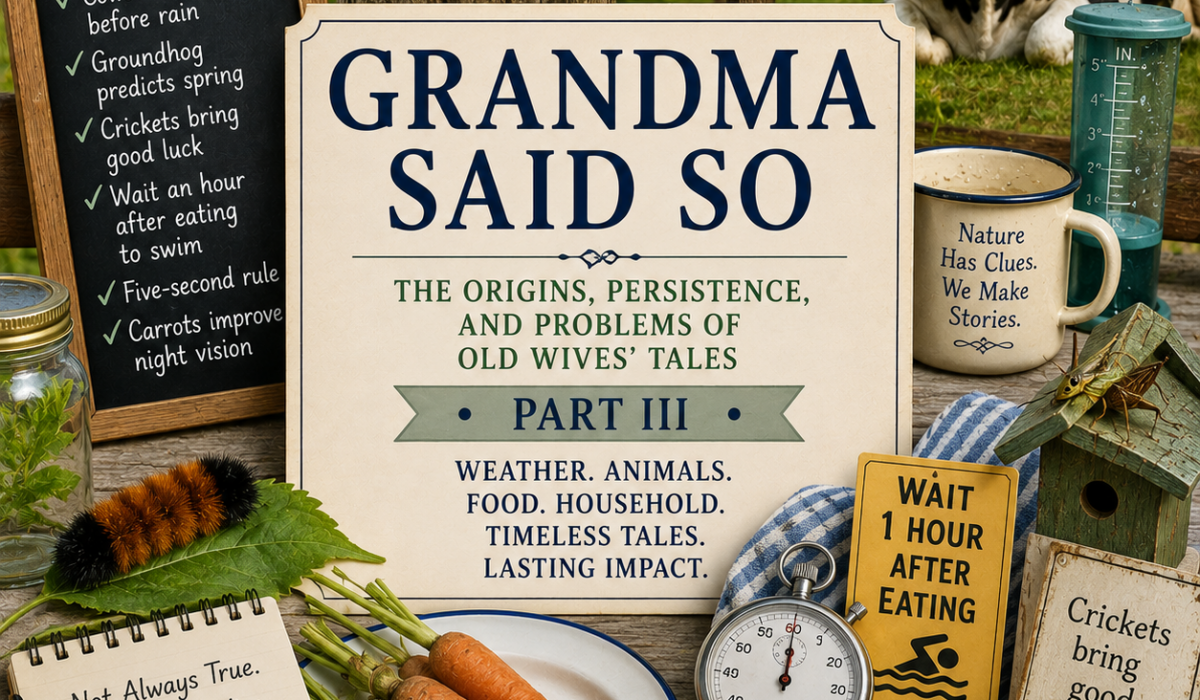
Weather, Wildlife, and Wisdom from the Front Porch
Long before weather satellites, nutritional science, lifeguards, pediatricians, and meteorologists, people still longed for answers. They wanted to know when winter would arrive, whether rain was coming, what foods promoted health, and how to avoid danger. In the absence of knowledge, generations relied upon observation, experience, and a heaping dose of speculation. An occasional conclusion proved useful, while most others survived because they were memorable.
Unlike the tales surrounding pregnancy or illness, many old wives’ tales about weather, animals, food, and household life emerged from close interaction with the natural world. Farmers watched insects. Families observed animals. Parents attempted to keep children safe. Over time, practical observations slowly became folklore, folklore became tradition, and tradition became “wisdom.” The problem, as always, is that repetition is not the same thing as truth. In this final installment, we examine seven more enduring old wives’ tales and ask whether they represent genuine wisdom, mistaken conclusions, or something in between.
I. Woolly Bear Caterpillars Predict Winter Severity
For generations, people have examined woolly bear caterpillars to predict the coming winter. According to the traditional belief, the wider the caterpillar’s brown band, the milder the winter will be. A narrow brown band supposedly signals severe cold and heavy snow.
The tale originated among rural farming communities in North America during the nineteenth century. Farmers naturally sought signs that might help them prepare for winter, and the distinctive coloration of the woolly bear caterpillar offered an appealing source of prediction.
The progression accelerated in the twentieth century when newspapers, festivals, and local folklore celebrated annual woolly bear forecasts. Entire events emerged around interpreting caterpillar coloration. Some communities even crowned official woolly bear prognosticators.
Scientific studies, however, have found no evidence supporting the predictive power of caterpillars. Their coloration is influenced by age, genetics, nutrition, and environmental conditions experienced during development, not supernatural knowledge of future weather patterns.
The tale survives because it embodies a romantic image of rural wisdom. People enjoy believing that nature offers secret clues about the future.
Scripture certainly encourages observing creation. Proverbs directs attention to animals and the natural world. But observation differs from divination. The woolly bear remains fascinating. It simply lacks access to next January’s forecast.
II. Cows Lying Down Mean Rain Is Coming
The origin likely stems from observations that livestock sometimes alter behavior before weather changes. Animals can detect shifts in temperature, humidity, barometric pressure, and other environmental factors that humans often overlook. This genuine sensitivity created fertile ground for folklore.
Over time, the observation evolved into a prediction. If cows were lying down, rain must surely be approaching.
Modern studies suggest that cows spend a significant portion of every day lying down regardless of weather conditions. While some research indicates animals may respond to changing atmospheric conditions, the relationship is far more complicated than the traditional saying suggests.
The tale survives because it occasionally appears accurate. Rain follows. The cows happened to be lying down. The prediction receives credit The biblical lesson is not that observation is foolish but that conclusions require caution. Not every pattern reflects causation. Sometimes cows are simply resting.
Scripture portrays livestock as part of God’s orderly creation, but nowhere suggests that cattle function as meteorological prophets. Their expertise remains firmly within the realm of grass consumption.
Nevertheless, the image persists because it reflects humanity’s enduring hope that nature might whisper tomorrow’s secrets to those paying attention.
III. A Groundhog Can Predict the Arrival of Spring
Every February, thousands of morons gather to watch a rodent emerge from a hole and supposedly forecast the arrival of spring. That such an event receives international media coverage remains one of civilization’s more charming mysteries.
The tradition traces its roots to European Pagan weather folklore, particularly German customs involving hedgehogs. When immigrants settled in North America, the groundhog became a convenient substitute.
According to the tradition, a groundhog seeing its shadow predicts six more weeks of winter, while failing to see its shadow indicates an early spring. The logic is based upon weather conditions rather than animal behavior. A clear, sunny day produces shadows and often accompanies colder weather patterns.
Over time, the custom evolved from folk prediction into cultural celebration. Entire communities built festivals around the event, complete with ceremonies, costumes, and official groundhog spokesmen.
Scientific accuracy remains unimpressive. Studies comparing groundhog predictions to actual weather outcomes consistently reveal results hovering around random chance. The tradition endures because it transforms seasonal uncertainty into communal entertainment.
Scripture encourages wisdom but leaves weather prediction to God. Job 38 reminds us how little control we possess over the natural world.
The groundhog’s greatest achievement is demonstrating forecasting abilities on par with most educated meteorologists, that is to say +/- 50%
IV. Crickets in the House Bring Good Fortune
Across numerous cultures, crickets have long been regarded as symbols of blessing, prosperity, and protection. Finding a cricket inside the home was considered a sign of good fortune in many pagan religions.
The belief appears in European, Asian, and Native American traditions. Because crickets produce distinctive songs and tend to inhabit warm, stable environments, they became associated with domestic peace and household well-being.
In ancient China, crickets were especially revered. Some families even kept them in decorative cages as symbols of luck and prosperity. Similar beliefs emerged elsewhere, reinforcing the insect’s positive reputation. The progression from observation to superstition was straightforward. Healthy homes often contained crickets. Therefore, crickets must cause good fortune.
The logical problem is obvious. Crickets generally prefer environments already favorable to their survival. Their presence reflects conditions rather than creating them. Scripture never attributes spiritual significance to household insects. Crickets are simply a part of God’s creation.
Nevertheless, this tale remains among the more pleasant examples of folklore. If people insist upon assigning symbolic meaning to insects, choosing cheerful singing crickets is preferable to many alternatives.
The cricket’s real contribution to the household is background music. Everything else is projection.
V. Wait an Hour After Eating Before Swimming
Few childhood rules have generated more frustration than the infamous one-hour waiting period after eating.
The warning emerged from concerns that digestion diverts blood flow away from muscles, potentially increasing the risk of cramps while swimming. Because cramps in water could be dangerous, parents and lifeguards adopted a cautious approach.
Over time, the recommendation evolved into a rigid commandment. Children who consumed a sandwich at noon were sometimes treated as aquatic hazards until well into the afternoon.
Modern research suggests the risk was greatly exaggerated. While vigorous exercise immediately after a very large meal may cause discomfort, ordinary swimming after normal eating presents no significant danger. The progression illustrates how reasonable caution can evolve into exaggerated folklore. A small concern became an absolute rule.
Scripture encourages prudence and responsible stewardship of life. But wisdom requires proportional responses to actual risks rather than imagined catastrophes.
The average child waiting an hour after eating probably faced a greater danger from boredom than from digestive complications. Still, countless parents continue enforcing the rule because “that’s how it’s always been done.”
VI. The Five-Second Rule
The infamous five-second rule, the claim that food dropped on the floor remains safe if retrieved quickly enough.
The rule appears to have emerged from a mixture of convenience, optimism, and humanity’s reluctance to waste perfectly good snacks. The exact timing varies by culture. Some versions allow three seconds, others ten. Apparently bacteria are faster in certain places.
The underlying assumption is that contamination requires long contact time. If the food is recovered quickly, germs supposedly have insufficient opportunity to transfer.
Scientific studies have repeatedly demonstrated that bacteria are transferred immediately under appropriate conditions. Surface type, food moisture, and environmental factors matter far more than an arbitrary countdown. Yet the rule persists because it provides moral permission to rescue food people do not wish to discard.
The tale reveals a fascinating feature of folklore. Not all old wives’ tales arise from fear. Some arise from convenience.
The five-second rule survives because people enjoy exceptions that benefit them personally.
VII. Eating Carrots Dramatically Improves Night Vision
Among the most successful pieces of wartime propaganda ever created is the belief that carrots dramatically improve night vision.
The tale gained widespread popularity during World War II when British authorities sought to conceal advances in radar technology. Reports attributed successful nighttime air operations to pilots consuming large quantities of carrots rather than sophisticated electronic detection systems.
The story spread rapidly. Because carrots contain vitamin A, which plays an important role in eye health, the claim possessed enough truth to sound convincing. The progression from propaganda to accepted wisdom was remarkable. Parents enthusiastically embraced a nutritional argument that encouraged children to eat vegetables.
Modern science confirms that vitamin A deficiency can impair vision. However, consuming carrots does not grant extraordinary nighttime eyesight. Once nutritional needs are met, additional carrots provide diminishing returns.
The tale remains popular because it combines patriotism, nutrition, and a convenient parenting strategy. Scripture praises truthfulness, though one suspects many parents quietly appreciate this particular exaggeration.
Carrots are healthy. They simply do not transform children into nocturnal surveillance specialists.
VIII. Frogs Cause Warts
For centuries Children have been told that handling frogs or toads will give you warts. Children exploring ponds and creeks have been cautioned against touching these amphibians lest they find themselves covered in unsightly bumps.
The belief originated from various Pagan spells. Many species of frogs and especially toads possess naturally bumpy, wart-like skin. Ancient and medieval people assumed that physical characteristics could somehow be transferred through contact. If an animal looked warty, perhaps touching it caused warts. The logic was flawed but understandable in an age before viruses and microbiology.
The progression of the tale was aided by coincidence. Warts are extremely common among children and adolescents because they are caused by strains of the human papillomavirus (HPV). A child who handled frogs and later developed warts naturally appeared to confirm the superstition.
Modern medicine has thoroughly debunked the claim. Human warts are caused by viruses transmitted between people, not by amphibians. While some toads secrete substances that may irritate the skin, they do not cause warts.
The tale survives because it combines childhood curiosity with parental caution. Adults preferred discouraging excessive handling of wildlife and found the wart story an effective tool.
Frogs are simply part of God’s creation, neither dispensing warts nor collecting them. The humble toad has spent centuries defending itself against an accusation it never deserved.
IX. Touching a Baby Bird Causes Its Mother to Reject It
Another common wildlife myth in America is the warning that touching a baby bird will cause its mother to abandon it because of the human scent left behind.
The belief likely emerged from good intentions. Adults wanted children to leave nests undisturbed and avoid handling fragile young birds. Rather than offering a lengthy explanation about wildlife conservation, a simple warning proved easier to remember.
The progression of the tale was helped by assumptions about animal behavior. Because many mammals rely heavily on scent, people assumed birds must do the same. If a human touched a nestling, surely the mother would detect the foreign odor and reject her offspring.
Modern ornithology has shown most birds possess a relatively poor sense of smell and rely far more heavily upon sight and sound. In the vast majority of cases, a parent bird will continue caring for its young even if a human has briefly touched them. While unnecessary handling can certainly stress the animal or damage the nest, abandonment due solely to human scent is completely unfounded.
The myth survives because it contains a worthy lesson wrapped in a false explanation. People generally should avoid disturbing wildlife. The reason, however, is respect for the animal rather than fear of transferring some invisible human contamination.
Scripture teaches stewardship of creation. Caring for wildlife begins with truth. The mother bird is usually far more devoted than the old wives’ tale gives her credit for.
X. Lightning Never Strikes the Same Place Twice
The claim that lightning never strikes the same place twice is often used metaphorically to describe rare events, but many people genuinely believe it as a statement about weather.
The origins of the phrase are difficult to trace, though versions have existed for centuries. It likely arose from the fact that lightning strikes are brief and unpredictable. Because witnessing two strikes at the same location seemed unlikely, people assumed it never happened.
The progression of the tale accelerated because lightning was poorly understood for most of human history. Before modern meteorology, thunderstorms appeared mysterious and terrifying. Simplified explanations offered comfort.
Unfortunately for the proverb, reality disagrees. Lightning frequently strikes the same location multiple times. Tall objects such as radio towers, church steeples, skyscrapers, and mountain peaks may be struck dozens or even hundreds of times each year. The Empire State Building, for example, receives repeated lightning strikes on a regular basis.
The persistence of the tale demonstrates how easily rare events become misunderstood. What feels improbable is not always impossible.
Scripture portrays lightning as part of God’s powerful creation. Ironically, the places most likely to be struck by lightning are often the very places that have already been struck before. If lightning could speak, it might object strongly to the reputation it has been given.
Conclusion
The old wives’ tales explored throughout this series reveal a fascinating reality about human nature. People are observers, storytellers, and pattern-seekers. We notice coincidences, remember successes, forget failures, and pass our conclusions to future generations. Sometimes these conclusions contain genuine wisdom. Other times they become cultural heirlooms preserved long after evidence has proved otherwise.
The biblical approach remains balanced. Scripture neither dismisses observation nor glorifies tradition. Instead, it calls believers to pursue truth wherever it may be found. “Buy the truth, and do not sell it” (Proverbs 23:23). Some old wives’ tales contain kernels of practical insight. Others belong in the category of entertaining folklore. The challenge is exercising discernment. Wisdom is not inherited automatically. It must be examined, tested, and grounded in truth.
Series Complete
Part I: Health, Sickness, and Folk Medicine
Part II: Pregnancy, Babies, and Generations of Guesswork
Part III: Weather, Wildlife, and Wisdom from the Front Porch